

wayground logo

Free Printable Worksheets

NEW

Font size

S
M
L
XL
Worksheets

Cellular Transport Test

Total questions: 61

Worksheet time: 2hrs 2mins

Name
Class
Date
1.
What means of particle transport requires energy?
a)
passive
b)
active
c)
facilitated
d)
osmosis
2.
What is the diffusion of water through a selectively permeable membrane?
a)
active transport
b)
osmotic pressure
c)
facilitated diffusion
d)
osmosis
3.
Diffusion is the movement of particles
a)
from low to high concentration
b)
from  high to low concentration
c)
from equilibrium to areas of high concentration
d)
all of the above
4.
The current model of the plasma membrane is called the
a)
hydrophobic layer
b)
transport bilayer
c)
phosphoproteins
d)
fluid mosaic model
5.
Facilitated diffusion requires
a)
no energy
b)
energy
6.
Placing a cell in an isotonic solution causes the cell to
a)
shrink
b)
swell
c)
stay the same
7.
Placing a cell containing 10% salt  into a solution containing 15% salt will cause the cell to
a)
shrink
b)
 swell
c)
stay the same
8.
Substance X is moving into a cell from an area of low concentration. Which of the following is responsible for transporting substance X into the cell?
a)
Proteins through the process of active transport
b)
Phospholipids through the process of active transport
c)
Proteins through the process of passive transport
d)
Phospholipids through the process of passive transport
9.
On the diagram below, indicating the direction of osmosis (water)
a)
Into the cell
b)
Outside the cell
c)
Remain the same inside and outside the cell
d)
Remain the same outside, but not inside
10.
The protein moves small molecules and ions across the cell membrane.
For example, ions are moves from the side where there are few ions to the side where there are more ions.
Which best describes this process of moving ions against a concentration difference?
a)
Facilitated diffusion not requiring energy
b)
Active transport requiring energy
c)
Passive transport
d)
Osmosis
11.
A person with swollen gums rinses his mouth with warm salt water, and the swelling decreases. Which of the following has occurred?
a)
The swollen gums have absorbed the saltwater solution.
b)
The saltwater solution lowers the temperature of the water in the gums.
c)
The salt in the solution has moved against the concentration gradient.
d)
The water in the gums has moved out due to the high concentration of salt in the solution. 
12.
The cell membrane of the red blood cell will allow water, oxygen, and carbon dioxide to pass through. Because other substances are blocked from entering, this membrane is called
a)
Perforated
b)
Semi-permeable
c)
Non-conductive
d)
Permeable
13.
Diffusion does not require the cell to expend ATP. Therefore, diffusion is considered a type of 
a)
endocytosis
b)
exocytosis
c)
active transport
d)
passive transport
14.
Which of the following is a true statement about diffusion? Diffusion 
a)
occurs from a high to low concentration
b)
occurs from low to high concentration
c)
occurs from low to low concentration
d)
occurs from high to high concentration
15.
Examine the diagram below. The process illustrated by the neurotransmitter leaving the sending neuron is called
a)
endocytosis
b)
exocytosis
c)
passive transport
d)
active transport
16.
My cells are Shriveled!    What state are my cells in?
a)
Hypertonic
b)
Hypotonic
c)
Isotonic
d)
Diffusion 
17.
When moving particles AGAINST their concentration gradient, this is called?
a)
Passive Transport
b)
Osmosis
c)
Active Transport
d)
Facilitated Diffusion
18.
If the question asks about Osmosis, I will look for an answer about?
a)
Particles
b)
Salt
c)
Sugar
d)
Water
19.
If the question asks about something being PUMPED, I will look for an answer about?
a)
Passive Transport
b)
Active Transport
c)
Facilitated Diffusion
d)
Osmosis
20.
My cells are in an Isotonic solution, and are in a constant internal environment.  What is this called?
a)
Homeostasis
b)
Respiration
c)
Evolution
d)
Diffusion
21.
A solute traveling DOWN its concentration gradient using a protein channel does this by ________ diffusion.
a)
Facilitated
b)
Active
c)
Osmosis
d)
Endocytosis
22.
Which way is the water moving in this cell?
a)
Water will move out of the cell
b)
Water will move into the cell
23.
Which way is the water moving in this cell?
a)
The water level will increase on the right side
b)
The water level will increase on the left side
c)
The water level on both sides will increase
d)
The water level on both sides will decrease
24.
Which way is the water moving in this cell?
a)
Water will move out of the cell
b)
Water will move into the cell
25.
Movement of particles through the cell membrane from high to low concentrations
a)
diffusion
b)
photosynthesis
c)
mitochondria
d)
active transport
26.
Allows certain molecules or ions to pass through it by diffusion and doesn't allow others.
a)
protein
b)
semi-permeable membrane
c)
isotonic
d)
homeostasis
27.
Equal percentage of solutes inside and out. 
Concentration of substances is the same. 
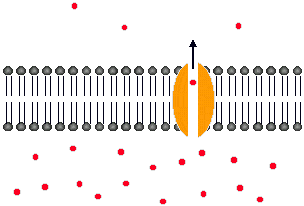
a)
hypotonic
b)
isotonic
c)
nucleus
d)
hypertonic
28.
Particles are too large to enter the membrane.
Need help from channel proteins. No energy required.
a)
active transport
b)
passive transport
c)
facilitated diffusion
d)
osmosis
29.
Engulfs large molecules and moves them inside the membrane.
Uses energy.
a)
exocytosis
b)
endocytosis
c)
protein channel 
d)
diffusion
30.
The substance that is dissolved in a solution. 
a)
solute
b)
solution
c)
solvent
d)
solidify
31.
The cell membrane is solid and rigid
a)
true
b)
false
32.
A state of biological balance
a)
homeostasis
b)
hypertonic
c)
hypotonic
d)
hippocampus
33.
____ is the molecule that provides energy for active transport.
a)
DNA
b)
ADP
c)
ATP
d)
RNA
34.
Osmosis, facilitated diffusion, and diffusion are all types of passive transport.
a)
TRUE
b)
FALSE
35.

Active transport is the movement of large materials across a cell membrane from ______ to ______ concentration

a)

high to low

b)

low to high

c)

high to high

d)

low to low

36.

An example of pump transport is

a)

glucose transport

b)

osmosis

c)

Na+/K+ Pump

d)

CO2 + O2 Transport

37.

white blood cells engulfing invading bacteria is an example of

a)

Endocytosis

b)

Exocytosis

c)

Diffusion

d)

Facilitated Diffusion

38.
What type of transport is this?
a)
Endocytosis
b)
Diffusion
c)
Exocytosis
d)
Osmosis
39.
What are 3 types of active transport?
a)
Riding a bike, Running through the mountains, walking on the beach
b)
Osmosis, Diffusion, Facilitated Diffusion
c)
Sodium/potassium Pump, Endocytosis, Exocytosis
d)
Throwing a ball, Playing tennis, driving a car
40.
Cells sometimes use energy to transport materials across the cell membrane.  This is called
a)
photosynthesis
b)
osmosis
c)
cellular respiration
d)
active transport
41.
What is the difference between active and passive transport?
a)
Active does not need energy and passive uses ATP (energy)
b)
Active uses ATP (energy) and passive does not need energy
c)
Active stores transport proteins and passive releases 
d)
Active uses hormones and passive does not 
42.
When cells form a vesicle to release materials, which form of transport is occurring? 
a)
Endocytosis
b)
Exocytosis
c)
Facilitated Diffusion
d)
Osmosis
43.

The sodium-potassium pump requires energy to move ions across the cell membrane against their concentration gradient so it is a type of.....

a)

active transport

b)

osmosis

c)

diffusion

d)

facilitated diffusion

44.
T/F: Both pinocytosis and phagocytosis are example of endocytosis. 
a)
True
b)
False
45.
The sodium-potassium pump usually pumps
a)
only potassium ions and sugar molecules
b)
potassium ions out of the cell
c)
sodium ions into the cell
d)
 potassium ions into the cell
46.
Which is NOT a form of active transport?
a)
Endocytosis
b)
Osmosis
c)
Exocytosis
d)
Pinocytosis
47.
When cells take in a liquid through active transport, what is it called?
a)
Exocytosis
b)
Phagocytosis
c)
Pinocytosis
d)
Osmosis
48.
When cells take in food particles through active transport, what is it called?
a)
Pinocytosis
b)
Phagocytosis
c)
Exocytosis
d)
Osmosis
49.
The sodium potassium pump usually pumps
a)
potassium out of the cell 
b)
sodium out of the cell 
c)
sodium into the cell 
d)
both potassium and sodium into the cell 
50.
a)

solute

b)

solvent

51.
a)

solute

b)

solvent

52.
a)

solute

b)

solvent

53.
a)

solute

b)

solvent

54.
a)

solute

b)

solvent

55.
a)

solute

b)

solvent

56.

the definition of a solution is

a)

solute + solution

b)

solvent + solution

c)

solute + solvent

d)

solution + dillution

57.

The substance being dissolved is called the ________

a)

solvent

b)

solid

c)

solute

d)

solvate

58.

Concentration is

a)

the amount of solute in the solvent

b)

the amount of solvent in the solute

c)

density

d)

particle size

59.

Which solution is more concentrated?

Solution 1:

500 mL of water

100 g of salt


Solution 2:

500 mL of water

90 g of salt

a)

Solution 1

b)

Solution 2

c)

They have the same concentration

d)

I have no idea

60.

In order to dilute a solution, you need to

a)

add more of the solid

b)

add more water

c)

find the mass

d)

find the volume

61.
You can make a solution more concentrated by adding more __________.
a)
solute
b)
solvent
c)
water
