
 Worksheets
Wave Behaviors
Total questions: 43
Worksheet time: 1hrs 26mins

This illustration best depicts which of the following behaviors?
Reflection
Refraction
Diffraction
Resonance

This image best depicts which of the following wave behaviors?
Reflection
Refraction
Diffraction
Resonance

This image depicts which of the following wave behaviors?
Reflection
Refraction
Diffraction
Resonance
Definition: When one object vibrating at the same natural frequency of a second object forces that second object into vibrational motion.
Reflection
Refraction
Diffraction
Resonance

The image depicts which of the following wave behaviors?
Resonance
Doppler Effect
Polarization
Diffraction

The image depicts which of the following wave behaviors?
Resonance
Doppler Effect
Interference
Polarization

The two blue and purple waves will undergo _________________ when they meet.
Constructive interference
Destructive interference

The image of the two waves depicts
Constructive interference
Destructive interference
Definition: the change in direction of a wave passing from one medium to another
Reflection
Refraction
Diffraction
Polarization
Definition: when a wave reaches the interface between two different media, typically some of the wave will bounce back into the original medium.
Reflection
Refraction
Diffraction
Polarization
Definition: The spreading out of waves as they pass through an opening or around objects.
Reflection
Refraction
Diffraction
Resonance
Two waves that undergo constructive interference must be...
In phase
Out of phase
Two waves that undergo destructive interference must be...
In phase
Out of phase
The two categories of waves are
Mechanical
Physical
Electromagnetic
Love
The two forms that waves can take are...
Transverse
Circular
Diamond
Longitudinal
Listen to the recording of someone yelling in a tunnel. Why do we hear something after each yell?
Sound waves are striking the walls of the tunnel and bouncing off of the walls.
Sound waves are striking the walls of the tunnel and going into the walls (they are not passing all the way through).
Sound waves are striking the walls of the tunnel and going all the way through the walls.
Sound waves are striking the walls of the tunnel and being bent as they go through the walls.

We can see through jellyfish because...
light waves are striking the jellyfish and bouncing off of it.
light waves are striking the jellyfish and going into it without passing all the way way through.
light waves are striking the jellyfish and going all the way through it.
light waves are striking the jellyfish and being bent.

This is a real unedited photo taken with a cell phone. The man is in a swimming pool with glass walls and water filled to the top. Why does it look like his head is separate from his body?
Light waves are bouncing as they pass from air to water.
Light waves are not passing from the air to the water.
Light waves are traveling in a straight line as they pass from air to water.
Light waves are bending as they pass from air to water.

Why does the arrow appear to change direction as water is poured into the glass? You can try this experiment at home.
Light waves are bouncing as they pass through air, glass and water.
Light waves are not passing through the air, glass, and water.
Light waves are traveling in a straight line as they pass through air, glass, and water.
Light waves are bending as they pass through the air, glass, and water.
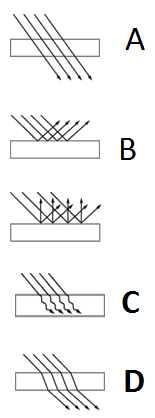

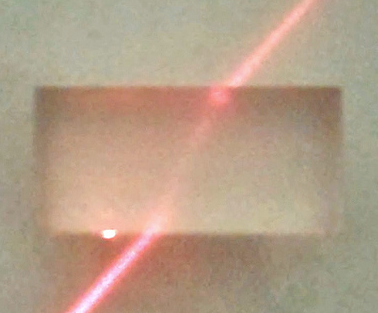
this is an example of
refraction
diffraction
infraction
reflection

What is this a description of?
What behavior of waves do bats use to learn about their environment?


This is a real picture of a polar taken at a zoo. Fortunately for the polar bear, its head is actually connected to its body. Why does it look like the head is separate from the body?
Light waves are bouncing as they pass from air to water.
Light waves are not passing from the air to the water.
Light waves are traveling in a straight line as they pass from air to water.
Light waves are bending as they pass from air to water.
Why is it a good idea to wear dark colors in the winter and not the summer?
Light waves are striking the dark material and bouncing off of it. Energy from the wave gets converted to thermal energy.
Light waves are striking dark material and going through it. Energy from the wave gets converted to thermal energy
Light waves are striking the dark material and staying in it. Energy from the wave gets converted to thermal energy.
Light waves are striking the dark material and being bent as they pass through. Energy from the wave gets converted to thermal energy.

Most rooms have hard flat walls. However, music studios have soft, foam-like material on them. Studios use these materials to prevent...
sound waves hitting the walls from bouncing back.
sound waves hitting the wall from staying in the walls.
sound waves hitting the wall from passing all the way through them.
sound waves hitting the wall from bending.

Why does the arrow appear to change direction as water is poured into the glass? You can try this experiment at home.
Light waves are bouncing as they pass through air, glass and water.
Light waves are traveling in a straight line as they pass through air, glass, and water.
Light waves are not passing through the air, glass, and water.
Light waves are bending as they pass through the air, glass, and water.
What happens to the speed of light as it goes from air into water?
Speeds up
Slows down
Doesn't change speed
Light cannot go from air into water
What happens to the speed of sound as it goes from air into water?
Speeds up
Slows down
Doesn't change speed
Sound cannot go from air into water
What does sound travel fastest in?
Solid
Liquid
Gas
Vacuum
What does light travel fastest in?
Solid
Liquid
Gas
Vacuum

During a lunar eclipse the moon blocks out the sun. However, some light is still able to bend around the moon and make it to the Earth. What wave behavior allows this to happen?
Refraction
Diffraction
Reflection
Absorption
What color will an object be to humans if the object absorbs all visible light?
Rainbow
White
Black
Gross Brown
What color will an object be to humans if the object reflects all visible light?
Rainbow
White
Black
Gross Brown

