wayground logo

Free Printable Worksheets

Font size

S
M
L
XL
Worksheets

Earth and Environmental Unit 2 Practice Test

Total questions: 74

Worksheet time: 2hrs 45mins

Name
Class
Date
1.
________is the instrument used to measure air pressure.
a)
barometer
b)
thermometer
c)
mercury
d)
watch
2.
What happens to air pressure as you move upward into the atmosphere?
a)
increases
b)
decreases
c)
stays the same
3.
Air pressure is greater _______.
a)
at the top of the mountain
b)
at the bottom of the mountain
c)
at the center of the mountain
4.
what are isobars?
a)
lines connecting places of equal temperature
b)
lines drawn connecting places of equal pressure
c)
lines drawn to places of different temperatures
d)
lines drawn to places of different pressures
5.
What does the air consist of?
a)
molecules
b)
helium
c)
density
d)
weather
6.
What is altitude?
a)
how much something weighs
b)
the distance above sea level
c)
how big something is
d)
how far away something is
7.
78% of earth's atmosphere is composed of ______________.
a)
methane
b)
oxygen
c)
argon
d)
nitrogen
8.
What Causes differences in air pressure around earth ? 
a)
Warm air rises at the equator, and cold air sinks at the poles.
b)
Equator gets over heated 
c)
Snow 
9.
Models that show heat rising up and cold moving down are models of:
a)
Conduction
b)
Complexion
c)
Radiation
d)
Convection
10.
The heat source for covection in the atmosphere is the:
a)
Core
b)
Water
c)
Land
d)
Sun
11.

Contains the Ozone Layer.

a)

Troposphere

b)

Stratosphere

c)

Mesosphere

d)

Thermosphere

e)

All of the above.

12.

Where ALL weather takes place.

a)

Troposphere

b)

Stratosphere

c)

Mesosphere

d)

Thermosphere

e)

All of the above.

13.

Where most water vapor is found.

a)

Troposphere

b)

Stratosphere

c)

Mesosphere

d)

Thermosphere

e)

All of the above.

14.

Meteors burn up in this layer.

a)

Troposphere

b)

Stratosphere

c)

Mesosphere

d)

Thermosphere

e)

All of the above.

15.

Air pressure decreases as altitude increases.

a)

Troposphere

b)

Stratosphere

c)

Mesosphere

d)

Thermosphere

e)

All of the above.

16.

Temperature increases with altitude (height). PICK TWO.

a)

Troposphere

b)

Stratosphere

c)

Mesosphere

d)

Thermosphere

e)

All of the above.

17.

Temperature decreases with altitude (height). PICK TWO.

a)

Troposphere

b)

Stratosphere

c)

Mesosphere

d)

Thermosphere

e)

All of the above.

18.
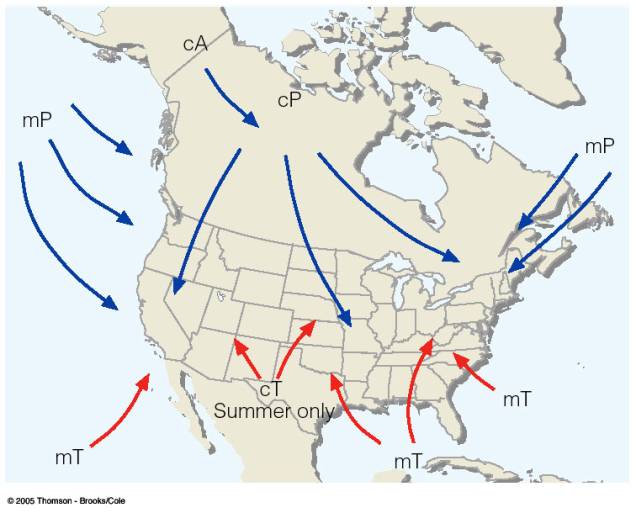
How do we name air masses?
a)
Water and temperature
b)
Air pressure
c)
Humidity and temperature
d)
Cold and warm
19.
How do we characterize an air mass that forms over the ocean?
a)
Dry
b)
Wet
c)
Cold
d)
Warm
20.
How do we characterize an air mass that forms over land?
a)
Dry
b)
Wet
c)
Cold
d)
Warm
21.
What types of air masses form over oceans?
a)
Maritime
b)
Continental
c)
Polar
d)
Tropical
22.
What's the humidity and temperature of a continental tropical air mass?
a)
Wet and cold
b)
Dry and warm
c)
Wet and warm
d)
Dry and cold
23.
What's the humidity and temperature of a maritime tropical air mass?
a)
Wet and cold
b)
Dry and warm
c)
Wet and warm
d)
Dry and cold
24.
A wet and cold air mass would be a...
a)
Maritime polar
b)
Continental polar
c)
Maritime tropical
d)
Continental tropical
25.
A dry and cold air mass would be...
a)
Maritime polar
b)
Continental polar
c)
Maritime tropical
d)
Continental tropical
26.
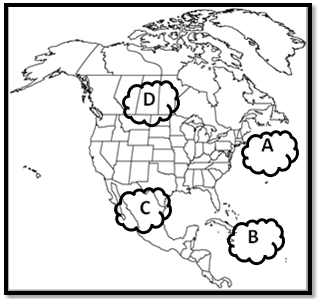
Which type of air would you find at air mass A?
a)
cold, dry
b)
warm, humid
c)
warm, dry
d)
cold, humid
27.
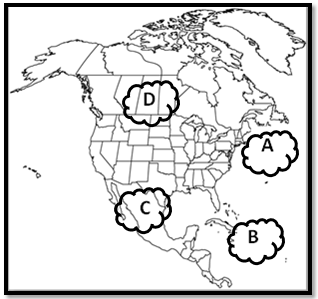
Which type of air would you find at air mass B?
a)
cold, dry
b)
warm, humid
c)
warm, dry
d)
cold, humid
28.
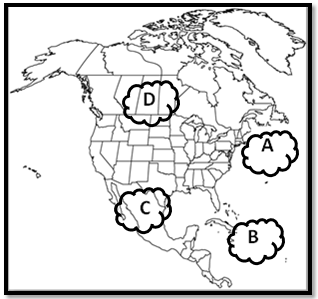
Which type of air would you find at air mass C?
a)
cold, dry
b)
warm, humid
c)
warm, dry
d)
cold, humid
29.
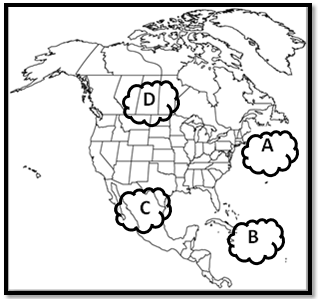
Which type of air would you find at air mass D?
a)
cold, dry
b)
warm, humid
c)
warm, dry
d)
cold, humid
30.
Which abbreviation of an air mass can be identified as dry and hot?
a)
cP
b)
mP
c)
cT
d)
mT
31.
Which abbreviation of an air mass can be identified as cold and moist?
a)
cP
b)
mP
c)
cT
d)
mT
32.
Air travels
a)
from high pressure to low pressure
b)
from low pressure to high pressue
33.
What kind of breeze is this & what time of day/night would it form?
a)
Land breeze - daytime
b)
Land breeze - nighttime
c)
Sea breeze - daytime
d)
Sea breeze - nighttime
34.

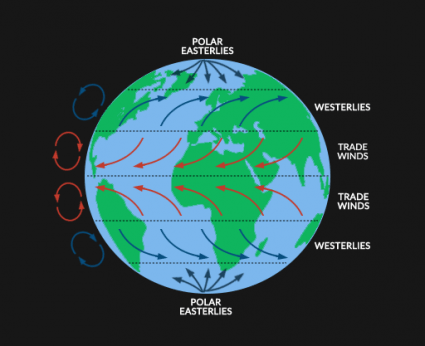
Which is the best explanation for how air masses move across the United States?

a)

The trade winds move air masses from west to east across the United States.

b)

The polar easteriles move air masses from west to east across the United States.

c)

The prevailing westerlies move air masses from west to east across the United States but may be deflected by the jet stream.

d)

The warm air of the Gulf Stream causes air masses to move from the Atlantic Ocean to the Pacific Ocean.

35.

A student in northern Ohio lost a balloon in a storm. Toward which state would the balloon MOST likely travel?

a)

Michigan

b)

Indiana

c)

Kentucky

d)

Pennsylvania

36.

What two factors determine the direction in which prevailing winds blow?

a)

the rotation of the Earth on its axis and the sun’s uneven heating of the earth

b)

the revolution of the earth around the sun and the sun’s uneven heating of the earth

c)

the rotation of the Earth on its axis and the cool air from the poles

d)

the revolution of the Earth around the sun and the cool air from the poles

37.

The trade winds and polar easterlies DO NOT typically impact NC's weather because

a)

they are sea breezes at the coast

b)

they are found near the equators or at the poles.

c)

they almost never are blowing

d)

they cancel each other out

38.

In general, how does air move?

a)

From areas of lower pressure to areas of higher pressure

b)

From areas of higher pressure to areas of lower pressure

c)

From areas of hot to cold

d)

A big fan blows it around

39.

What causes wind?

a)

Too much Taco Bell

b)

Differences in elevation

c)

The uneven heating of the Earth by the sun

d)

Ocean currents

40.

Which heats up and cools more quickly?

a)

Land

b)

Sea

c)

They heat and cool equally

41.

_______ is transfer of energy through empty space

a)

Conduction

b)

Convection

c)

Radiation

42.

_______ is the transfer of heat by gas or liquid. Cool air is more dense and pushes warm air above it.

a)

Conduction

b)

Convection

c)

Radiation

43.

Warm air going from the land to the water during night

Example: Cool air over the land sinks, warm air over the water rises

a)

Land Breeze

b)

Sea Breeze

44.

Which global winds move FROM the east to the west?

a)

Doldrums

b)

Cauldrons

c)

Westerlies

d)

Easterlies

45.

What causes the Coriolis Effect?

a)

Rotation of the Earth

b)

Rotation of the Moon

c)

Earth tilt

d)

Rotation of the Sun

46.

Objects in the NORTHERN Hemisphere deflect to which direction due to the Coriolis Effect?

a)

Left

b)

Up

c)

Down

d)

Right

47.

The Coriolis Effect is caused by what?

a)

The wind blowing

b)

Earth's gravity pulling things down

c)

The rotation of the Earth

d)

The pull of the Moon

48.

what is the coriolis effect?

a)

change in location of warm and cold surface water every 2-7 years

b)

tendency of objects moving large distances on Earth’s surface to bend to the right in the northern hemisphere & to the left in the southern hemisphere

c)

winds in northern Indian ocean that blow from the southwest in the summer & from the northeast in winter

d)

two layers of horizontal winds moving in opposite directions

49.

What is a front?

a)

when four air masses meet

b)

when three air masses meet

c)

when two air masses meet

50.

What happens at a front?

a)

the weather stays the same

b)

the weather changes

51.

What are the three types of fronts?

a)

warm

b)

cold

c)

mild

d)

stationary

52.

What two types of weather does High Pressure bring?

a)

humid

b)

dry

c)

rainy

d)

sunny

53.

What is the symbol for a Stationary Front?

a)
b)
c)
54.

What weather can you expect with a cold front?

a)

storms, then cool good weather

b)

a few days of rain

55.

What is the symbol for a Warm Front?

a)
b)
c)
56.
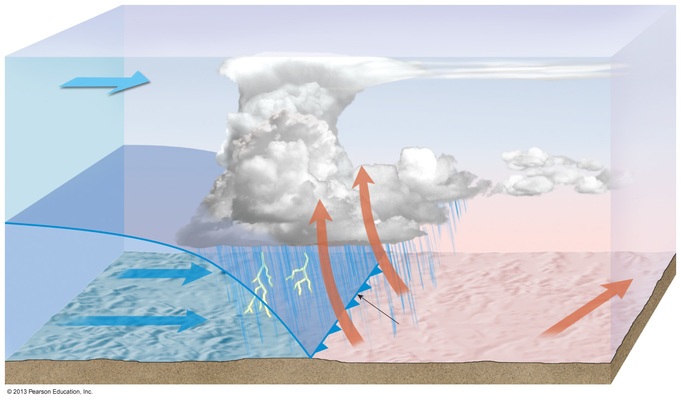
What type of storm front is this? 
a)
warm front
b)
cold front
c)
stationary front
d)
occluded front
57.
Which most likely produces clear, cool weather?
a)
zero air pressure
b)
stable air pressure
c)
a low pressure system
d)
a high pressure system
58.
_____________ air is more dense and tends to sink
a)
cold
b)
warm
c)
moist
d)
dry
59.
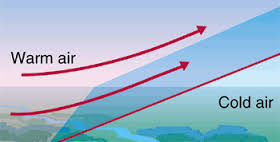
Which type of front is pictured?
a)
Cold front
b)
Warm front
c)
Occluded front
d)
Stationary front
60.
What symbol is this?
a)
warm front
b)
cold front
c)
stationary front
d)
occluded front
61.

Which front is there little movement?

a)

warm front

b)

cold front

c)

occluded front

d)

stationary front

62.

Which front is in this picture?

a)

Warm front

b)

Cold front

c)

stationary front

d)

occluded front

63.

What type of weather will you see along a cold front?

a)

Thunderstorms

b)

Sunny skies

c)

Gentle rain

d)

No weather

64.
Which city is experiencing thunderstorms?
a)
Denver
b)
New York 
c)
Miami 
d)
Boise
65.
Which city is currently experiencing a snow storm?
a)
Seattle
b)
Los Angeles
c)
Chicago
d)
New York
66.
Which city has the highest the highest temperature?
a)
Dallas
b)
Chicago
c)
Los Angeles
d)
Miami
67.
A cold front is approaching Minneapolis. What will happen to the air temperature?
a)
stay the same
b)
increase
c)
decrease
68.
what are isobars?
a)
lines connecting places of equal temperature
b)
lines drawn connecting places of equal pressure
c)
lines drawn to places of different temperatures
d)
lines drawn to places of different pressures
69.
___________is the result of the weight of a column of air pushing on an area.
a)
air pressure
b)
density
c)
volume
d)
none of the above
70.

The movement in the air caused by differences in air pressure ?

a)

Rain

b)

Wind

c)

Air

71.
What direction is the cold front moving?
a)
Northwest
b)
Southeast
c)
Northeast
d)
Southwest
72.

The cold front is moving

a)

east and southeast

b)

west and northwest

c)

north

d)

south

73.

Why do you see precipitation near the L? (select 2 answers)

a)

because that is low pressure and that is where air rises, forming clouds

b)

because that is where air is falling and it brings rain with it

c)

because southern Ohio is always rainy this time of year

d)

because the cold front is meeting the warm front which forces warm air to rise rapidly forming clouds

74.

You would expect to see clouds forming and possible precipitation

a)

in Utah (the H)

b)

in Florida

c)

in Nebraska (between the H and the L)

d)

in Indiana