
 Worksheets
Midterm Exam. Chemical Biology 2
Total questions: 100
Worksheet time: 1hrs 2mins
Which is the most common type of rotor used
Swinging bucket
vertical rotor
Fixed angel
None of the above
Which of the following rotor has longest radius from axis of rotation
Swinging bucket
Microfuge
vertical rotor
Fixed angle
WHich centrifuge separation is time independent
Isotonic
analytical
Rate zonal
Iso-density
What is the reason given in the lesson for the use of cell fractionation?
It allows cellular components, such as organelles, to be studied in isolation.
It allows cellular components to be viewed with a light microscope.
It allows for the study of interactions between all of the organelles.
Mitochondria and the endoplasmic reticulum cannot be studied together.
Why do cells have to be broken apart in detergent before they can be separated into different parts?
Detergents ensure the reaction is sterile.
Detergents help dissolve the cell membrane so cellular components can be removed.
Detergents help separate the cellular components based on size and density.
Detergents remove oil and other contaminants.
2. Which step of the cell fractionation procedure separates the cell into its fractions?
Centrifugation
Collection
Lysing
Purification
An effective way of purifying liquids containing suspensions is
crystallization
decanting
centrifuging
separating funnel
After centrifugation when sublimate settles, clear liquid
can be allowed to rest
can be allowed to form crystals
can be decanted off
can be evaporated
Sucrose or caesium chloride → What rotor is best for zonal?
True
False
Nucleic acids → Caesium chloride gradients are good for:
True
False
Rate of movement down the tube/centrifugal force → Order of particles
True
False
What happens when enzymes are heated to a high temperature?
The enzymes die.
The shapes of the enzyme are altered.
The enzymes' amino acid sequence changes.
The enzymes remain the same
Why are tissues placed into an ice cold isotonic buffer solution?
To keep the tissues cold
To keep the tissues fresh
To stop enzyme activity
To keep varied buffers
The suspended cells are disrupted by the process of homogenation in cell fractionation.
True
False
_ is a device for separating particles from a solution according to their size, shape, density, viscosity of the medium, and rotor speed
Centrifuge
Form
Sem
Rotor
Sediment forms at the bottom of centrifuge is called a _.
centrifuge
pellet
salt
supernatant
The overlying solution is called _
supernatant
sediment
salt
pellet
You have to filter homogenate to remove clumps.
True
False
Density gradient centrifugation is mainly used to
purify viruses, ribosomes, membranes
purify blood
purify urine
purify water
The particles of interest are placed on top of the gradient and centrifuge in ultracentrifuges.
True
False
A sucrose density gradient is created by gently overlaying lower concentrations of sucrose on higher concentrations in centrifuge tubes.
True
False
Zonal centrifugation is also known as band or gradient centrifugation.
True
False
In zonal centrifugation or gradient centrifugation, fractions are collected by creating a hole at the bottom of the tube.
True
False
Isopynic centrifugation is also called as density gradient centrifugation.
True
False
The solution of biological sample and cesium salt is uniformly distributed in a centrifuge tube and rotated in ultra centrifuge.
True
False
In cell fractionation, a _ is used to keep the pH constant so proteins are not denatured.
buffer
tissues
ions
salt
Usually, homogenization is done by grinding.
True
False
Grinding is done by mortar and pestle or potter homogenizer.
True
False
A cell organelle is subjectedto a centrifugal force when it is rotated at a ________.
a. high rate of speed
b. medium rate of speed
c. low rate of speed
d. very low rate of speed
Which of the following techniques is commonly used by biochemists in cell fractionation?
a. dfferntial centrifugation
b. density gradient centrifugation
c.both a and b
d. not stated
A sucrose density gradient is created y gently overlaying _______ concentrations of sucrose
a. lower
b. higher
c. medium
d. heavy
the ultracentrifuge is a centrifuge optimized for spinning a rotor at very ______ speed.
a. low
b. medium
c. high
d.quick
an ultra centrifuge is adevice for exceptionally ______ speed
a. high
b. low
c. quick
d. medium
Rate- Zonal density gradient ultracentrifugation is a powerful and reliable technique for separating particles base ontheir hydrodynamic volume.
a. True
b. False
Which is NOT a type of separation technique?
a. isopycnic
b. ultrafiltration
c. density gradient
d. infiltration
Cell is the structural and ____ unit of life?
a. functional
b. minute
c. macro
d. big
Cell contain organelles which performs a variety of specific functions
a. True
b. False
Electron micrographs explains only the structure but not the functions of the cell organelles
a. True
b. False
Individual organelle is identified using _______..
a. specific markers
b. specific name
c. specific time
d. specific way
Who developed the technique of cell fractionation?
a. Albert Claude
b. Albert Martinez
c. Albert einstein
d. Albert Claudio
A homogenizer is a material that uses disruptive forces
a. True
b. False
Homogeization means to" break open".
a. True
b. False
e Enzymes are commonly used to degrade the cell wall components which leads to the release of intracellular compounds .
a. True
b. False
Who developed the first analytical ultracentrifuge?
a. Theodore Swedberg
b. Theodore Schwann
c. Theodore Roosebelt
d. Theodore Theodore
Particles suspended in a solution are pulled downward by earths gravitational force.
a. True
b. False
Which of the centrifugal methods is the separation of organelles by size?
a. Density gradient centrifugation
b. Differential centrifugation
c. both a and b
d. a, b, and c
What are marker enzymes?
a. an enzyme that is known to be localized exclusively in the particular organelle
b. indicates the level of contamination by other organelles
c. stops chemical reaction
d. a, b, and c are correct
There are maker enzyes for major cell organelles.
a,True
b. False
Marker enzymes also provides information on the biochemical of the______.
a. fractionated organelle
b. fractionated tissues
c. fractionated organs
d. a,b and c are correct
choose the type of density gradient centrifugation
a. Rate- Zonal centrifugation
b. pellet
cc. homogenizer
d. supernatant
Separation by density is done on____.
a. density gradient centrifugation
b. differential centrifugation
c. both a and b
d. not mentioned
In a solution, what happens to a particles whose mass of density is higher than that of the solvent ?
a. sink
b. float
c. remain balance
d. all of the aove
The centrifuge works using sedimentation principle.
a. True
b. False

Ink can be separated by a method of -----------------------------------------------
distillation
filtration
chromatography
sedimentation
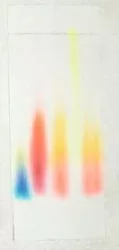
A substance is soluble if it can be dissolved.
In paper chromatography, the most soluble solute _____________________ .
does not move from the start point
stays closest to the start point
travels furthest away from the start point
can be found in the middle of the chromatogram
What is chromatography?
A way to see pretty colors
A laboratory technique used to separate a mixture.
A form of distillation
What molecules move up the paper to carry the different colors of ink?
color
fat
water
Which of the following mixture/s is/are separated by chromatography?
Pigments from natural colours
Colours in a dye
Colours of flowers extracts
All the above
Which of the following is correct about chromatography?
It separates those solutes that dissolve in the same solvent.
It separates those solutes that dissolve in different solvents.
It separates a solute that dissolves in a solid solvent.
It separates gaseous solutes from liquid solvents.
If a substance is not soluble in the solvent, what happens to the spot placed on the start line?
a) Dot moves to the top of the paper
b) Dot does not move at all
c) Dot moves to the left or right
d) Dot moves down to the bottom of the paper
In paper chromatography, the LEAST soluble solute ____.
does not move from the start point
stays closest to the start point
travels furthest away from the start point
can be found in the middle of the chromatogram
A substance is soluble if it can be dissolved.
In paper chromatography, the most soluble solute _____________________ .
does not move from the start point
stays closest to the start point
travels furthest away from the start point
can be found in the middle of the chromatogram
Chromatography separates a mixture of dyes on the basis of their
density or weight
gravity
boiling point
Which ink is a mixture of different inks?
red
black
blue
yellow
What molecules move up the paper to carry the different colors of ink?
color
fat
water
Which color dye had the greatest density or weight?
red
green
blue

