
 Worksheets
Solubility/Net Ionic Equations/Redox/Molarity/Titration
Total questions: 101
Worksheet time: 2hrs 54mins
2Ca(s) + O2(g) → 2CaO(s), calcium is...
In the reaction Zn + H2O → ZnO2 + H2 which element is oxidized?
(a)
Fe+2 + MnO4 → Fe+3 + Mn+2
What is the oxidation number of N in NO2-1?
(a)
CuCl2 + NaOH → Cu(OH)2 + NaCl
Which product is insoluble?
CuCl2(aq) + NaOH(aq) → Cu(OH)2(s) + NaCl(aq)
In this equation,
CuCl2+ NaOH → Cu(OH)2 + NaCl
Identify the insoluble product?
copper(II) hydroxide
sodium chloride
sodium hydroxide
copper(II) chloride
Identify the reaction that results in the formation of a precipitate.
AgNO3(aq) + NaOH(aq)→
BaNO3(aq) + CaCl2(aq)→
NaNO3(aq) + KOH(aq)→
More than one of these form precipitates
Define: Solubility
What is dissolved
What does the dissolving
A measure of how much solute can dissolve in solvent
a charged ion
What is the oxidation number of chlorine in HClO?
0
-1
+1
+5
Oxidation is the (a) of electrons.
Reduction is the (a) of electrons.
What is the oxidation number of nitrogen in N2?
-3
0
+4
-1
The sum of the oxidation numbers in SCN- is equivalent to
0
-1
+1
+3
The sum of the oxidation numbers in Na2CO3 is equivalent to
(a)
Which of the following represents oxidation?
C → CH4
Fe3+ → Fe2+
Cl2 → 2Cl-
Zn → ZnO
2Ca(s) + O2(g) --> 2CaO(s), calcium is __________
2CaO--> 2Ca + O2
What is the molarity of a 0.5L sample of a solution that contains 60.0 g of sodium hydroxide (NaOH)
0.8 M
1.5M
3.0M
6.0M
A student is preparing solutions for a laboratory experiment by dissolving solid solutes in liquid solvents. Which action will increase the rate of solubility
lowering the temperature of the solvent
stirring the solute in the solution
increasing the pressure on the solution
increasing the particle size of the solute
Which of the following types of solutions has more room to dissolve solute?
supersaturated
saturated
unsaturated
Which of the following is the correct formula for calculating molarity?
moles/liters of solution
moles/kg of solvent
# particles/Avogadro's #
theoretical yield/actual yield
What is the molality of a solution in which 3.0 moles of NaCl is dissolved in 1.5 Kg of water?
(a)
How many liters would you need to make a 1 M solution if you have 6 mol of Sodium Hydroxide?
(a)
What is the molarity of 4 g of NaCl (MM=58.45) in 3,800 mL of solution?
(a)
How many grams of solute are dissolved in 125.0 mL of 5.00 M NaCl (MM = 58.45)?
(a)
How many grams of AgNO3 are needed to prepare 0.125M solution in 250 mL of water?
(a)
What is the molarity of a solution made by diluting 26.5 mL of 6.00M HNO3 to a volume of 250 mL?
(a)
How many mL of 10.8M HCl are required to make 100.0 mL of 3.00M acid?
(a)
How many moles are needed to make 2.5 L of a 3.8 M solution?
(a)
How many grams of AgNO3 are needed to prepare 0.125M solution in 250 mL of water?
(a)
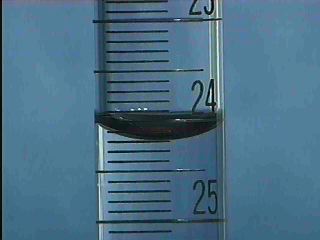
What is the concentration of citric acid if its volume is 25 ml and the titrated volume of the standard solution of 0.75 M is 12.4 ml
(a)
The concentration of the 30ml of citric acid solution is determined to be 1.23 M. Using the titration equation, predict the titration volume for the standard solution of 2.3 M.
(a)
Using n = MV, calculate the mass required to prepare 2.5 L of 1.0 M NaOH solution. Given the MM for NaOH is 40 g/mol
1000 g
100 g
10 g
1 kg
In acid-base titration, the equivalent point is when
a certain amount of acid has reacted completely with a certain amount of base according to stoichiometry
a certain amount of acid has reacted partially with a certain amount of base according to stoichiometry
How many moles of Na+ ions are there in
25cm3 of 0.01 mol/ L NaOH solution?
0.25 mol
2.5 mol
2.5 x 10⁻⁴ mol
2.5 x 10⁻³ mol
How many moles of Na+ ions are there
in 0.025 L of 1.0 mol / L of Na2SO4 solution?
0.025 mol
2.5 x 10³ mol
0.05 mol
1.0 x 10⁻³ mol
HCl + NaOH --> NaCl + H2O
How many moles of NaOH will neutralise 18.3cm3 of 1.0 mol / L HCl solution?
6.02 x 10²³ mol
1.83 x 10⁴ mol
0.0183 mol
18.3 mol
H2SO4 + 2NaOH --> Na2SO4 + 2H2O
How many moles of H2SO4 will neutralise 14.2 L of 0.01 mol/L NaOH?
1.42 x 10⁴ mol
7.1 x 10⁻⁵ mol
1.42 x 10⁻⁴ mol
7.1 x 10⁵ mol
HCl + NaOH --> NaCl + H2O
What volume of 0.01 mol HCl solution will neutralise
50 mL of 0.01 mol NaOH solution?
(a)
HCl + NaOH --> NaCl + H2O
What volume of 0.5 mol/L HCl solution will neutralise
25cm3 of 1.0 mol/L NaOH solution?
0.5cm3
12.5cm3
25cm3
50cm3
(a) are made up of solutes and solvents.
What of these is always soluble?
Nitrates
Phosphates
Carbonates
Hydroxides
The word "INSOLUBLE" meaning ________
Something which dissolve in water/liquid
Something which cannot dissolve in water/liquid
none
both
Which of the following is not a type of reduction
Gain of hydrogen
loss of electron
loss of oxygen
gain of electron
What is the precipitate formed between CaCl2 and NaOH?
CaCl2
NaOH
Ca(OH)2
NaCl
no precipitate is formed
Will the reaction between Cu(NO3)2 and K2SO4 happen?
yes
no
Which equation is a double displacement reaction?
Cl2 + 2KI --> 2KCl
Fe + O2 --> Fe2O3
CaCO3 --> CO2 + CaO
CaCO3 + 2HCl --> CaCl2 + H2CO3
What is the correct products for a reaction between NaNO3 and CuCl2
NaCu + ClNO3
NaCl + Cu(NO3)2
NaNO3 + CuCl2
No reaction occurs
Which among the following is(are) double displacement
reaction(s)?
(i) Pb + CuCl2 --> PbCl2 + Cu
(ii) Na2SO4 + BaCl2 --> BaSO4 + 2NaCl
(iii) C + O2 --> CO2
(iv) CH4 + 2O2 --> CO2 + 2H2O
(a) (i) and (iv)
(b) (ii) only
(c) (i) and (ii)
(d) (iii) and (iv)
Based on the activity series, will this reaction occur?
Au (s) + HCl (aq) →
Yes
No
Determine the two products when Na3PO4 reacts with SnO2.
NaO and SnPO4
Na2O and Sn(PO4)2
Na2O and Sn3PO4
Na2O and Sn3(PO4)4
___ Na2CO3 + ___ Ag3P → ___ Na3P + ___ Ag2CO3
3, 2, 1, 3
2, 2, 2, 3
3, 2, 2, 3,
3, 2, 3, 2
What is the oxidation number of chlorine in HClO?
(a)
What is the oxidation number of iodine in KIO3?
0
-1
+5
+1
In the reaction Zn + 2HCl --> ZnCl2 + H2
which element, if any, is oxidized?
Zinc
Hydrogen
Chlorine
None
If I have 340.0 mL of a 0.500 M NaBr solution, what will the concentration be if I add 560.0 mL more water to it? (Remember to use the total new volume)
.188 M
3.78 M
.389 M
1.76 M
Match the following
term that describes the strength or concentration of a solution
molarity
adding solvent to make solution less concentrated
dilution
describes the ability for a substance to dissolve at a specific temperature
solubility
a substance that dissolves another substance
solvent
a substance that is being dissolved by another substance
solute
The higher the molarity, the ________ the solution
more concentrate
less concentrated
How many mL of 1.0M KBr solution would you need to prepare 250 mL of a 0.2M dilution?
175 mL
250 mL
50 mL
5 mL
If it takes 50 mL of 0.5 M KOH solution to completely neutralize 125 mL of sulfuric acid solution. What is the concentration of the H2SO4 solution?
(a)
If it takes 25 mL of 0.05 M HCl to neutralize 345 mL of NaOH solution, what is the concentration of the NaOH solution?0.0036
(a)
A 20.00 mL sample of a solution of Sr(OH)2 is titrated to the equivalence point with 43.03 mL of 0.1159 M HCl. What is the molarity of the Sr(OH)2 solution?
0.06235 M
0.1247 M
0.2494 M
0.1159 M
A 35.00 mL sample of ammonia solution is titrated to the equivalence point with 54.95 mL of a 0.400 M sulfuric acid solution. What is the molarity of the ammonia solution?
0400
0.630 M
1.26 M
2.54 M
A student titrates a 20.00 mL sample of a solution of HBr with unknown molarity. The titration requires 20.05 mL of a 0.1819 M solution of NaOH. What is the molarity of the HBr solution?
(a)
Vinegar can be assayed to determine its acetic acid content. Determine the molarity of acetic acid in a 15.00 mL sample of vinegar that requires 22.70 mL of a 0.550 M solution of NaOH to reach the equivalence point.
0.416 M
0.832 M
1.66 M
0.550 M
Which of the following reactions does NOT have a net ionic equation?
C9H20 + O2 --> CO2 + H2O
AgNO3 + CaCl2 --> AgCl + Ca(NO3)2
NH4I + PbOH --> NH4OH + PbI2
Fe(NO3)2 + KOH --> KNO3 + FeOH
Write out the full ionic equation and the net ionic equation for the reaction:
sodium sulfate(aq) + silver nitrate(aq) -->
Net ionic equations for the reaction: magnesium chloride(aq) + lithium carbonate(aq) -->
Net ionic equations for the reaction: potassium hydroxide (aq) + aluminum nitrate (aq)

