Wayground logo

Free Printable Worksheets

Font size

S
M
L
XL
Worksheets

Forces & Motion Study Guide

Total questions: 100

Worksheet time: 3hrs 20mins

Name
Class
Date
1.
What is the speed of a man who runs 10 miles in 1 hr?
a)
20 miles
b)
10 m/min
c)
10 miles/hr
d)
20 hrs
2.
What is the equation to calculate speed?
a)
speed = distance/time
b)
speed = time/distance
c)
speed = time x distance 
d)
speed = speed/time 
3.
What is the equation to calculate distance?
a)
distance = speed/time
b)
distance = time/speed
c)
distance = speed/distance
d)
distance = speed x time 
4.
A car travels 30 miles/hr for 3 hours, calculate the distance it will travel
a)
90 miles
b)
10 miles
c)
600 miles
d)
90 km
5.
Two skaters begin at rest. Skater 1 has a smaller mass than Skater 2. After they push off each other,...
a)
Skater 1 experiences a greater change in momentum
b)
Skater 2 experiences a greater change in momentum
c)
Skater 1 has a greater velocity than Skater 2
d)
Skater 1 experiences a greater force
6.
Why does a rolling ball stop?
a)
Gravity
b)
Friction
c)
Waterfalls
d)
Sand
7.
Wheels on a skateboard most likely experiences-
a)
Rolling Friction
b)
Sliding Friction
c)
Fluid Friction
d)
Static Friction
8.
Balanced or unbalanced?
a)
balanced
b)
unbalanced
9.
What would you call a tree if you compared it with a moving car?
a)
reference point
b)
beacon
c)
compass
d)
friction
10.
What type of friction acts upon a non-moving object?
a)
Static Friction
b)
Kinetic Friction
c)
Rolling Friction
d)
Sliding Friction
11.
What causes a change in motion on an object?
a)
balanced force
b)
unbalanced force
c)
balanced mass
d)
unbalanced mass
12.
What is velocity?
a)
the quickness of an object
b)
the location of an object
c)
acceleration
d)
speed in a specific direction
13.

What is the changing of position over time?

a)

motion

b)

reference point

c)

acceleration

d)

speed

14.
a)

Fast

b)

Slow

15.
a)

Fast

b)

Slow

16.

What is the speed of a car travelling 50m in 4s?

a)

200 m/s

b)

12.5 m/s

c)

12.5 m

d)

200m

17.

Which of the graphs shows that one of runners started 10 yards further ahead of the

other?

a)
b)
c)
d)
18.

In which of the following graphs below are both runners moving at the same speed?

a)
b)
c)
d)
19.

Match the description to the graph:

"The car is traveling at a constant speed."

a)
b)
c)
d)
20.

Segment A-B The bus is _________________.

a)

at rest

b)

returning (to original position)

c)

moving forward

21.
The speedometer on your car tells you
a)
average velocity
b)
instantaneous velocity
c)
average speed
d)
instantaneous speed
22.
What two measurements are necessary for calculating speed?
a)
Mass and time
b)
Temperature and mass
c)
Mass and distance
d)
Distance and time
23.
How long did it take this object to travel 10 m?
a)
0 s
b)
10 s
c)
15 s
d)
20 s
24.
What is velocity?
a)
the quickness of an object
b)
the location of an object
c)
acceleration
d)
speed in a specific direction
25.
Why does a car accelerate as it round a corner at a constant speed?
a)
Its direction changes
b)
It doesn't
c)
It slows down
d)
Its speeds up  
26.

In each of the following cases, determine where the car has no acceleration?

a)

A car speeds up after a stoplight turns green.

b)

A car slows down as it approaches a red light

c)

A car with the cruise control set at 80 km/h going down a straight highway

d)

A car turning a curve at a constant speed

27.
A negative acceleration means that your object is _____. 
a)
not accelerating
b)
not moving
c)
speeding up 
d)
slowing down 
28.

A positive acceleration means that your object is _____.

a)

not accelerating

b)

not moving

c)

speeding up

d)

slowing down

29.
Which of the following is a unit for acceleration?
a)
km/s
b)
m/s2
c)
mi/hr
d)
ft
30.
If the velocity vector and acceleration vectors are moving in the same direction then
a)
speed will increase.
b)
speed will decrease.
c)
speed will be constant. 
31.
The bottom picture is an example of 
a)
balanced forces 
b)
unbalanced forces
32.
What is the net force of the bottom picture?
a)
100 W
b)
700 W
c)
100 N
d)
700 N
33.
The sum of all of the forces acting on an object is known as the what?
a)
net force
b)
vectors
c)
resultant velocity 
d)
gravity 
34.
Balanced forces always have a net force of 
a)
10 N
b)
0 W
c)
10 W
d)
0 N
35.
The SI unit for force is 
a)
Watt (W)
b)
Power (P)
c)
Newton (N)
d)
Force (F)
36.
How much force is needed to accelerate a 3kg skateboard at 5m/s2. 
a)
8N
b)
1.6N
c)
0.6N
d)
15N
37.

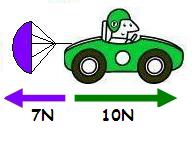
What is the net force?

a)

3 N

b)

3 N, right

c)

17 N, right

d)

3 N, left

38.
What is the net force?
a)
20 N 
b)
0 N 
c)
400 N 
d)
40 N 
39.

A ____________ is a push or a pull on an object.

a)

friction

b)

force

c)

magnet

d)

gravity

40.

What is the unit for FORCE?

a)

N (Newtons)

b)

lbs (pounds)

c)

g (grams)

d)

m/s (meters per second)

41.
A magician pulls a tablecloth out from under dishes and glasses on a table without disturbing them.
a)
Newton's 1st Law
b)
Newton's 2nd Law
c)
Newton's 3rd Law
d)
None of them
42.

A person’s body is thrown outward as a car rounds a curve on a highway.

a)

Newton's 1st Law

b)

Newton's 2nd Law

c)

Newton's 3rd Law

d)

None of them

43.
Rockets are launched into space using jet propulsion where exhaust accelerates out from the rocket and the rocket accelerates in an opposite direction.
a)
Newton's 1st Law
b)
Newton's 2nd Law
c)
Newton's 3rd Law
d)
None of them
44.
A picture is hanging on a wall and does not move.
a)
Newton's 1st Law
b)
Newton's 2nd Law
c)
Newton's 3rd Law
d)
None of them
45.
Pushing a child on a swing is easier than pushing an adult on the same swing, because the adult has more inertia.
a)
Newton's 1st Law
b)
Newton's 2nd Law
c)
Newton's 3rd Law
d)
None of them
46.
A person’s body is thrown outward as a car rounds a curve on a highway.
a)
Newton's 1st Law
b)
Newton's 2nd Law
c)
Newton's 3rd Law
d)
None of them
47.
Rockets are launched into space using jet propulsion where exhaust accelerates out from the rocket and the rocket accelerates in an opposite direction.
a)
Newton's 1st Law
b)
Newton's 2nd Law
c)
Newton's 3rd Law
d)
None of them
48.
"For every action, there is an equal and opposite reaction."
a)
Newton's 1st Law
b)
Newton's 2nd Law
c)
Newton's 3rd Law
d)
Newton's 4th Law
49.
"For every action, there is an equal and opposite reaction."
a)
Newton's 1st Law
b)
Newton's 2nd Law
c)
Newton's 3rd Law
d)
Newton's 4th Law
50.
Force = Mass x Acceleration
a)
Newton's 1st Law
b)
Newton's 2nd Law
c)
Newton's 3rd Law
d)
Newton's 4th Law
51.
The tendency of an object to resist changes in its motion is...
a)
inertia
b)
force
c)
acceleration
d)
velocity
52.
Any push or pull on an object.
a)
force
b)
velocity 
c)
inertia
d)
momentum
53.
The force that opposes motion between two surfaces in contact with each other.
a)
inertia
b)
friction
c)
momentum
d)
gravity
54.
The combination of all the forces acting on an object is the...
a)
net force
b)
action force
c)
reaction force
d)
balance force
55.

An archer pulls the bowstring back, then releases the string and the arrow flies forward. Pulling the string back is the...

a)

action force

b)

reaction force

c)

net force

d)

inertia

56.

When two equal forces act in opposite directions on an object, they are called ______________________.

a)

frictional force

b)

balanced force

c)

centripetal force

d)

gravitational force

57.

When an unbalanced force acts on an object, the force ______________________.

a)

changes the motion of the object

b)

is cancelled by another force

c)

does not change the motion of an object

d)

is equal to the weight of the object

58.
An automobile you are riding in suddenly stops, but you continue to go forward.
a)
Newton's
1st
Law of Motion
b)
Newton's
2nd
Law of Motion
c)
Newton's
3rd
Law of Motion
59.
You push against a wall and the wall is pushing back on you.
a)
Newton's
1st
Law of Motion
b)
Newton's
2nd
Law of Motion
c)
Newton's
3rd
Law of Motion
60.
Which force produces a change in motion?
a)
unbalanced force
b)
balanced force
c)
gravitational force
d)
frictional force
61.
A sled sliding on a flat, icy surface with a constant velocity is best described by
a)
Newton’s first law of motion for objects at rest.
b)
Newton’s first law of motion for objects in motion.
c)
Newton’s second law of motion.
d)
Newton’s third law of motion.
62.
A magician pulls a tablecloth out from under dishes and glasses on a table without disturbing them.
a)
Newton's 1st Law
b)
Newton's 2nd Law
c)
Newton's 3rd Law
d)
None of them
63.

Which two of these forces act on parachutes?

a)

Air Resistance

b)

Gravity

c)

Thrust

d)

Kinetic Energy

64.

What causes an object to fall faster?

a)

Smaller surface area

b)

Larger surface area

c)

If it has a parachute

d)

If it is softer

65.

Another name for air resistance is...

a)

Buoyancy

b)

Streamline

c)

Gravity

d)

Drag

66.

Air resistance pushes against falling

objects and __________________.

a)

Speeds them up

b)

Keeps them afloat

c)

Slows them down

d)

Spins them

67.

The upward force which is exerted against a falling object is

a)

gravity

b)

terminal velocity

c)

air resistance

d)

intertia

68.

Complete the sentence.

It is not the difference in gravity that causes objects to fall at different speeds, it’s the difference in the amount of__________________.

a)

Gravity

b)

Mass

c)

Air resistance

69.

The amount of matter in an object is its _____________.

a)

Weight

b)

Mass

c)

Force

70.

Gravity is the force between two objects

a)

True

b)

False

71.

Earth's gravity pulls everything toward:

a)

North

b)

South

c)

East

d)

The center of the earth

72.

Gravitational force is smaller between

a)

Larger objects

b)

Smaller objects

73.
A person would weigh less on on the Moon than on the Earth because . . .
a)
Moon has more mass, and therefore more gravity
b)
Moon has less mass, and therefore more gravity
c)
Moon has more mass, and therefore less gravity
d)
Moon has less mass and therefore less gravity
74.
What states that "every object in the universe attracts every other object"?
a)
Law of Universal Gravitation
b)
Newton's First Law of Motion
c)
My mother
d)
Inertia & gravity
75.
Force of gravity is inversely proportional to
a)
Mass
b)
Weight
c)
Distance
d)
Time
76.
Two factors effecting the magnitude of the force of gravity between 2 objects are...
a)
mass and distance 
b)
mass and matter
c)
distance and weight 
d)
weight and mass
77.

What prevents planets from drifting off into space and keeps it in the planets in our Solar System?

a)

Gravity

b)

Weight

c)

Friction

d)

Forward Motion

78.
When pressure is applied to a confined fluid, the increase in pressure is transmitted equally to all parts of the fluid. This fact is called________.
a)
Pascal's Principle
b)
Newton's Principle
c)
Archimedes' Principle
d)
Bernoulli's Principle
79.

What is the SI unit of pressure?

a)

Kg/m3

b)

Pa

c)

kg m-3

d)

N m2

80.

What is the formula for pressure?

a)

P = F / A

b)

P = F A

c)

P = A / F

d)

F = P / A

81.

The pressure resulting from a force of 50 N exerted over an area of 5 m2 is

a)

10 Nm2

b)

0.1 Nm2

c)

10 N m-2

d)

0.1 Pa

82.
In what direction(s) does air exert pressure?
a)
everywhere
b)
no where
c)
there is no pressure
d)
downward
83.

When force increases...

a)

pressure increases

b)

pressure decreases

c)

pressure stays the same

d)

pressure increases then decreases

84.

Buoyancy is best described as

a)

the force which allows that would normally sink to float

b)

a force which pulls objects toward the center of the earth

c)

mass minus volume

d)

a lifeboat

85.

The best example of buoyancy is a

a)

ship

b)

plane

c)

the ocean

d)

Jon Osloff

86.
What is buoyant force?
a)
An upward force exerted by fluids on an object.
b)
An downward force exerted by fluids on an object.
87.

What is displacement?

a)

The ability to float

b)

Degree of compactness of a substance

c)

The moving of something from its place or position

88.

What is density?

a)

The ability to float

b)

Degree of compactness of a substance

c)

The moving of something from its place or position

89.

Who is more likely to sink?

a)

A heavy person

b)

A thin person

90.

The unit used to measure mass is

a)

cubic centimeters (cm3 )

b)

milliliters (mL)

c)

g/cm3

d)

grams (g)

91.
Which box has a higher density?  
a)
Box A
b)
Box B
c)
cannot be determined
d)
they are the same
92.

Viscosity can be described as...

a)

a physical property of liquids

b)

a physical property of solids

c)

a chemical property of liquids

93.

High viscosity can be described as...

a)

a liquid that flows quickly

b)

a liquid that flows slowly

94.

Peanut butter is an example of a...

a)

High viscosity liquid

b)

Low viscosity liquid

c)

Isnt a liquid at all! Don't be silly.

95.

Which of these factors affects Viscosity?

a)

Temperature

b)

Colour

c)

Taste

96.

Which of the following liquids is viscous?

a)

honey

b)

water

c)

soy sauce

d)

cooking oil

97.
What is viscosity?
a)
A liquid's resistance to flow.
b)
a liquids flow.
c)
a liquid
d)
gas to solid.
98.

Define the term “fluid.”

a)

A fluid is any substance that flows. It may be a liquid or a gas.

b)

A fluids includes substances that flow. They can only be a gas.

c)

A fluids includes substances that flow. They can only be a liquid.

99.

The best example of a substance with low viscosity is?

a)

Honey

b)

Soap

c)

Marbles

d)

Water

100.

Which viscosity can be described as "thick"?

a)

Low viscosity

b)

High viscosity