
 Worksheets
Forces and interactions
Total questions: 87
Worksheet time: 44mins
Name
Class
Date
1.

When Sabrina jumped into the air, she ___
a)
floated away
b)
landed on her feet
c)
landed on her head
d)
moved sideways
2.

What force pulls everything toward the ground, including you?
a)
gravity
b)
friction
c)
elasticity
d)
electrical force
3.

A push or pull acting on an object is called ___
a)
a lever
b)
a pusher
c)
a force
d)
a puller
4.

Everything would fly off into space, without ___
a)
frictional forces
b)
french fries
c)
water
d)
the force of gravity
5.

Which English scientist was the first person to seriously study gravity?
a)
Michael Faraday
b)
Charles Darwin
c)
Albert Einstein
d)
Isaac Newton
6.

What event led to an "Aha!" moment for Sir Isaac Newton?
a)
He was hit by a falling apple
b)
He awoke from a deep sleep
c)
He had a dream about gravity
d)
He ate a delicious apple
7.

Which type of objects are pulled toward Earth?
a)
only apples
b)
only light objects
c)
only heavy objects
d)
all objects
8.

If you are holding an apple, a bowling ball, and a feather, then let go of them, ___
a)
they're all going down
b)
the feather will stay put
c)
only the bowling ball falls
d)
only the heavy objects fall
9.

Sir Isaac determined that "what goes up ___"
a)
isn't affected by gravity
b)
stays up
c)
must come down
d)
goes into orbit
10.

A thrown ball will go up or sideways for a little bit ___
a)
then keep going
b)
then come back
c)
while it's not affected by gravity
d)
then will fall to the ground
11.

Near the surface of the Earth, gravity is the cause that produces the effect of ___
a)
all unsupported objects falling down
b)
supported objects falling down
c)
all unsupported objects falling up
d)
supported objects falling up
12.

What is the force that pulls objects down toward the Earth?
a)
gravity
b)
friction
c)
air resistance
d)
static electricity
13.

Where, on Earth, do penguins live?
a)
America
b)
Africa
c)
the Arctic
d)
Antarctica
14.

When we talk about gravity, 'up' just means ___
a)
towards the North Pole
b)
away from the South Pole
c)
away from the Earth
d)
toward the Earth
15.

When we talk about gravity, 'down' just means ___
a)
towards the North Pole
b)
away from the South Pole
c)
away from the Earth
d)
toward the Earth
16.

"Gravity pulls things down to Earth", really means that gravity pulls things ___
a)
toward the South Pole
b)
toward the Earth
c)
away from the North Pole
d)
toward Antarctica
17.

Gravity is the force of attraction ___
a)
on a light object, due to a heavier one
b)
on a heavy object, due to a lighter one
c)
between two objects of the same size
d)
between any two objects made of matter
18.

A logical description of a scientific idea is called ___
a)
an argument
b)
an altercation
c)
a disagreement
d)
a dispute
19.

In the experiment, the finger represented ___
a)
the Earth
b)
the force of gravity
c)
the penguin
d)
the Arctic
20.

In the experiment, the elastic band represented ___
a)
the Earth
b)
the force of gravity
c)
the penguin
d)
the Arctic
21.

The penguin tries, really hard, to jump and then it ___
a)
is forced back to Earth
b)
finally flies away
c)
is forced toward the South Pole
d)
is forced toward the North Pole
22.

What is the name of the large artificial satellite orbiting our planet?
a)
the International Space Station
b)
the American Space Station
c)
the U.S. Skylab
d)
the Mir station
23.

A push or pull acting on an object is called ___
a)
a torque
b)
a force
c)
power
d)
momentum
24.

Which force keeps everything from sailing off the ground and into space?
a)
gravity
b)
static cling
c)
elasticity
d)
static electricity
25.

When we throw something into the air, no matter what, ___
a)
gravity pulls it back to Earth
b)
gravity pulls it South
c)
gravity pulls it North
d)
it just keeps going
26.

The speed that a rocket must have to escape from the Earth's gravity is called ___
a)
the break-away speed
b)
the departure velocity
c)
the escape velocity
d)
the liberation speed
27.

The larger an object is, the bigger its gravitational pull is, and ___
a)
a larger escape velocity is needed
b)
a smaller escape velocity is needed
c)
a weaker escape velocity is needed
d)
a more powerful escape velocity is needed
28.

Compared to that of the Earth, the escape velocity you need to take off from the moon is ___
a)
a lot more
b)
slightly more
c)
slightly less
d)
a lot less
29.

The more mass that two objects have, ___
a)
the greater the force is between them
b)
the lesser the force is between them
c)
the greater the tension is between them
d)
the lesser the tension is between them
30.

Data that supports or disputes a scientific idea is called ___
a)
clues
b)
details
c)
evidence
d)
statistics
31.

When tossing a ping pong ball in the air, the amount of force is the cause and ___
a)
the mass of the ball is the effect
b)
the height of the ball is the event
c)
the height of the ball is the effect
d)
the mass of the ball is the event
32.

To move more massive objects against the pull of gravity, it takes ___
a)
less force
b)
more force
c)
less resistance
d)
more resistance
33.

Gravity exists between any two objects that ___
a)
have an escape velocity
b)
are in orbit
c)
have mass
d)
are planets
34.

How many people have actually been on the moon?
a)
12
b)
16
c)
20
d)
24
35.

The natural pull of objects toward each other is called ___
a)
gravity
b)
magnetism
c)
stickiness
d)
attractiveness
36.

The speed needed to overcome the force of Earth's gravity is called ___
a)
the freedom force
b)
the break-out speed
c)
the escape velocity
d)
the release trajectory
37.

A push of pull acting on an object is called ___
a)
gravity
b)
a force
c)
momentum
d)
energy
38.

"Mass" is a measure of ___
a)
how large an object is
b)
how far an object can be thrown
c)
how fast an object will move
d)
how much matter is in an object
39.

The farther away something is from the Earth ___
a)
the less it will feel the pull of Earth's gravity
b)
the more it will feel the pull of Earth's gravity
c)
the faster it can go
d)
the slower it will go
40.

The closer an object gets to the Moon, ___
a)
the less it will feel the Moon's gravity pulling on it
b)
the more it will feel the Moon's gravity pulling on it
c)
the heavier it will get
d)
the lighter it will get
41.

Shooting stars are actually pieces of rock that have broken off from passing ___
a)
comets or asteroids
b)
planets or asteroids
c)
comets or planets
d)
stars or planets
42.

A meteor is a rock that has ___
a)
been caught in Earth's gravity
b)
been caught in the Moon's gravity
c)
collided with Earth's surface
d)
collided with the Moon's surface
43.

Which two things affect the pull of gravity?
a)
the size of the objects and the resistance between them
b)
the density of the objects and their speed
c)
the mass of the objects and the distance between them
d)
the mass of the objects and their escape velocities
44.

Human made objects that orbit the Earth are called ___
a)
artificial satellites
b)
natural satellites
c)
artificial asteroids
d)
natural asteroids
45.

The path that an object follows around another object is called ___
a)
an orbit
b)
a circle
c)
a progression
d)
a force
46.

The natural pull of objects toward each other is called ___
a)
elasticity
b)
an orbit
c)
gravity
d)
the moon
47.

How were the huge craters on the Moon formed?
a)
by chunks of rock came together
b)
by lava flowing on the surface
c)
by colliding with the Earth
d)
by asteroids hitting it
48.

How long does it take for the Moon to orbit the Earth?
a)
about one day
b)
about seven days
c)
about 27 days
d)
about 365 days
49.

What is Earth's only natural satellite?
a)
the Sun
b)
the Moon
c)
the International Space Station
d)
an asteroid
50.

What is the biggest artificial satellite ever flown in space?
a)
the Moon
b)
the ISS
c)
NASA's Skylab
d)
Mir
51.

The ISS moves pretty fast, completing 16 orbits around our planet every ___
a)
hour
b)
day
c)
week
d)
minute
52.

Which of the following is NOT a function of Earth's artificial satellites?
a)
forecasting weather
b)
monitoring drought
c)
communicating with devices
d)
storage of moon rocks
53.

The orbit of a satellite is determined by a delicate balance of ___
a)
its velocity and its mass
b)
its mass and the Earth's gravitational pull
c)
its mass and its function
d)
its velocity and the Earth's gravitational pull
54.

So, technically, the Moon and other satellites are always ___
a)
moving too slow to hit the Earth
b)
going to hit the Earth
c)
falling towards the Earth
d)
moving too fast to escape Earth's gravity
55.

The natural pull of objects toward each other is called ___
a)
the solar system
b)
gravity
c)
a satellite
d)
an orbit
56.

Earth travels around the Sun, completing the whole trip every ___
a)
24 hours
b)
7 days
c)
27 days
d)
365 days
57.
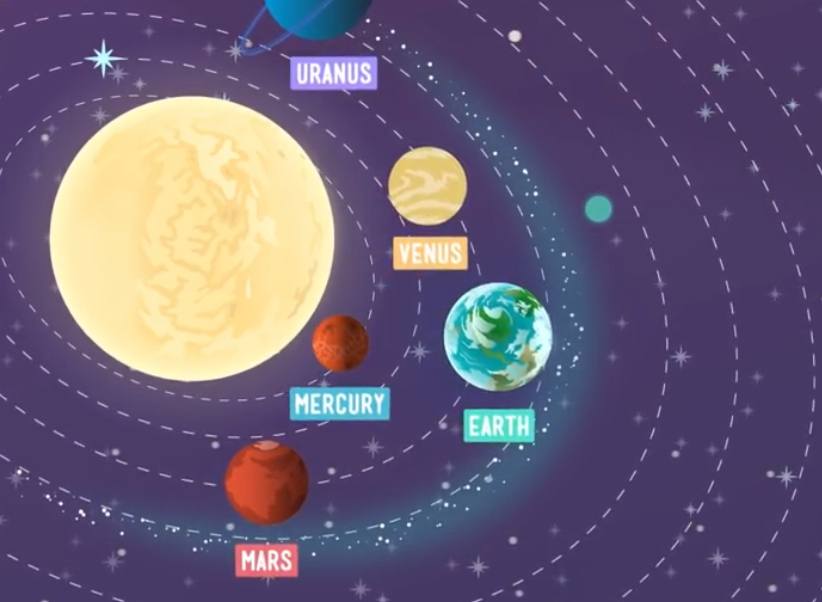
Why do we orbit the Sun and not the other way around?
a)
brighter objects tend to orbit duller ones
b)
duller objects tend to orbit brighter ones
c)
lighter objects tend to orbit heavier ones
d)
heavier objects tend to orbit lighter ones
58.

The Sun is the heaviest object in our solar system. It's about ___
a)
twice as heavy as Jupiter
b)
200 times heavier than Jupiter
c)
500 times heavier than Jupiter
d)
1000 times heavier than Jupiter
59.
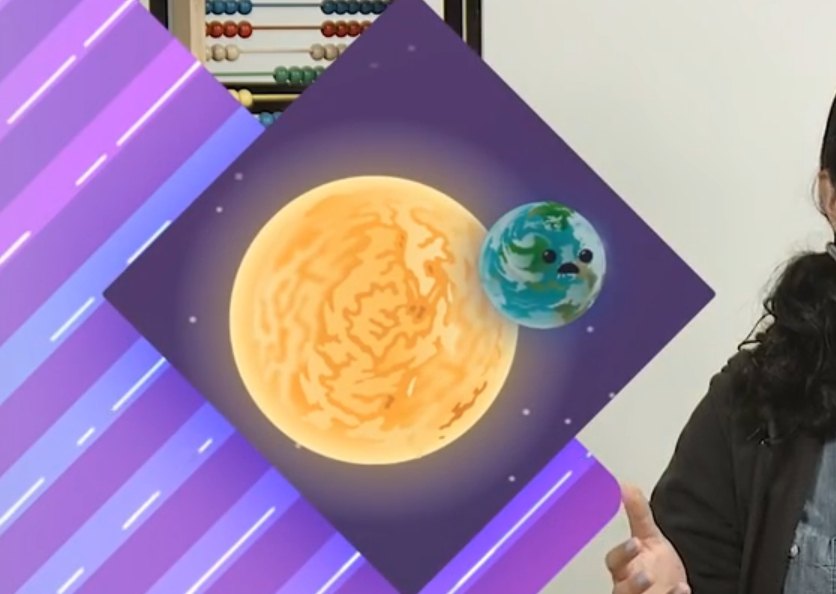
The Earth doesn't totally get sucked into the Sun, because ___
a)
it's moving too slowly around it
b)
it's moving fast enough around it
c)
it's too heavy too pull in
d)
it's too far away
60.

A group of stars, gas and dust bound together by gravity is called ___
a)
an orbit
b)
the Sun
c)
a galaxy
d)
a black hole
61.

What is the name of our galaxy?
a)
the Solar System
b)
Orbital Galaxy
c)
the Andromeda Galaxy
d)
the Milky Way
62.

An object that has a gravitational pull stronger than anything else in space is called ___
a)
a black hole
b)
a galaxy
c)
dark matter
d)
an orbit
63.

What object is at the center of our Milky Way galaxy?
a)
a giant star
b)
a black hole
c)
our solar system
d)
the Earth
64.

The eight main planets tend to orbit the Sun in a relatively circular way in the same ___
a)
straight line
b)
identical orbit
c)
imaginary plane
d)
ideal curve
65.

Which dwarf planet has a weird orbital path, off-level with the other planets?
a)
Pluto
b)
Neptune
c)
Ceres
d)
Eris
66.

Pluto is sometimes closer to the Sun than which planet?
a)
Jupiter
b)
Saturn
c)
Uranus
d)
Neptune
67.

All things caught in our planet's gravity will, in some way, have the potential to ___
a)
fall to Earth
b)
orbit the Moon
c)
orbit the Sun
d)
lose their mass
68.

Mass is a measure of ___
a)
the size of an object
b)
how electrons move in an object
c)
how much stuff is under an object
d)
how much matter is in an object
69.

The heaviness of an object, caused by the pull of gravity, is called ___
a)
mass
b)
weight
c)
density
d)
bulkiness
70.

Who performed the experiment on the Moon using a feather and a hammer?
a)
David Scott
b)
Neil Armstrong
c)
Buzz Aldrin
d)
Buzz Lightyear
71.

When a feather and a hammer are dropped on the Moon, what will happen?
a)
the feather will hit the ground first
b)
the hammer will hit the ground first
c)
both will hit the ground at the same time
d)
the feather will float away
72.

The friction between the air and a moving object is called ___
a)
air resistance
b)
the atmosphere
c)
gravity
d)
upward draft
73.

On Earth, the feathers flat fluffy shape makes it ___
a)
run into more air resistance than the hammer does
b)
run into less air resistance than the hammer does
c)
more dense than the hammer
d)
heavier than the hammer
74.

On the Moon, a hammer and a feather fall at the same rate because ___
a)
the Moon has almost no atmosphere
b)
the Moon has a dense atmosphere
c)
the Earth has a dense atmosphere
d)
the Earth has almost no atmosphere
75.

Data that supports or disputes a scientific idea is called ___
a)
conjecture
b)
a theory
c)
evidence
d)
a hypothesis
76.

Flat paper seems to fall more slowly than crumpled paper due to ___
a)
gravity
b)
the difference in weight
c)
the difference in mass
d)
air resistance
77.

On Earth, objects can seem to fall at different speeds because of ___
a)
atmospheric turbulence
b)
wind speed
c)
air resistance
d)
land breezes
78.

Who was the astronaut that dropped a feather and a hammer on the Moon?
a)
David Scott
b)
Buzz Aldrin
c)
Neil Armstrong
d)
Chris Hadfield
79.

In what year did David Scott perform his experiment on the Moon?
a)
1954
b)
1971
c)
1995
d)
2014
80.

What was the result when a hammer and a feather were dropped on the Moon?
a)
the hammer hit the ground first
b)
the feather hit the ground first
c)
they both hit at the same time
d)
the hammer landed on the astronaut's foot
81.

It's not a difference in gravity that causes objects to hit the ground at different times, it's ___
a)
a difference in air resistance
b)
a difference in masses
c)
a change in densities
d)
similarities in volume
82.

In Earth's atmosphere, after attaching a parachute to the tennis ball, it ___
a)
takes less time to reach the ground
b)
takes longer to reach the ground
c)
takes the same time to reach the ground
d)
hits the ground harder
83.

More friction means ___
a)
more air resistance, and a shorter time to hit the ground
b)
less air resistance, and a shorter time to hit the ground
c)
more air resistance, and a longer time to hit the ground
d)
less air resistance, and a longer time to hit the ground
84.

An area in which there is no air or gas is called ___
a)
a vacancy
b)
a dust bin
c)
a vacuum
d)
a hole
85.

In a vacuum, there is no air. No air means ___
a)
no air resistance
b)
lots of air resistance
c)
no gravity
d)
lots of gravity
86.

In a vacuum, objects dropped at the same height will hit the ground ___
a)
at the same time
b)
at different times
c)
at unpredictable times
d)
in no time flat
87.

When it comes to objects falling on Earth, it's the resistance that ___
a)
drops the hammer
b)
makes the difference
c)
floats the feather
d)
causes the vacuum
100 %

