wayground logo

Free Printable Worksheets

Font size

S
M
L
XL
Worksheets

U5: CH 12 & 15 Test Review

Total questions: 102

Worksheet time: 2hrs 35mins

Name
Class
Date
1.
Homozygous is when...
a)
the alleles are the same
b)
the alleles are different
c)
the alleles are absent
d)
the alleles are present
2.
Heterozygous is when...
a)
the alleles are the same
b)
the alleles are different
c)
the alleles are absent
d)
the alleles are present
3.
In a heterozygous genotype, the ___________ allele takes over in the phenotype.
a)
recessive
b)
dominant
c)
lower case letter
d)
both 
4.
B = brown fur  b = white fur
In the punnett square, what is the probability for white fur? 
a)
0%
b)
25%
c)
50%
d)
75%
5.
In the punnett square shown, what must the genotype of the missing parent be?
a)
BB
b)
Bb
c)
bb
d)
Tt
6.
What genotype is missing from this Punnett Square?
a)
RrYy
b)
RRYY
c)
rryy
d)
RrYY
7.

An organism is a hybrid genotype (Tt) but is appears tall instead of short.

a)

Law of Dominance

b)

Law of Segregation

c)

Law of Independent Assortment

8.

If your genotype is Bb, then you can only pass a B or b to your child but you can't pass both.

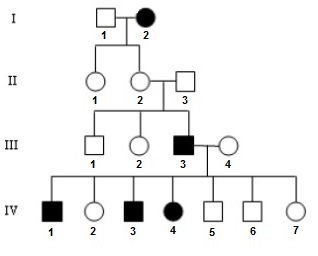
a)

Law of Dominance

b)

Law of Segregation

c)

Law of Independent Assortment

9.

Person A is smart and has brown hair while Person B is also smart but has blonde hair.

a)

Law of Dominance

b)

Law of Segregation

c)

Law of Independent Assortment

10.

There are more right-handed people in the world.

a)

Law of Dominance

b)

Law of Segregation

c)

law of Independent Assortment

11.

One gene for the type of earlobes a person will have will be in each gamete.

a)

Law of Dominance

b)

Law of Independent Assortment

c)

Law of Segregation

12.

Which of Mendel's laws states that alleles are separated during meiosis?

a)

Law of Dominance

b)

Law of Segregation

c)

Law of Independent Assortment

13.

Law of Independent Assortment

a)

every organism has two alleles which separate when gametes are produced

b)

alleles for traits are the same

c)

genes from different traits are inherited independently of one another

d)

the allele combination of an organism

14.

Law of Segregation

a)

every organism has two alleles which separate when gametes are produced

b)

alleles for traits are the same

c)

genes from different traits are inherited independently of one another

d)

the allele combination of an organism

15.
___________________________ is the study of how traits are passed on, or inherited.
a)
dominant traits
b)
ratio
c)
phenotype
d)
genetics
16.
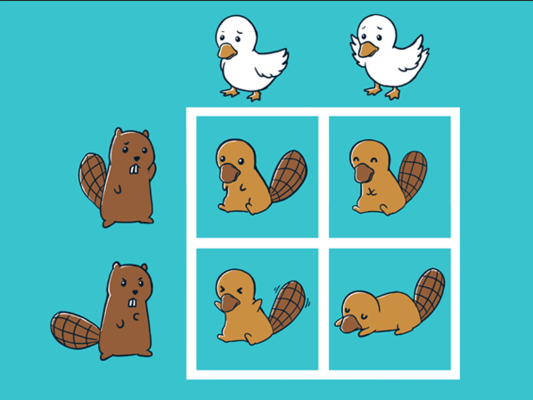
If this image were real, it would represent what type of inheritance?
a)
incomplete dominance
b)
codominance
c)
polygenic inheritance
d)
compete dominance
17.
A red flowered plant (RR) breeds with a White flowered plant (WW). The gene for petal color in these plants expresses incomplete dominance.  What percentage of the offspring will have pink (RW) flowers?
a)
0%
b)
25%
c)
50%
d)
100%
18.
Aa, DD, bB, yy are all examples of
a)
genotypes
b)
phenotypes
19.
What you see, or the physical appearance.
a)
Genotype
b)
Phenotype
c)
Homozygous
d)
Heterozygous
20.
This is an example of ___________?
a)
Incomplete dominance
b)
Co-Dominance
21.
How are Incomplete Dominance and Co Dominance different than a normal Mendelian cross?
a)
There is no difference
b)
The heterozygous genotype has a unique phenotype
c)
There is no heterozygous genotype
d)
There is only one phenotype regardless of genotype.
22.
What type of inheritance is shown?
a)
complete
b)
incomplete
c)
codominance
d)
sex-linked
23.
What do you call the non-Mendelian inheritance pattern that states that neither trait is dominant and the traits appear to blend together?
a)
Codominance
b)
Incomplete dominance
c)
Polygenic traits
24.
This type of inheritance pattern shows BOTH traits in possible offspring
a)
complete dominance
b)
incomplete dominance
c)
co-dominance
d)
dominant pattern
25.
How many phenotypes are present in this pictures?
a)
1
b)
2
c)
3
d)
4
26.

Many genes determine 1 trait (ex: skin color)

a)

Incomplete Dominance

b)

Polygenic

c)

Codominance

d)

Multiple alleles

27.
For an XX female to express a recessive sex-linked trait, she must have....
a)
two recessive alleles
b)
a Y chromosome 
c)
one recessive allele
d)
two dominant alleles
28.

Human height occurs in a continuous range because it is affected by the interaction of many genes, making it a(n)

a)

autosomal trait

b)

polygenic trait

c)

codominant trait

d)

sex-linked trait

29.

Which term is correctly matched with the description?

a)

Co-dominance occurs when two traits blend together to form a new phenotype.

b)

Human skin color is an example of codominant trait.

c)

Incomplete dominance occurs when traits blend producing a third phenotype.

d)

Human blood type is not an example of multiple alleles.

30.
What type of inheritance is determined by multiple genes located at different loci on different chromosomes and there can be a range of traits?
a)
Codominance
b)
Incomplete dominance
c)
Polygenic traits
31.

Three or more alternative forms of a gene that can occupy the same locus.

a)

multiple alleles

b)

codominant

c)

polygenic

d)

incomplete dominance

32.

Check all that apply.

Human ABO blood type is a _________ trait.

a)

multiallelic

b)

polygenic

c)

codominant

d)

X-linked

33.
In the following Punnett Square, R represents red scales and B represents blue scales.  If scale type shows co-dominance in fish, what is the probability of each color in the offspring?
a)
50% blue, 50% red and blue, 0% red
b)
50% purple and 50% blue
c)
100% red and blue
d)
0% red, 0% blue, 100% red and blue
34.

In the blood type Punnett square shown, what is the probability the offspring will inherit each blood type?

a)

50% A, 25% B, 0% AB, 25% O

b)

25% A, 50% B, 25% AB, 0% O

c)

50% A and 50% B

d)

25% AB, 50% A, 25% O

35.
What are the possible genotypes for this cross?
a)
TT = 25% Tt= 50% tt=25%
b)
all tall
c)
TT= 75% tt = 25%
d)
Tt = 100%
36.
If a gene is found only on the X chromosome and not the Y chromosome, it is said to be what?
a)
sex-linked trait
b)
polygenic trait
c)
codominant trait
d)
incomplete dominance trait
37.
Which of the following genotypes belongs in the red box in the Punnett square?
a)
XBXB
b)
XbXb
c)
XbY
d)
XBY
38.
The visual representation of an individual's chromosomes is a 
a)
phenotype
b)
genotype
c)
karyotype
d)
stereotype
39.
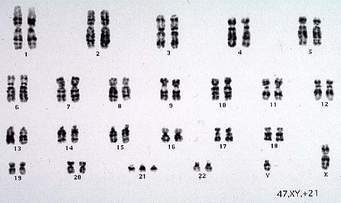
What is the chromosomal condition of the individual whose karyotype is seen in the image?
a)
Trisomy 21 (Down's Syndrome)
b)
Trisomy 13 (Patau Syndrome)
c)
Trisomy 18 (Edward's Syndrome)
d)
XXY Sex Chromosomes (Klinefelter's Syndrome)
40.
What is the phenotype of a person with the genotype AO?
a)
type A
b)
type O
c)
AA
d)
OO
41.

If two parents are heterozygous for type A blood (AO), what is the probability that their offspring would have type O blood? Draw the Punnett Square. Do not guess.

a)

100 %

b)

75%

c)

50%

d)

25%

42.
Hemophilia is a recessive x-linked disorder.
Which genotype represents a female who is a carrier for hemophilia?
a)
XHXh
b)
XhXh
c)
XHXH
d)
XhY
43.
If a father is AA and a mother is AB, what is the probability for a child with AB blood? 
a)
0%
b)
25%
c)
50%
d)
75%
44.
Some mammals have fur color genes that produce pigment only when the outside temperature is above a certain level. This is an example of how the environment of an organism can
a)
destroy certain genes
b)
cause new mutations to occur 
c)
stop the process of evolution
d)
influence the expression of a gene
45.

Genes are inherited, but their expression can be modified by the environment. This statement explains why

a)

some animals have dark fur when the temperature is within a certain range

b)

offspring produced by sexual reproduction look exactly like their parents

c)

identical twins who grow up in different homes have the same characteristics

d)

animals can be cloned, but plants cannot

46.
Hereditary information is stored inside the
a)
ribosomes, which have chromosomes that contain many genes
b)
ribosomes, which have genes that contain many chromosomes
c)
nucleus, which has chromosomes that contain many genes
d)
nucleus, which has genes that contain many chromosomes
47.
Which of the following is NOT a factor that affects gene expression?
a)
environmental factors 
b)
cell location 
c)
chemical messages 
d)
number of cell divisions 
48.
In the human population, there are 100s of genes may code for the HLA protein.  How many of these alleles does an individual human possess?
a)
200
b)
4
c)
2
d)
100
49.

Which statement is true about X-linked genes?

a)

The male needs two copies of the gene but will express the trait regardless of whether the alleles are dominant or recessive.

b)

The male needs two copies of the gene but will express the trait only if both alleles are dominant.

c)

The male needs only one copy of the gene and will express the trait regardless of whether the allele is dominant or recessive.

d)

The male needs only one copy of the gene but will express the trait only if the allele is dominant.

50.
What is it called when a sperm and egg meet?
a)
meiosis
b)
fertilization
c)
cell division
d)
mitosis
51.
Which process and type of resulting cells are represented?
a)
mitosis, gametes
b)
mitosis, body cells
c)
meiosis, gametes
d)
meiosis, body cells
52.
The chromosomes that pair up during meiosis, are called __________ chromosomes.  
a)
homozygous 
b)
asexual
c)
homologous
d)
genes
53.
A male shark has 40 chromosomes in each of its sex cells. How many would be present in its body cells?
a)
20
b)
40
c)
80
d)
160
54.
Which letter(s) in the diagram correspond to cells that are haploid? 
a)
A
b)
B
c)
C
d)
A and B
55.
Compared to the number of chromosomes contained in a body cell, how many chromosomes would normally be contained in a gamete?
a)
The same number
b)
One-fourth as many
c)
Twice as many
d)
Half as many
56.
What causes genetic variation in meiosis?
a)
chromosomes lining up
b)
crossing over of chromosomes
c)
separation of chromosomes
d)
chromosomes pulling apart
57.
What is one of the advantages, why is it better to reproduce sexually versus asexually?
a)
survival of the fittest
b)
overproduction
c)
genetic variation
d)
cloning
58.
Crossing over helps promote 
a)
male genotype
b)
genetic variation
c)
DNA replication
d)
mitosis
59.
A human zygote should have _____ chromosomes inside.
a)
46
b)
23
c)
92
d)
64
60.
What do experts say is the most common form of Down Syndrome?
a)
Trisomy 47
b)
Trisomy 46
c)
Trisomy 21
d)
Trisomy 23
61.
Females have ____ and males have _____ chromosomes.
a)
XX, XY
b)
XY, XX
c)
XX, XX
d)
XY, XY
62.
A human being has a somatic cell that has 46 chromosomes.  What is the haploid number found in a gamete?
a)
23
b)
46
c)
69
d)
92
63.
What is this?
a)
Trisomy 13
b)
Monosomy 21
c)
47, XXY
d)
Trisomy 21
64.
Diploid Cells are represented by
a)
2n
b)
n
c)
4n
d)
1/2 n
65.
a)

INCREASES GENETIC VARIATION

b)

TAKES PLACE IN PROPHASE I

c)

CROSSING OVER

d)

ALL ARE TRUE

66.

MEIOSIS

a)

REDUCES THE NUMBER OF CHROMOSOMES BY ONE HALF

b)

PRODUCES UNIQUE SEX CELLS-1N

c)

ALLOWS TRAITS TO BE PASSED TO OFFSPRING

d)

ALL ARE TRUE

e)

INCREASE GENETIC VARIATION

67.

MEIOSIS PRODUCES 4 CELLS-THE CHROMOSOME NUMBER IS ...

a)

DIPLOID

b)

HAPLOID

68.
Which of the following cells is a gamete?
a)
egg
b)
bone
c)
heart
d)
muscle
69.
The fertilized egg is termed a/an _____.
a)
gamete
b)
allele
c)
homolog
d)
zygote
70.

Is the following cell diploid or haploid?

a)

Diploid

b)

Haploid

71.
In sexual reproduction, chromosome reduction is necessary to ___.
a)
ensure that all offspring have the correct diploid number of chromosomes
b)
ensure that all offspring have the correct haploid number of chromosomes
c)
ensure that all daughter cells are identical
72.

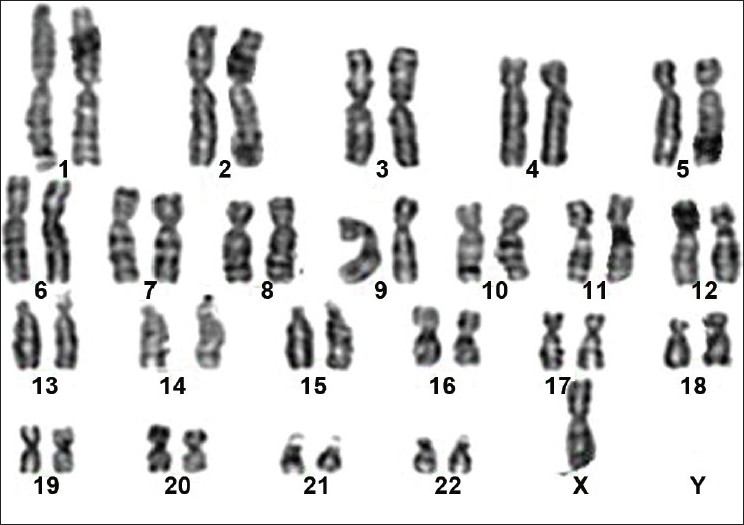
Is this karyotype for a male or female?

a)

MALE

b)

FEMALE

73.

What is unique to Prophase I- is that the duplicated chromosomes pair up to form _______.

a)

a centrosome

b)

a tetrad

c)

the mitotic spindle

d)

sister chromatids

74.

Where does meiosis occur?

a)

ovaries

b)

testes

c)

ovaries and testes

75.
a)
This karyotype shows Trisomy 21
b)
This karyotype has no abnormality
c)
This karyotype is missing a sex chromosome (monosomy x)
d)
This karyotype is from a gamete
76.
Based on the Karyotype shown, at which chromosome pair can we identify a genetic disorder? 
a)
Chromosome pair 5
b)
sex chromosomes
c)
Chromosome pair 21
d)
There are no chromosomal disorders
77.
A pair of identical chromosomes shown in a karyotype, one inherited from mom, and one inherited from dad are called
a)
sister chromotids
b)
centromeres
c)
homologous chromosomes
d)
autosomes
78.
Nondisjunction can result in 
a)
trisomy conditions
b)
monosomy conditions
c)
additional sex chromosomes
d)
all of these
79.
When chromosomes fail to separate correctly during anaphase of meiosis, what can occur?
a)
extra chromosomes are found in the sex cell
b)
chromosomes of the sex cell are doubled
c)
chromosomes of the sex cell are halved
d)
meiosis never completes
80.
The phase in mitosis where chromosomes move away and are pulled apart by spindles to opposite sides of the cell.
a)
prophase
b)
anaphase
c)
metaphase
d)
telephase
81.
Determine the sex of the individual whose karyotype is displayed in the image.
a)
female
b)
male
82.
A sperm contains
a)
Both an X and a Y chromosome
b)
Two X chromosomes
c)
An X OR a Y chromosome
d)
only a Y chromosome
83.
An egg contains
a)
22 autosomes and an X chromosome
b)
22 autosomes and an Y chromosome
c)
44 autosomes and 2 X chromosomes
d)
44 autosomes and an X and a Y chromosome
84.
What makes this individual's karyotype not normal?
a)
An extra sex chromosome
b)
An extra autosome
c)
A missing sex chromosome
d)
A missing autosome
85.

A chart that displays family relationships indicating traits or disorders

a)

Punnett square

b)

Pedigree

c)

Karyotype chart

86.

In a pedigree chart, men are represented by

a)

Circles

b)

Diamonds

c)

Squares

87.

In a pedigree chart, women are represented by

a)

Circles

b)

Diamonds

c)

Squares

88.

In a pedigree, individuals that are carriers are represented as shapes that are

a)

Not shaded

b)

Fully shaded

c)

Half shaded

89.

In a pedigree, individuals that are unaffected are represented as shapes that are

a)

Not shaded

b)

Fully shaded

c)

Half shaded

90.

In a pedigree, individuals that are affected are represented as shapes that are

a)

Not shaded

b)

Fully shaded

c)

Half shaded

91.

When working to find genotypes of individuals in a pedigree, you may need to use a

a)

Punnett square

b)

Dihybrid cross

c)

Karyotype chart

92.
How many generations are shown in this pedigree?
a)
1
b)
2
c)
3
d)
4
93.
How many kids did the mother and father from the first generation have?
a)
2
b)
4
c)
5
d)
6
94.
This pedigree represents the inheritance of hemophilia in this family. How many of the females have the hemophilia trait?
a)
8
b)
5
c)
2
d)
3
95.
Is this trait (the shaded individuals) dominant or recessive?
a)
dominant
b)
recessive
96.

In this pedigree, which gender can be carriers of colorblindness and not have it?

a)

Just males

b)

Just females

c)

Both genders

97.
Give the genotype for person II-1, for this autosomal trait.
a)
GG
b)
Gg
c)
gg
d)
we cannot be 100% sure of the genotype
98.
If a trait SKIPS a generation, it is an indication that the trait is....
a)
dominant
b)
recessive
c)
incompletely dominant
d)
co-dominant
99.
If this pedigree shows an autosomal recessive disorder, what MUST the genotype of individual II-3 be?
a)
HH
b)
Hh
c)
hh
d)
None of the above
100.

Objective #13

This is a pedigree that follows blue eyes which is a recessive trait. What is the genotype of the father (square) in generation 1?

a)

Aa

b)

AA

c)

aa

d)

A?

101.

Individuals that are shaded in have premature hair whitening. Is this trait dominant or recessive? How do you know?

a)

Dominant because it skips generations

b)

Dominant because it is present in every generation

c)

Recessive because it skips generations

d)

Recessive because it is present in every generation.

102.

Huntington's Disease is a dominant trait.

What is the correct genotype for individual I-2?

a)

HH

b)

Hh

c)

hh

d)

H?