
 Worksheets
SCIENCE 10 Q4 Monthly EXAM Review
Total questions: 54
Worksheet time: 1hrs 1mins
What is the formula for Boyle's Law?
P1V1=P2V2
P1V1/P2V2
P1V2=P2V1
P1/V1=P2/V2
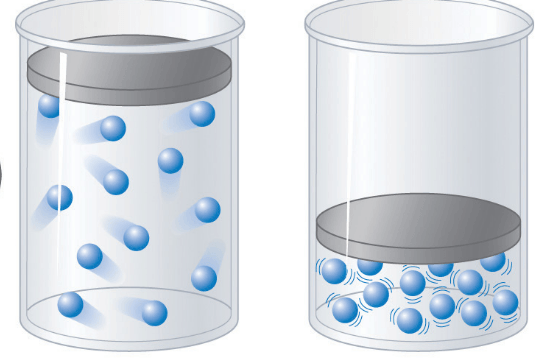
IF we are using Boyles' law and our Pressure goes UP, what must our volume do?
Go UP
Go DOWN
Stay the same
Wrong law.
Which best explains why increasing the pressure on a gas decreases the volume of the gas sample?
Increasing the pressure causes the gas particles to hit the container walls more often.
Increasing the pressure on a gas sample moves the gas particles closer together.
Increasing the pressure on a gas sample causes the kinetic energy to increase.
1. Which measurement measures the amount of space a substance takes up?
Temperature
Pressure
Volume
Mass
2. Which measurement can be identified by the unit K (Kelvin)?
Temperature
Pressure
Volume
Mass
3. Which measurement can be identified by the unit L (Liters)?
Temperature
Pressure
Volume
Mass
4. According to Charles Law, the relationship between Temperature and Volume can best be described as....
Inverse Relationship
Direct Relationship
No Relationship
5. According to Charles Law, if Temperature of a gas increases Volume will also....
Increases
Stays the same
Decreases

6.Which Graph best shows the relationship between Temperature and Volume?
A
B
7. If the temperature of a gas is doubled from 100K to 200K, what happens to the volume of the gas?
Cuts in half
Triples
Doubles
Stays the same
8. If the temperature of a gas is tripled from 100K to 300K, what happens to the volume of the gas?
Cuts in half
Triples
Doubles
Stays the same
9. If the temperature of a gas is cut in half from 200K to 100K, what happens to the volume of the gas?
Cuts in half
Triples
Doubles
Stays the same

10. A 500L container filled with a gas. This gas heated from 200K to 400K. If the pressure remains constant, what is the new volume of the container?
250 L
1000 L
500 L
2000 L
If I initially have 4.0 L of a gas at a pressure of 1.1 atm, what will the volume be if I increase the pressure to 3.4 atm?
1.29 L
12.36 L
1.29 atm
12.36 atm
If I have 5.6 liters of gas in a piston at a pressure of 1.5 atm and compress the gas until its volume is 4.8 L, what will the new pressure inside the piston be?
1.8 atm
3.27 atm
1.8 L
3.27 atm
I’ve got a car with an internal volume of 12,000 L. If I drive my car into the river and it implodes, what will be the volume of the gas when the pressure goes from 1.0 atm to 1.4 atm?
8571.43 L
3210.26 L
8669.0 atm
3905.33 atm
A sample of nitrogen occupies a volume of 250 mL at 25oC. What volume will it occupy at 95oC?
308.70 mL
456.1 mL
308.70oC
456.1oC
Oxygen gas is at a temperature of 40oC when it occupies a volume of 2.3 liters. To what temperature should it be raised to occupy a volume of 6.5 liters?
611.84oC
611.84 K
880.33 K
880.33oC
Hydrogen gas was cooled from 150oC to 50oC. Its new volume is 75 mL. What was its original volume?
98 mL
98 K
98oC
98 L
A rigid plastic container holds 1.00 L methane gas at 0.9 atm pressure when the temperature is 22.0°C. How much more pressure will the gas exert if the temperature is raised to 44.6°C?
0.97 atm
1.82 atm
0.97oC
1.82oC
1.The ideal gas law can be mathematically described as PV=nRT.
TRUE
FALSE
2. The ideal gas law summarizes all gas laws.
TRUE
FALSE
3. The gas constant in the ideal gas law is equivalent to 0.08206 L atm/mol K.
TRUE
FALSE
4.In the ideal gas law, volume is directly related to moles.
TRUE
FALSE
5.The number of moles of gas is inversely proportional to the number of particles.
TRUE
FALSE
Which biomolecule helps form muscles?
Nucleic Acid
Carbohydrate
Protein
Lipids
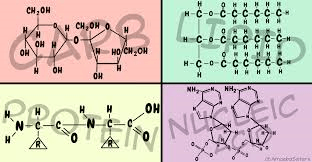
What do we call the building blocks of biomolecules?
elements
monomer
function
crumbling
What is the monomer for carbohydrates?
Monosaccharide
Amino Acid
Glycerol and fatty acid
Nucleotide
Which macromolecule is responsible for Quick energy?
Carbohydrate
Lipid
Protein
Nucleic acid
Which biomolecule would starch and glucose be considered?
Carbohydrates
Lipids
Proteins
Nucleic acids
Which biomolecule would DNA be considered?
Carbohydrates
Lipids
Proteins
Nucleic acids
Which type of macromolecule has the monomer nucleotide?
Carbohydrate
Lipid
Protein
Nucleic Acid
Which is used to make muscle and hair?
Carbohydrate
Lipid
Protein
Nucleic Acid
Which biomolecule is made from glycerol and fatty acid?
Carbohydrate
Lipid
Protein
Nucleic Acid
Which biomolecule stores genetic information?
Carbohydrate
Lipid
Protein
Nucleic Acid
Which biomolecule is used to make cell membranes?
Carbohydrate
Lipid
Protein
Nucleic Acid

What type of biomolecule is seen in this picture?
Carbohydrate
Lipid
Protein
Nucleic Acid

