wayground logo

Free Printable Worksheets

NEW

Font size

S
M
L
XL
Worksheets

Biology Unit 8 Evolution and Classification Review

Total questions: 60

Worksheet time: 1hrs 23mins

Name
Class
Date
1.
Who was the naturalist that traveled the world to study plants and animals?
a)
Albert Einstein
b)
Charles Darwin
c)
Charles Barkley
d)
Isaac Newton
2.
Which term refers to the process by which individuals that are better suited to the environment survive and reproduce therefore passing down their genes to their offspring? 
a)
Evolution 
b)
Variation 
c)
Adaptation
d)
Natural Selection 
3.
When an organism completely dies out, it is called.....
a)
Adaption
b)
Extinction
c)
Fossilization
d)
Mutation
4.
Genetic differences between organisms of the same species
a)
Variation
b)
Adaptation
c)
Behavior
d)
Environment
5.
The struggle for existence against other members of an organisms species is
a)
Competition
b)
Natural Selection
c)
gene flow
d)
genetic drift
6.
A well-tested concept that explains a wide range of observations is called a(an):
a)
hypothesis
b)
experiment
c)
cause and effect
d)
scientific theory
7.
What is an organism that has similar characteristics and can reproduce?
a)
species
b)
organism
c)
embryology
d)
vestigial 
8.
What conclusion can be drawn from the diagram to the right about Troodontidae and Oviraptorosauria? 
a)
They all share the common ancestor Archaeopteryx.
b)
They all share the common ancestor Dromaeosauridae.
c)
They have all of the same traits in common with Archaeopteryx.
d)
There were no evolutionary changes between these two species.
9.
The diagram shows the beaks of four Finches that developed over time from one parent species. Explain why the beak shape of each species of Finch developed differently. 
a)
They adapted to look better, so they could reproduce and pass on traits.
b)
Their beaks adapted to help them hide from predators.
c)
They adapted to better eat the different foods available to them in the region they live in.
d)
They adapted so they could smell better.
10.
Which information would best help scientists verify the relationships among the organisms shown above?
a)
The organisms' DNA.
b)
The organisms' population sizes.
c)
The organisms' migratory patterns.
d)
The organisms' nutritional requirements.
11.
Individuals that are well adapted to their environment will survive and produce:
a)
Fewer mutations
b)
Stronger genes
c)
More offspring
d)
Better traits
12.
You look at two species and see very similar DNA. What does this likely tell you?
a)
These are the same animal.
b)
These animals have a common ancestor.
c)
These animals are not likely related.
d)
These animals are likely becoming one species.
13.
According to the theory of natural selection, some individuals more likely than others to survive and reproduce because they:
a)
pass on to their offspring their newly acquired traits.
b)
are better adapted to their environment than others and will pass on those adaptations to future offspring.
c)
do not pass on newly acquired traits.
d)
produce fewer offspring than others in the same environment.
14.
A population of peppered moths with a dark grey variation and a light grey variation lives in light colored birch forest. It is hunted by sight. Which statement is most likely true?
a)
there are equal number of light and dark grey peppered moths in the population
b)
more light grey moths survive than dark grey moths
c)
more dark grey moths survive than light grey moths
d)
all peppered moths will be eaten before they can reproduce
15.
Natural selection and evolution work on what level of life organization?
a)
individuals
b)
biomes
c)
populations
d)
ecosystems
16.
Organisms with traits that are favorable to their survival and reproduction are ________ likely to pass on their genes to the next generation, and thus ________ common in the population
a)
more, less
b)
more, more
c)
less, less
d)
less, more
17.
Comparing two individuals of a species, evolutionary “fitness” would be best measured by which of the following?
a)
the length and width of the individuals
b)
the number of offspring
c)
the mass of the food eaten in its life
d)
the mass of the individuals
18.

Who would have stated "acquired traits" such as a giraffe needing a long neck so they stretch it over time

a)

Darwin

b)

Lamarck

19.
Lamarck’s ideas about evolution include the concept that differences among the traits of organisms arise as a result of
a)
continual increases in population size.
b)
the actions of organisms as they use or fail to use body structures.
c)
an unchanging local environment.
d)
the natural variations already present within the population of organisms.
20.
Wisdom teeth in humans would be an example of what? 
a)
Homologous Structures
b)
Mandatory Structures
c)
Ancestry Structures
d)
Vestigial Structures
21.
Looking at the similarities in development between different organisms would be an example of which piece of evidence?
a)
Palentology
b)
Embryology
c)
Cytology
d)
Structure Analysis
22.
When analyzing fossils, where would the oldest fossils be found?
a)
Closest to the surface
b)
The lowest level 
c)
In the middle
23.
Charles Darwin’s observation that finches of different species on the Galápagos Islands have many similar physical characteristics supports the hypothesis that these finches 
 
a)
have the ability to interbreed.
b)
acquired traits through use and disuse.
c)
all eat the same type of food.
d)
descended from a common ancestor.
24.

Mutations are important because they bring about

a)

death of the organism in which they develop

b)

genetic variation needed for a population to evolve

c)

benefits for the individual, not for the population

d)

changes in genotype, but not phenotype

25.

Why is competition important for natural selection?

a)

It shows which variations are more successful, allowing the organisms with those variations to survive.

b)

It causes organisms, regardless of which traits they have, to die out, reducing the population size.

c)

It causes organisms to get stronger due to having to outcompete other species.

d)

Competition is not important for natural selection.

26.
Bird wings and butterfly wings are an example of
a)
Homologous structure
b)
Analogous structure
c)
Mimicry
d)
Camoflague
27.

Evolved from the same ancestor, but have different functions

a)

Homologous structures

b)

Analogous structures

c)

Vestigial structures

d)

All of the above

28.

Evolved from different ancestors, but due to living in similar environments have a similar function.

a)

Homologous structures

b)

Analogous structures

c)

Vestigial structures

d)

All of the above

29.
Humans, birds, whales, and lizards all have similar arm bones. What is the reason for this?
a)
The function of these bones is the same in all animals
b)
They live in similar environments
c)
They have a common ancestor
d)
All organisms resemble humans
30.

An anatomical feature that no longer seams to have a purpose in the current form of an organism

a)

Homologous structure

b)

Analogous structure

c)

Vestigial structure

d)

None of the above

31.

Whales have pelvic bones. What type of structure does this best represent?

a)

Homologous structure

b)

Analogous structure

c)

Vestigial structure

d)

None of the above

32.
A flash flood carried a raft of Amazon ants away from their original population. There is enough distance between the two groups, that they will never meet in nature again. What type of reproductive barrier is this?
a)
behavioral isolation
b)
temporal isolation 
c)
gametic isolation
d)
geographic isolation 
33.
The term for the formation of new and distinct species over the course of evolution is...
a)
speciation
b)
biological species concept
c)
reproductive barrier
d)
natural selection
34.
What is a species? 
a)
A group of organisms that can mate with each other and produce fertile offspring. 
b)
A group of organisms that can mate and produce offspring even if those offspring are infertile.
c)
A group of organisms that genetically are very different from each other. 
d)
Indivual organisms that live in the same environment. 
35.

Who created a two-name classification system based on similarities between organisms?

a)

Linnaeus

b)

Buffon

c)

Charles Darwin

d)

Lamarck

36.
Scientific theories are based on
a)
general assumptions of how systems work.
b)
mathematical principles that can be proven true.
c)
large amounts of data collected over time.
d)
observations from within only one scientific discipline.
37.
A possible explanation to a problem that has not yet been tested. 
a)
data
b)
theory
c)
hypothesis
d)
fact
38.
Which kingdoms are prokaryotic?
a)
Archaebacteria and Animalia
b)
Eubacteria and Archaebacteria
c)
Fungi and Protista
d)
Plantae and Eubacteria
39.
In which kingdom do I belong if I am unicellular, autotrophic, and eukaryotic?
a)
Archaebacteria
b)
Protista
c)
Animalia
d)
Plantae
40.
All of the following have a nucleus except...
a)
bacteria
b)
animals
c)
plants
d)
protists
41.
Which kingdom contains multicellular, heterotrophic organisms whose cells have NO cell walls?
a)
Protista
b)
Fungi
c)
Plantae
d)
Animalia
42.
When DNA is contained in a nucleus, the cell is...
a)
eukaryotic
b)
prokaryotic
c)
unicellular
d)
multicellular
43.
Animals must eat other organisms for food, so they are classified as...
a)
heterotrophs
b)
autotrophs
c)
eukaryotic
d)
prokaryotic
44.
This organism is best classified as...
a)
prokaryotic, unicellular, and heterotrophic
b)
eukaryotic, unicellular, heterotrophic
c)
eukaryotic, unicellular, autotrophic
d)
prokaryotic, unicellular, autotrophic
45.
These organisms are best classified as...
a)
eukaryotic, multicellular, and heterotrophic
b)
eukaryotic, multicellular, and autotrophic
c)
eukaryotic, unicellular, and heterotrophic
d)
prokaryotic, multicellular, and heterotrophic
46.

Which is the correct order?

a)

Kingdom Phylum Order Class

b)

Class Order Family Genus

c)

Domain Phylum Kingdom Species

d)

Order Family Species Genus

47.
The scientific name for an organism includes which taxa?
a)
class and family 
b)
genus and species 
c)
domain and kingdom 
d)
kingdom and phylum 
48.
The 8 levels of classification, from most broad to most specific are ...
a)
Domain, Genus, Family, Order, Class, Phylum, Kingdom, Species
b)
Domain, Species, Kingdom, Genus, Phylum, Family, Class, Order
c)
Domain, Kingdom, Phylum, Class, Order, Family, Genus, Species
d)
Order, Kingdom, Species, Domain, Phylum, Family, Class, Genus
49.
What is the most primitive organism shown on the cladogram?
a)
chimp
b)
perch
c)
hagfish
d)
salamander
50.
Which organisms pictured on the cladogram have hair?
a)
prosimians only
b)
prosimians and humans
c)
humans only
d)
prosimians and birds
51.
Which group(s) of organisms do not have vertebrae?
a)
lampreys and lancelets
b)
lampreys and tuna
c)
lancelets only
d)
salamanders, tuna, and lampreys
52.
Organisms in this smallest taxonomic group share many characteristics.
a)
domain
b)
kingdom
c)
species
d)
class
53.
Which scientific name is written correctly?
a)

Okapia Johnstoni

b)

Carcharodon carcharias

c)

balaenoptera Musculus

d)

panthera leo

54.
According to this cladogram, birds are LEAST related to -
a)
Amphibians
b)
Sharks
c)
Ray Finned Fish
d)
Crocodiles
55.
Which trait do only humans have, according to the cladogram?
a)
jaws
b)
mammary glands & hair
c)
terrestrial during all life stages
d)
opposable thumbs
56.
According to the cladogram, which organism is most distantly related to the human?
a)
crayfish
b)
rat
c)
perch
d)
frog
57.
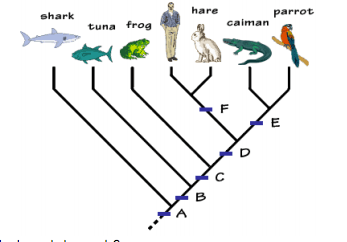
On the cladogram, which organism is the closest relative of the human?
a)
Frog
b)
Hare
c)
Caiman
d)
Parrot
58.
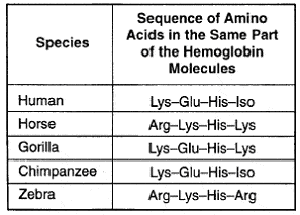
You look at two species and see very similar amino acid sequences. What does this likely tell you?
a)
These are the same animal.
b)
These animals have a common ancestor.
c)
These animals are not likely related.
d)
These animals are likely becoming one species.
59.

According to Oparin & Haldane, all of the following were thought to compose early earth's atmosphere, except.....

a)

ammonia

b)

hydrogen gas

c)

hydrocarbons

d)

oxygen

e)

water vapor

60.

Approximately how many years ago did Earth form?

a)

460 years

b)

460,000 years

c)

4.6 million years ago

d)

4.6 billion years ago