
Font size
 Worksheets
Science EOG Practice Questions
Total questions: 89
Worksheet time: 1hrs 27mins
What is the term for a feature that allows an organism to survive better in its environment?
variation
adaptation
homologous structure
vestigial structure
Which of the following correctly depicts homologous structures? Choose all that apply.
Similar structure, different function
Different structure, similar function


Which of the following are abiotic factors in an ecosystem?
water, oxygen and carbon dioxide, soil, temperature, sun
sun, plants, animals, air and temperature
temperature, dogs, cats, air and sun
sun, temperature, trees, fungus

How many producers are in this food web?
3
4
2
1


Eutrophication is
an increase in the growth of algae due to buildup of nutrients in a lake or pond.
when spores are released in the air and reproduction may begin.
a decrease in the growth of algae due to a buildup of nutrients in a lake or pond.

Ice core
A long cylinder of ice obtained from drilling through ice caps used to study past climates and atmospheres
broken ice chips that are best used to cool grape soda
atoms that don't move and remain electrons when exposed to nuclear physical changes
a lot of reading. Did you read this one too? Good, cause the answer is all about climates and atmosphere
What is the term for a feature that allows an organism to survive better in its environment?
variation
adaptation
homologous structure
vestigial structure

states that younger rock is found above older rock when comparing undisturbed sedimentary rock layers
law of superposition
trace fossil
matter can't be created or destroyed
atoms

A technique used to determine the actual age of a fossil
relative dating
absolute dating or radioactive dating
rock layers
index fossils


Which of the following correctly lists the layers in order from oldest to youngest?
A, B, C, D, E
E, B, C, D, A
E, D, C, B, A
C, B, A, D, E

The diagram below represents the evolutionary history of the horse. Which best accounts for the changes in the horse?
Through artificial selection, larger horses survived and were chosen to reproduce
Through artificial selection, smaller horses were bred out of the gene pool, leaving only larger horses
Through natural selection, favorable adaptions were passed to offspring, allowing for the evolution of the horse
Through natural selection, horses acquired traits that produced changes and then were passed on to their offspring
What best describes mutualism?
Ticks live and feed on dogs and other animals’ blood to survive.
Mushrooms send out long, underground structures which allow them to grow in other areas.
Ants attack animals that try to feed on the acacia tree, and the ants feed on the nectar of the tree.
Which description relates to an abiotic ecosystem factor?
New organisms in the environment rely on favorable weather conditions for survival.
Plants growing in the environment provide a source of shelter for other organisms.
Animals in the environment feed on algae and rich organic material found in the water bed.
A large number of flu cases have developed quickly in North carolina. Health care professionals urge the population of North carolina to receive a flu vaccine. Which explains what they are trying to achieve?
They were trying to prevent the spread of a bacterial pandemic.
They were trying to prevent the spread of a bacterial epidemic.
They were trying to prevent the spread of a viral pandemic.
They were trying to prevent the spread of a viral epidemic.
Which best describes the amount of Earth's total water supply that is usable freshwater?
less than 1%
less than 25%
greater than 50%
greater than 75%
Which is the best example of a pure substance?
peanuts
gold
Which best explains how periods on the periodic table are organized?
increasing atomic number from left to right
increasing number of neutrons from left to right
Which best explains why the total mass of the products would be less than the total weight of the reactants after a chemical reaction?
Gases were released into the atmosphere.
Precipitates were created in the new solution.

Which pair of elements has the most similar properties?
Al and F
N and P
If a chemical reaction such as photosynthesis begins with 6 atoms of Carbon (C), how many atoms of Carbon (C) should be in the products?
12 atoms of Carbon (C)
6 atoms of Carbon (C)
Which shows one example of a physical change and one example of a chemical change?
boiling water and shredding paper
freezing water and burning coal
A science teacher mixes calcium chloride and vinegar in a test tube. He passes the test tube around for his students to feel. The students notice that the test tube is hot. The science teacher asks the students to decide if the mixing of the two chemicals involved a physical or chemical change. He also asks the students to justify their answer. Which student gave the correct response?
Student 1: The change was physical because a temperature change occurred.
Student 2. The change was chemical because a temperature change occurred.
Student 3: The change was physical because the two chemicals mixed.
Student 4: The change was chemical because the two chemicals mixed.
How would excessive increases in nitrate and phosphorus concentration affect freshwater systems?
It would cause excessive algal blooms.
It would cause increased dissolved oxygen.
It would cause increased water clarity.
It would cause extremely cold water.
Is a microbe that needs a person or animal to survive. It contains genetic material. Sometimes theses cannot be killed. It causes diseases like flu, common cold, herpes, rabies and ebola.
Bacteria
Virus
Parasite
Fungi
Is a single celled microbe that causes diseases such as strep throat, meningitis, TB, cholera and staph infection. Can multiple quickly in the body. There are good and bad types of these in the body.
Bacteria
Virus
Parasite
Fungi
If Hunter has a bacterial infection such as strep throat, can he take an antibiotic to get rid of it?
Yes because antibiotics only kill bacteria
Yes because antibiotics can kill any microbe
No because antibiotics only kill viruses
No because antibiotics are bad for you
Dead or weakened versions of a disease that our bodies can easily fight off that can give us immunity from the disease is called a
Shot
doctor
vaccine
drug
Which statement BEST describes the two events?
Which of the following provides the most energy in the quickest amount of time
an apple
a piece of bread
water
chicken

They give us fuel and energy. They are in pasta, bread and cereal.
carbohydrates
protein
fats
fibre
Which organism go through cellular respiration?
animals
plants
both animals and plants
none
Why did scientists edit the genes of bacteria to produce insulin?
Because the bacteria were diabetic
Because bacteria have simple DNA that is easier to manipulate, making it easy to produce insulin in a lab
Because bacteria's complex DNA was perfect for insulin production
Because insulin has no use outside of a lab setting
Which of the following is the process of using technology to create or modify living things?
Biotechnology
Replication
Transcription
Translation
How are clones different from similar organisms produced through natural selection?
They are selectively bred organisms.
They are biologically similar organism.
They are not living individuals.
They are genetically identical.
3) How can agricultural biotechnology have a positive impact on the environment?
By developing crops that are pest resistant requiring fewer pesticides to be used.
planting crops in shaded areas.
Harvesting crops that have thick stems and leaves.
water crops with a recycled irrigation system.
4) How can using genetically engineered crops impact North Carolina’s economy?
Improve quality of farm equipment.
Decreased availability of productive land.
Decreased food production and more debt for farmers.
Increased food production and income for the farmers.
6) What type of job would a person who studied biotechnology in college be likely to have?
A job making medicines
A job studying stars.
A job studying the physical features on Earth.
12) What would be a negative side of genetically modified foods?
Lower cost of production.
Long-term health effects, such as possible allergies to proteins not found in foods before GMO’s.
Ability to produce more food in less time.
Ability to grow more nutritious food in less time.
17) Rice does not provide enough of certain vitamins. How could biotechnology be used to change this?
Using a high nitrogen fertilzer.
Using herbicide to get rid of weeds.
Genetic modification of rice plants that are pest resistant and to produce vitamins they cannot make without biotechnology
Using pesticide to get rid of pests that can harm the crop.
Which use of biotechnology most benefits North Carolina agriculture?
producing human vaccines
producing disease resistant crops
producing new medicines from bacteria
producing enzymes to eliminate pollutants

They give us energy. They are in butter, oil and cheese.
protein
fats
fibre
carbohydrates
If you look at a Heterogeneous Mixture it will look:
The same every where
Uniform in appearance
Different through out
Red in color
Which is an example of a pure substane
Milk
Chicken Noodle Soup
Sugar
Bronze
Elements combine to make?
Atoms
Mixtures
Compounds
Substances
2H2 + O2 --> 2H2O
2H2 + O2 --> 2H2O
Al + O2 --> 2Al2O3
a unique number for each element that equals the number of protons in an atom of that element
element name
element symbol
atomic number
atomic mass
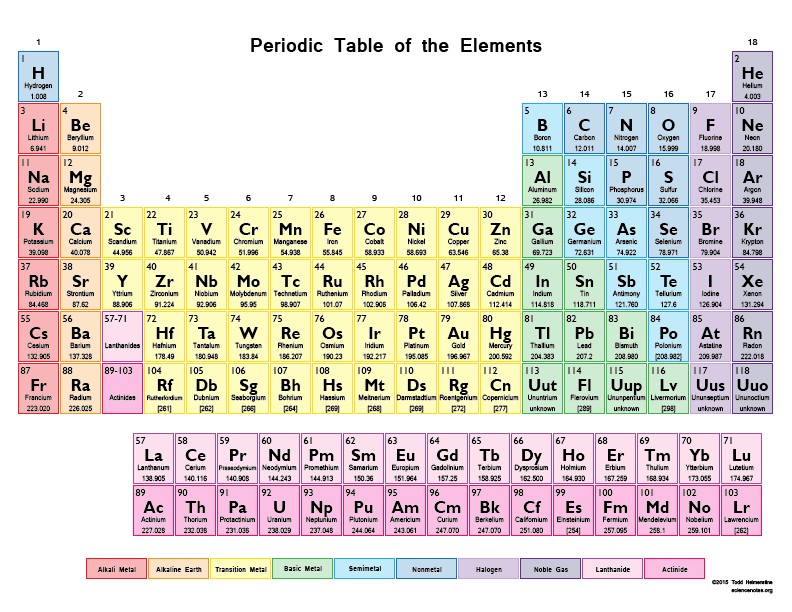
How many protons are in a sodium atom, Na? (tap to enlarge the periodic table)
Sodium has 1 proton.
Sodium has 3 protons.
Sodium has 11 protons
An element has the mass number 12 and atomic number 6. The number of neutrons in it is:
6
10
4
8

