Wayground logo

Free Printable Worksheets

Font size

S
M
L
XL
Worksheets

Throwback Thursday 3/31 - Ohio 8th Science State Test Review

Total questions: 73

Worksheet time: 1hrs 27mins

Name
Class
Date
1.
Is this a balanced or unbalance force?
a)
Balanced
b)
Unbalanced
c)
Neither one
d)
Both
2.
Calculate the net force of the object.
a)
10N
b)
2N
c)
15N
d)
5N
3.
What is the net force of this object?
a)
0N
b)
50N
c)
25N
d)
5N
4.

Students are playing tug-of-war. If group B pulls the rope to the right with a force of 400 N and group A pulls the rope to the left with a force of 250 N, what will happen to the ribbon in the middle of the rope?

a)

The ribbon will move to the left and group A will win the tug-of-war.

b)

The ribbon will move to the right and group B will win the tug-of-war.

5.
The forces represented by the arrows in the diagrams are applied to the four objects that are at rest on a table. Which object is most likely to move to the right?
a)
Object W
b)
Object X
c)
Object Y
d)
Object Z
6.
The forces represented by the arrows in the diagrams are applied to the four objects that are at rest on a table. Which object is most likely to remain in place?
a)
Object W
b)
Object X
c)
Object Y
d)
Object Z
7.
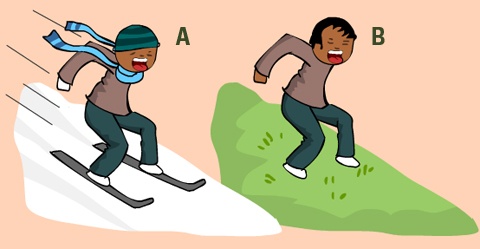
Why is it harder for the boy in Image B to get down the hill?
a)
Motion
b)
Friction
c)
Work
d)
Displacement
8.

What information do you need to accurately describe motion?

a)

speed and direction

b)

speed only

c)

speed, direction, and a reference point

9.

Why does the test dummy go flying after the car hits the object?

a)

mass

b)

reference point

c)

inertia

10.

Is the driver of the car moving?

a)

yes

b)

no

c)

it depends on the reference point

d)

it depends on the car's speed

11.

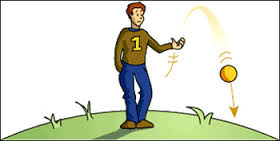
What force causes the ball to fall down?
a)
Weight
b)
Mass 
c)
Gravity
d)
Viscosity
12.

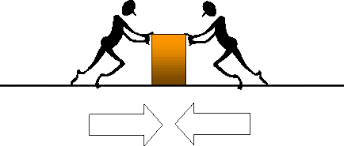
What will the box do?

a)

move to the right

b)

start moving

c)

stop moving

d)

stay still

13.
Which statement describes a vector?
a)
It has magnitude but no direction
b)
It has direction but no magnitude
c)
It has both direction and magnitude
d)
It has constant magnitude but no
 direction
14.

Which two of these forces act on parachutes?

a)

Air Resistance

b)

Gravity

c)

Thrust

d)

Kinetic Energy

15.

Which has more air resistance?

a)
b)
16.
What is the correct order (starting from the surface) of Earth's layers?
a)
crust, mantle, inner core, outer core
b)
mantle, outer core, inner core, crust
c)
inner core, outer core, mantle, crust
d)
crust, mantle, outer core, inner core
17.
Which layer of the earth is a pure liquid?
a)
crust
b)
mantle
c)
outer core
d)
inner core
18.
How does temperature change as you move from the crust to the core?
a)
it gets cooler
b)
it gets hotter
c)
it stays the same
d)
the core is frozen
19.
What layer is shown by letter A?
a)
Crust
b)
Mantle
c)
Outer core
d)
Inner core
20.
What layer is shown by letter B?
a)
Crust
b)
Mantle
c)
Outer core
d)
Inner core
21.
What layer is shown by letter C?
a)
Crust
b)
Mantle
c)
Outer core
d)
Inner core
22.
What layer is shown by letter D?
a)
Crust
b)
Mantle
c)
Outer core
d)
Inner core
23.

Which layer is the densest?

a)

Z

b)

X

c)

W

d)

V

24.
Which layer of the earth is the coolest?
a)
crust
b)
mantle
c)
outer core
d)
inner core
25.
Which box has a higher density?  
a)
Box A
b)
Box B
c)
cannot be determined
d)
they are the same
26.
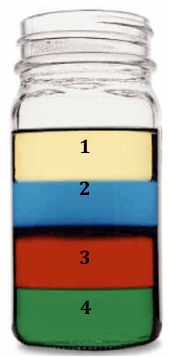
Put the liquids in order from most dense to least dense?
a)
4, 3, 2, 1
b)
1, 2, 3, 4
c)
3, 4, 2, 1, 
d)
4, 3, 1, 2
27.

In convection, WARMER magma ______.

a)

rises

b)

sinks

28.

In convection, COOLER magma ______.

a)

rises

b)

sinks

29.

Which layer is the hottest layer of Earth?

a)

crust

b)

mantle

c)

outer core

d)

inner core

30.

At which number is the magma getting heated?

a)

1

b)

2

c)

3

d)

4

31.

In our lab, why did the cold, blue water sink?

a)

less dense

b)

more dense

c)

stayed the same density

32.

This is an image of the moon. Why does it look so much like the inside of the Earth?

a)

It was another planet at one point.

b)

The materials all mixed together.

c)

Planets form layers based on the density of the material.

33.

Which layer would you predict is the densest layer of Jupiter?

a)

clouds

b)

gaseous hydrogen

c)

metallic hydrogen

d)

core

34.
What are the puzzle pieces of the Earth's surface called?
a)
Tectonic plates
b)
Puzzles
c)
Earthquakes
35.

Which of these crusts is the densest?

a)

oceanic crust

b)

continental crust

c)

both the same

36.

What drives plate movement?

a)

the subducton of the sea floor

b)

the different densities of the oceanic and crustal plates

c)

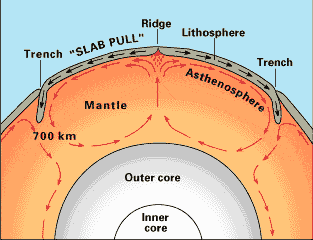
convection currents in the asthenosphere

d)

the friction force between the plates that move past each other

37.
The area around the Pacific Ocean where lots of earthquakes and volcanoes happen is called the ____________.
a)
Ring of Earth
b)
Ring of Fire
c)
Ring of Stone
d)
Ring of Diamond
38.

What are tectonic plates made from?

a)

crust

b)

mantle

c)

lithosphere

d)

asthenosphere

39.

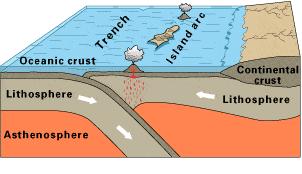
What type of boundary is shown in the diagram?

a)

Divergent

b)

Convergent

c)

Slide/Transform

40.

What type of boundary is shown in the diagram?

a)

Divergent

b)

Convergent

c)

Slide/Transform

41.

What type of boundary is shown in the diagram?

a)

Divergent

b)

Convergent

c)

Transform

42.

The process by which the ocean floor sinks beneath a deep-ocean trench and back into the mantle is known as _______

a)

convection.

b)

continental drift.

c)

subduction.

d)

conduction.

43.

Scientists think that convection currents flow in Earth’s

a)

continents.

b)

mantle.

c)

lithosphere.

d)

inner core.

44.
Hot matter is _________ dense and ___________
a)
less, sinks
b)
less, rises
c)
more, sinks
d)
more, rises
45.

Observe this diagram of a plate boundary. One statement BEST describes what is happening. It is that

a)

the oceanic crust is melting.

b)

the denser ceanic crust is subducting under the less dense oceanic crust

c)

volcanic islands are forming.

d)

the tectonic plates are moving away from each other.

46.
Trenches, deep underwater canyons on the sea floor are created at this type of boundary 
a)
Divergent
b)
Convergent, Subduction Zone
c)
Transform 
47.
New crust is created at this type of  boundary.
a)
Divergent
b)
Convergent, Subduction Zone
c)
Transform 
48.
Mountains are created at this type of  boundary.
a)
Divergent 
b)
Convergent
c)
Transform 
49.
The movement of weathered material on the Earth's surface by wind, water, and ice is
a)
erosion
b)
deposition
c)
landslides
50.
The breakdown of rock into smaller particles from the effects of wind, water and ice is
a)
deposition
b)
delta
c)
weathering
51.
The buildup of land by depositing sediment and soil in a new location is
a)
earthquake
b)
weather
c)
deposition
52.
A triangle-shaped (deposit) landform at the mouth of a river as it empties into a body of water is
a)
weather
b)
delta
c)
landform
53.
A delta forms when the river meets the ocean because 
a)
the river is colder than the ocean
b)
the river slows down and drops sediments
c)
the earth builds up pressure in the river
54.
What natural force formed the Grand Canyon millions of years ago?
a)
a landslide
b)
an earthquake
c)
a river
55.
What is the primary cause of slow change like a canyon forming?
a)
erosion from wind.
b)
erosion from water.
c)
deposition from wind.
d)
deposition from water.
56.

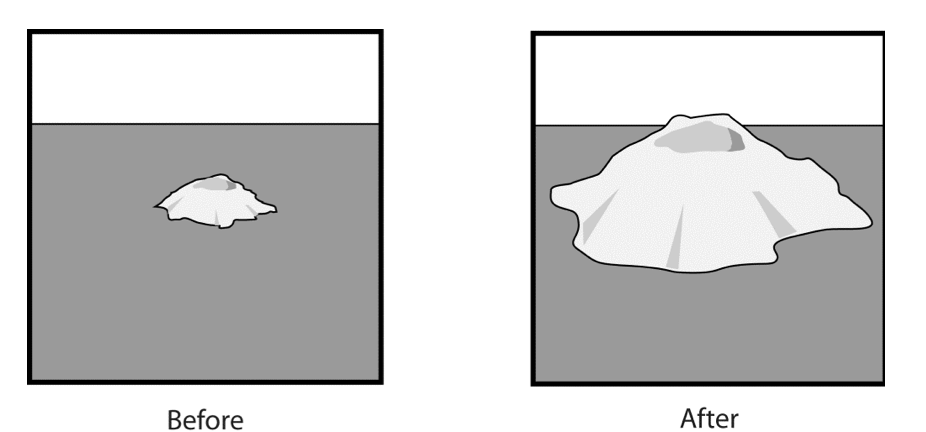
The picture shows an island in the middle of the ocean that increased in size in only a few weeks.

Which of the following most likely caused this rapid change in the island?

a)

Earthquake shaking the water

b)

Movement of waves

c)

Eruptions of a volcano

d)

Piling up of sand

57.
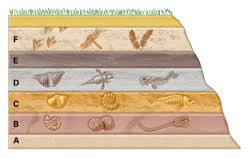
Which rock layer contains the newest fossils?
a)
F
b)
E
c)
B
d)
C
58.
The Law of Superposition helps scientists to determine what?
a)
The absolute age of rock layers
b)
The age of fossils
c)
The relative age of rock layers
d)
the super powers of rocks
59.
According to the law of superposition, which layer is the youngest?
a)
A
b)
B
c)
C
60.

How old do Paleontologists believe the Earth is?

a)

2020 years old

b)

3.6 billion years old

c)

4.6 billion years old

d)

4.6 million years old

61.
Which of the following rock layers is relatively the oldest?
a)
H
b)
P
c)
L
d)
M
62.
Which fossil is relatively the oldest?
a)
Trilobite
b)
Ammonite
c)
Crinoid
d)
Gastropod
63.
The number of years that have passed since the rock formed is the rock's
a)
relative age
b)
law of superposition
c)
absolute age
d)
index fossil
64.
The age of a rock compared to the ages of other rocks is the rock's
a)
absolute age
b)
geologic age
c)
sedimentary age
d)
relative age
65.

What percentage of Rubidium-87 will remain after 2 half-lives?

a)

25%

b)

12.5%

c)

6.25%

d)

3.125%

66.

Examine the rock layers below. Label the oldest layers.

a)

Sandstone

b)

Shelly limestone

c)

Shale

67.
Which of the following is NOT an example of natural selection? 
a)
People selectively breeding hamsters.
b)
Insect populations developing resistance to certain pesticides.
c)
Bacteria becoming resistant to antibiotics.
d)
Male birds of certain species developing colorful feathers to attract female mates.
68.
Which term refers to the process by which individuals that are better suited to the environment survive and reproduce therefore passing down their genes to their offspring? 
a)
Evolution 
b)
Variation 
c)
Adaptation
d)
Natural Selection 
69.
When an organism completely dies out, it is called.....
a)
Adaption
b)
Extinction
c)
Fossilization
d)
Mutation
70.

What is the term for a feature that allows an organism to survive better in its environemtn?

a)

variation

b)

adaptation

c)

homologous structure

d)

vestigial structure

71.

Which type of rock are most fossils found?

a)

sedimentary rock

b)

metamorphic rock

c)

igneous rock

d)

fossils

72.

Which scientist visited the Galapagos Islands and came up with the theory of natural selection?

a)

Theodor Schwann

b)

Gregor Mendel

c)

Charles Darwin

d)

Rudolf Virchow

73.

Scientists have collected millions of fossils of different organisms, and have developed a timeline of life on Earth. What do we call this?

a)

Mutation

b)

Natural Selection

c)

The theory of evolution

d)

Fossil Record