wayground logo

Free Printable Worksheets

Font size

S
M
L
XL
Worksheets

Biology Chapter 11 Review

Total questions: 99

Worksheet time: 3hrs 18mins

Name
Class
Date
1.
has more than 2 variations
a)
regulatory genes
b)
multiple alleles
c)
mendelian inheritance
2.
phenotypes that is a blend of the heterozygous gene pair
a)
incomplete dominance
b)
multiple alleles
c)
regulatory genes
3.
regulates the expression of other genes
a)
dominant
b)
multiple alleles
c)
regulatory genes
4.
the genetic code for the gene
a)
phenotype
b)
genotype
c)
homozygous
5.
trait shows only if both parents pass it on
a)
recessive
b)
dominant
c)
codominan
6.
when you have two different genes
a)
heterozygous
b)
dominant
c)
homozygous
7.
when you have two of the same genes
a)
heterozygous
b)
recessive
c)
homozygous
8.
phenotypes that shows both traits
a)
semi-dominant
b)
heterozygous
c)
codominance
9.
rule where genes come in only dominant or recessive
a)
Regulatory Genes
b)
Mendelian Inheritance
c)
Incomplete Dominance
10.
the physical look of a trait
a)
phenotype
b)
genotype
c)
recessive
11.
shows even if only one parent passes on the gene
a)
recessive
b)
regulatory gene
c)
dominant
12.
the following letters are an example of _______  dd
a)
recessive
b)
homozygous recessive
c)
homozygous dominant
d)
dominant
13.
Dd letters are an example of....
a)
heterozygous genes
b)
homozygous genes
c)
dominant genes
d)
recessive genes
14.
DD is an example of
a)
homozygous recessive
b)
dominant
c)
Homozygous dominant
d)
recessive
15.
A homozygous dominant dog with brown fur is crossed with a heterozygous dog with brown fur. What are the percentages of the possible genotypes?
a)
100% BB
b)
75% BB and 25%Bb
c)
50 % BB and 50% Bb
d)
50% Bb and 50% bb
16.
The man who studied genetics and came up with genetics is
a)
Watson
b)
Crick
c)
Mendel
d)
Darwin
17.
What law states that in Tt the person will only show the dominant allele
a)
law of segregation
b)
law of independent assortment
c)
law of dominance
d)
law of punnett squares
18.
Genotype refers to the ...
a)
physical expression of the genes
b)
the possible combination of alleles in a gene
c)
whether an allele is dominant or recessive
d)
how an organism will appear
19.

Squidward has light blue skin, and his genotype for this trait is Bb. Which of the following would describe Squidward?

a)

Purebred

b)

Hybrid

c)

Homozygous

d)

Sex-linked

20.
An offspring will receive how many alleles from each parent to determine a specific trait?
a)
one
b)
two
c)
three
d)
five
21.
Which of the following is a phenotype?
a)
BB
b)
Bb
c)
bb
d)
Blue eyes
22.
What is a phenotype
a)
The genetic make up (code)
b)
The physical trait
23.
the passing of genetic traits from parent to offspring.
a)
heredity
b)
trait
c)
gene
d)
allele
24.
having two of the same genes for the trait (sometimes called purebred).
a)
homozygous
b)
hetrozygous
c)
protein
d)
chromosome
25.
having two different genes for a trait (sometimes called hybrid).
a)
protein
b)
homozygous
c)
heterozygous
d)
genotype
26.
Magda is a tall, 11 year old drummer. She has a scar on her right cheek. She is good at swimming. Which of her traits did Magda most likely inherit?
a)
height
b)
the scar
c)
ability to swim
d)
ability to play drums
27.
Two brown eyed parents (Bb) have a baby. What is the chance the baby is blue eyed?
a)
0 %
b)
25%
c)
50%
d)
75%
28.
G = green, g = yellow
The genotype for a yellow plant is...
a)
GG
b)
Gg
c)
gg
d)
all of the choices result in yellow
29.
An allele whose trait only shows up when no dominant allele is present.
a)
hidden allele
b)
dominant allele
c)
recessive allele
d)
present allele
30.
Two heterozygous (Tt) tall pea plants are crossed. Which describes their offspring?
a)
50% tall and 50% short
b)
75%tall and 25% short
c)
100%short
31.
W=white hair
w= non-white hair
If you cross a horse with WW and a horse with ww what fraction of the offspring would be expected to have white hair?
a)
none
b)
3/4
c)
1/2
d)
all
32.

Who is considered the "father" of modern genetics?

a)

Einstein

b)

Mendel

c)

Disney

d)

Washington

33.
A single cross such as flower color.
a)
mono hybrid
b)
dihybrid
c)
crossing over
d)
homozygous
34.
What type of "square" helps us solve genetic problems?
a)
carpenter square
b)
Mendel square
c)
Punnett square
d)
genetic square
35.
TT,tt,PP,pp,SS,ss are examples of alleles that are?
a)
homozygous
b)
heterozygous
c)
different
d)
homologous 
36.
The exact genetic makeup of an organism, such as RR, Tt, PP is its?
a)
phenotype
b)
dominance
c)
genotype
d)
trait
37.
Y for yellow body is dominant over y for blue body.  What alleles would produce yellow bodies?
a)
YY,yy
b)
Yy,yy
c)
YY only
d)
YY,Yy
38.
"The Great White Shark was 20 feet in length.  Phenotype or Genotype?
a)
phenotype
b)
genotype
39.
Females-XX; MalesXY.  A couple has 4 girls.  What is the chance the next child will be a boy?
a)
75%
b)
100%
c)
25%
d)
50%
40.
If "T" is the allele for tall and "t" is the allele for short, then Tt would produce?
a)
tall
b)
short
c)
medium
d)
not enough info
41.
A physical characteristic that can be passed from parent to offspring.
a)
behavior
b)
trait
c)
strong muscles
d)
ability to fly a plane.
42.

What plant did Mendel study?

a)

pea plant

b)

spinach

c)

carrots

d)

sunflowers

43.

Which of the following alleles is homozygous (purebred) recessive?

a)

TT

b)

Tt

c)

tt

d)

ts

44.

Red (R) is dominant over white (r). How can a flower be white?

a)

It can have RR and be white.

b)

It has to have rr.

c)

It has to have rR

d)

There is no way it can be white until the third generation.

45.

Which of the following is an inheritable genetic trait?

a)

language

b)

type of music you like

c)

eye color

d)

slow growth due to insufficient nutrition.

46.

Alternant or different genes that code for the same trait are called?

a)

chromosomes

b)

segments

c)

alleles.

d)

homozygous.

47.
Dominant or recessive?
tt
a)
Dominant 
b)
Recessive
48.
Dominant or recessive?
Dd
a)
Dominant
b)
recessive
c)
neither
d)
homozygous
49.
Emily has brown hair. Which is most likely a true statement about Emily?
a)
Emily’s favorite color is brown.
b)
Emily has a parent with brown hair.
c)
Emily’s older brother has brown hair. 
50.
What should students use to identify the percent chance of a trait being passed down from a parent to its offspring?
a)
a graph
b)
a flow chart
c)
a data table
d)
a Punnett square
51.
Which statement best supports why many offspring look similar to their parents?
a)
Offspring inherit characteristics from one parent.
b)
Offspring inherit characteristics from both parents.
c)
Parents choose which characteristics to pass on to their offspring.
d)
Parents choose to change their appearance to match that of their offspring.
52.
Bob is a tall, slender young man with red hair and blue eyes. Which couple would most likely be Bob’s parents?
a)
a slender, red-haired father and a tall, blue-eyed mother
b)
a tall green-eyed father with long brown hair and a short, brown-haired mother
c)
a short, green-eyed, black-haired father and a tall, brown haired, brown-eyed mother
d)
a short, plump brown-haired father with freckles and a short, blue-eyed red-haired mother
53.
What are the possible combinations of a pea plant with the alleles PP and a male pea plant with the alleles pp.
P= purple
p= white
a)
all Pp
b)
all PP
c)
Pp,PP,Pp,PP
d)
all pp
54.
When the allele combination is a dominate and a recessive trait together which trait will be seen?
a)
Dominate
b)
Recessive
c)
none
d)
both
55.
Homozygous is when...
a)
the alleles are the same
b)
the alleles are different
c)
the alleles are absent
d)
the alleles are present
56.
B = brown fur  b = white fur
In the punnett square, what is the probability for white fur? 
a)
0%
b)
25%
c)
50%
d)
75%
57.
Aa is
a)
homozygous (purebred)
b)
heterozygous (hybrid)
58.
What is a phenotype?
a)
The expression of a trait; physical appearance.
b)
refers to the genetic makeup of an individual
c)
An organism that has the same genes for a trait (ex. TT or tt)
d)
the passing of traits from parent to offspring
59.
This means Different Gene
a)
Dominant
b)
Recessive
c)
Homozygous
d)
Heterozygous
60.
Homozygous or heterozygous?
BB
a)
Homozygous
b)
Heterozygous
61.
Which of the following is a phenotype?
a)
Aa
b)
red hair
c)
heterozygous
d)
DNA
62.
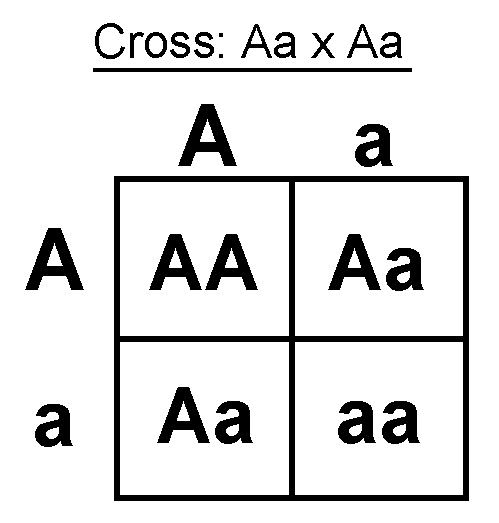
T - tall and t = short
In the punnett square below, what belongs in the missing square
a)
tt
b)
Tt
c)
Bb
d)
TT
63.
What you see, or the physical appearance.
a)
Genotype
b)
Phenotype
c)
Homozygous
d)
Heterozygous
64.
What is the probability of heterozygous offspring?
a)
25%
b)
50%
c)
0%
d)
100%
65.
What allele combination should go in the missing box?
a)
AA
b)
Aa
c)
aa
d)
none of these
66.
Each one of the boxes on the Punnett Square represents what probability of an offsprings' genotype?
a)
25%
b)
1%
c)
10%
d)
0%
67.
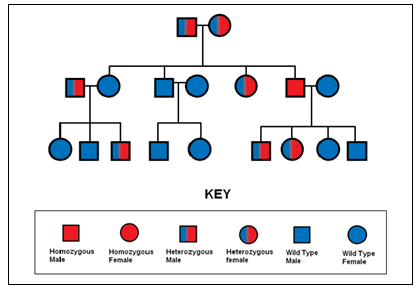
In a pedigree, what shape represents a male?
a)
circle
b)
square
c)
triangle
d)
diamond
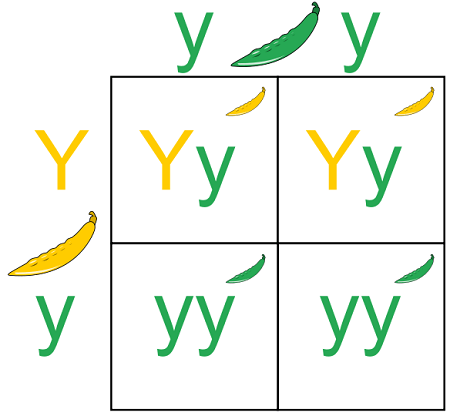
68.
Which choice best represents the genotype of this cross?
a)
1 Yy: 2 yy: 0 YY
b)
2 Yy: 2 yy: 0 YY
c)
3 Yy: 1 yy: 0 YY
d)
1 Yy: 3 yy: 0 YY
69.
What is the phenotype of the offspring? (A-Brown hair; a-blond hair) 
a)
50 % Brown Hair and 50% Blond Hair 
b)
25 % Brown Hair and 75% Blond Hair 
c)
75 % Brown Hair and 25% Blond Hair 
d)
0% Brown Hair and 100% Blond Hair 
70.
Which of the following genotypes is homozygous dominant?
a)
A
b)
Aa
c)
AA
d)
aa
71.
Which of the following genotypes is heterozygous?
a)
Bb
b)
BB
c)
bb
d)
B
72.
Which of the following is homozygous recessive?
a)
Tt
b)
tt
c)
TT
d)
T
73.
The cells produced via meiosis are called:
a)
sex cells
b)
somatic cells
c)
body cells
d)
skin cells
74.
This produces 2 identical cells.
a)
mitosis
b)
meiosis
75.

A human usually has xx amount of chromosomes.

a)

6

b)

23

c)

4

d)

46

e)

92

76.
What phase is  shown in the picture?
a)
anaphase 1
b)
anaphase 2
c)
metaphase 1
d)
telophase 1
77.
Meiosis makes sperm and egg cells. In humans, sperm and egg cells each have _____ chromosomes. Therefore a fertilized human egg cell (sperm and egg cell combined) would create a cell with _____ chromosomes.
a)
23, 46
b)
46, 23
c)
2, 4
d)
50, 100
78.
What causes genetic variation in meiosis?
a)
chromosomes lining up
b)
crossing over of chromosomes
c)
separation of chromosomes
d)
chromosomes pulling apart
79.
Goes through P.M.A.T two rounds 
a)
Mitosis
b)
Meiosis
c)
Osmosis
d)
Transcription
80.
If the Diploid number of Carrots is 18, the haploid number is
a)
18
b)
9
c)
27
d)
36
81.
If a somatic cell in a butterfly contains 24 chromosomes, a butterfly egg would contain
a)
3
b)
6
c)
12
d)
24
82.
When homologous chromosomes match up, they form a structure call a ___________.
a)
tetrad
b)
triad
c)
diploid
d)
gamete
83.
A male shark has 40 chromosomes in each of its sex cells. How many would be present in its body cells?
a)
20
b)
40
c)
80
d)
160
84.
Chromosomes exchange genetic material during 
a)
crossing over
b)
replication
c)
synthesis
d)
translation
85.

Name this phase of Meiosis

a)

Anaphase II

b)

Anaphase I

c)

Metaphase I

d)

Metaphase II

86.

The phase in Meiosis where crossing over occurs:

a)

Metaphase I

b)

Prophase I

c)

Prophase II

d)

Profés

87.

Name this phase of Meiosis:

a)

Telophase I

b)

Prophase II

c)

Telophase II

d)

Anaphase II

88.

The phase in Meiosis in which 2 daughter cells are formed:

a)

Anaphase I

b)

Anaphase II

c)

Telophase I

d)

Metaphase II

89.

Name this phase of Meiosis:

a)

Prophase I

b)

Prophase II

c)

Metaphase I

d)

Metaphase II

90.

The phase of Meiosis in which chromatids separate:

a)

Prophase II

b)

Metaphase II

c)

Telophase II

d)

Anaphase II

91.

Name this phase of Meiosis:

a)

Metaphase I

b)

Anaphase II

c)

Anaphase I

d)

Metaphase II

92.

The phase of Meiosis in which tetrads are formed:

a)

Prophase I

b)

Metaphase I

c)

Anaphase I

d)

Telophase I

93.

Name this phase of Meiosis:

a)

Metaphase I

b)

Anaphase I

c)

Prophase II

d)

Telophase I

94.

The phase of Meiosis in which homologous pairs line up along the equator:

a)

Anaphase I

b)

Metaphase I

c)

Anaphase II

d)

Metaphase II

95.

Name this phase of Meiosis:

a)

Anaphase I

b)

Metaphase I

c)

Telophase I

d)

Prophase I

96.

The phase of Meiosis in which 4 daughter cells are formed:

a)

Telophase I

b)

Prophase II

c)

Anaphase II

d)

Telophase II

97.

Name this phase of Meiosis:

a)

Metaphase I

b)

Prophase II

c)

Telophase I

d)

Anaphase II

98.

The phase of Meiosis in which homologous chromosomes are moved to opposite sides:

a)

Metaphase I

b)

Prophase I

c)

Telophase I

d)

Anaphase I

99.

Name this phase of Meiosis:

a)

Prophase II

b)

Metaphase I

c)

Metaphase II

d)

Anaphase II