
 Worksheets
Timberlake Chemistry Chapter 10 Review Study Deck
Total questions: 112
Worksheet time: 2hrs 3mins

This could be the dot diagram of
Mg
Cl
C
O
What is the goal of the Lewis Dot Structure?
To determine the electron position.
To show the element's valence electrons & bonding capabilities.
To find the atomic mass of an element.
To search for the number of electrons in an individual atom.
How many valence electrons should Lithium have in its Lewis dot model?
1
2
3
4
How many valence electrons should Oxygen have in its Lewis dot model?
5
6
7
8
How many valence electrons should Magnesium have in its Lewis dot model?
1
2
3
4

This is a correct dot diagram for nitrogen (N)
true
false

This is a correct dot diagram for carbon (C)
true
false

This is a correct dot diagram for neon (Ne)
true
false
Which of these is incorrect?


How many electrons should Boron have around its Lewis dot model?
1
2
3
4


(Top picture is A, bottom picture is D.)



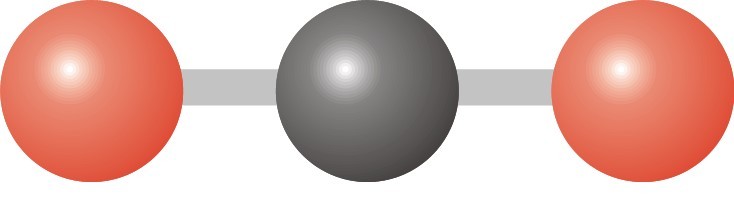
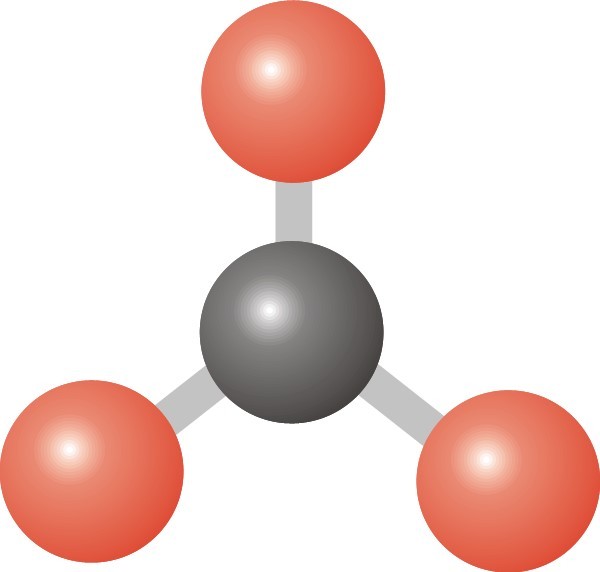
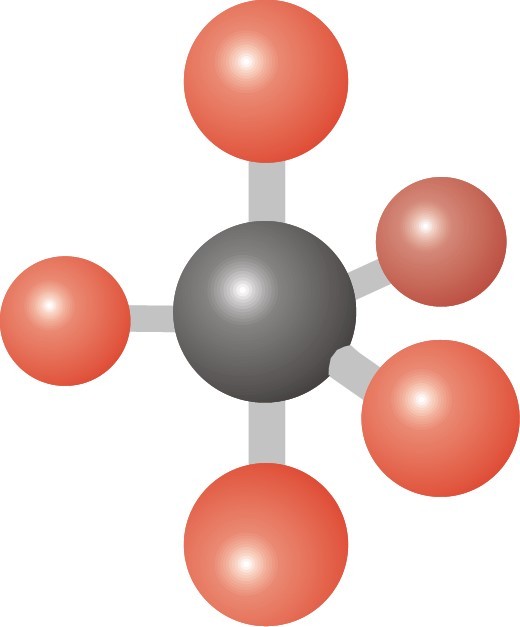
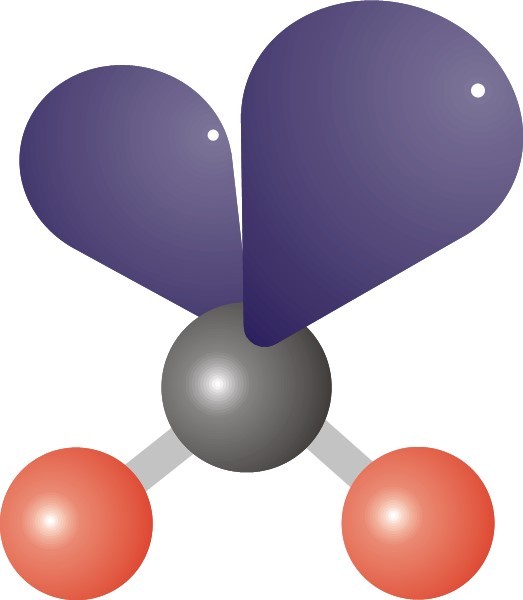
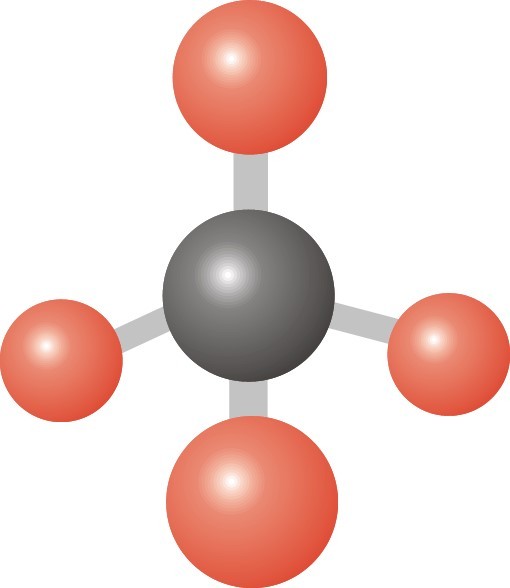
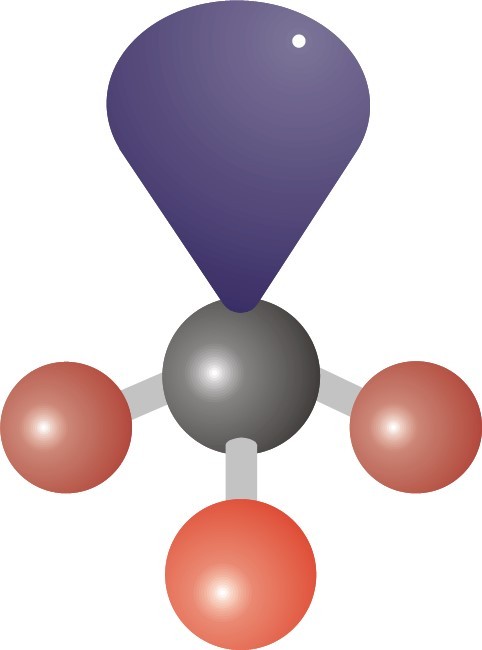
What molecular geometry would PH3 have?
Trigonal Pyramidal
Trigonal Bipyramidal
Bent
Linear


What shape would this have?
Trigonal planar
Pyramidal
Tetrahedral
Bent

The geometry of a molecule with 2 bonded pairs of electrons and 2 lone pairs of electrons, AB2E2
Tetrahedral
Trigonal Planar
Bent
Trigonal Pyramidal
Linear

AB3 is a symbol for molecular shape __________________
Tetrahedral
Linear
Trigonal planar
Trigonal pyramidal
The general formula for TETRAHEDRAL shape is __________
AB2
AB3
AB4
AB
N or C?
H or F?
F, N, B
C, H, and O
Cl or Al?
Se, S, and O
Electronegativity (a) as you go down a group.
What does electronegativity do as you go across a period?
decrease
no pattern
stay the same
increase
As you move across a period, the outer electrons are ________ to the nucleus, so the nucleus of the atom is ________ to attract electrons in a bond.
closer, more able
closer, less able
further, less able
further, more able

The electrons in a POLAR covalent molecule are shared...
Evenly
Unevenly
Electrons are not shared

The electrons in a NONPOLAR covalent molecule are shared...
Evenly
Unevenly
Electrons are not shared

The electrons in an ionic molecule are shared...
Evenly
Unevenly
Electrons are not shared

In a polar covalent bond, the electrons spend more time and localize around the atom...
with the Greatest Electronegativity
with the Lowest Electronegativity
Each atom Equally

In a nonpolar covalent bond, the electrons spend more time and localize around the atom...
with the Greatest Electronegativity
with the Lowest Electronegativity
Each atom Equally

Partial charges are present in which type of bond(s)?
Ionic
Nonpolar Covalent
Polar Covalent
Both Polar Covalent and Ionic
All covalent

Partial charges like the ones shown here are called:
dipoles
deltas
ions
magnetic poles

In this Lewis structure, the symbol above F means...
electrons are being transferred to Fluorine
electrons are less attracted to F than H
electrons are more attracted to F than H
Fluorine has formed an anion
Order the types of bonds based on the charge of their molecules. (lowest amount of charge to greatest)
Polar Covalent --> Ionic --> Nonpolar Covalent
Ionic --> Nonpolar Covalent --> Polar Covalent
Nonpolar Covalent --> Polar Covalent --> Ionic

Look at this covalent molecule as a whole. What type of molecule is it? (Is it symmetrical?)
Polar
Non-polar
Ionic

Look at this covalent molecule as a whole. What type of molecule is it? (Is it symmetrical?)
Polar
Non-polar
Ionic

Look at this covalent molecule as a whole. What type of molecule is it? (Is it symmetrical?)
Polar
Nonpolar
Ionic

Look at this covalent molecule as a whole. What type of molecule is it? (Is it symmetrical?)
Polar
Nonpolar
Ionic

Look at this covalent molecule as a whole. What type of molecule is it? (Is it symmetrical?)
Polar
Nonpolar
Ionic

Will PH3 form a polar or nonpolar bond based on the electronegativity difference ?
polar
nonpolar
ionic
A covalent bond usually forms between:
a metal and a nonmetal
either metals or nonmetals
two metals
two nonmetals

When you have Br-Br, what is the polarity?
Polar
nonpolar
Ionic

When you have Li-O, what is the polarity?
nonpolar
polar
ionic

When you have H-Cl, what is the polarity?
nonpolar
polar
ionic
Thermal energy always moves:
From a high temperature object to a lower temperature object.
From a lower temperature object to a higher temperature object.
From an object with lower kinetic energy to an object with higher kinetic energy.
From an object of higher mass to an object of lower mass.

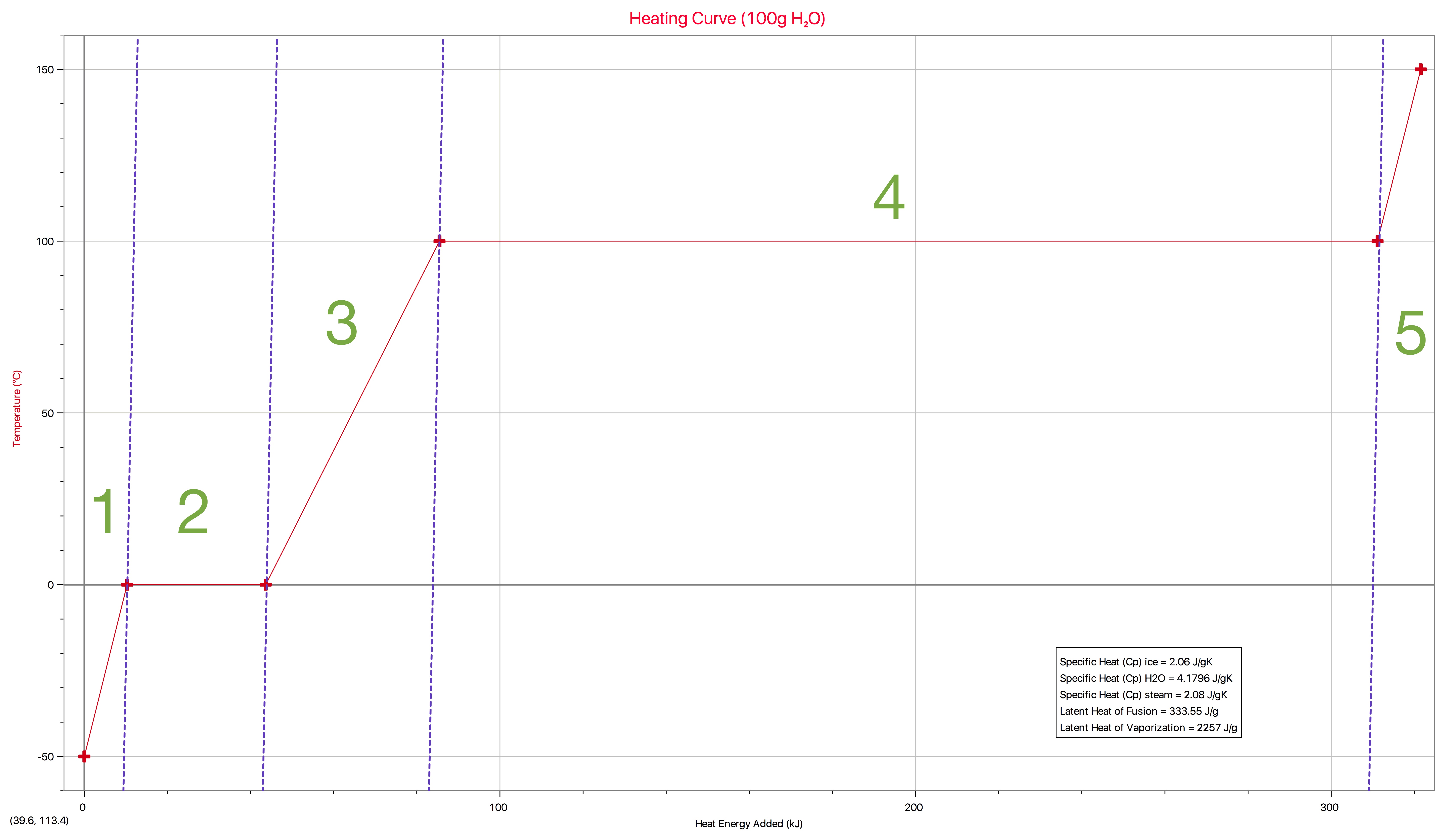
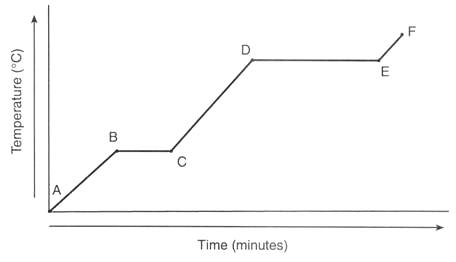
Given the heating curve of a solid being heated at a constant rate, what is the boiling point of this substance?
20°C
50°C
110°C
170°C

The melting point of the sample is
-60 ºC
-100 ºC
60 ºC
100 ºC

NaCl(s) was heated up starting at an initial temperature of 0°C. The heating curve is shown in the picture. What is the melting point of this substance?
0°C
801°C
1000°C
1465°C

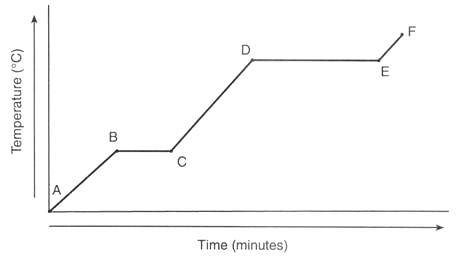
Given the heating curve of water, what is happening to potential and kinetic energy during segment CD?
the potential energy and kinetic energy both increase
the potential energy increases while the kinetic energy decreases
the potential energy is constant while the kinetic energy increases
the potential energy increases while the kinetic energy is constant
A 15.75-g piece of iron absorbs 1086.75 joules of heat energy, and its temperature changes from 25°C to 175°C. Calculate the specific heat capacity of iron.
0.46 J/goC
1.654 J/goC
2,567,446.875 J/goC
How many joules of heat are needed to raise the temperature of 10.0 g of aluminum from 22.0°C to 55.0°C, if the specific heat of aluminum is 0.903 J/g°C?
298 Joules
0.003 Joules
297 J/g°C
0.003 J/g°C
A 300.0 g piece of copper is heated and fashioned into a bracelet. The amount of energy transferred by heat to the copper is 66,300 J. If the specific heat of copper is 0.3845 J/g 0C, what is the change of the copper's temperature?
641 °C
7,650,000 Joules
The specific heat of aluminum is 0.9025 J/g°C. How much heat(Q) is released when a 10.0 g piece of aluminum foil is taken out of the oven and cools from 100.0° to 50.0°?
451 J
45.1 J
400 J
20.0 g of water. specific heat of water is 4.184 J/g°C. temperature changes from 25.0° C to 20.0° C, how much heat energy (Q) moves from the water to the surroundings?
418 Joules
209 J
83 J
4.18 J
∆t= 66
∆t=124
∆t=100
∆t=76
The specific heat(c) of copper is 0.38 J/g °C. What is the temperature change(∆t) when 100.0 Joules of heat(Q) is added to 20.0 grams?
13 °C
13.2°C
13.16 °C


