wayground logo

Free Printable Worksheets

NEW

Font size

S
M
L
XL
Worksheets

KSA Test Preparation IV- Energy, Earth Science, + Plants

Total questions: 69

Worksheet time: 59mins

Name
Class
Date
1.
Solar Energy is transferred to _____ Energy.
a)
Mechanical
b)
Solar
c)
Sound
d)
Electrical
2.
Some students observing a classroom device being used, noticed the below energy transformations. 
Electrical → Mechanical → Sound
Which device were the students most likely observing?
a)
A triple beam balance measuring an object’s mass.
b)
A pencil sharpener plugged into a wall outlet.
c)
A projector displaying a diagram on the screen.
d)
A working flashlight used to light up a dark corner.
3.
Which of these is an example of light energy being transformed into chemical energy?
a)
A glow stick lights up when broken.
b)
Water heated by the sun evaporates.
c)
A plant makes sugar in the sunlight.
d)
A battery causes a buzzer to vibrate.
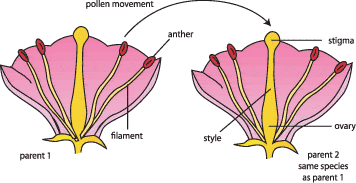
4.
Which kind of energy change occurs when a candle is burning?
a)
Chemical to light.
b)
Light to electrical.
c)
Solar to heat.
d)
Chemical to electrical.
5.
Which type of energy transformation occurs when a flashlight shines?
a)
chemical → thermal → electrical
b)
chemical → electrical → light
c)
thermal → chemical → light
d)
chemical → electrical → chemical
6.
When water falls through a dam and turns a turbine connected to a generator, electricity is produced. This electricity is often used to light our homes and offices. Which of the following shows the energy transformations that occurs?
a)
electrical → light → mechanical
b)
chemical → mechanical → electrical
c)
mechanical → chemical → light
d)
mechanical → electrical → light
7.
The picture shows a microwave oven. As a microwave oven is operated, electrical energy is transformed into all of the following types of energy EXCEPT —
a)
Solar
b)
Light
c)
Thermal
d)
Mechanical
8.
Which of the following systems transforms chemical energy to light energy?
a)
Fan
b)
Lamp
c)
Compass
d)
Burning a candle
9.
The Theory of the Conservation of Energy states -
a)
Energy can be created, just not destroyed. It changes its form from one type to another.
b)
Energy can never be created nor destroyed. It can only change its form from one type to another.
c)
The total energy in our Universe changes, as different forms of energies can be transformed from each other under certain circumstances.
d)
Energy transformations do not passively occur in our lives, rather we actively make use of energies and transform energies.
10.
Energy transformations occur when...
a)
energy is created through conduction
b)
energy changes from one form to another
c)
two forces slide together that are touching
d)
a chemical reaction takes place
11.
_________ is a force that resists the sliding of two surfaces that are touching.
a)
Ficiton
b)
Friction
c)
Function
d)
Fashion 
12.
Hands being rubbed together quickly is an example of...
a)
Chemical energy
b)
the movement of electrons
c)
Friction
d)
Fusion
13.
The form of energy involved in eating a peanut butter and jelly sandwich can be transformed into riding a bike. What types of energy occur in this transformation?
a)
Nuclear - biomechanical
b)
Chemical - mechanical
c)
Potential - kinetic
d)
Electromagnetic - thermal
14.
A material that transfers heat very well is called a _________.
a)
insulator
b)
conductor
c)
radiator
d)
transistor
15.
A material that does not allow heat to transfer well is called a(n) _______.
a)
conductor
b)
blocker
c)
insulator
d)
blanket
16.
Thermal energy is measured in....
a)
Joules
b)
Newtons
c)
Grams
d)
Volts
17.
This is an example of a(n) _____________.
a)
Insulator
b)
Electromagnetic force
c)
Conductor
d)
Insurgent
18.
The spoon in this picture is an example of ______________.
a)
Convection current
b)
Conduction
c)
Currency
d)
Convection
19.
The water in this picture demonstrates an example of _________.
a)
Convection
b)
Conduction
c)
Radiation
d)
Insulation
20.
what type of energy is stored in a battery?
a)
electrical
b)
chemical
c)
thermal
d)
mechanical
21.
Mechanical Energy is transferred to _____ Energy.
a)
Solar
b)
Mechanical
c)
Electrical
d)
Potential
22.
What kind of energy is represented in the picture?
a)
Thermal
b)
Chemical
c)
Sound
d)
Nuclear
23.
The process that moves weathered rocks is called
a)
erosion
b)
gravity
c)
layering 
d)
folding
24.
This picture is a sea arch. As erosion from ocean waves continues, what will most likely happen to the hole in this landform?
a)
It will become larger
b)
It will fill with sediment
c)
it will remain the same size
d)
it will be covered with water
25.
The process that moves weathered rocks is called
a)
erosion
b)
gravity
c)
layering 
d)
folding
26.
When a volcano no longer erupts, the lava inside cools and forms
a)
melted igneous rock
b)
ash 
c)
cinders
d)
solid igneous rock
27.
The Mississippi River deposits soil as it empties into the Gulf of Mexico. This shows an example of 
a)
rocks can dissolve in water
b)
flowing water carries soil from place to place
c)
salt water is denser than fresh water
d)
Earth's land area keeps growing
28.
Changes in the Earth's crust can be slow or fast. Which of these is the BEST example of a slow change?
a)
volcanic erruption
b)
weathering
c)
landslide
d)
earthquake
29.
Mr. Gonza owns a large farm in southwestern Georgia. This year, he plans to leave several fields fallow (without crops). What should Mr. Gonza do to prevent soil erosion on the empty fields?
a)
plant grass to hold the soil
b)
water the empty fields regularly 
c)
fertilize the soil throughout the growing season
d)
plow the soil deeply and regularly
30.
A mountain range is MOST LIKELY formed due to 
a)
erosion of the land around a mountain
b)
deposition from a nearby river that results in soil accumulated over time
c)
they have always existed, but due to their density, they are never changed
d)
tectonic plates shifting during an earthquake
31.
Which describes the landform from which melted rock is forced out of an opening in Earth's surface?
a)
fault
b)
erosion
c)
volcano
d)
folded mountain
32.
The formation of gorge is MOST LIKELY a result of 
a)
Earthquakes because they are constructive 
b)
volcanoes because they are destructive
c)
water erosion because it is both constructive and destructive
d)
plate tectonics because a gorge occurs when the plates shift 
33.
The Sahara Desert in Africa has a landscape of huge sand dunes. This landscape is constantly changing. Which force in nature causes this constant change of the desert landscape?
a)
earthquake
b)
hurricane
c)
lightning strikes 
d)
wind storms
34.
Dams and levees are used to control 
a)
land from sliding into rivers and streams
b)
weather from breaking down the banks of rivers
c)
water preventing it from flooding nearby areas
d)
populations of animals from creeping into rivers and streams
35.
Liquid water changing slowly into a gas and rising into the atmosphere is called
a)
evaporation
b)
condensation
c)
rain
d)
typhoon
36.
Shifting pieces of the Earth's crust are called
a)
tectonic plates
b)
volcano
c)
magma
d)
island
37.
Which is the most abundant gas in the atmosphere?
a)
Oxygen
b)
Nitrogen
c)
Ozone
d)
Carbon Dioxide
38.
Only about how much of available water on Earth is fresh water?
a)
97%
b)
1%
c)
53%
d)
11%
39.
What is the source of energy for the water cycle?
a)
gravity
b)
transpiration
c)
the oceans
d)
the sun
40.

The land feature formed when sediment is deposited at the mouth of a river is called a(n) ____________.

a)

beach

b)

dune

c)

canyon

d)

delta

41.

The Hawaiian Islands were formed as a result of _____________.

a)

deposition

b)

glaciers

c)

hurricanes

d)

volcanic activity

42.

Which of these can rapidly affect Earth’s surface?

a)

earthquakes

b)

annual rainfall

c)

sediment deposits

d)

frozen precipitation

43.

Certain land features form where plates meet. Which land feature forms where two continental plates collide?

a)

glaciers

b)

oceans

c)

mountains

d)

trenches

44.

How does a volcano cause a constructive change to the Earth's surface?

a)

It floods the land.

b)

It adds new land.

c)

It takes land away.

d)

It breaks apart land.

45.

The Grand Canyon was formed as the result of _______________.

a)

erosion

b)

a glacier

c)

a volcano

d)

an earthquake

46.

The breakdown of rock into smaller pieces by natural processes is called _________.

a)

deposition

b)

fossilization

c)

sediment

d)

weathering

47.
The tip of the style that has sticky hairs to trap pollen is the ___.
a)
stamen
b)
stigma
c)
ovary
d)
style
48.
The part of the stamen that produces pollen grains is the ___.
a)
anther
b)
pistil
c)
filament
d)
ovary
49.
The male reproductive structure of a flower is the ___.
a)
pistil
b)
ovary
c)
stamen
d)
ovule
50.
The part of the flower on which the pollen grains land.
a)
anther
b)
stamen
c)
style
d)
stigma
51.
The part of a flower that produces the male reproductive cells.
a)
anther
b)
style
c)
stigma
d)
filament
52.
Pollination can occur between flowers of the same plant. 
a)
True 
b)
False 
53.
What is the function of nectar?
a)
To provide food for the flower
b)
To attract pollinators
c)
To attract animals to disperse the fruits
d)
To produce perfumes for Man
54.
Pollination is the process by which pollen
a)
causes people to sneeze
b)
is formed inside a plant
c)
moves from stamen to stigma
d)
moves from stigma to stamen
55.
Brightly colored parts of flowers that attract insects.
a)
petals
b)
pistils
c)
stamen
d)
filaments
56.
What is the female part of the flower used during reproduction?
a)
Pistil
b)
Petal
c)
Stigma
d)
Stamen
57.

Female part of the flower

a)

Pistil

b)

Stamen

c)

Ovary

d)

Sepals

58.

Produces pollen

a)

Ovule

b)

Stem

c)

Pistil

d)

Anther

59.

Leaflike parts that cover and protect the flower bud

a)

Ovary

b)

Sepals

c)

Style

d)

Pollen

60.

Supports the flower, also serves to transport water and food

a)

Filament

b)

Pistil

c)

Stem

d)

Style

61.

Becomes the fruit

A flower structure that encloses and protects ovules and seeds as they develop.

a)

Petal

b)

Ovule

c)

Stigma

d)

Ovary

62.
All of the following are examples of seed dispersal except:
a)
wind
b)
volcanic eruptions
c)
physical movement (rolling)
d)
animals droppings
63.
The male reproductive structure of a flower is the ___.
a)
pistil
b)
ovary
c)
stamen
d)
ovule
64.
What is seed dispersal?
a)
plant reproduction
b)
ability of plants to make food
c)
moving seeds to a new location
d)
adaptation of plants to produce more seeds
65.
How many parent(s)are needed for asexual?
a)
4
b)
1
c)
9
d)
100
66.
Requires two parents
a)
sexual reproduction
b)
asexual reproduction
67.
Small grains that contain a plant's male reproductive cells.
a)
stamen
b)
pollen
c)
pistil
d)
stigma
68.
Small leaf-like structures forming an outer circle at the base of a flower.
a)
petals
b)
sepal
c)
stigma
d)
pistil
69.
Fertilization is the process by which an 
a)
egg and pollen combine
b)
embryo grows into a plant
c)
animal carries pollen between plants