
Font size
 Worksheets
Ecology AKS 13 Review Part 2
Total questions: 30
Worksheet time: 1hrs 15mins

An ecologist studying an ocean ecosystem found that the removal of the sea stars (starfish) from the ecosystem drastically affected it. In this ecosystem the sea stars were a(n)
predatory species
keystone species
competitive species
primary species

On the pyramid diagram, animals that feed on herbivores are no lower than
Level A
Level B
Level C
Level D

Which of these is the greatest limiting factor for plants that grow on the floor of a rain forest?
Herbivores
Sunlight
Water
Space
Based on the method by which they get food, organisms are classified as autotrophs or heterotrophs. Which organism listed below is correctly paired with its metabolism?
Mushroom-heterotroph
Fish-autotroph
Grass-heterotroph
Mushroom-autotroph

What is the main cause of fish kills in rivers polluted by fertilizers?
decreased oxygen levels
increase water temperature
decreased mineral sources
increased water levels

Most populations introduced to a new ecosystem grow until factors such as lack of food and overcrowding limit their growth, as illustrated above.
What does the portion of the graph labeled B represent?
Slowing growth
Birthrate decreases
Death rate increases
Exponential growth
Water __________________ and Nitrogen also cycle between the atmosphere, environment and organisms but __________________ does NOT cycle through the atmosphere.
Carbon, Phosphorus
Phosphorus, Carbon
Nitrogen, Carbon
Carbon, Nitrogen
How to humans add excess Nitrogen and Phosphorus to the environment?
Combustion
Fossil fuels
Littering
Fertilizers
Which of the following are density dependent factors?
competition for resources
predation
disease
natural disasters
Which of the following are examples of a density independent factors?
forest fire
seasonal cycles
storms
disease
Factors like predation can have a positive benefit to the population of prey organisms because predators tend to keep prey populations below their ___________.
carrying capacity
sustainibility number
exponential growth point
competition level
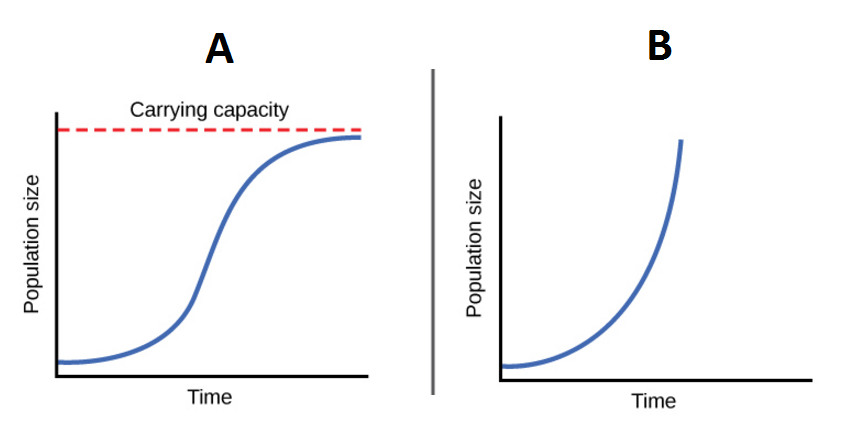
What type of growth model is shown in image A?
Exponential
Logistic
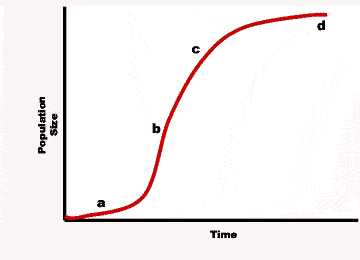
What point on the graph represents carrying capacity?
a
b
c
d
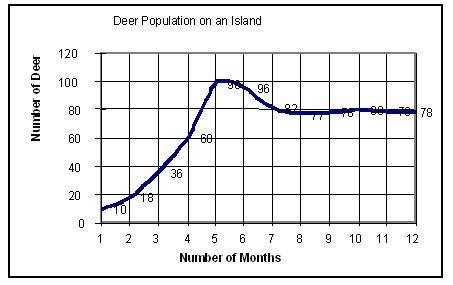
Which choice most closely approximates the deer population's carrying capacity based on the graph?
100
80
60
10


After a volcanic eruption, lava covers the land. What is the order that plants grow to repopulate the area?
Lichens → Shrubs → Grasses → Trees
Lichens → tree → shrubs→Grasses
Grasses → Lichens → Shrubs → Trees
Lichens → Grasses → Shrubs → Trees


Which of the following is an abiotic factor?
Bacteria
Plants
Protist
Sunlight


How much of the energy in each level of a ecological pyramid gets LOST as heat or used by the organism so that it CANNOT be passed on to the next trophic level?
80%
90%
10%
20%

What statement is true about the carbon dioxide-oxygen cycle?
animals breathe in nitrogen and release O2 which is used by plants
animals breathe in nitrogen and release CO2 which is used by the plants
animals breathe in O2 and release CO2 which is used by plants
animals breathe in CO2 and release O2 which is used by plants

