
 Worksheets
apes chapter 9 -Climate change
Total questions: 135
Worksheet time: 1hrs 7mins


Earth's average temperature has increased 1°C in the past century. Which reason best explains this increase in temperature?
lower levels of ozone in the atmosphere
lower levels of nitrogen in the atmosphere
higher levels of carbon dioxide in the atmosphere
higher levels of oxygen in the atmosphere
Which of the following gases is NOT a greenhouse gas?
carbon dioxide
nitrogen
water vapor
methane
Which of the following are evidence of climate change?
extreme weather events
increase in the average global temperature
melting of polar ice caps
all of the above
The main human activity that releases carbon dioxide (CO2) into the atmosphere is...
using bottled water
burning fossil fuels
texting on cellphones
eating meat
Which of the following is contributing to an increase in carbon dioxide (CO2) in the atmosphere?
deforestation
burning fossil fuels
burning down trees
all of the above
Which of the following is produced by cows?
Carbon Dioxide
Water Vapor
Argon
Methane
an area's climate changes and it gets LESS rainfall. what can happen?
more hurricanes
more forest fires
floods
more diseases
what human activities lead to an increase in the amount of greenhouse gases and therefore lead to climate change?
burning fossil fuels for energy
transportation (cars, planes, trains)
farming
all of the above
human activities lead to climate change and global warming because
there are LESS greenhouse gases in the atmosphere and the temperature decreases
there is the SAME amount of greenhouse gases in the atmosphere and the temperature stays the same
there are MORE greenhouse gases in the atmosphere and the temperature is increasing
Warming seas will...
Increase the number of storms
Decrease the number of storms
The number if storms will stay the same
Climate Change will cause...
More intense tropical storms
Less intense tropical storms
no more storms
Earths climate has...
Decreased by 10 degrees
Increased by 2 degrees
Decreased by 2 degrees
increased by 10 degrees
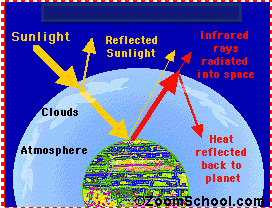
The role of the Intergovernmental Panel on Climate Change is to
implement carbon taxes on companies that burn excessive fossil fuels
collect and analyze scientific climate data like that from ice cores
review scientific climate data to assess the current state of climate change
introduce policies to help with mitigation and adaptation strategies
An example of a climate change mitigation strategy is
mandating more fuel efficient vehicles
building structures to protect from rising sea levels
species migration
using drought resistant crops

What is a major cause of coral bleaching?
Too much carbon dioxide is dissolved in ocean water
Not enough carbon dioxide is dissolved in ocean water
Whales chewing on coral reefs
Too much sunlight
One possible positive consequence of an increase in CO2 in the atmosphere?
Plants may grow faster and produce more sugars
Pests like pine beetles will die
Forest fires will be extinguished by the lack of oxygen
Corals will grow faster
What is Arctic (or polar) amplification?
the phenomenon that temperature near the poles is increasing at a higher rate than at lower latitudes
the intensification of the polar jet stream due to melting ice caps
the increased productivity of Arctic ecosystem due to increased upwelling
the migration of the polar front due to stronger pressure contrasts
Which of the following best describes the primary goal of the Paris Agreement?
to create a fund to help countries deal with disaster relief
to validate the science behind climate change for the global community
to keep the global climate temperature increase to under 2 degrees Celsius
to reduce deforestation worldwide


Layer of Earth's atmosphere the contains "good" O3
Troposphere
Hydrosphere
Mesosphere
Asthenosphere
Stratosphere

The ocean becomes this with the absorption of excess CO2
alkaline
acidic
neutral
shallower
none of these

Molecule with the highest greenhouse trapping ability
CO2
H2O
CFC
NO2
O3

A species who is very close to extinction
threatened
endangered
invasive
least concern
alien
committing industrialized countries and economies in transition to limit and reduce greenhouse gases (GHG) emissions in accordance with agreed individual targets
Kyoto Protocol
CITES
Montreal Protocol
Endangered Species Act
NEPA

Which is NOT a part of HIPPCO?
Human population
Income (affluence)
Climate change
Pollution
Overharvesting

Organisms that are successful in a new environment due to access to abundant resources and no predators
threatened
keystone
endangered
least concern
invasive

This had the goal of decrease production of CFCs by the year 2000
Montreal Protocol
Kyoto Protocol
Paris Agreement
NEPA
CITES

The international agreement between governments to ensure that international trade in specimens of wild animals and plants does not threaten the survival of the species
CITES
Endangered Species Act
Montreal Protocol
Kyoto Protocol
Sioux Falls Animal Act

Where there is a lot of mixing of air, weather, and "bad" ozone
Troposphere
Hydrosphere
Mesosphere
Asthenosphere
Stratosphere

Which is NOT true about ocean warming?
The distribution of heat in the oceans is not uniform
Coral bleaching rates are decreasing
Warm water holds less dissolved oxygen than colder water
Sea levels are rising due to thermal expansion
Many species are relocating further from the equator

A species that has been categorized by the International Union for Conservation of Nature (IUCN) as evaluated as not being a focus of species conservation is
threatened
keystone
endangered
least concern
invasive

Evidence for climate change on Earth includes
Global temperature decline
Warming oceans
Increasing glaciers
Lowering sea levels
None of these

Which of the following anthropogenic activities is most closely associated with depletion of the stratospheric ozone layer?
Flooded cropland
Garbage incineration
Mining of talc
Disposal of refrigerators and air conditioners
None of these

Which is NOT an invasive species in South Dakota?
Zebra mussel
Ring-necked pheasant
Rusty crayfish
Western mosquitofish
All of these are invasive species

Which is a threatened species in South Dakota?
Eastern hognose snake
Ring-necked pheasant
Rusty crayfish
Black footed ferret
Pallid sturgeon

Which is an endangered species in South Dakota?
Walleye
Ring-necked pheasant
Rusty crayfish
Black footed ferret
Zebra mussel

A source of heat to warm up oceans is
sunlight
water vapor
carbon dioxide
all of these
none of these
Which of the following is likely to increase biodiversity within a biome?
Landscape fragmentation
Introduction of an invasive species
Immigration of humans
Speciation
A disease epidemic
In an acre of grassland, net primary productivity is best measured as
carbon taken up by plants in sunlight plus carbon released by plants in the dark
carbon taken up by plants in sunlight
aboveground biomass of plants
aboveground and belowground biomass of plants
carbon taken up by plants in sunlight minus carbon released by plants in the dark
Ocean acidification represents a key component of the
nitrogen cycle
hydrologic cycle
phosphorus cycle
carbon cycle
sulfur cycle
When does the South Pole experience 24 hours of sunlight per day?
From the March equinox to the September equinox
From the September equinox to the March equinox
Only on the March and September equinoxes
Only on the December and June solstices
From the December solstice to the June solstice
Over long time periods, global climate change may change the ________ of a species.
I. realized niche
II. fundamental niche
III. extinction rate
I only
II only
I and II
I and III
I, II and III
Which is NOT true regarding keystone species?
Keystone species can be mutualists with other species.
Keystone species are often rare individuals in a community.
Keystone species are most likely to be commensalists.
Keystone species can be highly lethal to several species in a community.
Keystone species may interact with only a single other species
Which is most likely to be the replacement-level fertility for a developing nation in the third phase of demographic transition?
1.8
2.0
2.2
3.5
5
A population with an age distribution shaped like a pyramid
I. exhibits a stable population size.
II. is likely to exhibit high population momentum.
III. has a high crude birth rate.
I only
III only
I and II
I and III
II and III
Which contributes to the physical weathering of rocks?
Acid rain
Burial in sediment
Volcanic activity
Growth of plant roots
Deposition
Which is a positive externality that results from the construction of a hydroelectric dam?
Construction of a fish ladder to help migrating fish pass the dam
Millions of fish killed when they are sucked into the dam turbines
Creation of valuable lake shoreline that promotes housing and tourism
Loss of seasonal flooding leading to less sediment deposition along river banks
Changes in the temperature profile of the river before and after the dam
Which of the following is NOT an outcome of a prescribed fire burn?
Dead biomass is retained in the forest.
Nutrients in dead material are liberated for primary producers.
The risk of larger forest fires is minimized.
Habitat is provided for early-succession species.
The burning of the forest can stimulate the growth of other plant species.
Which provides protection against the risks that genetically modified crops pose to global crop biodiversity?
No-till agriculture
Integrated pest management
Broad-spectrum herbicides
Use of a pesticide treadmill
Buffer zones around crops
Which will NOT result in energy savings?
Increasing insulation of walls and ceilings in a residence
Replacing LED bulbs with CFL bulbs
Using a passive solar design in the construction of a new building
Installing sensors to turn off lights when a room is vacant
Implementing a financial incentive to encourage the replacement of old household appliances
Concentrated solar thermal systems implement
active solar technology.
photovoltaic cell technology.
passive solar technology.
smart grid technology
Energy Star appliances
Which phenomenon is part of a negative feedback with regard to global warming?
Increased absorption of CO2 by the ocean
Methane production from peatland decomposition
Increased evapotranspiration from plant growth
CO2 release from forest fires during dry spells
Reduced albedo resulting from melting ice


Earth's average temperature has increased 1°C in the past century. Which reason best explains this increase in temperature?
lower levels of ozone in the atmosphere
lower levels of nitrogen in the atmosphere
higher levels of carbon dioxide in the atmosphere
higher levels of oxygen in the atmosphere
Which of the following gases is NOT a greenhouse gas?
carbon dioxide
nitrogen
water vapor
methane
Which of the following are evidence of climate change?
extreme weather events
increase in the average global temperature
melting of polar ice caps
all of the above
The main human activity that releases carbon dioxide (CO2) into the atmosphere is...
using bottled water
burning fossil fuels
texting on cellphones
eating meat
Which of the following is contributing to an increase in carbon dioxide (CO2) in the atmosphere?
deforestation
burning fossil fuels
burning down trees
all of the above
Which of the following is produced by cows?
Carbon Dioxide
Water Vapor
Argon
Methane
an area's climate changes and it gets LESS rainfall. what can happen?
more hurricanes
more forest fires
floods
more diseases
what human activities lead to an increase in the amount of greenhouse gases and therefore lead to climate change?
burning fossil fuels for energy
transportation (cars, planes, trains)
farming
all of the above
human activities lead to climate change and global warming because
there are LESS greenhouse gases in the atmosphere and the temperature decreases
there is the SAME amount of greenhouse gases in the atmosphere and the temperature stays the same
there are MORE greenhouse gases in the atmosphere and the temperature is increasing
Warming seas will...
Increase the number of storms
Decrease the number of storms
The number if storms will stay the same
Climate Change will cause...
More intense tropical storms
Less intense tropical storms
no more storms
Earths climate has...
Decreased by 10 degrees
Increased by 2 degrees
Decreased by 2 degrees
increased by 10 degrees
The role of the Intergovernmental Panel on Climate Change is to
implement carbon taxes on companies that burn excessive fossil fuels
collect and analyze scientific climate data like that from ice cores
review scientific climate data to assess the current state of climate change
introduce policies to help with mitigation and adaptation strategies
An example of a climate change mitigation strategy is
mandating more fuel efficient vehicles
building structures to protect from rising sea levels
species migration
using drought resistant crops
What is a major cause of coral bleaching?
Too much carbon dioxide is dissolved in ocean water
Not enough carbon dioxide is dissolved in ocean water
Whales chewing on coral reefs
Too much sunlight
One possible positive consequence of an increase in CO2 in the atmosphere?
Plants may grow faster and produce more sugars
Pests like pine beetles will die
Forest fires will be extinguished by the lack of oxygen
Corals will grow faster
What is Arctic (or polar) amplification?
the phenomenon that temperature near the poles is increasing at a higher rate than at lower latitudes
the intensification of the polar jet stream due to melting ice caps
the increased productivity of Arctic ecosystem due to increased upwelling
the migration of the polar front due to stronger pressure contrasts
Which of the following best describes the primary goal of the Paris Agreement?
to create a fund to help countries deal with disaster relief
to validate the science behind climate change for the global community
to keep the global climate temperature increase to under 2 degrees Celsius
to reduce deforestation worldwide

What is climate change?
When Earth's temperature is not balanced
When Earth's temperature is balanced

Who keeps the Earth warm?
The Sun
The greenhouse gases
Both of them
None of them

What causes "natural climate change"?
Volcanic eruptions
Changes in the sun's energy
Both of them
None of them

What activities release greenhouse gases (cause climate change)?
Burning oils to make planes and cars move
Dumping trash on landfills
Cutting down trees
All of them

What causes climate change?
The increase in greenhouse gases
The decrease in greenhouse gases

What are some effects of climate change?
Glaciers and ice sheets melting
Seas rising
Storms getting stronger
All of them

How can we stop climate change?
Walk to close places instead of using the car
Turn off the lights when you're not in a room
Recycle more
All of them

How does the Earth maintain cool?
It releases some heat from the sun back to space
It absorbs the sun's heat

What is the objective of this goal?
Combat climate change and its impacts
Help people consume less food

What is the global goal we'll be working on?
No Poverty
Gender Equality
Climate Action
All of them

