
 Worksheets
Reporting Category 3: Biological Evolution & Classification
Total questions: 200
Worksheet time: 17hrs 40mins


Derived traits are
highly selected traits
primitive features
newly evolved traits
acquired heritable traits from parents

What structures are similar in arrangement, function, or both with a common evolutionary origin?
vestigial structures
analogous structures
homologous structures
The ___________ closely related the species are, the ____________ number of sequences will be shared.
more; greater
less; greater
more; smaller
Wisdom teeth is an example of ________________________.
Homologous structures
Vestigial structures
Analogous structures

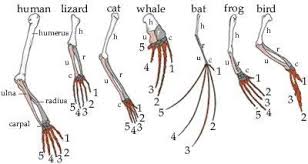
What do the colors mean on the picture?
The colors represent that all of the species on the picture can walk.
The colors represent the different functions and arrangements for the species.
The colors represent the the different ancestors the species shared.
The same colors represent similar arrangement, function, or both.
Which of the following is NOT used to support the theory of evolution?
DNA Sequence
Fossil Record
Acquired Heritable Traits
Embryological Development
Clues about how organisms change over time is
mutations
biogeography
homologies
fossil record
a predessor that an organism shares with another organism
homology
common ancestor
mutation
fossil
comparing bone structure is a
fossil record
anatomical homology
developmental homology
molecular homology
species that show similar embryonic development
fossil record
anatomical homology
developmental homology
molecular homology
comparing the molecules, specifically DNA or amino acid sequence, to show how closely they are related
fossil record
anatomical homology
developmental homology
molecular homology
Which of the following are types of homologies we discussed?
common ancestor
anatomical homologies
developmental homologies
molecular homologies
Same structure-different function
common ancestors
homologous structures
analogous structures
stasis
different structures--same function (wings)
common ancestors
homologous structures
analogous structures
stasis
Which pattern of evolution occurs gradually?
biogeography
stasis
punctuated equilibrium
gradualism
Which pattern of evolution shows new species appearing suddenly?
biogeography
stasis
punctuated equilibrium
gradualism
Showing no evolutionary changes for long periods of time?
biogeography
stasis
punctuated equilibrium
gradualism
the breaking apart and movement of continents from one massive landform called Pangaea
biogeography
gradualism
continental drift
natural selection
study of past and present geographical regions of the distribution of species
biogeography
analogous structures
continental drift
natural selection

This is a structure that was inherited but has lost most of its original function
homologous
analogous
vestigial
homozygous
Natural selection is the ability to:
live longer and reproduce
evolve and survive
mutate and grow
meditate and relax


Which statement is best supported by the information in this dendrogram/evolutionary tree?

What is the most reasonable conclusion one can draw from a comparison of these structures?
Survival of the fittest can best be described as –
the process by which only the strongest of a species will be able to survive and reproduce
the process in which organisms that are better adapted to their environment will have a better chance of surviving and reproducing
the reason the strongest of the species will not be able to reproduce as often as others
the reason weaker organisms in a species will always be killed by predators


The image shows part of the humerus bone in different genera of primates. Which statement is best supported by the observable structures of the different humerus bones?
the primates lived in similar environments
the primates shared a common ancestor
the primates interbreed with similar organisms in a population
the primates had diets that consisted of similar types of foods

Researchers studying populations of lizards from the genus Gallotia on the Canary Islands compared the protein cytochrome b in different populations. The table shows the number of differences in the cytochrome b protein between different populations. Which conclusion about the relatedness of the lizards do these data support?
G. atlantica and G. stehlini are the least closely related
G. simonyi and G. bravoana are the most closely related
G. galloti eisentrauti and G. galloti palmae are the most closely related
G. galloti eisentrauti and G. galloti galoti are the least closely related

Cetaceans are whales and their relatives. The diagram shows some fossils of cetaceans. Which statement provides the best evidence that Ambulocetus natans is an ancestor of Basilosaurus isis?
Homologous structures occur in each fossil
Similar nitrogenous bases are found in the DNA of each fossil
The fossils were found in different locations
The youngest fossil is larger than the older fossils
Bactrian camels, dromedaries, llamas, and alpacas are all members of the same taxonomic family, Camelidae. Members of this family all have two toes, no hooves, true canine teeth, and a split upper lip. The family Camelidae originated in North America. The physical features of animals in this family and the family's geographical origin provide evidence that all these animals -
live in the same type of ecosystem
have slowly evolved to become herbivores
have a common ancestor
exchanged DNA at some point in the past
In 2010, scientists excavated a skull fossil that provides evidence of a newly discovered species of big cat. Based on the evidence, scientists hypothesize that big cats branched off from smaller wild cats about 6 million years ago. Which of these resources did the scientists most likely rely on to form their hypothesis?
a food web showing feeding relationships of organisms where the fossil skull was found
population and migration data for small wild cats living in the ecosystem where the skull was found
the fossil record and DNA comparisons of big cats and small cats
the historical record of interactions between different species of big cats

An analysis of DNA and RNA sequences can be used to classify organisms. A dendrogram, such as the one shown below, is based on molecular data. It can be used to represent evolutionary relationships within a group of organisms that are hypothesized to have descended from a common ancestor. Which statement is best supported by the information in this dendrogram?
Lesser pandas are more genetically similar to giant pandas than they are to raccoons
Brown bears are more genetically similar to giant pandas than they are to sun bears
Lesser pandas are more genetically similar to racoons than they are to giant pandas
The bear species are all more genetically similar to dogs than they are to giant pandas

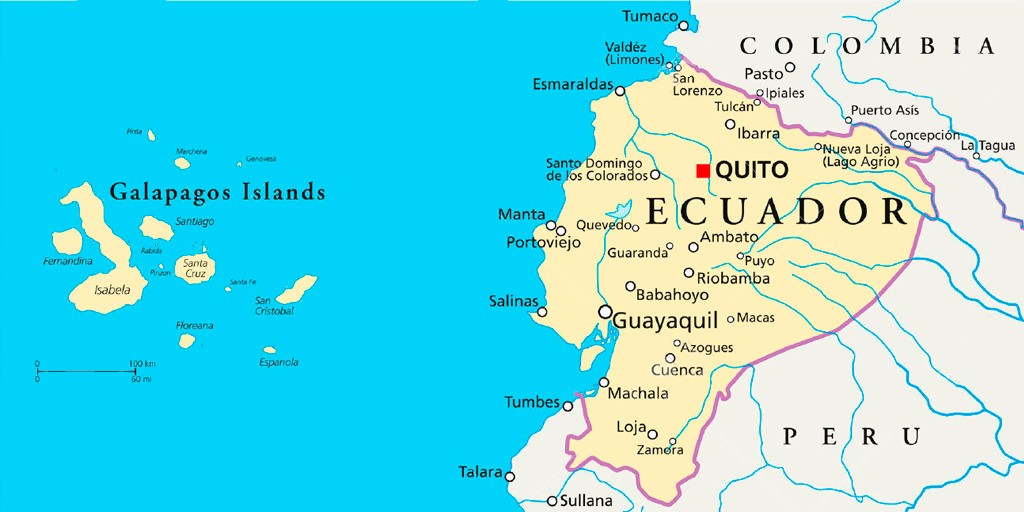
Three species of lizards of the genus Gallotia are found on the Canary Islands, a chain of seven volcanic islands off the wet coast of Africa. The easternmost island, Lanzarote, is the oldest, while the westernmost island, El Hierro, is the youngest. The distribution of lizard species is shown on the map. Which statement about the ancestry of the lizards from the genus Gallotia is best supported by this information?
The common ancestor of the lizards first colonized the island of El Hierro
The ancestors of each species came from different continents at different times
the common ancestor of the lizards probably came from Africa
The ancestors of each species evolved in Spain and were brought to the islands at the same time

The opossum, which is native to North America, and the kangaroo, which is native to Australia, are marsupials. The fact that both these mammals incubate their immature offspring in a pouch provides evidence that they -
belong to the same species
must range great distances to eat
have very similar skeletal structures
are descended from a common ancestor
Genome maps provide the DNA sequences of chromosomes. Some scientists have compared the genome maps of a hedgehog and a sloth. What do these genome maps allow the scientists to determine?
The color patterns of the offspring of each species
How much the size ranges of the two species differ
The methods of proteins synthesis that each species uses
How closely related the two species are to each other

Zoogeographic regions are characterized by the presence of specific groups of animals. These regions are determined by the taxonomic or phylogenetic relationships of animals. The map shows the zoogeographic regions proposed by the naturalist Alfred Russel Wallace in 1876. The similarities of organisms in which two areas numbered above provide the best evidence for common ancestry between the organisms in both locations?
1 and 2
3 and 4
5 and 6
7 and 8

The limbs of several organisms are shown in the illustrations below. Scientists sometimes compare the limbs of these organisms to look for evidence of common ancestry. These limbs provide evidence of common ancestry because they -
have the same basic structure
perform the same function
are the same size
are parts of mammals

The diagram illustrates an embryonic stage of two organisms. Which of the following can be determined by observing the embryos shown in the diagrams?
The organisms share a common ancestry
The organisms belong to the same genus
The organisms are native to the same geographic areas
The organisms will grow into anatomically similar adults


Which is NOT a vestigial structure?
Tailbone
Brain
Appendix
Hip bones in snakes
Which of the following pieces of fossil evidence supports the theory that lizards and birds descended from the same reptilian ancestor?
The discovery of a fossil organism with a lizard- like skeleton, extended finger bones, and feathers.
The discovery of a fossilized nest with remains of eggs shaped like modern bird eggs.
Fossilized tree bark and wood showing that a lizard excavated nest holes in the tree.
Evidence of fossil bird skeletons near an area that was swampy.

Similarities observed between species could be the result of traits originating from a common ancestor. Organisms living at which location on the map would be least likely to share a common ancestor with the others?
1
2
3
4

Which of the following statements is supported by the fossil evidence provided by Archaeopteryx?
All dinosaurs must have had feathers.
Dinosaurs may have been a common ancestor to modern birds.
Dinosaurs were able to maintain stable internal body temperatures.
Modern birds developed feathers randomly from recent genetic mutations.

Which of the following pieces of evidence from the past can explain the similarities between these species living on different continents today?
A common bird ancestor must have lived in North America and given rise to all the modern species.
A common ancestor to these species myst have lived during a time period when the continents were connected.
Each of the birds randomly developed similar traits through natural selection.
Australia must have been the site of prehistoric rainforests, where birds originated.

Based on similarities observed in living elephants and fossilized mammoths, we can conclude that their common ancestor-
Lived in tropical climates
Fed on other animals
Was covered in hair
Had a long trunk
Each Zoogeographical region is characterized by the presence of specific groups of animals. The dotted lines represent the borders between these regions. Which of the following would create a border between zoogeographic regions?
A large number of predators living in the border area.
Mountains, oceans, and other geological barriers.
Hurricanes, thunderstorms, and other severe weather.
Ancient human migration patterns.
Living organisms today can be traced back through the fossil record to find their ancestors. When comparing fossil remains with living organisms, the two species are more likely to be related if they-
Share anatomical traits.
Are located in the same geographical region.
Contain different bone and skin structure.
Are the same size.

High amounts of solar radiation, resulting in frequent irreversible mutations in animal species.
An overabundance of producers that feed very large numbers of diverse animals.
Geographic isolation from all other parts of the world.
Importation of unique species to the continent by humans over the last century.

A mutation arose in the first whale and all whales since have the same trait.
An ancestor to whales had legs and the remaining hip bones are a vestigial trait.
Whales are evolving and will eventually have hind legs.
The hip bone was developed as a result of over feeding on calcium rich food sources.

Frogs and toads belong to the order Anura. The smallest organism in this order is about 7 millimeters long, while the largest member is about 30 centimeters long. Which of these lists best describes this order?


A student wants to use the Venn diagram below to show the characteristics of two kingdoms of organisms. The characteristics that the two kingdoms share will be listed in the shaded area where the circles intersect. Which of these is a characteristic that the student should list in the shaded part of the diagram?
heterotrophic
prokaryote
mobile
multicellular

Two populations of mice living in the same forest are separated by a large water-filled ditch. After a rainstorm, flooding brings several mice from one population to the other population. When the mice from the first population reproduce with members of the second population, which of the following will likely occur?
All the offspring will die as a result of reproductive mutations.
The offspring will be forced to leave the second population.
The offspring will be genetically identical to their parent from the first population.
The offspring in the second population will have greater genetic variety.

Adult mountain lions (Puma concolor) are almost 2 meters long. They have a black spot over each eye. The common names used throughout the United States for this species are listed below. Why is it best for scientists to use the name from the standardized taxonomic system?
The standardized name differentiates mountain lions and pumas.
The standardized name is less descriptive of the animal that has been observed.
Communication with other scientists about mountain lions will be reduced.
All scientists will be using one name for mountain lions.

This diagram of the fossil record represents changes in mollusks over millions of years. How can the pattern of change in the fossil record best be explained?
The mollusks were well adapted to their stable environment. A large, sudden change occurred in their environment. After the change the mollusks with the bigger shells were better adapted for the new environment.
The mollusks were well adapted to their stable environment. The mollusks hybridized with a smaller species of mollusk. A new species of mollusk with a bigger shell resulted.
The mollusks were not well adapted to their environment. The length of the mollusks’ shells changed gradually over time. The mollusks in the original population that had small shells died over a period of many years.
The mollusks were well adapted to their environment. Humans introduced a new species of mollusk that was not adapted to this environment. The introduced mollusk outcompeted the native mollusk species.

The survival of a species depends on its ability to adapt to changes in the environment. A species must be capable of surviving and reproducing despite changes to food sources, climate, or threats from predators. Which statement correctly describes a way that mutations increase the likelihood that a species will survive in a changing environment?
Mutations are a source of variation in the species.
Mutations are the cause of disease in the species.
Mutations are not harmful when they occur in somatic cells of the species.
Mutations are always passed on to subsequent generations of the species.

The green frog (Lithobates clamitans clamitans) is found in many parts of the United States. The table contains some information about this frog. Why does the ability to lay 1,000 to 5,000 eggs increase the fitness of the species L. clamitans clamitans?
It increases opportunities for offspring to compete for limited resources.
It increases the probability that some offspring will survive long enough to reproduce.
It increases the probability that moving water will promote gene flow from one population to another.
It increases the chance of the recombination of alleles, leading to genetic drift in the population.

A prey population consists of individuals with a variety of running speeds. The adaptation that allows some of these animals to run fast would be an example of natural selection if it helps them —
survive and undergo mutations in their DNA
lower the mortality rates of the population
produce offspring that run at average speeds
reproduce and increase the frequency of their genes in the population

The quiver tree grows in desert areas in southern Africa. In recent decades average temperatures have been rising in southern Africa. Scientists predict that this warming trend will continue. Quiver trees in the hottest parts of their range near the equator are dying, but quiver trees at high elevations or in parts of the range that are farther from the equator are growing and reproducing. Which of these best explains what is happening to the quiver tree population in southern Africa?
Individual quiver trees are unable to adjust to the rising temperatures, and only those in cooler parts of the range will survive.
The quiver tree species is unable to survive rising temperatures throughout its range. The species is likely to undergo rapid extinction.
Individual quiver trees can quickly adapt to rising temperatures. Individual trees will change their method of seed dispersal in cooler parts of the range.
The quiver tree species will survive by producing offspring suited for warmer temperatures.

Five general characteristics of organisms in kingdoms Plantae or Fungi are listed in the box. Which table correctly lists the characteristics of the organisms in the two kingdoms?


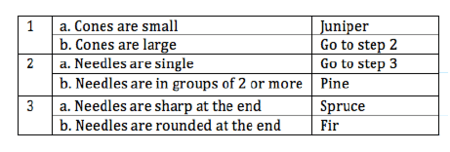
This dichotomous key can be used to identify some conifers. Based on the key, which of these best describes the leaves and cones of the longleaf pine?
Needle-like straight leaves that are mostly over 25 cm long and found in clusters of three; no thorns on cones
Flattened and scale-like leaves that are mostly over 25 cm long; soft and leathery cones
Needle-like straight leaves with a length of 25 cm that are mostly found in clusters of five; thorny cones
Leaves with a length of 25 cm that are found in clusters of more than five; no thorns on cones

In 2010, scientists excavated a skull fossil that provides evidence of a newly discovered species of big cat. Based on the evidence, scientists hypothesize that big cats branched off from smaller wild cats about 6 million years ago. Which of these resources did the scientists most likely rely on to form their hypothesis?
A food web showing feeding relationships of organisms where the fossil skull was found
Population and migration data for small wild cats living in the ecosystem where the skull was found
The fossil record and DNA comparisons of big cats and small cats
The historical record of interactions between different species of big cats

Scientists around the world use a standardized taxonomic system. Why would scientists want to use a taxonomic system that is standardized?
In order to avoid confusion with the identification of organisms
Because Linnaeus established the system
So that Latin names can be applied for a practical purpose
In order to place organisms in different groups

Nudibranchs are marine gastropods that lack shells. Many of these gastropods retain the foul-tasting poisons of their prey and secrete them when threatened. The bright coloration of the nudibranchs warns predators to avoid them. Based on this information, how has adaptation allowed marine gastropods to be successful without a shell?
They find enough food as they move through the marine environment.
They blend in with their environment to hide from their predators.
They are not attacked by most predators and are able to reproduce successfully.
They have bright colors that attract a mate.

What characteristics do all of these animals have in common?
Vertebrate
Lungs
Endothermic
Mammal

What do both the squirrel and lion have in common that the other animals do not?
They are both vertebrates
They both have lungs
They are both mammals
They both lose their canine teeth.

Is a bird more closely related to a prosimian or to an amphibian?
Birds are more closely related to prosimians because they have more in common.
Birds are more closely related to amphibians because they have more in common.

What do amphibians, birds, prosimians and humans all have in common? Check all that apply.
Hair
Endothermic
Eukaryotic
Tetrapod
Vertebrate

According to this cladogram, what characteristics do prosimians have in common with humans?
Hair
Eukaryotic
Vertebrate
Endothermic
Tetrapod

According to the cladogram, which of the following is NOT a derived characteristic?
light bones
Allosaurus
down feathers
3-toed foot; wishbone

Which group on the cladogram arose FIRST?
Theropods
Allosaurus
Robin
Velociraptor

Do theropods have light bones?
yes
no

Does Allosaurus have light bones?
yes
no
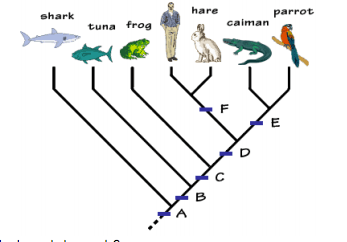
On the cladogram, which organism is the closest relative of the parrot?
Frog
Hare
Caiman
Parrot
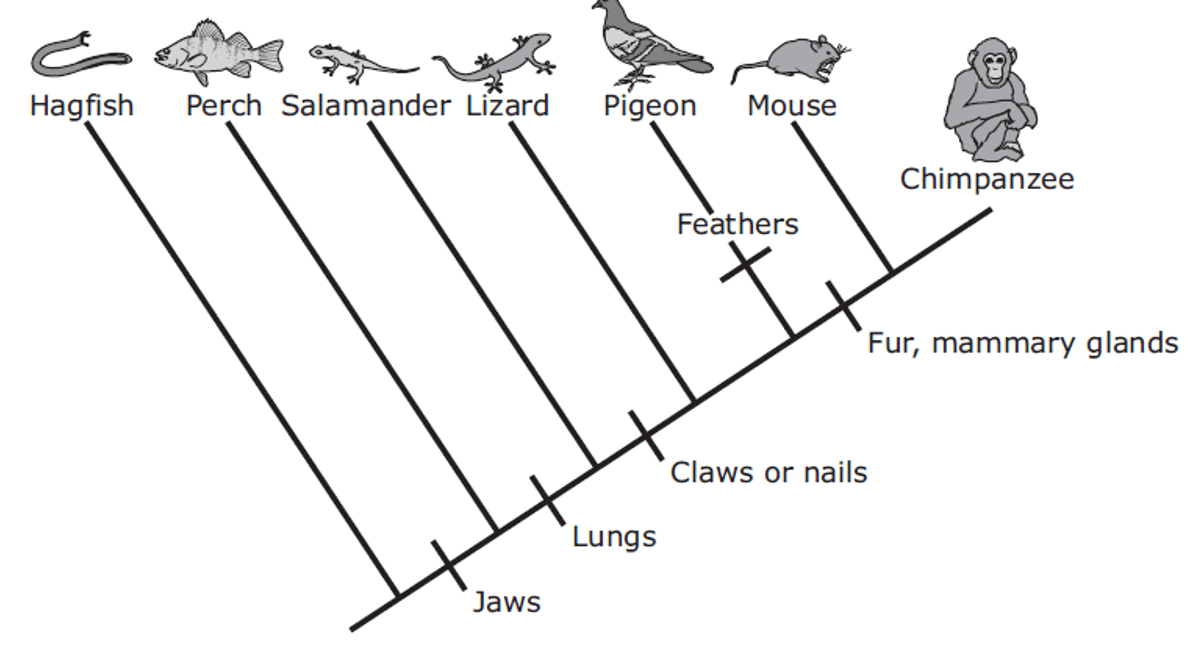
All the animals to the right of the salamander would have the common characteristic of...
Fur
Claws or nails
Lungs
Jaws
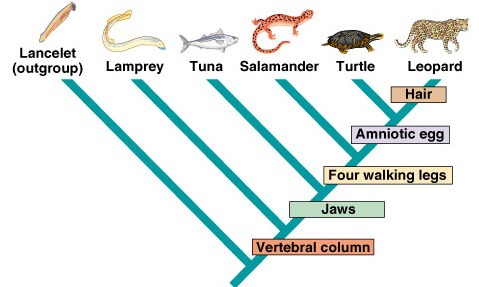
Which is the newest trait?
Amniotic egg
Walking legs
Jaws
Hair


NUCLEOTIDES ARE THE BUILDING BLOCKS OF...
CARBOHYDRATES
LIPIDS
NUCLEIC ACIDS
PROTEINS
AMINO ACIDS ARE THE BUILDING BLOCKS OF...
CARBHYDRATES
LIPIDS
NUCLEIC ACIDS
PROTEINS
FATTY ACIDS AND GLYCEROL ARE THE BUILDING BLOCKS OF..
CARBOHYDRATES
LIPIDS
NUCLEIC ACIDS
PROTEINS

Structures with similar function that evolved due to similar environmental pressures but no common ancestry are called.
Homologous Structures
Analogous Structures
Vestigial Structures
None of the above

Structures that have different functions but evolved from a common ancestor are called
Homologous Structures
Analogous Structures
Vestigial Structures
None of the above

Similar environmental pressures acting on species over time best explains
Homologous structures
Analogous structures

Which of the following may produce new traits in species over time?
A need for new traits
Consistent environmental pressures
A stable environment with little change
An abundance of resources

Which of the following traits do turtles have?
Vertebral column
Hinged jaw
Four walking legs
Amniotic egg
Hair

Which of the following organisms has a vertebral column? Choose all that apply.
Lancelets
Lamprey
Tuna
Salamander
Turtle

Which best explains why turtles and leopards are the most closely related in this phylogenetic tree?
They are both land-walking animals
They share the most traits
They share the most recent common ancestor
Option 2 and 3
All of the above

Which of the following traits evolved first, or is the oldest trait, in this cladogram?
Fur / mammary glands
Claws or nails
Lungs
Jaws

Which of the following traits do pigeons and lizards share? Choose all that apply.
Jaws
Lungs
Claws or nails
Feathers
Fur and mammary glands

Which of the following point to evidence of common ancestry? Choose all that apply.
Shared traits
Similar DNA and amino acid sequences
Having similar predators
Similarities in embryo development
Traits that have a similar function

What evidence from this chart points to a closer common ancestor between humans and gorillas?
We are both mammals
We are both apes
Having a higher amino acid difference
Having a lower amino acid difference
According to fossil records, the horses that lived 50 million years ago were much smaller, weaker and slower than modern horses. Which process is most likely responsible for the changes that have led to the increased size, strength, and speed in horses?
commensalism
inbreeding
migration
evolution by natural selection
Extinction of a species could result from:
evolution of a type of behavior that produces greater reproductive success.
synthesis of a hormone that controls cellular communication
limited genetic variability in the species
fewer unfavorable mutations in the species

Scientists are studying the evolutionary history of a group of plants in the United States, and they developed an evolutionary tree, as shown. Which statement can be inferred from the evolutionary tree?
Species 1 is most closely related to Species 8.
Species 2 is most closely related to Species 3.
Species 3 is most closely related to Species 7.
Species 5 is most closely related to Species 6.
Mutations within a DNA sequence are:
natural processes that produce genetic diversity.
natural processes that always affect the phenotype.
unnatural processes that always affect the phenotype.
unnatural processes that are harmful to
genetic diversity.
A single species of squirrel evolved over time into two species, each on opposite sides of the Grand Canyon. This change was most likely due to:
higher mutation rates on one side
low genetic diversity in the initial population
the isolation of the two groups
differences in reproductive rates
Certain insects resemble the bark of the trees on which they live. Which statement details a possible biological explanation for this resemblance?
The insects needed camouflage, so they developed protective coloration.
Natural selection played a role in the development of the of this protective coloration.
The lack of mutations resulted in the protective coloration
The trees caused mutations in the insects that resulted in protective coloration
Theodosius Dobzhansky discovered that successful species tend to have a wide variety of genes that do not appear to be useful to the species in its present environment. What did this discovery help explain about genetics and the changes that occur in a species over time?
Environments with more organisms tend to have more successful species.
Species with greater genetic diversity adapt more easily to changing environments.
Changing environments prevent species from adapting and surviving.
Species in a stable environment are more resistant to a changing environment.

The data shows four amino acids found across 3 species. Which phylogenetic tree best represents the information in the chart?


A large population of cockroaches was sprayed with an insecticide. A few of the cockroaches survived and produced a population of cockroaches that was resistant to this spray. What can best be inferred from this example?
A species will adapt no matter what the environment.
The environment has no effect on the survival of an organism.
Insecticides cause mutations that are passed on to the next generation.
Individuals with favorable variations survive and reproduce.

The human hemoglobin molecule contains a chain of 146 amino acids. The chart below shows how many amino acids in other animal hemoglobin differ from the human hemoglobin. Based on this evidence alone, to what animal are humans more closely related?
Rhesus monkey
Mouse
Chicken
Frog
What is the difference between the DNA of a dog and the DNA of a fly?
the type of sugar building blocks
the sequence of nucleotides
the strength of hydrogen bonds
the strength of covalent bonds
Scientists believe that the polar bear in Alaska and the brown bear in Russia evolved from a common ancestor. Which would be responsible for this evolutionary change?
artificial selection
asexual reproduction
sexual competition
geographic isolation
An antibiotic which was effective 20 years ago against a specific type of bacterial infection no longer works against the same kind of infection today. Which best explains why the antibiotic is no longer as effective as it was 20 years ago?
bacteria resistant to the antibiotic have killed off nonresistant bacteria
viruses have changed the structure of the bacteria that causes the infection
resistant bacteria have survived and reproduced at a greater rate than nonresistant bacteria
the human body has developed an immunity to the antibiotics
Multicellular eukaryotic autotrophs belong to which kingdom?
Animalia
Fungi
Plantae
Protista


bacteria belong to which domain?
Eukarya
Prokarya
Archaea
Bacteria
What is binomial nomenclature (naming)?
A two headed turtle
A two name naming system
A two grouped system to classify
A microscope with two lenses.
What is the science of organizing, classifying and naming living things?
taxification
taxadermy
taxonomy
toxicology
In a properly written scientific name, which part is written entirely in lowercase?
species
genus
phylum
family

Which of the following taxa contain the fewest members?
phyllum
family
genus
class

Which category of classification has the largest variety of organisms?
genus
phylum
species
kingdom

Aristotle is said to be the first to classify organisms. Into which two groups did he classify all living things?
fungi and bacteria
humans and animals
living and nonliving
plants and animals
Which is the best prediction regarding the current classification system?
The system may change as new information and organisms are discovered.
Scientists will become bored with the current system and develop a new one.
Over time, organisms will become extinct, so classification will become simpler.
The system is set in stone and most likely will not change.

An organism identified with binomial nomenclature includes which two taxa?
class and order
family and genus
genus and species
kingdom and phylum
Which taxonomic category is higher than the others?
Class
Genus
Family
Phylum
Scientists currently classify organisms based on features they share. How will this most likely change in the future?
They will be classified based on DNA analysis.
They will be classified based on similar organs.
They will be classified based on common descent.
They will be classified based on protein production.

What is the order of the taxonomic levels from least specific to most specific?
Kingdom, Family, Species, Order, Class, Phylum, Genus
Kingdom, Phylum, Class, Order, Family, Genus, Species
Species, Order, Kingdom, Family, Genus, Phylum, Class
Species, Genus, Family, Order, Class, Phylum, Kingdom

What is monster # 1 ?
Alienus quadlegicus
Alienus haircus
Alienus Tritoothicus
Alienus Blobicus
What is monster # 3 ?
Alienus Fuzzicus
Alienus Stripicus
Alienus Tritoothicus
Alienus Blobicus
What is monster # 4 ?
Alienus Fuzzicus
Alienus Stripicus
Alienus Quadlegicus
Alienus Blobicus
What is monster # 5 ?
Alienus Fuzzicus
Alienus Tritoothicus
Alienus Hairicus
Alienus Blobicus
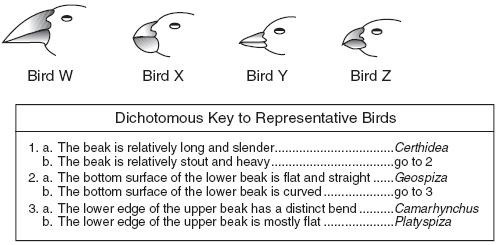
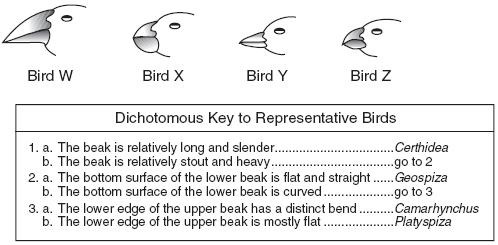


What class of vertebrates does organism T belong to?
Amphibians
Birds
Fish
Mammals

Which leaf is shown in the drawing?
Magnolia
Redbud
Sweetgum
None of the above

Look at the dichotomous key below. What are the characteristics of salamander?
Can fly
cannot fly
scales
no fur
In a dichotomous key, organisms should be classified based on their
diet
habitat
observable features
sounds they make

Identify leaf F
Cydonia
Magnolia
Aesculus
Fraxinus
Ilex

Which of the following organisms is M. erminea?
A
B
C
D
E

A
B
C
D

A
B
C
D

A
B
C
D

A
B
C
D

A
B
C
D

A
B
C
D
What word describes a trait that helps an organism survive in its environment?
natural selection
mutation
camouflage
adaptation
Based on the organism skulls, which organisms share the most recent common ancestor?
Select the two correct answers.


Based on the fossil layers shown, what can you infer about the past environment at this location?
The environment at this location has never changed
The organisms at this environment became simpler over time
The environment began as a dry land environment, then evolved into an ocean or water environment.
The environment began as an ocean or water environment, then evolved into a dry land environment.

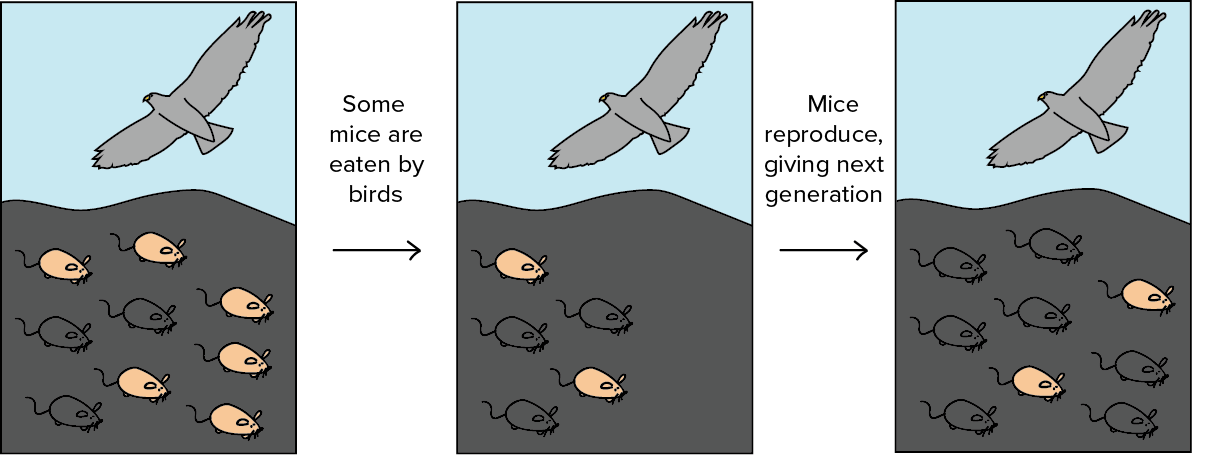
The figure shows how natural selection of a single-trait gene affects lizard survival.
Which of the following most likely causes the changes in allele distribution?
The allele for light gray coloration disappears from the population. This may be because light gray lizards are more visible to predators and therefore they might be less likely to survive and reproduce.
The allele for black coloration decreases fitness and becomes less common. This may be because black coloration keeps the lizards cool during hot summer temperatures.
Medium gray coloration in lizards appears to be a neutral mutant allele that allows the lizards to hide better from predators. This leads to increases in phenotype and allele frequency of gray coloration.
Because black and medium gray lizards are less visible to predators, these alleles are neutral to natural selection and therefore will not disappear from the population of lizards.
Which of the following is NOT part of the that mechanisms of natural selection?
Organisms produce more offspring than can survive.
Disease and natural disaster will limit population growth.
Species today descended with modifications from ancestral species.
Organisms with advantages will survive and reproduce.

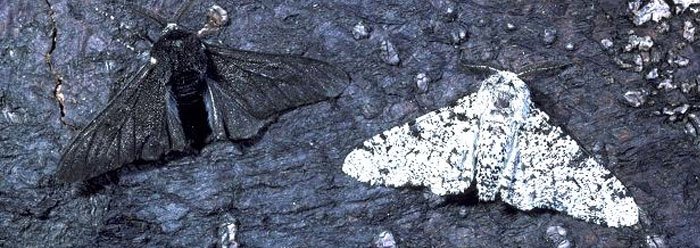
What is the most likely explanation of the data shown below?
There has been a drought in the area that is affecting all life forms.
The population of natural predators of the moths has gotten smaller.
The moths are living in an environment with light trees.
The moths are living in an environment with dark trees.

Adaptations can be:
camouflage
ability to survive cold weather
hunting skills
all of the above

Due to pollution, a pond becomes darker over time. Which trait variation became more common?
light fish
dark fish
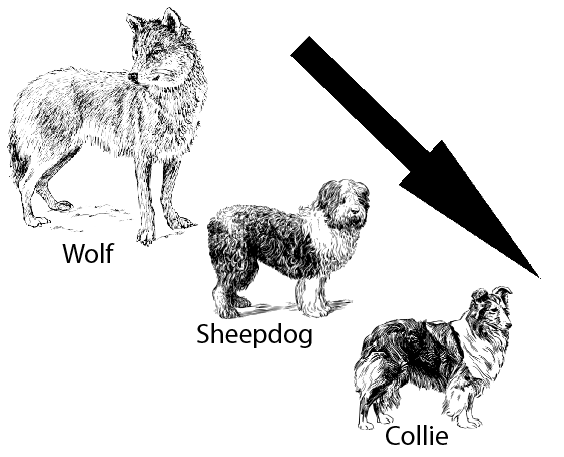
Gradualism means Natural Selection would normally happen over many generations and very
slowly
quickly
in space
beyond time
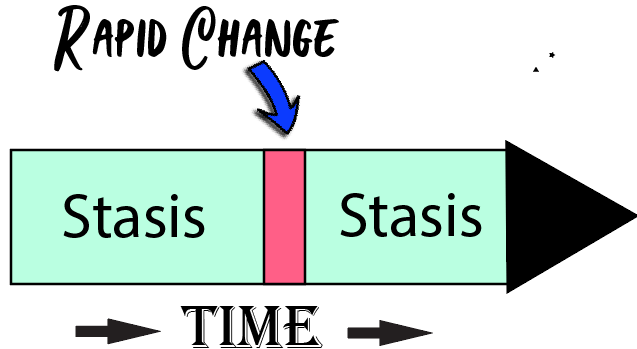
Punctuated Equilibrium implies catastrophic events caused natural selection to speed up due to great environmental changes.
True
False
Organisms of the same species do not interbreed for various reasons.
Genetic Isolation
Gene Pool
Adaptation
Survival of the Fittest
Organisms of the same species can no longer interbreed therefore creating two species.
Gene Pool
Genetic Drift
Gene Frequency
Speciation
You find a species that seems to be unicellular and is eating smaller cells around it. It has organelles and a nucleus. Which kingdom is it MOST likely a part of?
Fungi
Bacteria
Protists
Plants
Which of the following is NOT a unicellular kingdom?
Prokaryotes
Protists
Archaea
Fungi
Which one is NOT a difference between plants and fungi?
Plants use cellulose but fungi use chitin
Plants are autotrophs but fungi are heterotrophs
Plants have cell walls but fungi don't
Plants make their own food and fungi decompose their food
You identify a small living organism that is eating something at your feet. It's visible but pretty tiny, you take it to a lab and find that it has cell walls made of chitin. Which is its domain and kingdom?
Prokaryote, Fungi
Eukaryote, Fungi
Prokaryote, Plant
Eukaryote, Plant
Which is NOT a eukaryote?
Plants
Animals
Archaea
Protists
How are mammals different from all the other classes of vertebrates?
They don't have keratin
They don't have a backbone
They don't lay eggs (except two)
They aren't animals
Which best explains why a sponge is an animal?

All animals breath and sponges breath
Animals live underwater and so do sponges
Animals are multicellular heterotrophs and so are sponges



