wayground logo

Free Printable Worksheets

Font size

S
M
L
XL
Worksheets

21-22 Biology - Trimester 2 Final Units 6-9, 14

Total questions: 200

Worksheet time: 5hrs 53mins

Name
Class
Date
1.
Which is NOT true of MEIOSIS?
a)
Produces two cells
b)
Allows for genetic recombination
c)
Produces gametes
d)
Includes crossing over
2.

What are the "X" shaped things in the drawing.

a)

PMATs

b)

Chromosomes

c)

Ribosomes

d)

Telophase

3.

During what phase of Mitosis do the chromosomes line up in the Middle

a)

Metaphase

b)

Prophase

c)

Telophase

d)

Anaphase

4.

PMAT helps us remember the correct order of the phases of Mitosis. Which of the following has the phases of Mitosis in the correct Order

a)

Interphase, Mitosis, Cytokinesis

b)

Prophase, Metaphase, Anaphase, Prophase

c)

Anaphase, Telophase, Prophase, Telophase

d)

Prophase, Metaphase, Anaphase, Telophase

5.

What is the purpose of Mitosis?

a)

Growth of an organism and Repair of damaged tissue

b)

To help the body get rid of extra cells

c)

To increase the amount of classwork you have to do

d)

To get rid of the nucleus

6.
Cells spend 90% of their time in this stage of the cell cycle. This is the reason you would see most cells in this stage if viewed under a microscope.
a)
Prophase
b)
Metaphase
c)
Anaphase
d)
Interphase
7.

What is the correct order of the cell cycle?

a)

Interphase, Cytokinesis, Mitosis

b)

Interphase, Mitosis, Cytokinesis

c)

Cytokinesis, Mitosis, Interphase

d)

Anaphase, Telophase, Cytokinesis

8.
How many chromosomes does a human cell have?
a)
42
b)
46
c)
24
d)
64
9.
How many daughter cells are produced in mitosis?
a)
1
b)
2
c)
4
d)
6
10.
Sexual reproduction requires _____ parents and asexual reproduction requires ___ parents
a)
1,1
b)
2,2
c)
2,1
d)
1,2 
11.
What is a disadvantage of asexual reproduction?
a)
New species of organisms cannot come into being.
b)
The offspring does not multiply rapidly.
c)
The offspring does not live for long.
d)
All of these
12.
The genetic instructions are found in ---- within the DNA
a)
traits
b)
chromosomes
c)
genes
d)
DNA
13.
When a starfish grows a new body off a broken arm, what kind of reproduction is this?
a)
Sexual
b)
Differentiation
c)
Asexual 
d)
Specialization
14.
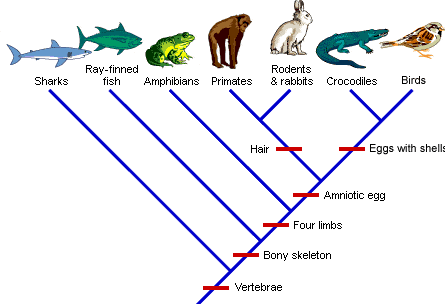
What percentage of chromosomes are handed down by a sperm cell?
a)
75%
b)
25%
c)
50%
d)
100%
15.

CROSSING OVER INCREASES

a)

LIFE SPAN

b)

GENETIC VARIATION

c)

THE NUMBER OF OFF-SPRING

d)

ALL ARE TRUE

16.

MEIOSIS

a)

REDUCES THE NUMBER OF CHROMOSOMES BY ONE HALF

b)

PRODUCES UNIQUE SEX CELLS-1N

c)

ALLOWS TRAITS TO BE PASSED TO OFFSPRING

d)

ALL ARE TRUE

e)

INCREASE GENETIC VARIATION

17.

MEIOSIS PRODUCES 4 CELLS-THE CHROMOSOME NUMBER IS ...

a)

DIPLOID

b)

HAPLOID

18.
Which process and type of resulting cells are represented?
a)
mitosis, gametes
b)
mitosis, body cells
c)
meiosis, gametes
d)
meiosis, body cells
19.
What is it called when a sperm and egg meet?
a)
meiosis
b)
fertilization
c)
cell division
d)
mitosis
20.
Females have ____ and males have _____ chromosomes.
a)
XX, XY
b)
XY, XX
c)
XX, XX
d)
XY, XY
21.
What is this?
a)
Trisomy 13
b)
Monosomy 21
c)
47, XXY
d)
Trisomy 21
22.
What do experts say is the most common form of Down Syndrome?
a)
Trisomy 47
b)
Trisomy 46
c)
Trisomy 21
d)
Trisomy 23
23.

What is the division of cytoplasm called?

a)

chromosome

b)

mitosis

c)

cytokinesis

d)

the cell cycle

24.
the uncontrolled division of cells that results in malignant growth 
a)
tissues
b)
cancer
c)
mitosis
d)
anaphase
25.

Name the phase:

Hint: Chromosomes are moving apart.

a)

Anaphase

b)

Telophase

c)

Metaphase

d)

Prophase

26.

Name the phase that all of these cells are in.

Hint: Cells spend most of their time in this phase preparing to divide.

a)

prophase

b)

anaphase

c)

interphase

d)

metaphase

27.

What is the name of the female gamete in humans?

a)

Sperm

b)

Zygote

c)

Ovary

d)

Ovum

28.

What is the main advantage of sexual reproduction?

a)

Clones being produced

b)

The offspring being genetically identical to the parents

c)

Genetic variation allowing adaptation if there is an environment change

d)

Having two parents

29.

Mutations are either inherited or caused by a mutagen in the environment.

a)

T

b)

F

30.
What are the nucleotides made of?
a)
Sugar, Phosphate, nitrogen base
b)
Phosphate, Adenine, nitrogen base
c)
Thymine, Adenine, Cytomine
d)
Phosphate, Nitrogen, Adenine
31.
Which of the following best describes a DNA molecule?
a)
double helix
b)
contains ribose
c)
made of amino acids
d)
contains Uracil
32.
Which of the following units are repeatedly joined together to form a strand of DNA? (This is the MONOMER of DNA.) 
a)
amino acids
b)
nucleotides
c)
fatty acids
d)
polysaccharides
33.
Adenine bonds with ______________.
a)
Guanine
b)
Thymine
c)
Cytosine
d)
Adenine
34.
Why is DNA important?
a)
it is very small and very complicated
b)
it's in everything
c)
it serves as the blueprint for traits of all living things
d)
because we eat it every day for energy
35.
What are the 4 nitrogen bases?
a)
adenine, thymine, cytoplasm, and guanine
b)
adenine, thymine cytosine, and guanine
c)
adenine, thymine, cytosine, and gylcerol
d)
adenine, thymine, cytosine, and glucose
36.
Which 2 molecules forms the sides (backbone) of the DNA ladder?
a)
deoxyribose and adenine
b)
deoxyribose and a hydrogen bond
c)
sugar and the nucleus
d)
deoxyribose (sugar) and phosphate
37.
In RNA, Uracil pairs with ______. 
a)
cytosine
b)
adenine
c)
guanine
d)
thymine
38.

DNA holds the code for making

a)

lipids

b)

carbohydrates

c)

proteins

d)

sugars

39.

The mRNA leaves the ________ to find the ribosome to make proteins.

a)

cell

b)

nucleotide

c)

nucleus

d)

mitochondrion

40.
The main function of tRNA is to...
a)
carry a message that, when translated, forms proteins
b)
form a portion of ribosomes
c)
string together complementary RNA and DNA strands
d)
bring amino acids from the cytoplasm to the ribosomes
41.
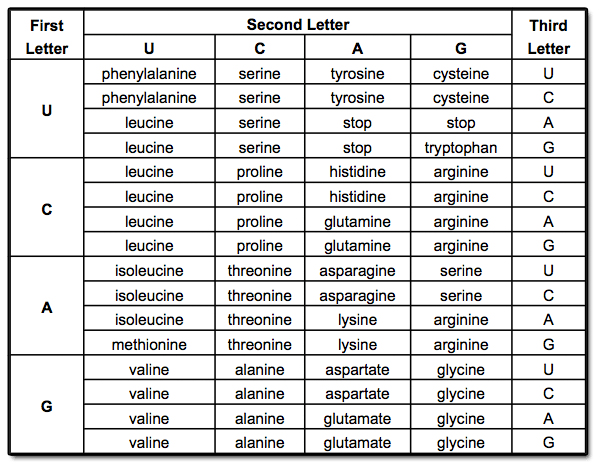
What amino acid is represented by the codon UUA?
a)
Phenylalanine
b)
Tyrosine
c)
Leucine
d)
Stop codon
42.
What part of protein synthesis does this diagram represent?
a)
mRNA
b)
tRNA
c)
rRNA
d)
RNA
43.
which process is shown?
a)
diffusion
b)
repiration
c)
recombination
d)
translation
44.
What is the three base sequence of mRNA that codes for a single amino acid?
a)
Anticodon
b)
Codon
c)
Protein
45.
What is the location in the cell for transcription?
a)
nucleus
b)
cytoplasm
c)
ribosome
d)
mitochondria
46.
Genetic info flows in one direction. Which best represents this flow?
a)
DNA-protein-RNA
b)
Protein-RNA-DNA
c)
RNA-protein-DNA
d)
DNA-RNA-protein
47.
Does the order of amino acids in a protein matter?
a)
YES!
b)
NO!
48.

What process is happening in the diagram?

a)

transcription

b)

translation

c)

dna replication

d)

mitosis

49.
Which enzyme has the job of unzipping the double helix?
a)
Helicase
b)
Polymerase
c)
Ligase
d)
Primerase
50.
Which enzyme fixes the Okazaki fragments in the lagging strand?
a)
Helicase
b)
Polymerase
c)
Ligase
d)
Primerase
51.

If a strand reads: 3' A A A T T T C 5' The matching DNA strand would read...

a)
5' T T T A A A G 3'
b)
3' T T T A A A G 5'
c)
5' A A A T T T C 3'
d)
3' U U U A A A G 5'
52.
What are the gaps between the newly synthesized DNA on the lagging strand called?
a)
Okazaki fragments
b)
Polymer gaps
c)
Helicase fragments
d)
Acidic gaps
53.
The enzyme that splits open the DNA creates what's called a fork - where the DNA separates into the lagging strand and the ______ strand.
a)
leading
b)
leveraging
c)
Okazaki
d)
ligase
54.
Polymerase is able to replicate the new DNA ______ along the leading strand.
a)
continuously
b)
only in short fragments
c)
very slowly
d)
prokaryotically
55.
Sometimes, DNA is called "semi-conservative." Why might this be?
a)
The old strand is "conserved" and used to make the new strands
b)
Uracil is "conserved" in that it is only used to make the new strands
c)
ATP is "conserved" via the usage of facilitated diffusion
d)
Ligase is "conserved" in that it is denatured by the process
56.

What enzyme is responsible for replicating DNA?

a)

RNA polymerase

b)

helicase

c)

DNA polymerase

d)

Ribosomes

57.

Which letter in the picture below depicts the leading strand in DNA replication?

a)

A

b)

C

c)

B

d)

None of the above

58.
If the percentage of DNA is made of 30% Thymine, what is the correct percentage of Guanine?
a)
30
b)
15
c)
20
d)
60
59.
Choose the nucleotide sequence of the RNA strand that would be complementary to the following strand: 
GTAGTCA
a)
UATUAGA
b)
ACGACTG
c)
CAUCAGU
d)
CATCAGT
60.
What mutation has occurred here? 
T-G-A-C-C-A
T-G-A-G-C-A
a)
Substitution
b)
Deletion
c)
Insertion
d)
Frameshift 
61.
Are all mutations bad?
a)
Yes
b)
No
62.
Any change in the sequence of DNA is...
a)
transgenic shift
b)
Single Genotype
c)
Monohybrid Trait
d)
Mutation
63.
Why are insertion and deletion (frameshift) mutations so harmful?
a)
They change all of the codons from the mutation on down the line, which changes the amino acid sequence
b)
They insert things that an organism doesn't need.
c)
They often delete things that organisms need.
d)
Insertion and deletions are not any more harmful than substitution mutations.
64.
Why is the order of amino acids so important?
a)
The order of amino acids dictates what shape the protein will fold into.
b)
It is not important. The protein folding chamber will force the protein to fold into the correct shape.
65.
DNA molecule segment is : TTACGCAAG
The mutated DNA segment is TTCGCAAG. This is an example of ___ mutation.
a)
Substitution
b)
Deletion
c)
Insertion
d)
Inversion
66.
A type of substitution in which no  amino acids change is called 
a)
Missense
b)
Nonsense
c)
Silent
d)
Deletion
67.
Which of the following can increase the rate of mutation?
a)
UV Radiation
b)
Viruses
c)
toxic chemicals 
d)
All of the above
68.
A frameshift mutation would result from...
a)
a base deletion only
b)
a base substitution only
c)
either an insertion or deletion of a base
d)
a base insertion only
69.

A way to combat disease by using a vector (often a virus) to deliver a lab-made nucleic acid (gene) to fight the disease by creating new proteins.

a)

DNA Fingerprinting

b)

Human Genome Project

c)

Genetic Engineering

d)

Gene Therapy

70.

An organism whose DNA has been modified?

a)

Genetically Modified Organism

(GMO)

b)

Human Genome Project

c)

DNA Fingerprinting

71.

What are some types of DNA Technology?

a)

Human Genome Project

b)

DNA Fingerprinting

c)

Genetic Engineering

d)

Gene Therapy

e)

All the options are correct

72.

The term cloning can refer to any of a number of biotechnologies that aim to reproduce a genetic copy of an entire organism.

a)

True

b)

False

73.

What is biotechnology?

a)

Making useful products by using living systems and organisms

b)

An area of biotechnology that is centered around the use of DNA.

c)

The aim to reproduce a genetic copy of an entire organism.

74.
Homozygous is when...
a)
the alleles are the same
b)
the alleles are different
c)
the alleles are absent
d)
the alleles are present
75.

What color of pea seed was dominant?

a)

Yellow

b)

YY

c)

yy

d)

Green

e)

Allele

76.

What is the genotype of the purebred green pea?

a)

Yellow

b)

YY

c)

yy

d)

Green

e)

Allele

77.

What is the term for each "form" of the gene for pea color?

a)

Yellow

b)

YY

c)

yy

d)

Green

e)

Allele

78.
Are recessive traits shown with capital or lowercase letters? 
a)
Capital
b)
Lowercase
79.
He is known as the father of modern day genetics.
a)
Gregory Mendel
b)
Greg Mendel
c)
Gregor Mendel
d)
Grace Mendel
80.
Tall is dominant to short. What is the phenotype of this organism?
Tt
a)
tall
b)
short
81.
What are the possible phenotypes in this punnett square?
a)
Bb, bb, BB
b)
purple, white
c)
Bb, bb
d)
light purple
82.

What does Mendel's Principle of Dominance describe?

a)

How larger animals will pass on characteristics more than small ones will

b)

How the characteristics of one allele can be dominant over another

c)

Why hybrids are often infertile

d)

Why one species can drive another species out of a habitat

83.

In two trait crosses there are four posibble phenotypes because you are crossing two separate traits. One trait might be the height (tall or short) of the plant and another trait may be the texture of the seeds (rough or smooth). which of the following describes why this occurs?

a)

incomplete dominnace

b)

codominance

c)

polygenic traits

d)

Law of independent assortment

84.

What are the possible phenotype(s) of the offspring? (A-Brown hair; a-blond hair)

a)

50 % Brown Hair and 50% Blond Hair

b)

25 % Brown Hair and 75% Blond Hair

c)

75 % Brown Hair and 25% Blond Hair

d)

0% Brown Hair and 100% Blond Hair

85.
What is the yellow seed genotype?
a)
aa
b)
Aa
c)
AA
d)
AA or Aa
86.
What genotype would go in box 2?
a)
BB
b)
Bb
c)
bb
87.

What is the probability of heterozygous offspring?

a)

0%

b)

100%

c)

50%

d)

25%

88.

What are the possible genotypes for this cross?

a)

TT = 25% Tt= 50% tt=25%

b)

all tall

c)

TT= 75% tt = 25%

d)

Tt = 100%

89.
W=white hair
w= non-white hair
If you cross a horse with WW and a horse with ww what fraction of the offspring would be expected to have white hair?
a)
none
b)
3/4
c)
1/2
d)
all
90.
Two brown eyed parents (Bb) have a baby. What is the chance the baby is blue eyed?
a)
0 %
b)
25%
c)
50%
d)
75%
91.
What goes in box 3
a)
Aabb
b)
AABB
c)
AAbb
d)
aaBb
92.
What is the genotype for a pea plant heterozygous for round seeds (R), and homozygous recessive for green seeds (y)?
a)
Ry
b)
RRyy
c)
RrYy
d)
Rryy
93.

Based off this punnett square, what fraction of the offspring will have wrinkled, yellow seeds?

a)

9/16

b)

3/16

c)

1/16

d)

16/16

94.

What is Dihybrid Inheritance?

a)

Inheritance of one characteristic

b)

Inheritance of three characteristic

c)

Inheritance of 1/2 characteristic

d)

Inheritance of two characteristics

95.
If you have a parent who has GgBb as their genotype, what are the possible alleles they could donate to their gametes?
a)
GB, Gb, gB, gb
b)
GB, GB, gb, gb
c)
Gb, Gb, Gb, GB
d)
GG, BB, gg, bb
96.
What pattern of inheritance is shown in this image?
a)
Codominance
b)
Incomplete dominance
c)
Polygenic traits
97.

What is NOT a possible genotype for someone with type B blood?

a)

IBIB

b)

IAIB

c)

IBi

98.

Which cross could produce a child with blood type A?

a)

IAi x ii

b)

IAi x IBIB

c)

IAIA x IBIB

d)

IBIB x ii

99.
this image is an example of
a)
codominance
b)
dominance
c)
incomplete dominance
100.
The sex of a child is determined by
a)
whether the father's sperm contains an x or y chromosome
b)
whether the mother's egg contains an x or y chromosome
c)
the age of the parents
101.
Why is the gene for a disease or disorder more likely to be found on the X chromosome than Y?
a)
The X chromosome has many more genes
b)
The Y chromosome has many more genes
102.
Males are more likely to suffer from a sex-linked disease or disorder because
a)
males are the weaker sex
b)
males have less DNA
c)
males have 1 X chromosome, so the disorder is more likely to be expressed
103.
When we say that a woman is a carrier for a genetic disease or disorder it means that
a)
she has 1 gene, but not the disorder
b)
she has 2 genes for the disorder
c)
she can pass the gene only to male children
d)
she can pass the gene only to female children
104.
If a gene is found only on the X chromosome and not the Y chromosome, it is said to be 
a)
sex-linked trait
b)
polygenic trait
c)
codominant trait
d)
incomplete dominance trait
105.
How many generations are shown in this pedigree?
a)
1
b)
2
c)
3
d)
4
106.
What does a filled in square represent?
a)
Not affected Female
b)
Not affected Male
c)
Affected Male
d)
Affected Female
107.
How many kids did the mother and father from the first generation have?
a)
2
b)
4
c)
5
d)
6
108.
What do half colored symbols represent?
a)
The individual is a carrier (heterozygous).
b)
The individual expresses the trait.
c)
The individual has both recessive alleles.
d)
The individual has both dominant alleles.
109.
What is this?
a)
Pedigree
b)
Karyotype
c)
Venn diagram
d)
Punnett Square
110.

Individuals that are shaded in have premature hair whitening. Is this trait dominant or recessive? How do you know?

a)

Dominant because it skips generations

b)

Dominant because it is present in every generation

c)

Recessive because it skips generations

d)

Recessive because it is present in every generation.

111.
If this pedigree shows an autosomal recessive disorder, what MUST the genotype of individual II-3 be?
a)
HH
b)
Hh
c)
hh
d)
None of the above
112.
What disease is characterized by abnormally shaped red blood cells?
a)
hemophilia
b)
sickle cell anemia
c)
phenylketonuria
d)
Huntington's 
113.
This karyotype was taken from a  ________.
a)
normal female
b)
female with Down's syndrome
c)
female with Turner's syndrome
d)
male with Turner's syndrome
114.

Genetic disorder where the gene affects the cells that produce mucus, sweat, and digestive juices. It causes these fluids to become thick and sticky. They then plug up tubes, ducts, and passageways.

a)

Klinfelter's syndrome

b)

Cystic Fibrosis

c)

Down's Syndrome

d)

Turner's Syndrome

115.

A recessive disorder where the body can't produce melanin?

a)

Albinism

b)

Tay-Sachs

c)

Achonroplasia

d)

Turner Syndrome

116.

It means that a species or a population (not an individual) will change over time as traits are passed on from generation to generation.

a)

Heredity

b)

Evolution

c)

Natural Selection

d)

Adaptation

117.

Two Parts to the Theory of Evolution (proposed by Charles Darwin)

(Choose 2)

a)

We came from monkeys

b)

The universe is 14 Billion years old

c)

Living things here today descended from common ancestry.

d)

Natural selection is a process that occurs when living things with favorable (inherited) characteristics survive to reproduce, thereby passing on those beneficial characteristics.

118.

Who is the father of evolution?

a)

Darwin

b)

Wallace

c)

Lamarck

d)

Malthus

119.

The number of living things on earth.

a)

Biodiversity

b)

Fossil

c)

Species

d)

Gene Pool

120.

______________ refers to the idea that the individuals that are most fit are those that can make it to reproductive age and pass on their traits.

a)

Selective breeding

b)

Extinction

c)

Evolution

d)

Survival of the Fittest

121.

Which of the types favors one extreme or the other?

a)

Stabalizing

b)

Directional

c)

Offsetting

d)

Disruptive

122.
How do adaptations help animals?
a)
to hide from predators
b)
to hunt for food
c)
to survive in their habitats
d)
All of these are correct
123.

Which of the following is NOT a type of adaptation?

a)

Physical/Structural

b)

Independent

c)

Physiological

d)

Behavioral

124.

Which of the following has an example of Camouflage?

a)

Physical/Structural

b)

Independent

c)

Physiological

d)

Behavioral

125.

A type of genetic drift in which small groups of organisms separate from a larger population and form new small colonies.

a)

Gene Flow

b)

Founder Effect

c)

Natural Selection

d)

Artificial Selection

126.

The exchange of genes between two populations.

a)

Genetic Drift

b)

Founder Effect

c)

Gene Flow

d)

Genetic Recombination

127.

This is a pattern of natural selection in which the average (or intermediate) form of a trait is the most advantageous, and so a population evolves away from the extremes and toward the average

a)

Disruptive selection

b)

Directional selection

c)

Stabilizing selection

d)

Middle selection

128.

A category of body structures that are formed in similar ways during embryonic development and share similar patterns of bone structure.

a)

Homologous structures

b)

Analogous structures

c)

Vestigial structures

d)

Bone structures

129.

A type of structure that is physically present, but does not seem to serve a significant function for an organism.

a)

Homologous structure

b)

Analogous structure

c)

Vestigial structure

d)

Standard structure

130.
Which layer is the youngest
a)
1
b)
2
c)
3
d)
4
131.

Which of the following is the collection of life's remains found in sedimentary rock?

a)

natural selection

b)

homologous structures

c)

Charles Darwin

d)

the fossil record

132.
A theory has significant evidence to support it.  True or False
a)
True
b)
False
133.

What is the largest divisions of geological time?

(Not the largest span of geologic time)

a)

Era

b)

Period

c)

Epoch

d)

Eon

134.

What era are we currently living in?

a)

Paleozoic Era

b)

Mesozoic Era

c)

Cenozoic Eon

d)

Cenozoic Era

135.

What was the "Age of Reptiles"

a)

Ice Age

b)

Mesozoic Era

c)

Precambrian Era

d)

Precambrian Eon

136.

In what era did the "Trilobite" become the world's dominant species?

a)

Paleozoic

b)

Mesozoic

c)

Cenozoic

d)

Precambrian

137.

What is the name of the supercontinent that separated in the Mesozoic Era?

a)

Pangea

b)

Pangaea

c)

League of Nations

d)

United Nations

138.

An organism identified with binomial nomenclature includes which two taxa?

a)

class and order

b)

family and genus

c)

genus and species

d)

kingdom and phylum

139.

What is the order of the taxonomic levels from least specific to most specific?

a)

Kingdom, Family, Species, Order, Class, Phylum, Genus

b)

Kingdom, Phylum, Class, Order, Family, Genus, Species

c)

Species, Order, Kingdom, Family, Genus, Phylum, Class

d)

Species, Genus, Family, Order, Class, Phylum, Kingdom

140.
Organisms in this smallest taxonomic group share many characteristics.
a)
domain
b)
kingdom
c)
species
d)
class
141.
How many Domains are there?
Name them:
a)
3; Archaea, Bacteria, Eukarya
b)
2; Bacteria, Eukarya
c)
1; Eukarya
d)
3; Bacteria, Eukarya, Protists
142.
A tool used by a taxonomist to identify an unknown organism is known as a __________.
a)
dichotomous key
b)
binomial nomenclature
c)
scientific name
d)
binomial key
143.
The science of classifying and naming organisms is ______________.
a)
evolution
b)
taxonomy
c)
grouping
d)
scientific names
144.

Modern Classification (Phylogeny) adds what to Linnaeus's taxonomic criteria?

a)

evolutionary relationships & DNA (biochemical characters)

b)

habitat type

c)

fewer categories than Linnaeus

d)

a naming system called binomial nomenclature
145.
According to this cladogram, primates are most closely related to -
a)
Amphibians
b)
Rodents and rabbits
c)
Crocodiles
d)
Birds
146.
According to this cladogram, birds are LEAST related to -
a)
Amphibians
b)
Sharks
c)
Ray Finned Fish
d)
Crocodiles
147.

This biome is the most diverse

a)

taiga

b)

arctic (polar)

c)

rainforest

d)

desert

148.
Which of the following best describes an ecosystem?
a)
all the living organisms in an area and their physical surroundings
b)
a region with a distinct climate
c)
all the living organisms of the same species throughout the world
d)
all the living organisms in an area
149.
What biome do we live in?
a)
Tundra
b)
Taiga
c)
Tropical Rainforest
d)

Mixed Forest/Deciduous Forest

150.
Water would be an example of ...
a)
A biotic factor
b)
An abiotic factor
151.
A collection of organisms that belong to different populations but all live in the same area and interact with one another.
a)
Population
b)
Ecosystem
c)
Community
d)
Ecosphere
152.

A non-living organism such as sunlight is a(n) ____________ factor while a living organism such as a spider is a(n) ___________ factor.

a)

chemical; non-chemical

b)

biotic; abiotic

c)

abiotic; biotic

d)

contributing; non-contributing

153.
Which biome is characterized by low temperatures and low amounts of rainfall?
a)
tundra
b)
desert
c)
temperate deciduous forest
d)
tropical rain forest
154.
Which biome has deciduous trees (which lose their leaves)?
a)
Temperate Forest
b)
Rainforest
c)
Grasslands
d)
Taiga
155.

If there are 1,000,000 producers in this pyramid of numbers, how many "herbivorous consumers" (primary consumers) can be supported?

a)

1,000,000

b)

100,000

c)

10,000

d)

1,000

156.

If only 10% of the energy in the pyramid is available as you move from one trophic level to the next, what happens to the other 90%?

a)

Passed on to decomposers

b)

Metabolized and "lost" as heat energy and waste

c)

Assembled into tissues of producers permanently

d)

False statement - 100% of the energy is available

157.

The initial source of energy for all ecosystems is...

a)

The Sun

b)

Photosynthesis

c)

Sugar

d)

There is no one source

158.

If you constructed a food chain, what role does the plant play?

a)

Producer

b)

Primary Consumer

c)

Secondary Consumer

d)

Tertiary Consumer

159.

If the average Bluefin Tun weighs 20 pounds, how many pounds of secondary consumers are needed in the third trophic level to support it?

a)

20 pounds

b)

200 pounds

c)

2,000 pounds

d)

20,000 pounds

160.

In the levels of ecological organization, all of the Bull Frogs in a pond would be an example of a...

a)

Population

b)

Community

c)

Ecosystem

d)

Biome

161.

An autotroph does

a)

Photosynthesis

b)

Cellular Respiration

162.

This is the equation for

a)

cellular respiration

b)

photosynthesis

163.
a)

Photosynthesis

b)

Cellular Respiration

164.

N2 is

a)

Nitrogen that plants take up by their roots to grow

b)

Nitrogen gas found in the atmosphere

c)

Nitrogen found in living organisms

d)

ammonia

165.

A form of nitrogen that dissolves in water so plants can use it is called

a)

NH4+ Ammonium

b)

Nitrates NO3- or Nitrite NO2-

c)

N2 Nitrogen gas

d)

NH3 Ammonia

166.

Chemical process that animals and plants use to obtain energy.

a)

Transpiration

b)

Respiration

c)

Photosynthesis

d)

Percolation

e)

Denitrification

167.

Organic material (like coal and oil) that are the remnants of dead/decayed matter from millions of years ago.

a)

Diffusion

b)

Decomposers

c)

Detrivores

d)

Fossil fuels

e)

Denitrification

168.

Which form of carbon dioxide affects global temperatures?

a)

carbon stored in plants

b)

dissolved carbon dioxide

c)

atmospheric

d)

geologic

169.

A lion eating a zebra is an example of:

a)

predation

b)

mutualism

c)

commensalism

d)

parasitism

170.

A tick living on the body of a deer

a)

predation

b)

mutualism

c)

commensalism

d)

parasitism

171.

An aphid providing food to an ant in exchange for protection

a)

predation

b)

mutualism

c)

commensalism

d)

parasitism

172.
succession that occurs in an area where soil is already present
a)
ecological succession 
b)
primary succession 
c)
secondary succession
d)
pioneer speciles
173.
the first organisms that appear in an ecological community
a)
ecological succession 
b)
primary succession 
c)
secondary succession
d)
pioneer speciles
174.
How do lichens contribute to primary succession?
a)
Lichens decompose organic matter from animals and plants
b)
Lichens begin to break down rock to form soil
c)
Lichens are nitrogen fixing bacteria
175.

The prefix Bio means

a)

life

b)

birds

c)

science

d)

ecosystems

176.

What % of the species that have every lived are alive today?

a)

1%

b)

10%

c)

50%

d)

75%

177.

Which of the following is NOT an example of a Density Dependent Factor?

a)

Parasitism

b)

Natural Disasters

c)

Predation

d)

Competition

178.

The movement of individuals into an area is known as:

a)

Supplementation

b)

Emigration

c)

Immigration

d)

Eradication

179.

The maximum amount of organisms of a species that can be supported by an environment is:

a)

exponential growth

b)

logistic growth

c)

population growth

d)

carrying capacity

180.

Which of the following is NOT an example of a limiting factor?

a)

primary productivity

b)

limiting nutrient

c)

exponential growth

d)

disease

181.

Is this graph showing exponential growth or logistical growth?

a)

Exponential

b)

logistical

182.

When resources are unlimited, populations exhibit exponential growth, resulting in a

a)

J curve

b)

S curve

c)

Logistic Growth

d)

None are correct

183.

Which of the following are a cause for the increase in the human population growth rate? Select all that apply.

a)

advances in medicine

b)

disease

c)

advances in technology

d)

global conflicts

e)

improvements in agriculture

184.

Polllutants released into the air are called emissions. When they react with sunlight, they cause

a)

acid rain

b)

ozone depletion

c)

smog

185.

Which of the following correctly desscribe ozone? Select all that apply.

a)

causes acid rain

b)

protects organisms from harmful ultraviolet radiation

c)

produced by CFC's

d)

harmful to our lungs and immune system if inhaled

186.

Resources that are not replenished as quickly as they are used are _____.

a)

renewable

b)

nonrenewable

187.

Which renewable resource pushes a turbine using flowing water?

a)

hydroelectricity

b)

biomass

c)

nuclear

d)

wind

188.

What are certain things that can affect the health of organisms and the environment? Check all that apply

a)

Pollution

b)

Acid Rain

c)

Pesticide Overuse

d)

Ozone Depletion

189.

Green House gases

a)

absorb the sun's radiation and trap heat

b)

are good for our health

c)

absorb gravity and keep us attached to Earth

d)

expulse radiation to the sun and prevent us from getting to warm

190.
 Which of the following activities contributes the most to carbon emissions globally?
a)
Deforestation
b)
Agriculture
c)
Burning fossil fuels
d)
Respiration
191.

As garbage rots in landfills this harmful gas is produced

a)

Carbon dioxide

b)

Hydrogen

c)

Methane

d)

Water vapor

192.
How is acid rain formed?
a)
Carbon monoxide and carbon dioxide mix with water in the ocean.
b)
Carbon dioxide and oxygen mix with water in the air.
c)
Sulfur dioxide and carbon monoxide mix with lake water.
d)
Sulfur dioxide and nitrogen oxide mix with water in the air.
193.

Acid rain has a pH LESS than

a)

6

b)

7

c)

8

d)

3

194.

Coal, oil and gas are examples of

a)

Shell Fuels

b)

Bone fuels

c)

Fossil fuels

d)

Sea fulels

195.
1. What makes a species invasive?
a)
Moving to a new ecosystem and taking resources from natives 
b)
Not having papers
c)
Species that can't adapt
d)
Plants that take up too much space
196.
Humans are causing extiction in which ways?
a)
By over hunting animals for food or products.
b)
By destroying the natural habitat of species.
c)
By polluting the environments of the world.
d)
All of the above.
197.
Which of these sets of three items produce CFCs
a)
cars, factories, and cardboard
b)
spray cans, cardboard, insulation
c)
spray cans, refrigerant, cardboard
d)
spray cans, refrigerant, insulation
198.

Layer of gas in the stratosphere that protects life on earth by filtering out most harmful ultraviolet radiation from the sun

a)
Greenhouse Gases
b)
Troposphere
c)
Stratosphere
d)
Ozone Layer
199.

All-natural farming practice-no pesticides used

a)

inorganic farming

b)

organic farming

c)

monoculture farming

d)

polyculture farming

200.
Concentration of toxins in an organism as a result of ingesting other plants/animals in which the toxins are widely distributed
a)
biomagnification
b)
point-source pollution
c)
artificial eutrofication
d)
consumable pollution