
 Worksheets
Zoology Semester Adaptive Review
Total questions: 205
Worksheet time: 5hrs 52mins

A knife with a small, sharp, sometimes detachable blade, used by a surgeon
Forceps
Probe
Scalpel
Formaldehyde

Used to tease and separate specimens, pin body parts, and explore dissected animals
Scalpel
Probe
Forceps
Formaldehyde

Toward the front of the body
Superior
Inferior
Posterior
Anterior
Toward the back of the body
Superior
Inferior
Posterior
Anterior
Toward the head of the body
Superior
Inferior
Posterior
Anterior
The branch of science concerned with classification of organisms
Taxonomy
Ecology
Neurology
Botany
Which is the correct order of the taxonomy levels (from most broad to most specific)?
species, genus, family, order, class, phylum, kingdom, domain
domain, kingdom, phylum, class, order, family, genus, species
kingdom, domain, class, phylum, family, order, species, genus
species, phylum, kingdom, domain, order, class, family, genus
Which domain do ALL animals belong to
Archaea
Bacteria
Eukarya
Which kingdom will we be studying in this class?
Fungi
Protista
Plantae
Animalia
Which driving force of evolution is caused by an organism adapting to their environment?
Natural selection
Genetic drift
Non-random mating
Decreased population size
What is the definition of evolution
Organisms adapting
Organisms changing
Organisms growing
A change in the gene pool within a species

Identify the type of natural selection occurring?
Stabilizing
Dissruptive
Directional
Artificial

Identify the type of natural selection occurring?
Stabilizing
Dissruptive
Directional
Artificial

Identify the type of natural selection occurring?
Stabilizing
Dissruptive
Directional
Artificial
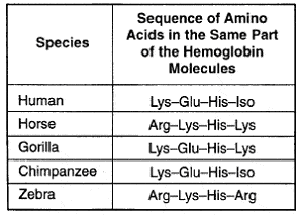
What does a cladogram show?
Same Kingdom
Same Domain
Same Family
Evolutionary relationships among organsims

Did a gorilla evolve from a tiger?
Yes
No

Which is closer related, tiger & salamander or tiger & shark?
tiger & salamander
tiger & shark
Neither
Both
What do herbivores eat?
Animals
Plants and Animals
Plants
Dead Animals
What do omnivores eat?
Animals
Plants and Animals
Plants
Dead Animals
Which of these is an autotroph?
Consumer
Producer
Decomposer
All of the biotic and abiotic factors.
community
ecosystem
population
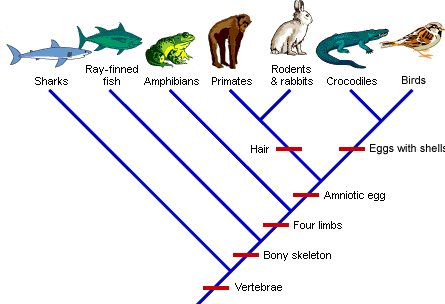





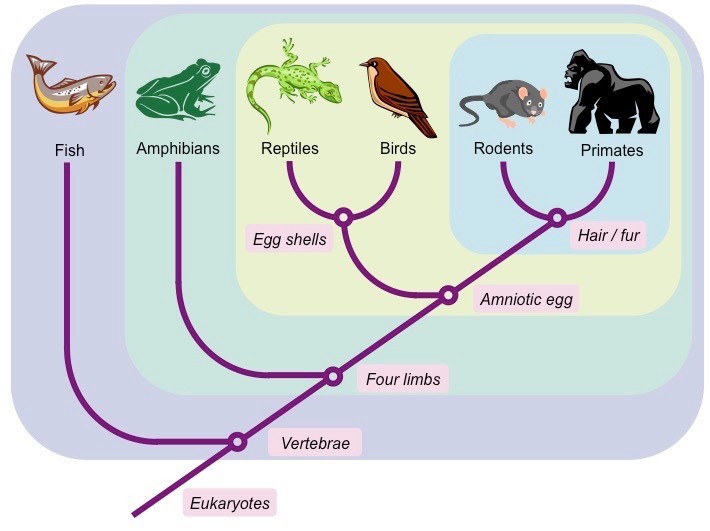
What characteristic distinguishes amphibians from birds and reptiles?
Amniotic egg
Egg shells
Vertebrae
Hair/fur

What distinguishes zebras from from giraffes?
un-branching horns (in males)
even number of toes
fur
carnivorous teeth

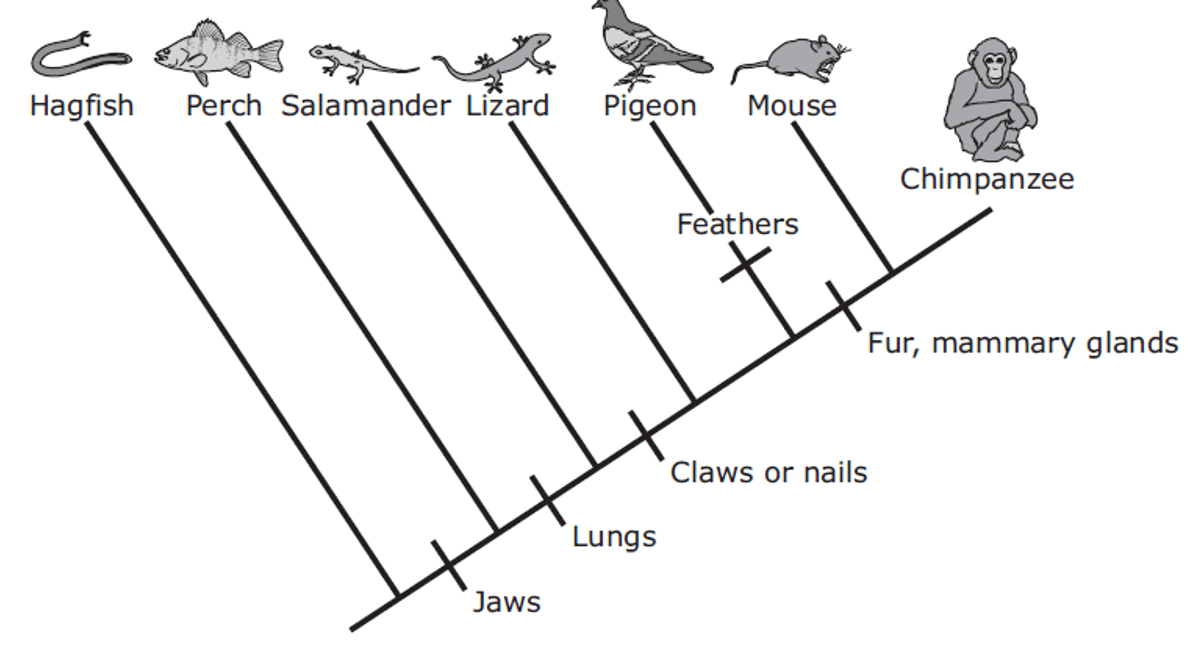
What characteristic do all the organisms on this cladogram share?
Being bi-pedal & having language
Complex brains
Fully binocular vision
Partial binocular vision & opposable thumbs


arachnids and insects?


According to this cladogram, primates are most closely related to....
Amphibians
Rodents & rabbits
Crocodiles
Birds
Which trait do only humans have, according to the cladogram?
jaws
mammary glands & hair
terrestrial during all life stages
bipedal & opposable thumbs
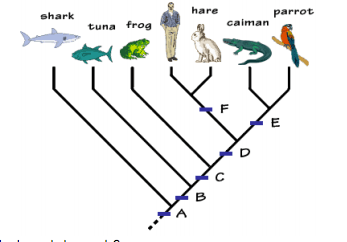
On the cladogram, which organism is the closest relative of the parrot?
Frog
Hare
Caiman
Parrot
All the animals to the right of the salamander would have the common characteristic of...
Fur
Claws or nails
Lungs
Jaws
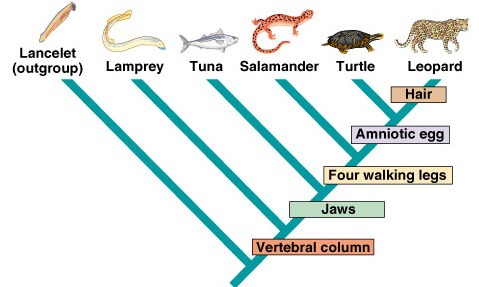
Which is the newest trait?
Amniotic egg
Walking legs
Jaws
Hair
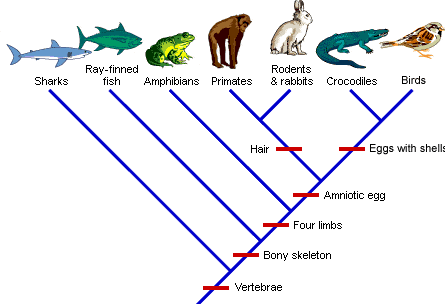
According to this cladogram, sharks are MOST closely related to which organism?
Amphibians
Ray finned fish
Crocodiles
Birds

What is this a picture of?
Pedigree
Cladogram
Family Tree
Oak Tree

Which letter represents caudal?
A
B
D
E

The arrow is pointing to which direction?
Dorsal
Medial
Transverse Plane
Lateral

The arrow is pointing to which direction?
proximal
medial
lateral
distal

This animal is divided by the _____________ plane
transverse
medial
dorsal
sagittal

Identify the direction of the RED arrow
proximal
palmar
distal
plantar

Identify the direction of the BLUE arrow
proximal
palmer
distal
plantar

Which letter is ventral?
A
B
C
D

The plane that divides the body into cranial and caudal parts:
sagittal plane
midsagittal plane
dorsal plane
transverse plane

Along the back
dorsal
ventral
distal
proximal

The arrow is pointing to which aspect?
cranial
vental
caudal
dorsal

The arrow is pointing which direction?
cranial
caudal
ventral
dorsal

The arrow is pointing to which side of the dog?
cranial
caudal
ventral
dorsal

What plane is the line showing
median
transverse
dorsal
sagittal

What plane is the line showing
median
transverse
dorsal
sagittal

What plane is the line showing
median
transverse
dorsal
sagittal
These are characteristics of Animalia, EXCEPT...
heterotroph
multicellular
prokaryotic
eukaryotic
An ...... is animal without backbone.
Vertebrate
Chordata
Invertebrate
Pisces
Which one of these has more species?
Invertebrate
Vertebrate
Based on body cavity, Animalia differs to...
coelom
acoelom
pseudocoelom
diploblastic
triploblastic

Animal that has 3 embryonic layers called as...
(a)
Animal that doesn't have body cavity called as...
(a)

Spongebob is classified in...
Phylum Chordata
Phylum Coelenterata
Phylum Porifera
Phylum Platyhelminthes
Animal's cell consist of...
cell wall
cell-membrane
Which one of these species that doesn't have true tissue?


Which one is not true about Phylum Platyhelminthes?
Flatworms
No true tissue
Acoelom
Simple circulation
Many parasitic

Snails are classified in phylum...
Arthropoda
Mollusca
Annelida
Nematoda
The basic unit of structure and function in living things
multicellular
cell
unicellular
heterotroph
A group of similar cells that perform a specific function
organ
organ system
tissue
organelle
A body structure that is composed of different kinds of tissues working together
organelle
organ
organ system
cell
A group of organs that work together to perform a major function
organ system
organ
tissue
organelle
A tiny cell structure that carries out specific function within the cell
organelle
organ
tissue
organ system
An animal without a backbone
sessile
invertebrate
vertebrate
multicellular
An animal with a backbone
vertebrate
invertebrate
tissue
organ
An organism consisting of many cells
multicellular
unicellular
taxonomy
adaptation
A reproductive process that involves 2 parents that combine their genetic material to produce a new organism
sexual reproduction
asexual reproduction
binary fission
taxonomy
An organism that cannot make its own food and gets food by consuming other living things.
heterotroph
multicellular
adaptation
sessile
The scientific study of how living things are classified
taxonomy
organ system
zoology
adaptation
The system of naming an organism based on its 2 part name, which is its genus and species
binomial nomenclature
adaptation
sexual reproduction
taxonomy
The study of animals
zoology
taxonomy
multicellular
organ system
Describes something that is permanently attached and unable to move
sessile
adaptation
organelle
heterotroph
The animal's digestive tract forms from the _______.
endoderm
mesoderm
ecotoderm
protostome
The embryo layer that forms the skin and nervous tissue is the _____.
endoderm
mesoderm
ectoderm
deuterostome
The ectoderm is on the outside of the developing embryo.
True
False
The innermost layer of the blastocyst is the
endoderm
gastrula
ectoderm
mesoderm
The middle layer of the blastocyst is the
endoderm
ectoderm
mesoderm
deuterostome
If the opening in the gastrula turns into the organisms mouth then it must be a
deuterostome
protostome
human
dog
Animal with a mouth that does NOT develop from the opening in the gastrula.
deuterostome
protostome
insect
snail
Layer of cells that lines the gastrula
endoderm
ectoderm
mesoderm
protostome
Animal in which the mouth does NOT develop from the opening in the gastrula
deuterostome
protostome
Layers of cells on the outer surface of the gastrula
ectoderm
endoderm
mesoderm
Single layer of cells surrounding a fluid-filled space that forms during early development
morula
gastrula
blastocyst
blastula

The scenario above is best described by the interaction of what three body systems?
X=respiratory system, Y=circulatory system, Z=reproductive system
X=muscular system, Y=nervous system, Z=immune system
X=circulatory system, Y=immune system, Z=muscular system
X=muscular system, Y=digestive system, Z=circulatory system

This is a complex system in our body that transports needed materials. It includes the heart and blood vessels.
skeletal system
respiratory system
digestive system
circulatory system
What is the most important function of the excretory system?
break down food
pump blood
remove waste
voluntary movement
What is the biggest function of the respiratory system?
to pump blood
to help us digest food
to take in oxygen and release carbon dioxide
to help us fight disease and infection
Which two body systems are primarily responsible for gas exchange between the body and the environment?
skeletal and muscular
circulatory and respiratory
circulatory and digestive
respiratory and excretory
How does the respiratory system depend on the circulatory system in order to function?
The circulatory system brings waste gases to the lungs and exchanges them for oxygen.
The circulatory system provides structural support and protection to the respiratory system.
The circulatory system pushes gases out of the body through the mouth and nose.
The circulatory system sends messages to the lungs so that one can breathe in and out.
How does the immune system depend on the circulatory system in order to function?
The circulatory system produces antibodies used by the immune system.
The circulatory system sends bacteria and viruses to the immune system.
The circulatory system transports immune system cells throughout the body.
The circulatory system protects the immune system from diseases.
What is the most important function of the digestive system?
gas exchange
break down food into usable nutrients
voluntary movement
fight bacteria and disease
Which two systems work together to break down and transport nutrients?
muscular and respiratory
circulatory and skeletal
digestive and circulatory
endocrine and digestive
What is the biggest function of the muscular system?
to help digest food
to help us move
to help us breathe
to help us remove waste

This is a system in the body that includes the brain, spinal cord, and nerves. It coordinates and controls the body's actions.
digestive system
nervous system
circulatory system
muscular system
Phylum Porifera
They are sponges
They are asymmetrical
They are filter feeders
All of the above
Sessile
They float from place to place
They live attached to an object their whole life
They use legs to move
They use a fin as a rudder
How do sponge obtain nutrients?
they bring water with plankton into their bodies through pores
they are filter feeders
their collar cells extract food from the water
all of the above
Cnidocytes
used for digestion
stinging cells of cnidarians
used to propel cnidarians
another word for tentacles
Ostia
central opening where water flows
motile cells found in the mesohyl
spins to create water flow in a sponge
series of tiny pores that brings water into a sponge
Osculum
simplest organisms
cells that regulate water flow
large opening where excess water flows
tiny pores that bring water into a sponge
Three types of sponge
Spongebob, sink sponge and car sponge
Gemmules, spicules and spongin
Ascon, Sycon and Leucon
Hydra, Amoeba, and Polyp
Monoecious
male and female gamete producing organs in the same body
male and female gamete producing organs housed in different bodies
sexually producing to produce offspring
sessile body form of Cnidarians
Which is not a class of sponges
Demonspongiae
Calcarea
Cnidaria
Hexactinellida
Organisms found in Phylum Cnidaria
Squids, Clams, and Octopi
Insects, Crabs and Lobsters
Bears, Cats and Goats
Jellyfish, sea anemones and Corals
Cnidarians display which type of symmetry?
Bilateral
Radial
Asymmetry
Polyp
Alternation of Generations means
that an organism is genetically diverse
that an organism can exchange DNA with other species similar to its own
that an organism displays two reproductive body forms within its life cycle
that an organism is sessile and not motile
The simplified nervous system in Cnidarians is called:
A nerve net
A brain
A gastrovascular cavity
A neuronal ring
Cnidarian Gastrovascular cavity
is a large organ made of many neurons or nerve cells
is a large opening where digestive juices are secreted to break down food particles
is a sexual organ that produces gametes
is a part of the of the tentacle
Dioecious
contains nematocysts
highly complex
separate male and female body forms
alternating between 2 body forms during an organism's life cycle.
What kind of worm is a platyhelminthes?
Flat worm
Round worm
Special ed worm
School worm
What type of symmetry do Platyhelminthes have?
Bilateral
Asymmetrical
Round
Small

Annelids reproduce by what type of reproduction?
Asexual
Sexual
Fragmentation
Both asexual and sexual
Which one of the following does NOT class of Annelid?
Oligochaeta
Polichaeta
Hirudinae
Tape worms

(earthworms)
(bristle worms)
(leeches)
(roundworms)


"jet propulsion"?


What are stinging organelles with a coiled thread found in the tentacles which are used to capture prey or defend against predators?
cnidocytes
nematocytes
choanocyte
pinacocytes
What kingdom do jellyfish and sponges belong to?
Cnidaria
Animalia
Chlorophyta
Porifera

This picture of a sea anemone would represent which form of a Cnidarian?
Larval
Polyp
Medusa
Free-swimming
Cnidarians were the first animals to develop _____________ cells so they could react to their environment.
epidermis
gastrodermis
nerve
collar
Roundworms reproduce sexually.
True
False
Free-living flatworms reproduce asexually by regeneration.
True
False
Which is true of both flatworms and roundworms?
They both have radial symmetry.
They both have bilateral symmetry.
they are both acoelomates.
They are both pseudocoelomates.
Which structures are only found in parasitic flatworms?
pharynx
eyespots
hooks and suckers
ganglia
By which mechanism are hookworms transmitted?
eating contaminated meat
drinking contaminated water
not washing their hands
going barefoot in contaminated soil

How are flatworms more complex than Cnidarians?
How they look
The way they eat
Their reproduction
They move and have a head

What makes flatworms a good hunter?
They have a head to see where their going
They are able to move
They can catch food
All of the above

What is an animal called, that can produce both sperm and eggs?
Flatworms
Hermaphroditic
Cnidarians
Cephalization
Nematodes are acoelomates.
True
False
Which of these is a common way that parasitic worms can be transmitted?
fecal-oral contact
by biting insects
consuming contaminated food or water
all of these are ways you can get worms!
Mollusks have
bilateral symmetry
radial symmetry
no symmetry
What are the three main groups of Mollusks?
Gastropods
Cephalopods
Annelids
Myriapods
Bivalves

To which group of mollusks does this squid belong?
cephalopod
bivalve
gastropod

To which group of mollusks this clam belong?
Gastropods
Cephalopods
Bivalves
Arthropods

To which group of mollusks this nautilus belong?
Cephalopods
Bivalves
Gastropods

To which group of mollusks this marine snail belong?
Gastropods
Cephalopods
Bivalves

To which group of mollusks this snail belong?
Gastropods
Cephalopods
Bivalves

To which group of mollusks this octopus belong?
Cephalopods
Gastropods
Bivalves
Which TYPE of mollusk is most intelligent?
Bivalve
Gastropod
Cephalopod
Which TYPE of mollusk has ONE or NO shell?
Bivalve
Gastropod
Cephalopod



