wayground logo

Free Printable Worksheets

Font size

S
M
L
XL
Worksheets

REVIEW for Human Anatomy & Physiology Sem II EXAM

Total questions: 100

Worksheet time: 1hrs 13mins

Name
Class
Date
1.
What is the largest organ in the human body?
a)
Skin
b)
Hair
c)
Nails
d)
All of the Above 
2.
Which layer of the skin contains lots of adipose tissue and connects the skin to muscle?
a)
Dermis
b)
Epidermis
c)
Keratin
d)
Subcutaneous
3.
Melanin:
a)
Helps protect skin from UV radiation
b)
Is found in almost every human being
c)
Is responsible for skin color
d)
All of the above
4.
Which layer of skin is "A" referring to?
a)
Epidermis
b)
Dermis
c)
Hypodermis
d)
Melanin
5.
which type of gland produces oil for waterproofing the skin? 
a)
sebaceous 
b)
 apocrine 
c)
ceruminous 
d)
eccrine 
6.
Where is the thickest skin found on the body?
a)
Soles of the feet
b)
Palms of the hands
c)
Scalp
d)
Elbows
7.
Which of the following is NOT part of the integumentary system?
a)
Skin
b)
Cartilage 
c)
Nails
d)
Hair
8.
Cancer of the bottom layer of the epidermis is called
a)
Malignant melanoma
b)
Basal cell carcinoma
c)
Impetigo
d)
Squamous cell carcinoma
9.
The sweat gland that produces "stinky" sweat is the 
a)
Apocrine gland
b)
Eccrine gland
c)
Sudoriferous gland
d)
Sebaceous gland
10.

What type of muscle tissue is found in the heart?

a)

skeletal

b)

smooth

c)

cardiac

d)

voluntary

11.

Muscles move bones by

a)

pushing

b)

pulling

c)

both pushing and pulling

12.

The elbow bends when

a)

the biceps muscle contracts

b)

the triceps muscles contracts

c)

the biceps muscle relaxes

d)

the triceps muscle relaxes

13.
The thin filament is composed of: 
a)
Myosin
b)
Actin
14.
What two chemicals are necessary for muscle contraction to occur?
a)
Niacin and Potassium
b)
Calcium and ATP
c)
Sodium and Potassium
d)
Ach and Potassium
15.
The functional contractile unit within muscle fiber is the:
a)
actin.
b)
nucleus.
c)
mitochondrion.
d)
sarcomere.
16.

Identify the highlighted muscle

a)

Deltoid

b)

Biceps

c)

Trapezius

d)

Hamstring

17.

Identify the highlighted muscle

a)

Biceps

b)

Gluteus Maximus

c)

Triceps

d)

Deltoid

18.

Identify the highlighted muscle

a)

Hamstrings

b)

Quadriceps

c)

Sartorius

d)

Gastrocnemius

19.

Identify the highlighted muscle

a)

Hamstrings

b)

Quadriceps

c)

Oblique

d)

Gluteus Maximus

20.

Which of the following is NOT a function of bones?

a)

hematopoiesis

b)

storage

c)

maintenance of body temperature

d)

protection

21.

Bone forming cells:

a)

osteocytes

b)

osteoblasts

c)

osteoclasts

d)

osteomasts

22.

Must be present in the blood at all times for the nervous system to transmit messages, for muscles to contract, and for blood to clot:

a)

calcium

b)

adipose tissue

c)

phosphorus

d)

iodine

23.

The forearm bone closest to the thumb is the __________.

a)

Ulna

b)

Radius

24.

What is the name for the connector that attaches bone to bone?

a)

ligament

b)

tendon

c)

joint

d)

cartilage

25.

What is the place where two bones meet?

a)

bones

b)

tendons

c)

ligament

d)

joint

26.

What bone is highlighted?

a)

Femur

b)

Cranium

c)

Ribs

d)

Skull

27.

What is the name for the connector that attaches muscle to bone?

a)

ligament

b)

tendon

c)

joint

d)

bones

28.

The blue bone(s) on the posterior end of the skull are called

a)

maxillary bones

b)

parietal bones

c)

nasal bones

d)

temporal bones

29.

The green bone(s) inferior to the parietal bones are called

a)

temporal bones

b)

frontal bones

c)

ethmoid bones

d)

sphenoid bones

30.

Where is the heart located?

a)

In your leg

b)

slightly left to the center of the chest

c)

slightly right to the center of the chest

d)

on the left side of your body

31.

Which of the following is associated with oxygenated blood?

a)

Aorta

b)

Pulmonary Artery

c)

Septum

d)

Right Ventricle

32.

Which of the following is associated with deoxygenated blood?

a)

Aorta

b)

Left Ventricle

c)

Tricuspid valve

d)

Septum

33.

The relaxing of the heart is known as

a)

Diastole

b)

Systole

c)

Heart Rate

d)

Cardiac Arrest

34.

Which of the following is a Blood vessel?

a)

Ventricles

b)

Heart

c)

Arteries

d)

Septum

35.

What is the role of veins in the cardiovascular system?

a)

Carry blood away from the heart

b)

Carry blood back to the heart

c)

Carry blood to the lungs

d)

Allows the exchanges of gases, nutrients and wastes between blood and the tissues

36.

What are the 3 main types of blood vessels?

a)

Capillaries, veins, aortas

b)

Capillaries, arteries, platelets

c)

Capillaries, veins, platelets

d)

Capillaries, veins, arteries

37.
Which part of the heart is this?
a)
Aorta
b)
Right Ventricle
c)
Left Atrium
d)
Left Ventricle
38.
Which part of the heart is this?
a)
Pulmonary Vein
b)
Pulmonary Artery
c)
Right Atrium
d)
Tricuspid Valve
39.

What prevents blood from flowing back into the atria when the ventricles contract?

a)

semilunar valves

b)

sinoatrial node

c)

atrioventricular node

d)

tricuspid and bicuspid valves

40.

Dopamine and Serotonin are examples of _______________

a)

Axon

b)

Neurotransmitters

c)

Somatic Nerves

d)

Autonomic Nerves

41.

Neurotransmitters are ______________ that travel across the ______________ to another cell.

a)

electrical signals; receptors

b)

electrical signals; synapse

c)

chemicals; receptors

d)

chemicals; synapse

42.

The branch like figures that receive impulses & conducts them to the cell body

a)

Dendrite

b)

Axon

c)

Cell Body

d)

Myelin Sheath

43.

What is number 3 pointing at on the neuron?

a)

Dendrite

b)

Axon

c)

Myelin Sheath

d)

Soma

44.

The pink structure is the.....

a)

frontal lobe

b)

occipital lobe

c)

parietal lobe

d)

temporal lobe

45.

Which 2 are parts of the central nervous system?

a)

brain

b)

nose

c)

spinal cord

d)

left big toe

46.

What is located below the cerebrum?

a)

The thalamus

b)

The cerebellum

c)

The diencephalon

d)

The hypothalamus

47.

When the spinal cord is severed and brain damage occurs, what substance could leak into tissues?

a)

Choroid plexus

b)

Cerebral aqueduct

c)

Cerebrospinal fluid

d)

Corpus callosum

48.

What part of the nervous system is responsible for slowing down breathing and pulse?

a)

Spinal Nerves

b)

Sympathetic

c)

Parasympathetic

d)

Spinal Nerves

49.

A rare disease in the US that leads to paralysis is known as:

a)

West Nile Virus

b)

Enephalitis

c)

Poliomyelitis

d)

Multiple sclerosis

50.

An elderly woman have tremors and shuffling of her gait might be developing:

a)

cerebral palsy.

b)

Alzheimer's disease.

c)

Parkinson's disease.

d)

multiple sclerosis.

51.

The part of the brain in charge of involuntary actions such as breathing and heartbeat.

a)

cerebrum

b)

medulla

c)

cerebellum

d)

neuron

52.

The part of the brain in charge of thinking and memory.

a)

cerebrum

b)

medulla

c)

cerebellum

d)

neuron

53.

The main function of the nervous system

a)

send messages to and from the brain and spinal cord to and from the body

b)

break down food to be used by the body

c)

remove wastes from the body

d)

all of these

54.

What carries food from the pharynx to the stomach?

a)

larynx

b)

trachea

c)

esophagus

d)

bronchioles

55.

What type of digestion takes place in the stomach?

a)

mechanical

b)

chemical

c)

both mechanical and chemical

56.

What enzyme is found in saliva that starts digesting carbohydrates?

a)

amylase

b)

chyme

c)

pepsin

d)

bile

57.

Where does the absorption of nutrients from food take place?

a)

stomach

b)

liver

c)

small intestine

d)

large intestine

58.

What makes the small intestine have such a large surface area?

a)

21 feet long

b)

villi

c)

microvilli

d)

all answers contribute

59.

What are the rhythmic muscular contractions of your esophagus called to help food move along?

a)

swallowing

b)

peristalsis

c)

inertia contractions

d)

paralysis

60.

What does the pancreas do?

a)

produces digestive enzymes to break down proteins and fats

b)

produces sodium bicarbonate to neutralize stomach acid

c)

regulates our blood sugar levels

d)

all answers are correct

61.
WHAT IS AFTER THE SMALL INTESTINE?
a)
Large intestine
b)
nothing
c)
liver
d)
pancreas
62.
Small muscular pouch responsible for storing bile
a)
pancreas
b)
mechanical
c)
amylase
d)
gallbladder
63.
The chewing and grinding of food into smaller pieces is an example of...
a)
Mechanical Digestion
b)
Chemical Digestion
64.
Bile is made by which digestive organ?
a)
Gallbladder
b)
Stomach
c)
Rectum
d)
Liver
65.
Number 4 is pointing to the....
a)
Anus
b)
Rectum
c)
Large Intestine
d)
Small intestine
66.
Number 2 is pointing to the...
a)
Esophagus
b)
Stomach
c)
Small intestine
d)
Anus
67.

ONCE FOOD IS BROKEN DOWN CHEMICALLY, IT IS TURNED INTO:

a)

BOLUS

b)

CHYME

68.
What is the volume that remains in the lungs even after a forceful exhale
a)
expiratory reserve
b)
residual volume
c)
inspiratory reserve
d)
total lung capacity
69.
What equipment is used to measure air being inspired and expired?
a)
spirometre
b)
spirometer
c)
inspirometer
d)
expirometer
70.
What muscles are used in breathing in and breathing out?
a)
diaphragm and intercostals
b)
diaphragm and lungs
c)
lungs and ribs
d)
lungs and diaphragm
71.
What is the role of the alveoli?
a)
to remove air
b)
allow air to travel to the alvelous
c)
gaseous exchange and diffusion
72.
When air pressure inside the lungs is less than air pressure in the atmosphere...
a)
Air moves into the lungs
b)
Air moves out of the lungs
73.

Which of the following is a collapsed lung

a)

Cystic fibrosis

b)

Emphysema

c)

Cyanosis

d)

COPD

e)

Pneumothorax

74.
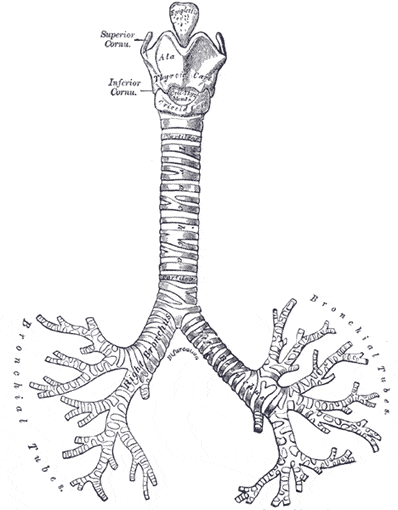
Given the following structures:
1. larynx
2. nasal cavity
3. pharynx
4. trachea
Which of the following is the correct order that air would flow during inhalation. 
a)
1,2,3,4
b)
2,3,1,4
c)
2,1,3,4
d)
4,2,3,1 
75.
When the diaphragm contracts...
a)
the volume of the thoracic cavity increases and the pressure decreases, causing air to rush into the lungs.
b)
the volume of the thoracic cavity decreases and the pressure increases causing air to rush out of the lungs. 
76.
The two main branches from the trachea (one to each lung)
a)
bronchi
b)
alveoli
c)
capillaries
d)
bronchioles
77.
The air sacs that are covered with capillaries where gas exchange takes place
a)
bronchi
b)
lungs
c)
oxygen
d)
alveoli
78.

When you breathe, your lungs take in ___ and remove ___.

a)

air/oxygen

b)

oxygen/carbon dioxide

c)

carbon dioxide/waste

d)

waste/air

79.
a flap of tissue that closes when we eat so food doesn't not go down the trachea
a)
larynx
b)
pharynx
c)
trachea
d)
epiglottis
80.

When air is pushed OUT of the lungs, what is the correct order for the tubes it passes through?

a)

bronchiole -> bronchi -> trachea -> nose

b)

bronchi -> bronchiole -> trachea -> nose

c)

trachea-> bronchi -> bronchiole-> nose

81.

What keeps your bronchi and bronchiole tubes open?

a)

cartilage rings

b)

ligament squares

c)

ciliated cells

d)

muscle

82.
What are the main organs of gas exchange in the respiratory system?
a)
diapragm
b)
lungs
c)
trachea
d)
bronchi
83.

Gaseous exchange happens because of...

a)

Osmosis

b)

Respiration

c)

Diffusion

d)

Semi-permeable membranes

84.
Dorsal refers to the front of the body
a)
True
b)
False
85.
Caudal refers to:
a)
The tail end
b)
The brain
c)
The burning of flesh to stop bleeding
86.
Proximal:
a)
Point of furthest attachment
b)
Point of nearest attachment
c)
the knee joint
87.
Superficial refers to:
a)
close to the surface
b)
deep in the body
c)
above a body part
88.
Another word to describe anterior is:
a)
ventral
b)
caudal
c)
pneumonoultramicroscopisilicovolcanoconiosis
89.
Sagittal is a plane that:
a)
is a Zodiac sign
b)
divides the body into R and L halves
c)
divides the body into top and bottom halves
90.
The anatomical position is:
a)
Standing with feet forward, arms at side, hands forward
b)
standing feet pointed outward, hands pointed inward
c)
impossible to perform unless
91.
Which organ of the excretory system stores urine until the body is ready to eliminate it?
a)
ureters
b)
urethra
c)
urinary bladder
d)
urea
92.
What is the main function of the excretory system?
a)
to collect and remove wastes from the body
b)
to strengthen skeletal muscles
c)
to protect the nervous system
d)
to bring oxygen to body cells
93.
Under normal conditions, which of the following substances is found in urine?
a)
blood cells
b)
protein
c)
glucose
d)
urea
94.
These organs are responsible for what?
a)
storing urine
b)
storing water
c)
filtering blood
d)
they don't have a particular job 
95.
What is #3?
a)
Kidney
b)
Ureters
c)
Bladder
d)
Urethra
96.
Proteins produced by B cells and designed to mark antigens to be destroyed, specific to the antigen.
a)
Antigens
b)
Active Immunity
c)
Antibodies
d)
Antibiotics
97.
First recognizes foreign body and eats it and displays it to the other cells
a)
Macrophage
b)
T Cells
c)
B Cells
98.
Which is an example of passive immunity?
a)
You have been infected
b)
You have been vaccinated
c)
You made antibodies
d)
You got your mother's antibodies
99.
What do memory cells do?
a)
Kills the virus
b)
Eats the virus
c)
Patrol the area and make the immune system work faster next time.
d)
Makes antibodies
100.
What is the first barrier against disease?
a)
White blood cells
b)
Red blood cells
c)
the skin
d)
leucocytes