wayground logo

Free Printable Worksheets

Font size

S
M
L
XL
Worksheets

Second Semester Review

Total questions: 93

Worksheet time: 2hrs 33mins

Name
Class
Date
1.
This bullseye demonstrates...
a)
High Accuracy & High Precision
b)
High Accuracy & Low Precision
c)
Low Accuracy & High Precision
d)
Low Accuracy & Low Precision
2.

Which is the more precise measurement?

a)

4 mL

b)

4.3 mL

c)

4.30 mL

d)

4.300 mL

3.

This is determined by the tool being used to take measurements

a)

Accuracy

b)

Precision

c)

Significant

d)

Estimate

4.

How close a measurement is to the accepted value is called..

a)

Accuracy

b)

Precision

c)

Significant

d)

Estimate

5.
10 cm = _____mm
a)
100
b)
1,000
c)
1
d)
0.1
6.
1,000 meter = ___________kilometer(s)
a)
0.001
b)
0.1
c)
1
d)
10
7.
648 g = ____ mg
a)
6,480
b)
64,800
c)
648,000
d)
64.8
8.
a)

22.0 mL

b)

20 mL

c)

22 mL

d)

20.2 mL

9.

What is the length of the red line?

a)

13 cm

b)

12 cm

c)

12.85 cm

d)

12.8 cm

10.

What is the distance the mouse travelled? What is the mouse's displacement?

a)

7 m; -1 m

b)

-1 m; 7 m

c)

8 m; 0 m

d)

0 m; -1 m

11.

What is the mouse's speed?

a)

1 m/s

b)

-1 m/s

c)

-0.14 m/s

d)

+0.14 m/s

12.

What is the difference between speed and velocity?

a)

speed has a direction

b)

velocity has a direction

c)

they are the same

13.

On a position-time graph, a horizontal line means

a)

the object is at rest

b)

the object is moving fast

c)

the object is moving backward

d)

it is not realistic to have a horizontal line.

14.
From point O to Point A the velocity is
a)
Increasing
b)
Decreasing 
c)
Constant
15.
From point A to Point B the velocity is
a)
Increasing
b)
Decreasing 
c)
Constant
16.
A golf ball accelerates off a tee at 15m/s2, changing its velocity from 0m/s to 50 m/s down the fairway. How long did it take the golf ball to accelerate?
a)
750 seconds
b)
35 seconds
c)
0.3 seconds
d)
3.3 seconds
17.
What is the SI unit for speed
a)
Km
b)
s
c)
m/s
d)
m/s2
18.
How long will your trip take (in hours) if you travel 350 km at an average speed of 80 km/hr? 
a)
80 hours
b)
.22 hours
c)
4.38 hours
d)

6 hours

19.
The picture of the position vs. time graph shows an object that is...
a)
accelerating/speeding up
b)
moving at a constant speed 
c)
not moving 
d)
accelerating/slowing down. 
20.
Why does a car accelerate as it round a corner at a constant speed?
a)
Its direction changes
b)
It doesn't
c)
It slows down
d)
Its speeds up  
21.
Which section of the graph shows decreasing velocity?
a)
CD
b)
DE
c)
EF
d)
GH
22.

A horse follows a dangling carrot for 20 m, if it took her 50 seconds to reach it, what was her velocity?

a)

1,000 m/s

b)

2.5 m/s

c)

0.4 m/s

d)

20 m/s

23.

The Illustration shows the force in Newtons (N) acting on three different blocks. Which boxes will move under these conditions?

a)

Blocks 1 and 2

b)

Blocks 2 and 3

c)

Blocks 1 and 3

d)

Blocks 1, 2, and 3

24.

A baseball bat hits a baseball with a force of 100 newtons. What is the force and its direction exerted by the ball on the bat?

a)

100 Newtons, same direction

b)

200 Newtons, same direction

c)

200 Newtons, opposite direction

d)

100 Newtons, opposite direction

25.
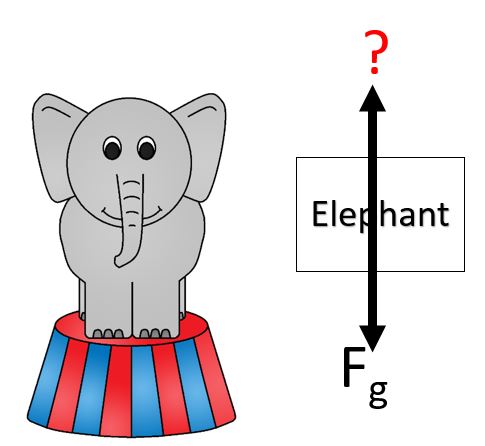
Name the missing force...
a)
Frictional force
b)
Weight force
c)
Thrust
d)
Normal force
26.
Name the missing force...
a)
weight force
b)
normal force
c)
applied force
d)
frictional force
27.

Which one is not an example of Newton's first law?

a)

A stationary car starting to move without being pushed by a force

b)

A fly being hit by a fly swatter

c)

An asteroid crashing into a planet

d)

A chair that isn't moving is picked up and thrown across the room

28.

Newton's first law states that an object at rest will remain at rest unless acted upon by...

a)

an unbalanced force

b)

a force

c)

a constant velocity

d)

a cheesecake

29.
__________ is the sum of all forces acting on an object. It is capable of accelerating a mass. 
a)
velocity
b)
gravity
c)
net force
d)
distance
30.
Newton's second law of motion describes acceleration as force divided by __________.
a)
mass
b)
inertia
c)
speed
d)
direction
31.
A 20 kg bike accelerates at 10 m/s2.  what was the force
a)
25 Newtons
b)
20 Newtons
c)
200 Newtons
d)
10 Newtons
32.

Football A has a greater mass than football B. Which football will have greater acceleration when both are thrown with the same force in the same direction?

a)

Football A

b)

Football B

c)

They will have the same acceleration

d)

Mass has no effect on acceleration

33.
How much work is being done with 200 N of force over 426 meters?
a)
85,200 J
b)
45,620 J
c)
90,480 J
d)
62,329 J
34.

The SI unit of work

a)

Joules

b)

Watts

c)

Newtons

d)

meters

35.

The SI unit for power

a)

Watts

b)

Joules

c)

Newtons

d)

Meters

36.

Gravitational potential energy depends on the ________ and ________ of the object.

a)

Height and mass

b)

Spring constant and Distance away from equilibrium

c)

Mass and Velocity

d)

Height and Friction

37.

A student with a mass of 62.0 kg walks up a flight of stairs with a height of 3.40 meters. If it takes him 7.00 seconds to get to the top, how much power did he generate?

a)

295 W

b)

2070 W

c)

86.8 W

d)

295.12 W

38.

Kinetic energy depends on the ________ and ________ of the object.

a)

Height and Mass

b)

Spring constant and Distance away from equilibrium

c)

Mass and Velocity

d)

Height and Friction

39.

If the amount of time to takes to move a box up the stairs decreases, what happens to power?

a)

decreases

b)

increases

c)

stays the same

40.

If the amount of time to takes to move a box up the stairs decreases, what happens to the amount of work?

a)

decreases

b)

increases

c)

stays the same

41.
Which type of radiation has the greatest penetrating power?
a)
Alpha
b)
Beta
c)
Gamma 
d)
Microwaves
42.
The nuclear process occurring at a nuclear power plant.
a)
Nuclear fusion
b)
Nuclear fission
c)
Combustion
d)
Multiplication
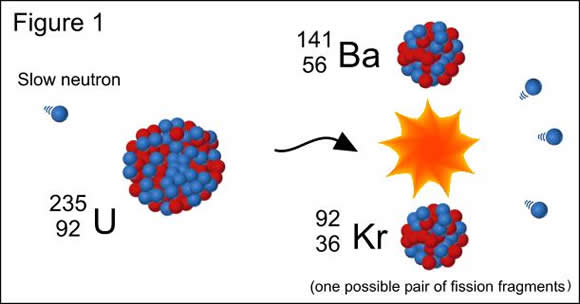
43.
Which nuclear process is shown in the picture?
a)
fission
b)
fusion
c)
alpha decay
d)
beta decay
44.
Balance the following equation:
146C --> 0-1e + ________
a)
145B
b)
146C
c)
147N
d)
42He
45.
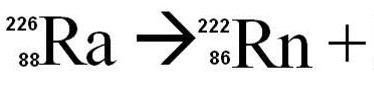
Complete the nuclear equation and determine the type of decay that is occurring in this reaction. 
a)
alpha
b)
beta
c)
gamma
d)
none
46.
Two or more nuclei combine to form one larger nucleus in the process of nuclear _____.
a)
Fusion
b)
Fission
c)
Tracing
d)
Decay
47.
Balance the following equation:
146C --> 0-1e + ________
a)
145B
b)
146C
c)
147N
d)
42He
48.
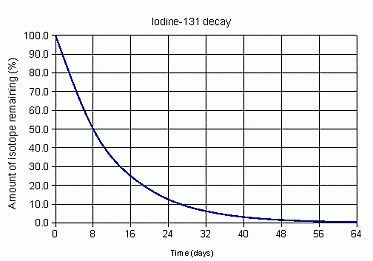
If 10 mg of iodine 131 is given to a patient, how much is left after 24 days? The half-life of iodine-131 is 8 days.
a)
1.25mg
b)
1.25g
c)
10g
d)
10mg
49.
What is the half-life of iodine-131?
a)
32 days
b)
8 days
c)
16 days
d)
24 days
50.
What is Half-life?
a)
The amount of time it takes for some of the nuclei in a sample of the isotope to decay
b)
The amount of time it takes for half the electrons in a sample of the isotope to decay
c)
The amount of time it takes for half the nuclei in a sample of the isotope to decay
d)
the amount of time it takes to double the nuclei in a sample of the isotope to decay
51.

How long would it take for a 100 gram sample of Ti-51 to decay so only 3.125 grams of radioactive material are left? The half-life of Ti-51 is 6 minutes.

a)

6 minutes

b)

24 minutes

c)

30 minutes

d)

60 minutes

52.
All waves carry
a)
energy
b)
light 
c)
matter
d)
particles
53.

Which one shows the amplitude of a wave?

a)
b)
c)
54.
In what type of wave does the medium vibrate parallel to the direction of the wave?
a)
surface wave
b)
longitudinal wave
c)
transverse wave
d)
electromagnetic wave
55.
In what type of wave does the medium move perpendicular to the movement of the wave?
a)
Transverse
b)
Longitudinal
c)
Electromagnetic
d)
Radio
56.

What is the relationship between wavelength and frequency?

a)

squared

b)

inverse

c)

direct

d)

square root

57.

A wave has the wavelength of 10 meters and a speed of 340 m/s. What is the frequency of the wave?

a)

0.029 Hz

b)

17 Hz

c)

34 Hz

d)

3400 Hz

58.
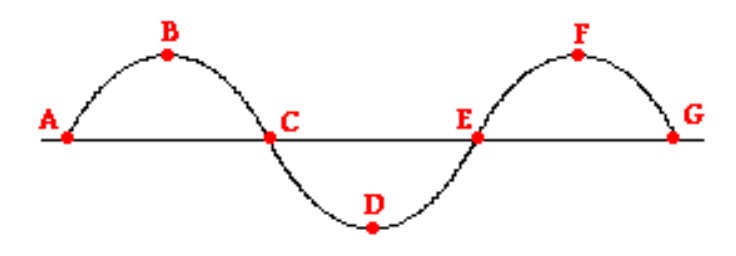
Which letter(s) represent the trough of the wave?
a)
A
b)
B & D
c)
D
d)
C & G
59.

Which letter(s) represent the wavelength of the wave?

a)

A to C

b)

B to F

c)

D to G

d)

E to F

60.
What is B?
a)
crest
b)
trough
c)
compression
d)
rarefaction
61.
The only charges that can move from one object to another are___________ charges.
a)
electric
b)
neutral
c)
positive
d)
negative
62.

Which of the following charge pairs would repel each other? (Choose all that apply)

a)

positive and negative

b)

negative and negative

c)

positive and positive

d)

negative and positive

63.

Determine how the following factor would affect the amount of resistance: longer wire

a)

increase resistance

b)

decrease resistance

c)

would not affect resistance

64.

Determine how the following factor would affect the amount of resistance: cooler temperature

a)

increase resistance

b)

decrease resistance

c)

would not affect resistance

65.

If you increase the size of the resistor and keep the voltage the same, what will happen to the current?

a)

Current will increase

b)

Current will decrease

c)

Current will stay the same

66.
The unit for current is the 
a)
Volt
b)
Ohm
c)
Electron
d)
Amp
67.
If the battery produced 12.6 Volts and what would be the current flow be for a 6 Ohm resistor
a)
2.1 Amps
b)
2.4 Amps
c)
1.71 Amps
d)
15 Amps
68.

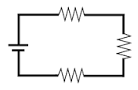
What type of circuit is this?

a)

Series

b)

Parallel

c)

Simple

69.
What type of circuit is pictured?
a)
series
b)
parallel
70.

In a series circuit, how is the brightness of a light bulb affected when another bulb is connected?

a)

It gets brighter

b)

It stays the same

c)

It gets dimmer

d)

It goes out

71.
In a _________ circuit, if one bulb goes out then the entire circuit doesn't work.
a)
Series
b)
Parallel
72.

What is the voltage at the battery?

a)

9.33 V

b)

10 V

c)

12 V

d)

22 V

e)

28 V

73.

What is the voltage at V1 (resistance is the same at all resistors)

a)

3V

b)

6V

c)

9V

d)

12V

74.

Which scientist is credited with determining that the universe is expanding with his studies on red shift.

a)

Einstein

b)

Hubble

c)

Armstrong

d)

Collins

75.

What does Hubble's Law state?

a)

the most distant galaxies moving away from earth are moving the fastest

b)

the most distant galaxies moving away from earth are moving the slowest

c)

the most distant galaxies are moving towards earth the fastest

d)

the closest galaxies to earth are not moving

76.

The concept of an expanding universe gave way to which theory

a)

steady state theory

b)

big crunch theory

c)

big bang theory

d)

red shift theory

77.

According to the Big Bang Theory, how old is the universe?

a)

6,000 years old

b)

6-10 million years old

c)

6.4 billion years old

d)

13-15 billion years old

78.

What are the two key pieces of evidence to support the Big Bang Theory

a)

red shift

b)

the size of the galaxies

c)

cosmic background radiation

d)

fusion

79.

According to the doppler effect, if an object is moving towards you the light will shift towards the _________ part of the light spectrum.

a)

red

b)

yellow

c)

blue

d)

black

80.

According to the doppler effect, if an object is moving away from you the light will shift towards the _________ part of the light spectrum.

a)

red

b)

yellow

c)

blue

d)

black

81.

What is the name of our galaxy?

a)

Snickers

b)

Milky Way

c)

Milk Dud

d)

Andromeda

82.
All the base-elements of the periodic table come from...
a)
the fission inside stars.
b)
the fusion inside stars.
c)
the fire inside stars.
d)
the fusion of planets.
83.

Which of the following are galaxy types?

a)

Spiral

b)

Elliptical

c)

Spherical

d)

Irregular

84.

Stars are born in clouds of stellar dust called _______________.

a)

nebulas

b)

galaxies

c)

planets

d)

supernovas

85.

What factor determines the life cycle of a star?

a)

color

b)

mass

c)

temperature

d)

location in the galaxy

86.

What is the last stage of our star (the sun)?

a)

red giant

b)

white dwarf

c)

supernova

d)

black hole

87.
Place these objects in order from smallest to largest.
a)
Planets, solar system, universe, galaxy
b)
Solar system, planets, galaxy, universe
c)
Planets, solar system, galaxy, universe
d)
Galaxy, solar system, planets, universe
88.
In the diagram given, what happens as we move to the left?
a)
Stars Get Larger
b)
Stars get Colder
c)
Stars get hotter
89.
Which star is the coldest?
a)
Yellow Star
b)
Red Star
c)
Orange Star
d)
Blue Star
90.
Which category is our Sun located in?
a)
White Dwarfs
b)
Supergiants
c)
Main Sequence
d)
Giants
91.
The category that contains the most stars is...
a)
Main Sequence
b)
Supergiants
c)
Giants
92.
A collection of stars, dust, and gas bound together by gravity is...
a)
Universe
b)
Solar System
c)
Planet
d)
Galaxy
93.
What is the graph that shows the relations between a star's surface temperature and absolute magnitude?
a)
H-R Diagram
b)
Star Cluster Map
c)
Einstein's Diagram
d)
Newton's Chart of Stars