wayground logo

Free Printable Worksheets

Font size

S
M
L
XL
Worksheets

Physics Final Exam Review

Total questions: 105

Worksheet time: 3hrs 43mins

Name
Class
Date
1.

How many significant figures are there in 125 meters?

a)

1

b)

2

c)

3

d)

4

2.

How many significant figures are there in 1008 grams?

a)

1

b)

2

c)

3

d)

4

3.

How many significant figures are there in 0.0054 grams?

a)

1

b)

2

c)

3

d)

4

4.

What is the product of 2.67 meters and 1.3 meters?

a)

3.4 meters

b)

3.5 meters

c)

3.47 meters

d)

3.471 meters

5.

What is the difference of 12.58 meters and 5.7 meters?

a)

7 meters

b)

6.9 meters

c)

6.8 meters

d)

6.88 meters

6.

What is the quotient of 15.3 meters and 7.4 meters?

a)

2.1 meters

b)

2.07 meters

c)

2.068 meters

d)

2.0676 meters

7.
How many sig figs are there?
0.000008
a)
1
b)
2
c)
6
d)
7
8.
How many sig figs are there?
100000000
a)
1
b)
9
c)
10
9.
1 meter = _______ cm
a)
1
b)
1,000
c)
100
d)
400
10.
Which unit is the smallest?  
a)
km
b)
mm
c)
m
d)
cm 
11.
1 L = _______ mL
a)
1
b)
10
c)
100
d)
1000
12.
The base unit of metric length.
a)
Meter
b)
Liter 
c)
Kilogram
d)
milligram
13.
The basic unit of metric volume is called a_____.
a)
Kilogram
b)
milligram
c)
Liter
d)
milliliter
14.

1 kg = (a)   g

15.

1 dg = (a)   g

16.

the distance an object travels per unit of time

a)

speed

b)

velocity

c)

acceleration

d)

displacement

17.

the distance an object travels per unit of time in a particular direction

a)

speed

b)

velocity

c)

acceleration

d)

displacement

18.

In which of the following the distance and displacement are equal

a)

motion of ball when thrown towards another player

b)

motion of an athelete running on a circular track

c)

A car travelling on one lane highway

19.

Distance and direction of an object's change in position from a starting point (HINT: Direct path from starting point to end point)

a)

displacement

b)

distance

c)

motion

d)

reference point

20.

Scott travels north 5 miles and then goes west 3 miles before coming straight back south 2 miles. What is his DISTANCE?

a)

10 mi

b)

7 mi

c)

8 mi

d)

6 mi

21.

Jasmine runs exactly 3 laps around a 400 meter track. What is the DISPLACEMENT?

a)

800 m

b)

400 m

c)

0 m

d)

1200 m

22.
After completing one trip on a roller coaster, the roller coaster's ________ is zero.
a)
displacement
b)
reference point
c)
length
d)
distance
23.
The graph respresents
a)
no motion
b)
constant velocity
c)
increasing velocity
d)
decreasing velocity
24.
At what time did runner A pass runner B?
a)
0 seconds
b)
1 second
c)
2 seconds
d)
3 seconds
25.
At 60 seconds, how far had this object traveled? 
a)
0 m
b)
10 m
c)
20 m
d)
40 m
26.
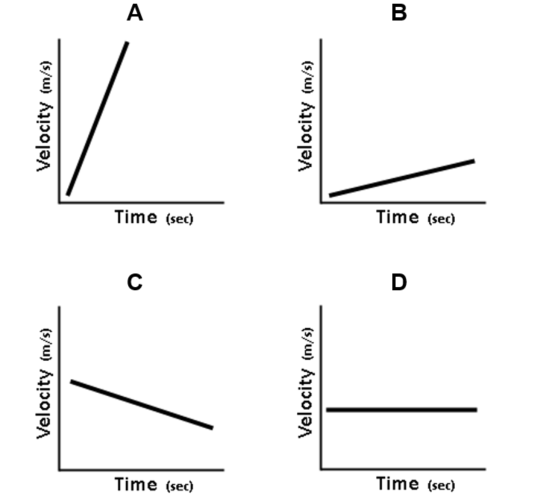
Which graph represents zero acceleration (constant velocity)?
a)
A
b)
B
c)
C
d)
D
27.

What is happening between 4 and 5 seconds?

a)

The object is slowing down in a negative direction.

b)

The object is slowing down in a positive direction.

c)

The object is speeding up in a positive direction.

d)

The object is speeding up in a negative direction.

28.

Select the two correct statements that describe the object's motion.

a)

The object is moving in the positive direction.

b)

The object is moving in the negative direction.

c)

The object is moving at a constant speed.

d)

The object is speeding up.

e)

The object is slowing down.

29.

Select the two correct statements that describe the object's motion.

a)

The object is moving in the positive direction.

b)

The object is moving in the negative direction.

c)

The object is moving at a constant speed.

d)

The object is speeding up.

e)

The object is slowing down.

30.

Select the two correct statements that describe the object's motion.

a)

The object is moving in the positive direction.

b)

The object is moving in the negative direction.

c)

The object is moving at a constant speed.

d)

The object is speeding up.

e)

The object is slowing down.

31.

What is object doing at t = 4 s to t = 6 s?

a)

At rest

b)

Speeding up

c)

Slowing down

32.

What is object doing at t = 7 s to t = 9 s?

a)

moving backward.

b)

speeding up

c)

moving forward

d)

slowing down

33.

At what time interval does the object have the greatest speed?

a)

t = 6 s to t = 9 s

b)

t = 1 s to t = 4 s

c)

t = 4 s to t = 6 s

34.
The rate at which velocity CHANGES is: 
a)
acceleration
b)
speed
c)
direction
d)
physics
35.
On a distance vs. time graph, the steeper the slope _____
a)
the slower the speed
b)
the faster the speed
c)
less acceleration
d)
greater acceleration
36.
Which graph represents the greatest acceleration?
a)
A
b)
B
c)
C
d)
D
37.
A quantity that is has magnitude and  direction is referred to as a
a)
vector quantity
b)
scalar quantity
38.
A quantity that is ignorant of direction is referred to as a
a)
vector quantity
b)
scalar quantity
39.
Wind blowing at 20 mph.Vector or scalar?
a)
Scalar
b)
Vector
40.
30 m/sec, East. Scalar or Vector
a)
Scalar
b)
Vector
c)
Neither
41.
A deer running 15 meters per second due west.Vector or scalar?
a)
Scalar
b)
Vector
42.
The _______ of two or more vectors is the sum of the vectors.
a)
components
b)
scalar
c)
resultant
d)
magnitude
43.
Which symbol is used to show vector quantities?
a)
Circle
b)
Line
c)
Arrow
d)
Triangle
44.

An example of scalar magnitude:

a)

velocity

b)

mass

c)

acceleration

d)

force

45.
If you throw a baseball straight up, what is its acceleration at the highest point?
a)
9.8 m/s2
b)
9.8 m/s
c)
0 m/s2
d)
0 m/s
46.
The more mass an object has, the faster it will fall.
a)
True
b)
False
47.
What is the horizontal acceleration of a projectile?
a)
0 m/s2
b)
9.8 m/s2
48.
What is the vertical acceleration of a projectile?
a)
0 m/s2
b)
9.8 m/s2
49.
An object is projected horizontally from a cliff.  The time it takes to hit the ground is
a)
more than if it was just dropped
b)
less than if it was just dropped
c)
the same amount of time than if it was just dropped
d)
impossible to determine
50.
Which angle will produce the greatest range (in the absence of air resistance)?
a)
0 degrees
b)
45 degrees
c)
90 degrees
d)
none of these
51.
The shape of the path a projectile follows...
a)
circular
b)
linear
c)
wavy
d)
parabolic
52.

In a projectile motion we always have...

a)

1 component (x)

b)

3 components (x,y, and z)

c)

2 components (x and y)

d)

0 components

53.

What is the direction of the acceleration for any projectile?

a)

The direction the projectile is traveling.

b)

Down

c)

Up

d)

Sideways

54.

The fact that an apple and a watermelon, dropped simultaneously from the same height, would hit the ground at the same time indicates that

a)

you don't like apples or watermelons.

b)

greater masses have greater acceleration.

c)

lesser masses have greater acceleration.

d)

acceleration is independent of mass.

55.

The initial horizontal velocity of a projectile is ____ its final horizontal velocity.

a)

less than

b)

equal to

c)

greater than

56.

What is true about the vertical velocity of a projectile launched horizontally?

a)

It is initially at its maximum value.

b)

It increases due to gravity as it falls.

c)

It remains constant throughout its trajectory.

d)

It decreases as it falls due to gravity.

57.
What is the net force and the direction of movement?
a)
50 Newtons, Left
b)
50 Newtons, Right
c)
500 Newtons, RIght
d)
450 Newtons, LEft
58.
What is Newtons 1st law of motion?
a)
Force= Mass multiplied by acceleration 
b)
An object at rest stays at rest unless acted on an unbalanced force. (inertia)
c)
For every action there is a equal and opposite  re-action.
d)
law of gravity 
59.
What law of motion does this picture represent?
a)
Newtons 3rd law
b)
Newtons 4th law
c)
Newtons 1st law
d)
Newtons 2nd law 
60.
What is Newtons 2nd law of motion?
a)
Pancakes 
b)
Force= Mass multiplied by acceleration
c)
For every action there is a equal and opposite  re-action.
d)
Law of gravity 
61.
For every action there is a equal and opposite...
a)
action
b)
movement 
c)
re-action 
d)
Newtons law of inertia 
62.
__________ is the sum of all forces acting on an object. It is capable of accelerating a mass. 
a)
velocity
b)
gravity
c)
net force
d)
distance
63.
A unbalanced force means that an object is 
a)
zero net force
b)
changing its motion
c)
sitting still
d)
object at rest
64.
What is the tendency of an object to resist a change in motion?
a)
coffee
b)
motion
c)
inertia
d)
gravity
65.
A sled sliding on a flat, icy surface with a constant velocity is best described by
a)
Newton’s first law of motion for objects at rest.
b)
Newton’s first law of motion for objects in motion.
c)
Newton’s second law of motion.
d)
Newton’s third law of motion.
66.
What is the definition of "weight"?
a)
the force in which gravity pulls on an object
b)
the time it takes to get on a ride 
c)
the amount of matter in an object
d)
the size of an object
67.
An empty truck and a fully loaded truck are next to each other at a traffic light. When the light turns green, the lighter truck increases speed more quickly. Which of these best explains this situations
a)
Newton's first law
b)
Newton's second law
c)
Newton's third law
d)
Conservation of momentum
68.
Any push or pull on an object.
a)
force
b)
velocity 
c)
inertia
d)
momentum
69.
The force that opposes motion between two surfaces in contact with each other.
a)
inertia
b)
friction
c)
momentum
d)
gravity
70.
A force that opposes motion between a surface in contact with the atmosphere.
a)
air resistance
b)
gravity
c)
momentum
d)
terminal velocity
71.

When two equal forces act in opposite directions on an object, they are called ______________________.

a)

frictional force

b)

balanced force

c)

centripetal force

d)

gravitational force

72.
A crumpled piece of paper hits the ground before a flat sheet of paper because
a)
the acceleration of gravity is greater on the  crumpled paper.
b)
there is more air resistance against the flat paper.
c)
the crumpled paper is more massive
d)
the crumpled paper is less massive.
73.

What is the unit for force?

a)

m/s2

b)

kg

c)

N

d)

F

74.

Unit for acceleration?

a)

m/s2

b)

kg

c)

newtons

d)

a

75.
Unit of mass
a)
m/s 2
b)
m/s
c)
newtons
d)
kg
76.
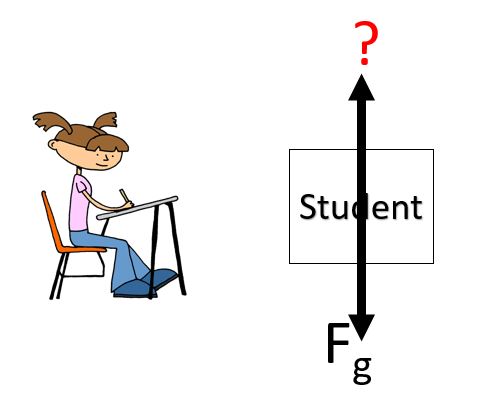
Name the missing force....
a)
weight force
b)
normal force
c)
frictional force
d)
tension force
77.
Name the missing force...
a)
spring force
b)
weight force
c)
normal force
d)
buoyant force
78.
Name the missing force...
a)
tension force
b)
frictional force
c)
normal force
d)
spring force
79.
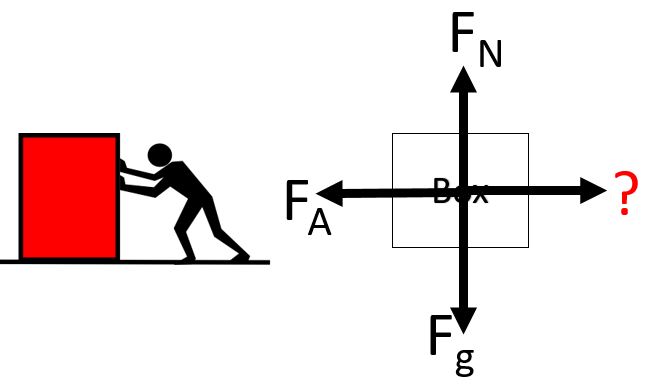
Name the missing force...
a)
frictional force
b)
weight force
c)
thrust
d)
buoyant force
80.
__________ is stored energy. 
a)
Potential
b)
Kinetic
c)
None of the above 
d)
All of the above 
81.
Gravitational potential energy depends on the ________ and ________ of the object. 
a)
Height and mass
b)
Friction and movement
c)
Mass and Movement
d)
Height and Friction 
82.
Energy due to motion is ____________ energy. 
a)
Potential 
b)
Energy
c)
Kinetic
d)
Friction
83.
At which point is potential energy greatest?
a)
W
b)
X
c)
Y
d)
Z
84.
As a pendulum swings from its highest to lowest position, what happens to its kinetic and potential energy? 
a)
Both the potential energy and kinetic energy decrease
b)
The potential energy decreases while the kinetic energy increases 
c)
The kinetic energy decreases while the potential energy increases 
d)
Bothe the potential energy and kinetic energy increase 
85.
At which point is kinetic energy greatest? 
a)
W
b)
X
c)
Y
d)
Z
86.
What is it called  when one form of energy is changed to another form?
a)
Energy change
b)
Energy conversion
c)
Electrical conversion
d)
Force change
87.
What is energy?
a)
the ability to do work
b)
mass and volume
88.
When energy moves from one form to another it is said to be _________________
a)
Transformed
b)
Eliminated
c)
Lost.
d)
Created 
89.
Energy from a compressed spring would be an example of...
a)
kinetic
b)
elastic
c)
gravitational
d)
chemical
90.

Power is _____

a)

the push or pull of an object

b)

the application of energy when an object moved

c)

is the rate of doing work

91.

The standard metric unit of power is _____.

a)

Joules

b)

Newtons

c)

Watt

92.

Which requires more work – a person walking up stairs or a person running up stairs?

a)

walking

b)

running

c)

they require equal work

d)

no work is required for either because the movement is vertical

93.
If a person does the same amount of work as someone else in half the time, which of the following is true?
a)
they did twice the work
b)
they did half the work
c)
they have twice the power
d)
they have half the amount of power
94.

Select all: Work is equal to...

a)

KE + PE

b)

Change in energy

c)

mg

d)

Fd

95.

In an elastic collision, ______ is conserved.

a)

Momentum only

b)

Kinetic Energy only

c)

Both momentum and energy

96.
In a perfectly inelastic collision, ______ is conserved. 
a)
Momentum only
b)
Kinetic Energy only
c)
Both momentum and kinetic energy
97.
Momentum is a ____________________ quantity
a)
science
b)
scalar
c)
vector
d)
energy
98.

The momentum of an object depends upon the object's ___________&_____________.

a)

size and shape

b)

mass and speed

c)

mass and veloctiy

d)

mass and energy

99.
The definition of momentum is
a)
Mass in Motion
b)
The size of an object
c)
The velocity of an object
d)
A comparison between two objects
100.
In any collision (crash) the ______ is ALWAYS constant
a)
Total Momentum
b)
total speed
c)
total Velocity
d)
Energy
101.
When the speed of an object is doubled, its momentum
a)
remains unchanged in accord with the conservation of momentum.
b)
doubles
c)
quadruples
d)
decreases
102.
The total momentum before a collision is _________ the total momentum after a collision.
a)
equal to 
b)
less than 
c)
more than
d)
It depends on the type of collision
103.
Which of the following has the least amount of momentum?
a)
An ant walking along the ground
b)
An ant at rest
c)
An elephant walking
d)
An elephant running
104.

What is the unit for momentum?

a)

m/sec

b)

kg/sec

c)

kg/m

d)

kg x m/sec

105.

In order for an object to have momentum it must be ________

a)

moving

b)

motionless

c)

alive

d)

asleep