
 Worksheets
U5 Spring Final Exam Review - Adv. Bio.
Total questions: 89
Worksheet time: 57mins

Does the presence of homologous structures in genetically different animals suggest common ancestry?
Yes
No


What type of evidence are shown in the picture above?
Fossils
Embryology
Homologous Structures
Vestigial Structures
_________________ show clear changes in an organism over time, the environment organisms lived in, the time period the organism lived in, and where the organism lived.
DNA
Vestigial structures
Fossils
Homologous structures
Recently, scientists have been able to use ___________to find common proteins and amino acids to determine how closely related species are.
DNA
Vestigial structures
Fossils
Homologous structures

What type of evidence is shown in the image above?
Fossils
Vestigial structures
Homologous Structures
DNA
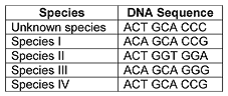

Which IS NOT used as evidence for evolution?
Fossils
Natural Selection
Early Development/Embryos
Body Structure/Anatomy
DNA/Proteins

Because whales have a pelvis and femurs, it shows whales are descended from an ancestor that was able to _____________________.
walk
sing
swim
polka

By looking at the genes of some animals we can determine which living species are most closely related to each other. This also reveals which species most recently diverged from their common ancestor.
Based on the partial gene segments shown, which pair of animals are genetically most closely related and therefore most recently diverged from their common ancestor?
Chimpanzee and Mouse
Rat and Mouse
Rat and Chimpanzee
have the ability to interbreed.

Images of the embryo and adult stages of three different organisms are shown.
Which of the following is the best conclusion that can be drawn from this evidence?
Having similar embryos indicates that these organisms eat the same types of food.
Having similar embryos indicates that these organisms live in a similar environment.
Having similar embryos indicates that these organisms share a recent common ancestor.
Having similar embryos indicates that a certain protein controls how many legs the adult organisms will have.
If a new trait DOES help an organism survive, what may happen to it?
It dies and its DNA is not passed on
It survives and its DNA is passed on
It changes its traits to adapt and survive

In the table shown, the DNA found in five primate species was compared to the DNA found in humans. The number of sequence differences was recorded. Based on the data in this table, what inference could you make about these species compared to humans?
Lemurs are most like humans.
Gorillas are most like humans.
None of the species are similar to humans.
Only the lemur differs from humans in any way.
Researchers discovered that the legs of birds are homologous to the feet of reptiles. Which claim is BEST supported by this fact?
Birds do not require legs
Birds and reptiles have a common ancestor
They randomly developed the same structures
Selection pressures have acted on birds, but not on reptiles

What evidence presented here supports the argument that vertebrates and insects evolved from a common ancestor?
The fact that the eye structures of vertebrates and insects are analogous
The fact that the genes encoding the eye structures of vertebrates and insects are analogous
The fact that the eye developmental genes of vertebrates and insects are homologous

What does it mean that the eye structures and specific genes for those structures are analogous but the genes that control eye development are homologous?
Select all that apply
It means vertebrates and insects had a common ancestor that possessed genes that coded for a primitive eye
It means every species that descended from the common ancestor developed additional genes that made changed the structure of their eye
It means that vertebrates and insects are not related to each other but developed eyes in a similar pattern

Which of these statements does NOT help explain why the development of gene sequencing technology provided a turning point in evidence gathering related to this claim?
Select all that apply
Before gene sequencing, the only evidence was the anatomical appearance of the eyes of vertebrates and insects
Because the eye structures are so different in appearance, it was easy to conclude these groups had no evolutionary relationship with each other
Gene sequencing shows that there are enough genetic similarities in the genes of eye development to suggest a very early common ancestor
Gene sequencing shows that, since the genes encoding eye structures are analogous, that vertebrates and insects share no common ancestors
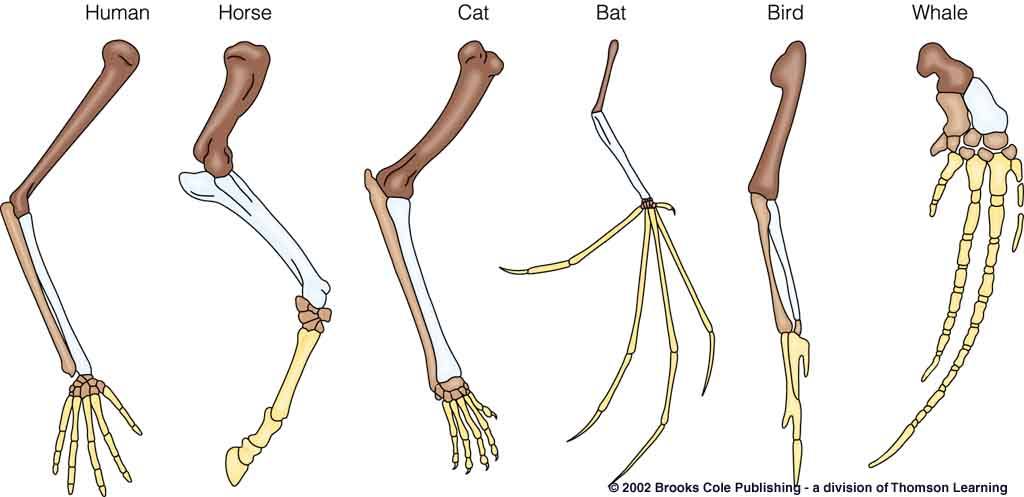
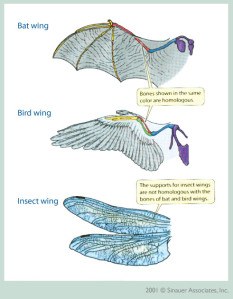

What
type
of structure?
Homologous
Analogous
Embryological
Vestigial

What
type
of structure?
Homologous
Analogous
Embryological
Vestigial

What
type
of structure?
Homologous
Analogous
Embryological
Vestigial

What
type
of structure?
Homologous
Analogous
Embryological
Vestigial

What
type
of structure?
Homologous
Analogous
Embryological
Vestigial

What
type
of structure?
Homologous
Analogous
Embryological
Vestigial
An anatomical feature that no longer seams to have a purpose in the current form of an organism
Homologous structure
Analogous structure
Vestigial structure
None of the above

Whales have pelvic bones. What type of structure does this best represent?
Homologous structure
Analogous structure
Vestigial structure
None of the above

Why would a fox's fur be brown in the summer and white in a winter?
The fox like to change fur colours.
The changing colour of the fur help the fox blend with the surroundings
The fox learn from its parents
The fox like to do that

A chameleon lies next to a large blue flower, so predators can NOT find it. This is an example of ....
camouflage
mimicry
migration
reproduction
Mimicry means ...
A tree has pink flower in the spring
A way of an animal blends with its environment
When one living thing looks like a different kind of living thing
Animals use camouflage to ...
to hunt or hide
to sleep
for fun
Which is not an example of camouflage ....
a tiger stripes blend in with long grass
a soldier's battle uniform helps him blend in to the background
a butterfly fish have an eye spot on the body to fools the predators
a polar bear has thick white fur
Camouflage means ....
a special place
a way an animals blend in with the surrounding
when an animal try to copy other animals

Which adaptation this organism using?
camouflage
mimicry
hide and seek
use body covering
Which is not an example of mimicry?
The fur of an arctic fox turn brown during the summer
The tongue of an alligator snapping turtle looks like a worm, so he lures fish to his mouth
A bad tasting butterfly & a good tasting butterfly have similar markings, so birds don't eat either kind
Which picture is not example of camouflage?


Which picture is not example of mimicry?


Darwin's Finches became separate species due to
Geographic isolation
Temporal Isolation
Behavioral Isolation
Postzygotic Isolation

The term for the formation of new and distinct species over the course of evolution is...
speciation
biological species concept
reproductive barrier
natural selection


Which of the three graphs shows directional selection?
A
B
C
______________________ is the percentage of any specific allele in the gene pool .
Gene flow
Gene pool
Genetic equilibrium
Physiological adaptations
Allelic frequency
______________________: is the transport of genes by migrating individuals .
Gene flow
Gene pool
Genetic equilibrium
Physiological adaptations
Allelic frequency
______________________: Picture all of the alleles of the population’s genes as being together in a large pool.
Gene flow
Gene pool
Genetic equilibrium
Physiological adaptations
Allelic frequency
______________________: is also disrupted by the movement of individuals in and out of a population.
Gene flow
Gene pool
Genetic equilibrium
Physiological adaptations
Allelic frequency
______________________: occurs whenever a physical barrier divides a population.
Adaptive radiation
Geographic isolation
Divergent evolution
Gradualism
Convergent evolution
______________________: is the idea that species originate through a gradual change of adaptations.
Adaptive radiation
Geographic isolation
Divergent evolution
Gradualism
Convergent evolution
______________________: occurs when populations change as they adapt to different environmental conditions, eventually resulting in new species.
Adaptive radiation
Geographic isolation
Divergent evolution
Gradualism
Convergent evolution
______________________: When an ancestral species evolves into an array of species to fit a number of diverse habitats.
Adaptive radiation
Geographic isolation
Divergent evolution
Gradualism
Convergent evolution
Bursts of change followed by periods of stability.
Punctuated equilibrium
Gradualism
Extinction
Speciation
A number of different species arise from one common ancestor.
Adaptive Radiation (aka, Divergent Evolution)
Gradualism
Coevolution
Speciation
When unrelated species evolve similar characteristics because they live in similar environments.
Convergent Evolution
Coevolution
Adaptive Radiation
Divergent Evolution
Two organisms change in response to each other forming a specialized relationship.
Coevolution
Convergent Evolution
Gradualism
Extinction
Hummingbirds have a beak just the right length to reach the nectar in a cardinal flower and as they feed their foreheads bump into the pollen structure. Cardinal flowers are red which hummingbirds can see but bees can’t. Cardinal flower’s pollen structure is just the right length for the hummingbird to pick up pollen as it feeds
Convergent
Divergent
Coevolution
Bees don’t see red, but do see yellow, blue, and ultra-violet light. Thus, bee-pollinated flowers are mostly yellow or blue with UV nectar guides (landing patterns) to guide the bee. They usually have a small, narrow floral tube to fit the tongue-length of that species of bee.
Convergent Evolution
Divergent Evolution
Coevolution
In the ocean surrounding Antarctica, there are fish that survive the cold water by using a molecule made of glycoproteins that circulates the blood and keeps it from freezing. Certain kinds of worms that live in the Arctic ocean also make antifreeze proteins that help them live in icy water.
Convergent Evolution
Divergent Evolution
Coevolution
The beaver in North America and the capybara in South America share a common ancestor, but have evolved over time to look different
Convergent Evolution
Divergent
Coevolution
Ants are the correct size and weight needed to open the flowers for the peony plant. The peony plant provides food for the ant and the ant fertilizes the peony’s flowers
Convergent
Divergent
Coevolution
The Galápagos tortoises share a common ancestor, but have necks of different lengths to best reach the food they need in their environment.
Convergent
Divergent
Coevolution
Whales, sharks, and penguins all have streamlined bodies and fins/flippers for moving in water even though they belong in different classes of animals (mammals, fish, and birds)
Convergent
Divergent
Coevolution
The Galápagos finches evolved through natural selection from a common ancestor into a wide variety of different looking species.
Convergent Evolution
Divergent Evolution
Coevolution
This kind of evolution is proven by DNA analysis and results in organisms with different ancestors becoming more alike as they adapt to similar environments.
Convergent Evolution
Divergent Evolution
Coevolution
The Galloti atlantica and Galloti galloti lizards evolved through natural selection from a common ancestor into a wide variety of different looking lizards.
Convergent
Divergent
Coevolution



