wayground logo

Free Printable Worksheets

Font size

S
M
L
XL
Worksheets

Unit 5 Review - Practice Quiz

Total questions: 131

Worksheet time: 2hrs 52mins

Name
Class
Date
1.

Cell division is also known as

a)

interphase

b)

meiosis

c)

mitosis

d)

replication

2.

Cells go through mitosis

a)

so an organism can grow

b)

so parts of an organism can heal after injury

c)

so an organism can

d)

all of these

3.

The stages of mitosis are sometimes referred to as

a)

PMAT

b)

PMAP

c)

MPTA

d)

ATPM

4.

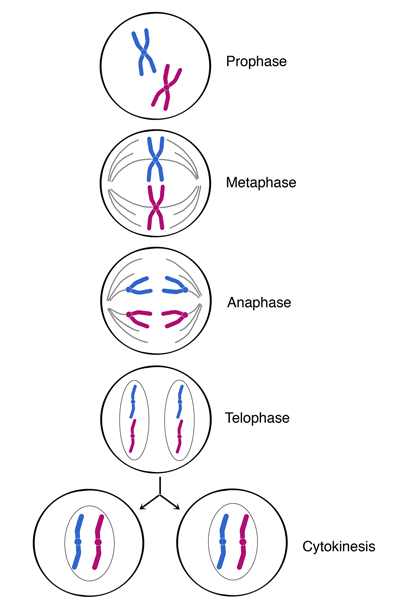
This graphic represents

a)

prophase

b)

metaphase

c)

anaphase

d)

telophase

5.

This graphic represents

a)

prophase

b)

metaphase

c)

anaphase

d)

telophase

6.

This graphic represents

a)

prophase

b)

metaphse

c)

anaphase

d)

telophase

7.

This graphic represents

a)

prophase

b)

metaphase

c)

anaphase

d)

telophase

8.

When a cell goes through mitosis, the daughter cells

a)

are genetically unique from the mother cell

b)

are genetically identical to the mother cell

c)

are used in sexual reproduction

d)

have half the number of chromosomes as the mother cell

9.

While mitosis splits the contents of the nucleus between the daughter cells, cytokineses

a)

uses microfilaments to pinch the cell in two in animals

b)

forms a cell plate in plant cells

c)

divides the cytoplasm and organelles between the daughter cells.

d)

all of these

10.

In which phase of the cell cycle does the replication of DNA occurs?

a)

G1 phase

b)

S phase

c)

G2 phase

d)

M phase

11.

What process involves the division of cell cytoplasm?

a)

Meiosis I

b)

Meiosis II

c)

Cytokinesis

d)

Karyokinesis

12.

The diagram shows the number of cells produced after a cell undergoes mitosis twice. What will be the number of cells produced if mitosis occurs two more time.

a)

8

b)

16

c)

32

d)

64

13.

Which of the following factors cause cancer cells to spread into other tissues?

I. Certain chemical compound like tar in tobacco smoke

II. Carcinogenic compounds such as formaldehyde

III. Radiation from X-rays, ultraviolet rays and gamma rays.

IV. Uncontrolled mitosis in the cell cycle

a)

I and II only

b)

III and IV only

c)

I, III and IV only

d)

I, II, III and IV

14.
The point on the chromosome where the two chromatids are held together is the
a)
centromere
b)
centriole
c)
chromosome
d)
chromatid
15.
Contains the genetic material and serves as the control center of the cell
a)
nuclear membrane
b)
spindle fibers
c)
nucleus
d)
telophase
16.
Chromosomes are made up of two identical sister _____________.
a)
chloroplasts
b)
nuclei
c)
chromatids 
d)
gens
17.
There are a TOTAL of ___ chromosomes in human body cells.
a)
23
b)
46
c)
92
d)
scientists don't know
18.
This picture shows which process? 
a)
mitosis
b)
meiosis
c)
the cell cycle
19.

Each daughter cell ends up with the ____ number of _______ as the ________ in mitosis.

a)

chromosomes, parent cel, same

b)

parent cell, same, chromosomes

c)

same, daughter cell, chromosomes

d)

same, chromosomes, parent cell

20.

Why do cells divide?

a)

To copy and divide

b)

To repair

c)

To replace

d)

All the above

21.
If a parent cell has 26 chromosomes, how many chromosomes would each daughter cell contain in mitosis?
a)
42
b)
13
c)
26
d)
1738
22.
Which cells are more efficient at obtaining nutrients?
a)
Small Cells
b)
Medium Size Cells
c)
Large Cells
d)
X-Large Cells
23.
The absorption of nutrients is determined by...
a)
The cell's volume
b)
The cell's surface area
c)
The cell's ribosomes
d)
The cell's DNA
24.
The amount of nutrients needed is determined by...
a)
The cell's volume
b)
The cell's surface area
c)
The cell's Rough ER
d)
The cell's Smooth ER
25.
Which type of cell is easier to get Oxygen in and waste out?
a)
small cell
b)
large cell
26.
As a cell becomes larger, its
a)
surface area increases faster than its volume.
b)
volume increases faster than its surface area
27.
The larger a cell is, the more difficult it is for the cell to move enough nutrients and wastes across its cell membrane to maintain its normal functions.
a)
True
b)
False
28.
As a cell’s size increases, its ratio of surface area to volume decreases.
a)
True
b)
False
29.
The amount of space something takes up is called the.... 
a)
Surface area
b)
Perimeter 
c)
Volume
d)
Weight
30.

Which of the following is least efficient?

a)

A

b)

B

c)

C

d)

D

31.

Which of the following has the largest surface area to volume ratio?

a)

A

b)

B

c)

C

d)

D

32.

what could be the cause for a cell to undergo apoptosis?

a)

DNA damage

b)

Radiation

c)

Nutrient deficiency

d)

All of the above

33.

Apoptosis can't kill which of the following?

a)

Cell infected with viruses

b)

Cell with DNA damage

c)

Cancer cells

d)

Immune cells

34.

Which of the following statements is correct?

a)

Cells communicates with one another in multicellular organisms using extracellular signalling molecules or hormones.

b)

Cells communicates with one another in unicellular organisms using extracellular signalling antigens and antibodies.

c)

Cells communicates with one another in multicellular organisms using intracellular signalling molecules only.

d)

Cells communicates with one another in unicellular organisms using intracellular signalling antigens and antibodies.

35.

_______ are the smallest units of life because they grow, reproduce, respond, and use energy.

a)

atoms

b)

elements

c)

cells

d)

all of the above

36.

Cells come from______.

a)

other preexisting cells

b)

cytoplasm

c)

organelles

d)

prokaryotes

37.

The cell theory states that_________

a)

cells come from cells

b)

all organisms are made of cells

c)

cells are the basic unit of structure and function for life

d)

all of the above

38.

________ is the scientist who saw small chambers when looking at cork, and named them “cells”.

a)

Newton

b)

Hooke

c)

Carson

d)

Manning

39.

The size of an organism is determined -

a)

by the size of the cells that make up the organism.

b)

by the number of cells that the organism has.

40.

The cell theory is a result of the work of one very important scientist name Hooke.

a)

True

b)

False

41.

A multicellular organism is made of

a)

one cell

b)

multiple cells

c)

unicellular cells

d)

there is no such thing as a "multicellular" organism

42.

One common feature of all cells is their ability to -

a)

work with other cells in a "unicellular" organism.

b)

reproduce themselves.

c)

be formed by spontaneous generation.

d)

exist without needing a cell membrane

43.

When a cell is ready to reproduce, it duplicates its contents, then divides into two similar (and sometimes exact duplicate) cells.

a)

True

b)

False

44.

Regardless of type, all cells

a)

have a cell membrane

b)

have cytoplasm

c)

can duplicate themselves by undergoing cell division

d)

all of the above

45.
Who are the three scientists credited with creating the Cell Theory?
a)
Schlieden, Schwann, Virchow
b)
Schindler, Schmeil, Vanderhoot
c)
Schwimmer, Shanazzek, Van Halen
46.
The first part of the Cell Theory states: "What happens in Cell Theory, stay in Cell Theory."
a)
True
b)
False
c)
I don't know
d)
Ummmm
47.
The second part of Cell Theory states: "All living organisms are made up of cells."
a)
True
b)
False
c)
I don't know
d)
If you say so
48.
The third part of cell theory states: "All cells come from prehistoric cells."
a)
False
b)
True
c)
Yep
d)
Not even close
49.
When observing cells, which of the following pieces of equipment is most appropriate?
a)
Hand lens
b)
Telescope
c)
Petri dish
d)
Microscope
50.
Why are microscopes important when studying most cells?
a)
Most cells are very large.
b)
Most cells are very small.  
c)
Most cells move very quickly.
d)
Most cells are dead.  
51.
Which of the following is NOT one of the basic points of Cell Theory?
a)
All living things are made of cells.
b)
The cell is the smallest living thing that can perform all the functions of life.
c)
Cells are too small to see without a microscope.  
d)
All cells must come from pre-existing cells.
52.
All organisms are made of:
a)
organelles
b)
cytoplasm
c)
DNA
d)
cells
53.
Rocks are not living because
a)
they never move
b)
they aren't needed for humans
c)
they are not made of cells
d)
they don't break down
54.
There are three parts to the cell theory. Which is NOT one of those parts?
a)
All organisms are composed of one or more cells.
b)
The cell is the basic unit of structure and organization in organisms.
c)
Cells spontaneously arise from carbon and nutrients carried in the bloodstream.
d)
All cells come from pre-existing cells.
55.
Anton van Leeuwenhoek made his own version of the microscope and discovered something very odd when he looked a the gunk on his teeth. What did he discover?
a)
Cells
b)
Bacteria
c)
Cavities
d)
Influenza
56.
Histones are 
a)
proteins wound up in DNA
b)
critical to maintaining the shape of chromosomes
c)
aid in the tight packing of DNA
d)
all of these 
57.
How many DNA molecules make up a chromosome?
a)
1
b)
2
c)
23
d)
46
58.
Each identical side of a chromosome is the 
a)
centromere
b)
chromatin
c)
centriole
d)
chromatid
59.
When DNA is in its less coiled, "relaxed," state, between cell divisions, it is called
a)
autosomes
b)
chromatid
c)
chromatin
d)
centromere
60.
The structure that holds two chromosomes together until they separate for cell division is the
a)
chromatid
b)
chromatin
c)
centromere
d)
cytoplasm
61.

A _______ is a segment of DNA that controls our traits.

a)

gene

b)

gamete

c)

chromosome

d)

chromatid

62.

A _________ is DNA tightly coiled around proteins.

a)

gene

b)

chromosome

c)

trait

d)

mutation

63.

The 2 exact copies of DNA in a chromosome are called ________.

a)

chromatids

b)

genes

c)

mutations

d)

pathogens

64.

How many chromosomes does a human body cell have, total?

a)

48

b)

46

c)

23

d)

47

65.

How many chromosomes do we get from each parent?

a)

12

b)

23

c)

46

d)

78

66.

Chromosomes are only visible when a cell divides.

a)

True

b)

False

67.

The disc shaped protein core that DNA wraps around is called

a)

histone

b)

nucleosome

c)

chromatin

d)

gene

68.

Chromosomes contain genetic information in the form of

a)

DNA

b)

histone

c)

centromere

d)

karyotypes

69.

A histone core with DNA wrapped around it is called a

a)

somatic cell

b)

gene

c)

centromere

d)

nucleosome

70.

A segment of DNA

a)

nucleosome

b)

gene

c)

histone

d)

chromatin

71.

The substance that chromosomes are composed of is called

a)

nucleosomes

b)

DNA

c)

chromatin

d)

histones

72.
The structures labeled B are
a)
centrioles
b)
chromatids
c)
centromeres
d)
chromopheres
73.
The structure labeled A is a(n)
a)
chromatid
b)
centriole
c)
centromere
d)
chromophere
74.
Which part of the Cell Cycle takes the longest?
a)
Interphase
b)
Mitosis
c)
Prophase
d)
Cytokinesis
75.
What happens in the first part of Interphase?
a)
Mitosis
b)
Cell Growth
c)
DNA Replication
d)
Anaphase
76.
What part of the cell cycle results in the splitting of the new cells?
a)
Interphase
b)
Mitosis
c)
Metaphase
d)
Cytokinesis
77.
What does DNA Replication mean?
a)
DNA is made.
b)
DNA makes new cells. 
c)
DNA copies itself.
d)
DNA starts the cell cycle.
78.
True or False. 
After a cell goes through cytokinesis, it starts mitosis all over again.
a)
True
b)
False
79.
What phase is this cell in?
a)
Cytokinesis
b)
Mitosis
c)
Prophase
d)
Metaphase
80.
What phase is this cell in?
a)
Mitosis
b)
Interphase
c)
Anaphase
d)
Telophase
81.
What phase is this cell in?
a)
Mitosis
b)
Cytokinesis
c)
Prophase
d)
Telophase
82.
What phase is this cell in?
a)
Mitosis
b)
Interphase
c)
Prophase
d)
Telophase
83.
What part of the cell cycle is this cell in?
a)
Mitosis
b)
Interphase
c)
Telophase
d)
Cytokinesis
84.
True or False.
Mitosis is made up of 5 phases.
a)
True
b)
False
85.
In what phase do the chromosomes line up in the middle of the cell?
a)
Cytokinesis
b)
Metaphase
c)
Prophase
d)
Telophase
86.
In what phase does chromatin condense to form chromosomes?
a)
Mitosis
b)
Interphase
c)
Prophase
d)
Anaphase
87.
In what phase do the chromosomes get pulled apart into sister chromatid to opposite sides of the cell?
a)
Prophase
b)
Interphase
c)
Metaphase
d)
Anaphase
88.
In what phase do the organelles disperse out into the daughter cells, and the cell prepares for cytokinesis?
a)
Prophase
b)
Interphase
c)
Mitosis
d)
Telophase
89.
What can the cell cycle also be called?
a)
Cell growth
b)
DNA Replication
c)
Preparation for Mitosis
d)
Cell Divison
90.
During what stage does the G1, S and G2 phases happen?
a)
Interphase
b)
M phase
c)
Mitosis
d)
Cytokinesis
91.
During which stage of the cell cycle does mitosis and cytokinesis occur?
a)
Interphase
b)
S phase
c)
M phase
d)
G1 phase
92.
During what phase of the cell cycle does the cell grow?
a)
G1 phase
b)
S phase
c)
M phase
d)
Cytokinesis
93.
Put the following stages of mitosis in order: anaphase, prophase, metaphase, and telophase. 
a)
prophase, metaphase, telophase, anaphase
b)
prophase, anaphase, metaphase, telophase
c)
prophase, metaphase, anaphase, telophase
d)
prophase, telophase, metaphase, anaphase
94.
Put the following stages of the cell cycle in order: G2, S, G1, M. 
a)
G1, S, G2, M
b)
S, G1, G2, M
c)
G1, M, G2, S
d)
M, G1, S, G2
95.
Put the following actions in order: DNA replicates, cell grows, cell divides, cell prepares for mitosis. 
a)
DNA replicates, cell grows, cell prepares for mitosis, cell divides
b)
cell grows, cell prepares for mitosis, DNA replicates, cell divides
c)
cell grows, DNA replicates, cell prepares for mitosis, cell divides
d)
DNA replicates, cell prepares for mitosis, cell grows, cell divides
96.
All Offspring of Asexual reproduction are identical
a)
True
b)
False
97.
How many parent(s)are needed for asexual?
a)
4
b)
1
c)
9
d)
100
98.
Which process is considered to be faster? 
a)
Asexual
b)
Sexual 
99.
How are genetic traits passed down from generation to generation?
a)
Chromosomes
b)
Reproduction
c)
DNA
d)
Genes
100.
True or False: Fission is a way to reproduce asexually.
a)
True
b)
False
101.

Which of the following statements are true about asexual reproduction? (chose all that apply)

a)

Asexual reproduction requires only one parent.

b)

The offspring in asexual reproduction are clones of the parent.

c)

The offspring in asexual reproduction are produced by mitosis.

d)

The offspring in asexual reproduction are produced by meiosis.

102.

Many plants reproduce asexual. Which of the following is not a form of plant asexual reproduction?

a)

Underground roots tubers or bulbs that can grow into new plants.

b)

Binary Fission

c)

Plant runners like the spider plant, and many berries

d)

Budding

103.

A hydra reproduces when an outgrowth, or bud, forms and continues to develop until it falls off of the parent. This is an example of:

a)

Binary Fission

b)

Sporulation

c)

Budding

d)

Vegetative Propagation

104.
a)
budding
b)
sporulation
c)
vegetative propagation
d)
binary fission
105.

Which is a type of Asexual Reproduction

a)

Sexual

b)

Binary fission

c)

Cells

d)

organism

106.

Cutting the roots from a carrot and allowing it to grow into a newly formed daughter carrot is called __________.

a)

Vegetative Reproduction

b)

Cloning

c)

Binary Fission

d)

Plants vs. Zombies

107.
What is cell differentiation?
a)
Process by which cells produce more cells
b)
Process by which cells become specialized
c)
Process by which cells become unspecialized
d)
Process by which cells die
108.
What is one goal of cellular differentiation/specialization?
a)
To create specialized cells to help organism maintain homeostasis.
b)
To many cells.
c)
To make stem cells
d)
to make single celled organisms
109.
Stem cells are
a)
cells that grow uncontrollably
b)
undifferentiated and can be any type of cell
c)
never go through cell division
d)
only found in embryos
110.
what is the role of stem cells in the body 
a)
fight against infection 
b)
provide specialized roles in the body 
c)
used for fertility treatment 
d)
they produce new specialized cells in the body to replace old cells that are used up 
111.
Stem cell research is controversial because in involves?
a)
social issues
b)
ethical issues
c)
educational issues
d)
economical issues
112.
What is the difference between embryonic stem cells and adult stem cells?
a)
Embryonic stem cells can differentiate into more cell types than adult stem cells
b)
Adult stem cells are pluripotent, just like embryonic stem cells
c)
Adult stem cells can differentiate into more cell types than embryonic stem cells
d)
Adult stem cells grow bigger than embryonic stem cells
113.
Why are scientists interested in studying stem cells?
a)
They never die.
b)
They come from the brain stem. 
c)
They can be transplanted into monkeys.
d)
They can become any type of cell.
114.
What is the importance of apoptosis?
a)
To eliminate damaged or unnecessary cells
b)
To create specialized cells
c)
To produce two identical cells
d)
To cause uncontrolled cell growth
115.
Stem cells can be obtained from
a)
embryos
b)
some adult tissues
c)
umbilical cord blood
d)
all of the above
116.
What process best explains how muscle cells and nerve cells can develop from the same fertilized egg?
a)
genetic engineering
b)
survival of the fittest
c)
differentiation
d)
selective breeding
117.
This type of cell sends messages throughout the body in the form of electrical impulse.
a)
nerve cell
b)
sperm cell
c)
muscle cell
d)
skin cell
118.
This type of cell carries oxygen throughout the body.
a)
gamete
b)
platelet
c)
white blood cell
d)
red blood cell
119.
How do stem cells know what type of cells to differentiate into?
a)
The nucleus has instructions to turn some genes on and some genes off.
b)
Signals from chemicals in the organism or from the environment determine which genes will be turned on and off.
c)
Genes turn on and off randomly.
d)
The cell has unique DNA that determines what the cell will become.
120.

What is Apoptosis?

a)

A tumor

b)

A protein

c)

Programmed cell death

d)

Cell cycle checkpoints

121.

What is cell differentiation?

a)

The process where unspecialized cells become different in structure and function.

b)

When DNA controls the cell cycle.

c)

The ability of cells to make more cells.

d)

The ability of cells to maintain homeostasis.

122.

The embryo layer that forms the skin and nervous tissue is the _____.

a)

endoderm

b)

mesoderm

c)

ectoderm

d)

deuterostome

123.

The animal's digestive tract forms from the _______.

a)

endoderm

b)

mesoderm

c)

ecotoderm

d)

protostome

124.

The ectoderm is on the outside of the developing embryo.

a)

True

b)

False

125.

The innermost layer of the blastocyst is the

a)

endoderm

b)

gastrula

c)

ectoderm

d)

mesoderm

126.

The middle layer of the blastocyst is the

a)

endoderm

b)

ectoderm

c)

mesoderm

d)

deuterostome

127.

How can a person's muscle cells have the same exact DNA sequences as their nerve cells even though the look and perform completely different?

a)

The two different cells become mutated

b)

The proteins expressed in each cell are different

c)

They actually have different DNA in the two types of cells.

d)

The genome of the different cells changes

128.
What is a Gene?
a)
A segment of RNA that encodes for a protein
b)
A chromosome
c)
A segment of DNA that encodes for a protein
d)
Your genome
129.
The difference between DNA code and the epigenome is that the DNA code is
a)
flexible, while the epigenome is fixed for life
b)
fixed for life, while the epigenome is flexible
c)
determined by the environment, while the epigenome is not
d)
determined by one's stress level, while the epigenome is not
130.
At what stage in the life of identical twins is the epigenome expected to be most similar?
a)
Age 6 months
b)
Age 21
c)
Age 55
d)
Trick quesiton; the epigenome never changes
131.
Which factor can affect the epigenome?
a)
nutrition
b)
exercise
c)
stress 
d)
all of these factors can affect the epigenome