wayground logo

Free Printable Worksheets

Font size

S
M
L
XL
Worksheets

Physical Science Final Exam Review

Total questions: 100

Worksheet time: 3hrs 59mins

Name
Class
Date
1.
A place or object used for comparison to determine if another object is in motion is called a
a)
comparison point
b)
reference point
c)
point of view
d)
motion detector
2.

The best reference points are stationary (not moving).

a)

true

b)

false

3.
the process of changing position
a)
motion
b)
reference point
c)
acceleration
d)
speed
4.
What is velocity?
a)
the quickness of an object
b)
the location of an object
c)
acceleration
d)
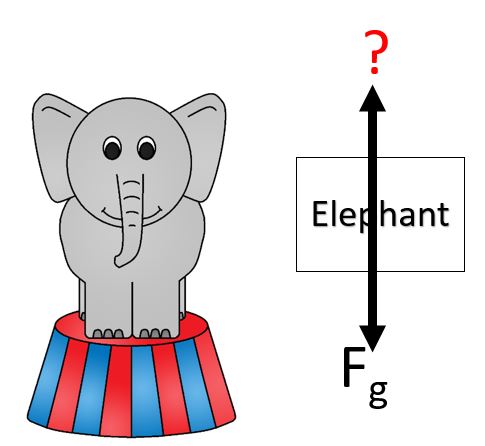
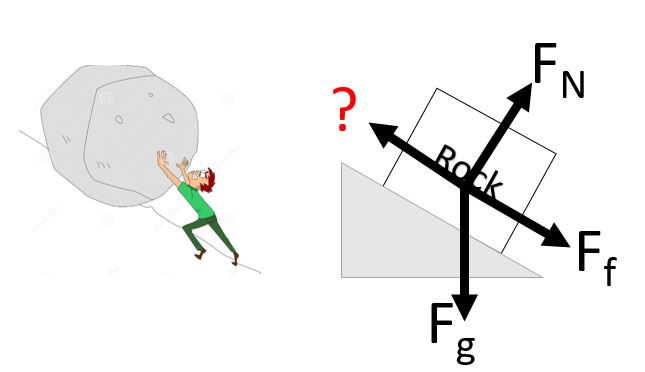
speed in a specific direction
5.
What has both size and direction?
a)
Victor
b)
Hector
c)
Vector
d)
Origin
6.
How fast does the hot air balloon appear to be moving to the person in the canoe?
a)
1 m/s to the left
b)
1 m/s to the right
c)
5 m/s to the left
d)
5 m/s to the right
7.

If a car passes you going 90 km/hr north while you are driving 80 km/hr north, how far is the car moving relative to your car

a)

170 km/hr N

b)

170 km/hr S

c)

10 km/hr S

d)

10 km/hr N

8.
What is magnitude?
a)
The direction that describes a quantity.
b)
A numerical value
c)
A unit of force
9.
Which statement describes a vector?
a)
It has magnitude but no direction
b)
It has direction but no magnitude
c)
It has both direction and magnitude
d)
It has constant magnitude but no
 direction
10.
Distance and direction of an object's change in position from a starting point
a)
displacement
b)
distance
c)
motion
d)
reference point
11.
 Ray runs 30 feet north, 30 feet west, and then 30 feet south. What is the distance?
a)
90 feet
b)
30 feet
c)
60 feet
d)
0 feet
12.
 Amy runs 2 miles south, then turns around and runs 3 miles north. What is displacement?
a)
5 miles
b)
1 mile 
c)
2 miles south
d)
1 mile north 
13.
Scott travels north 5 miles and then goes west 3 miles before coming straight back south 2 miles. What is his distance?
a)
10 miles
b)
7 miles
c)
8 miles
d)
6 miles
14.
30 m/sec, East. Scalar or Vector
a)
Scalar
b)
Vector
c)
Neither
15.

which of the following is a vector?

a)

velocity

b)

discance

c)

position

d)

speed

16.
Which statement describes a vector?
a)
It has magnitude but no direction
b)
It has direction but no magnitude
c)
It has both direction and magnitude
d)
It has constant magnitude but no
 direction
17.

Which would be used for the situation, scalar or vector:

The temperature change from noon to 6 pm

a)

scalar

b)

vector

18.

A quantity described by magnitude and does not need direction

a)

Vector

b)

Scalar

19.
Scott drives a Jeep 12 km east, then 4 km north, then finally 3 km west. He traveled a total distance of:
a)
5 km
b)
10 km
c)
13 km
d)
19 km
20.

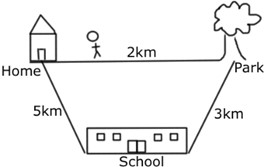
Jerry walked from home to school, then from the school to the park. What is his total displacement?

a)

2 km

b)

5 km

c)

8 km

d)

10 km

21.

Jerry walked from home to school, then from the school to the park. What is his total distance?

a)

2 km

b)

5 km

c)

8 km

d)

10 km

22.
Bill runs 400 meters to Andy's house, turns around, and runs 400 meters back home.  What is Bill's displacement?
a)
0 meters
b)
400 meters
c)
800 meters
d)
1600 meters
23.
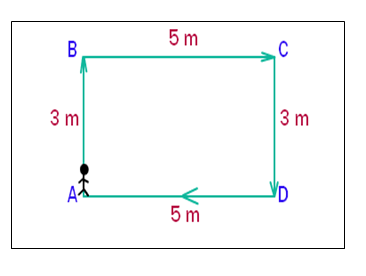
Sara walks from Point A to Point B. Which is true?
a)
Distance and displacement are EQUAL
b)
Distance is less than displacement
24.

After completing one trip on a roller coaster, the roller coaster's ________ is zero.

a)

displacement

b)

reference point

c)

length

d)

distance

25.
What is speed?
a)
how far you go
b)
how much distance is covered over a period of time
c)
how fast you accelerate
d)
the change in the location of a object
26.
A runner races in the 100 meter dash.  It takes her 10 seconds to finish.  What is her average speed?
a)
10 m/s
b)
1000 m/s
c)
100 seconds
d)
10 seconds
27.
What equation do I use to calculate distance?
a)
S = D/T
b)
T = D/S
c)
D=TS
28.
A storm is moving toward your house at a speed of 20 km/hr.  It is now 60 km away from your house.  In what time will the storm reach your house?
a)
0.3 hours
b)
1200 hours
c)
3 km
d)
3 hours
29.
What is the average speed of a walker who walks 500 m in 400 seconds?
a)
1.25 m/s
b)
100 m/s
c)
0.8 m/s
d)
200,000 m/s
30.
Becky leaves home and rides a distance of 30 km. It took her 2.5 hours. What is her speed?
a)
0.83 hm/hr
b)
12 km/hr
c)
27.5 km/hr
d)
75 km/hr
31.
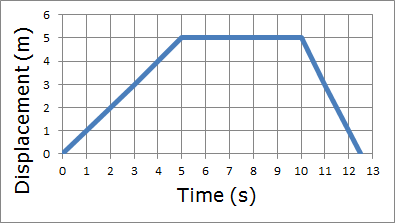
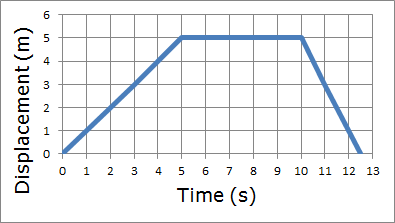
According to the graph how far does the person travel in the first 5 seconds?
a)
2 m
b)
10 m
c)
0 m
d)
5 m
32.
What is the person doing from 5 seconds to 10 seconds?
a)
Walking 
b)
Running
c)
Standing Still 
d)
Walking Fast
33.

The SI unit for acceleration is

a)

mph

b)

ft/sec

c)

m/s2

d)

m/s

34.

Acceleration is

a)

the rate at which velocity changes.

b)

the change in velocity

c)

the rate of change

d)

when you speed up only

35.

a=Δvta=\frac{\Delta v}{t}  

A car traveling at 25 m/s slows down at a constant rate for 5 seconds until it stops. What is its acceleration?

a)

-3 m/s2

b)

5 m/s2

c)

48 m/s2

d)

-5 m/s2

36.

a=Δvta=\frac{\Delta v}{t}  

A runner covers the last straight stretch of a race in 3 seconds. During that time, he speeds up from 3 m/s to 9 m/s. What is the runner's acceleration in this part of the race?

a)

1 m/s2

b)

-1 m/s2

c)

2 m/s

d)

2 m/s2

37.

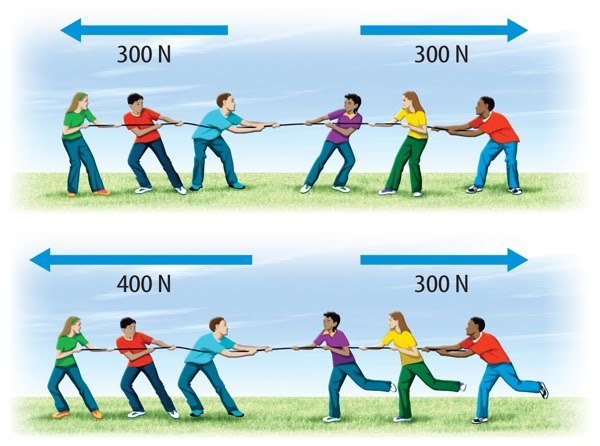
How do you find the net force of this image.

a)

Add up all the arrows

b)

Add a green arrow and the orange arrow.

c)

Subtract all the arrows.

d)

Add the green arrows and subtract the orange arrow.

38.

What is the overall Net Force and which side has a greater Net Force?

a)

641, Left

b)

571, Left

c)

601, Right

d)

480, Right

39.

If the wind is heading south with a force of 5 N, and a car is going north with force of 78936 N, what is the Net Force and Direction.

a)

78931 N North

b)

78931 N South

c)

78531 N North

d)

78531 N South

40.

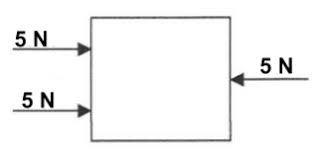
What is the Overall Net Force and which side has a greater Net Force?

a)

12, Right

b)

0, Both are balanced

c)

12, Both are balanced

d)

0, Left

41.

Is the Net Force balanced or Unbalanced?

a)

Balanced

b)

Unbalanced

42.

What is Force?

a)

A pull exerted on an object

b)

A push exerted on an object

c)

A push or pull exerted on an object

d)

Nothing

43.

With unbalanced forces, the object will move in the direction of the _______ force.

a)

equal

b)

smaller

c)

larger

44.
Which one is balanced?
a)
top
b)
bottom
c)
both
45.
What is the unit for FORCE? 
a)
N (Newtons)
b)
lbs (pounds)
c)
g (grams)
d)
m/s (meters per second)
46.
What is the net force?
a)
20 N 
b)
0 N 
c)
400 N 
d)
40 N 
47.
What will cause an object to move?
a)
Applied forces
b)
Balanced forces
c)
Unbalanced forces
48.

What force ultimately slows the roller coaster to a stop?

a)

Applied

b)

Normal

c)

Friction

d)

Gravitational

49.
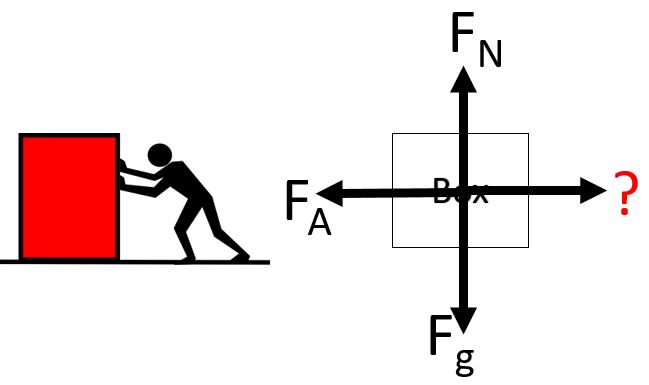
Name the missing force....
a)
weight force
b)
normal force
c)
frictional force
d)
tension force
50.
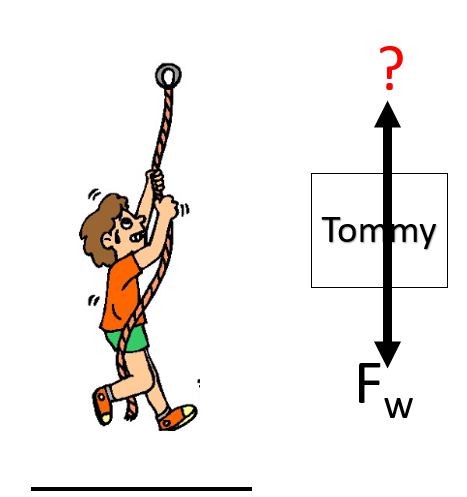
Name the missing force...
a)
frictional force
b)
weight force
c)
thrust
d)
buoyant force
51.
Name the missing force...
a)
tension force
b)
gravitational force
c)
normal force
d)
applied force
52.
Name the missing force...
a)
weight force
b)
normal force
c)
applied force
d)
frictional force
53.
Name the missing force...
a)
applied force
b)
weight force
c)
lift
d)
normal force
54.
Friction is a force that acts in an ___________ direction of movement.
a)
similar
b)
opposite
c)
parallel
d)
west
55.
How would the absence of friction affect a marble traveling on a long, straight path?
a)
The marble’s speed would decrease.
b)
The marble’s speed would increase.
c)
The marble would stop immediately. 
d)
The marble would remain at constant speed.
56.

What law is best described

a)

1st

b)

2nd

c)

3rd

d)

law of motion

57.

What law is best described

Equal and Opposite

a)

1st

b)

2nd

c)

3rd

d)

speed

58.

What law is best described

A magician pulls a tablecloth out from under dishes and glasses on a table without disturbing them.

a)

Newton's 1st Law

b)

Newton's 2nd Law

c)

Newton's 3rd Law

59.
What Unit do we Measure Force in? 
a)
Newtons
b)
Joules
c)
Force
d)
Kilograms
60.
What is Newton's First Law
a)
F=ma
b)
Every action has an equal and opposite reaction
c)
An object at rest stays at rest, an object in motion stays in motion. 
d)
Friction 
61.
Newton's third law states that any action will have a(n) _______ and ______ reaction
a)
Equal and similar
b)
Equal and opposite
c)
Equal and different
d)
Greater and opposite
62.
What is Newton's First Law known as? The Law of
a)
Friction
b)
Mass
c)
Inertia
d)
Gravity
63.
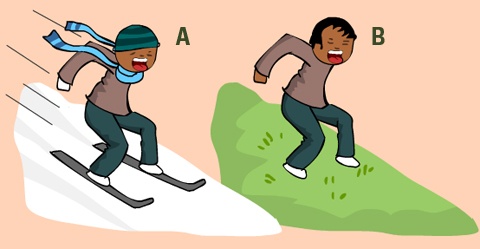
Why is it harder for the boy in Image B to get down the hill?
a)
Motion
b)
Friction
c)
Work
d)
Displacement
64.
It takes more force to accelerate the iron man on the left than the iron man on the right because the iron man on the left has more mass. This best describes
a)
Newton's first law, the law of inertia
b)
Newton's second law, the law of acceleration
c)
Newton's third law, the law of action reaction 
d)
The law of universal gravitation
65.
For every action, there is an equal and opposite reaction.
a)
Newton's
1st
Law of Motion
b)
Newton's
2nd
Law of Motion
c)
Newton's
3rd
Law of Motion
66.
What is the attractive force that exists between all objects that have mass?
a)
Weight
b)
Mass 
c)
Gravity
d)
Viscosity
67.

What is energy?

a)

Something that takes up space.

b)

The ability to make something move or change.

c)

Anything that has mass.

68.

Three friends were arguing about whether or not a system has energy. Who do you agree with?

a)

Jada: A system does not have energy if it is not moving.

b)

Chioma: ALL systems have energy, all of the time.

c)

Derrick: A system only has energy if it has the ability to move or change.

69.

What is potential energy?

a)

The energy an object has due to its position or condition.

b)

The energy an object has due to its chemical composition.

c)

The energy an object has due to its atomic structure.

70.

What is kinetic energy?

a)

The energy an object has due to its motion.

b)

The energy an object has due its chemical composition.

c)

The energy an object has due to its atomic structure.

71.

When does an object have NO kinetic energy?

a)

When it's at rest.

b)

When it's moving very slowly.

c)

When it has no electrical charge.

72.

Energy cannot be ____________ nor ________________.

a)

transformed

b)

created

c)

renewed

d)

destroyed

73.

The Law of Conservation of Energy states:

a)

Energy can created or destroyed but not transformed

b)

Energy cannot be created or destroyed, it can only transformed

c)

Energy can't be created, destroyed or transformed

d)

Energy cannot be created or destroyed.
74.
You serve a volleyball with a mass of 2 kg. The ball leaves your hand with a speed of 30 m/s. What is the KE of the ball?
a)
900 J
b)
1800 J
c)
60 J
d)
30 J
75.
A car is traveling with a velocity of 40 m/s and has a mass of 1120 kg. What is the KE of the car?
a)
22,400 J
b)
44,800 J
c)
896,000 J
d)
1,792,000 J
76.
An 2 kg apple is hanging in a tree, 10 ft off the ground. What is the gravitational potential energy of the apple?
a)
19.6 J
b)
20 J
c)
98 J
d)
196 J 
77.
The acceleration of an object due to gravity on Earth is...
a)
8.9 m/s2
b)
9.8 m/s2
c)
It depends on the mass of an object
d)
Equal to its kinetic energy
78.
A skydiver jumps from a plane and is halfway through her descent. At this point in time she has...
a)
Kinetic Energy
b)
Gravitational Potential Energy
c)
Both Kinetic and Gravitational Potential Energy
d)
She has no energy
79.
Which of the following has the greatest amount of gravitational potential energy?
a)
A 20 kg projector suspended 10 m in the air
b)
A 100 kg wrecking ball suspended 10 m in the air
c)
A 5 kg basketball suspended 10 m in the air
d)
They all have the same GPE because they are all 10 m in the air
80.
Which of the following affects the gravitational potential energy of an object?
a)
The mass of the object
b)
The height of the object
c)
The velocity of the object
d)
Both the mass and height of the object
81.

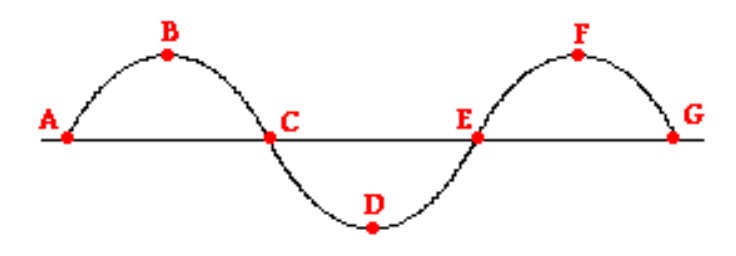
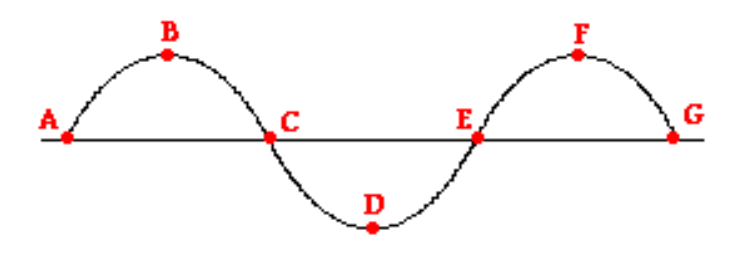
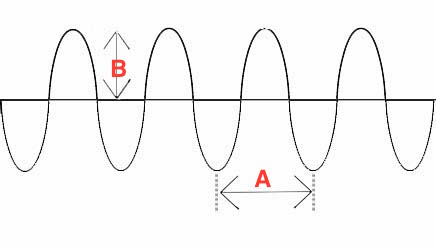
What property of the wave is represented by the letter "A"?

a)

amplitude

b)

crest

c)

trough

d)

wavelength

82.
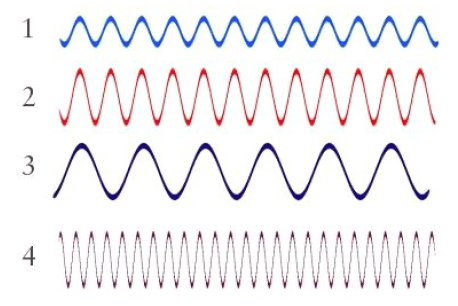
Which wave in the diagram has the greatest frequency?
a)
1
b)
2
c)
3
d)
4
83.

The highest point on a wave is:

a)

the crest

b)

the trough

c)

the top

d)

the coast

84.

Which letter(s) represent the trough of the wave?

a)

A

b)

B & D

c)

D

d)

C & G

85.
Which wave has a greater frequency?
a)
A
b)
B
86.
What kind of wave is pictured below?
a)
compressional wave
b)
transverse wave
c)
sound wave
d)
mechanical wave
87.
How would a person measure the wavelength on this sound wave?
a)
dense to less dense
b)
trough to crest
c)
compression to compression
d)
beginning of illustration to the end
88.

You can't hear sounds in outer space because there is no

a)

medium

b)

light

c)

energy

d)

heat

89.

All waves carry ________ as they travel from one place to another.

a)

matter

b)

space

c)

energy

d)

water

90.

What property of the wave is represented by the letter "B"?

a)

amplitude

b)

crest

c)

trough

d)

wavelength

91.

Which letter(s) represent the crest of the wave?

a)

A

b)

B & D

c)

B & F

d)

F

92.

Which wave in the diagram has the greatest wavelength?

a)

1

b)

2

c)

3

d)

4

93.

What's another name for a longitudinal wave?

a)

transverse

b)

compressional

c)

electromagnetic

94.
What is an example of a wave with a long wavelength and low frequency?
a)
Gamma rays
b)
Infrared
c)
Radio
d)
Visible light
95.

Which color has the longest wavelength?

a)

Yellow

b)

Red

c)

Green

d)

Purple

96.
Which has the SHORTEST wavelength and, therefore, the highest frequency/most energy
a)
Radio waves
b)
Ultraviolet Rays
c)
Gamma Rays
d)
X-rays
97.
A wave with a large wavelength will have a ______ frequency and _____ energy
a)
high, low
b)
high, high
c)
low, high
d)
low, low
98.

The name for the range of electromagnetic waves placed in order of increasing frequency is...

a)

Electromagnetic Spectrum

b)

Electromagnesis

c)

Visible light spectrum

d)

The range of light

99.

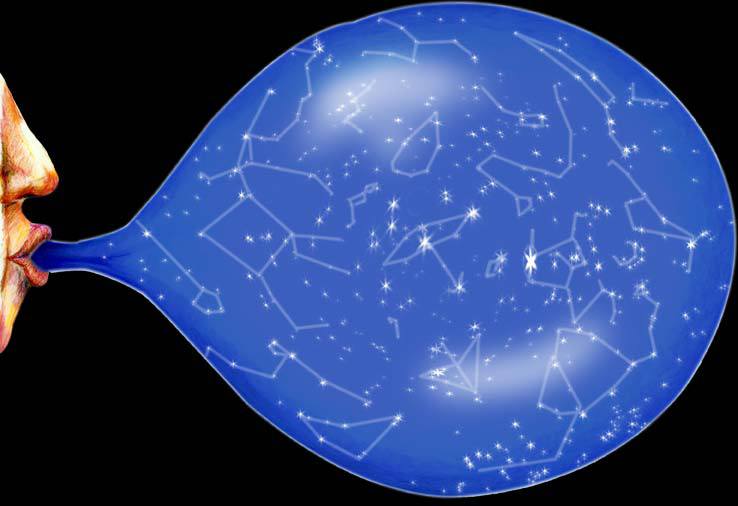
Most scientists believe the Big Bang Theory explains which of the following questions?

a)

How our planets and moons formed

b)

How our universe began

c)

How the sun turns hydrogen into helium

d)

How fast light travels through space

100.
What does the Big Bang theory suggest?
a)
The universe was just there
b)
The Milky Way is the only solar system
c)
The universe is continually expanding
d)
The universe is collapsing in toward a single point