
 Worksheets
HB 22 - 23 Evolution Test Review
Total questions: 70
Worksheet time: 1hrs 24mins
A population of rabbits grows rapidly from one year to the next. Then one year, a disease strikes approximately one fourth of the adult rabbits. The disease remains with the population in the years that follow.
As explained by Darwin’s theory, which of these conditions allows the rabbit population to evolve by natural selection?
The disease affects adult and juvenile rabbits equally.
The disease reduces the ability of the rabbits to reproduce.
Some rabbits are resistant to the disease, and they pass the resistance to their offspring.
No rabbits are resistant to the disease, and all die when the disease strikes them.
Grass plants in a population range in height from 6 cm to 25 cm. The short plants receive little sunlight, and the tall plants are eaten by grazing animals. Which statement best describes the effect of natural selection on the grasses?
Because average height grass plants are favored, stabilizing natural selection is occurring.
Because average height grass plants are favored, disruptive natural selection is occurring.
Because tall grass plants are favored by the animals that eat grass, directional selection is occurring.
Because short and tall grass plants are favored, normal natural selection is occurring.
Small-scale genetic changes over generations of a population describes which term?
(a)
Significant physical and genetic changes over a long period of time (many generations) that results in a new species describes which term?
(a)
This is one of the mechanisms of evolution; it is a continuous process in which organisms with traits that make them better-adapted to their environment are more likely to survive and reproduce than organisms without such adaptations.
(a)
A few blue birds from a population of birds (blue, white or red in color) are swept from their flock by a very random strong gust of wind. They arrive in a new location and make it their home. They reproduce and populate the area. Which general mechanism of evolution does this example fit?
(a)
Genetic drift is change in the allele frequency of a population due to...
random chance
natural selection
non-random mating (sexual selection)
artificial selection
Which of the following is an example of genetic drift?
A population of bald eagles in hunted over a short period of time. This results in a 40% reduction in alleles for a certain trait in the population.
A mistake in DNA replication occurs in a zygote going through mitosis. This results in a new trait.
Red fox pups are more likely to survive in a snowy environment if they are born white.
Farmer chooses seeds from largest apples to plant next year. This results in larger apples from year to year.
A deer from an established population in Sandusky wanders all the way to Avon and mates with a deer in the Avon population. Which mechanism of evolution does this example fit?
(a)
Bahamian female birds prefer mating with male birds that can perform a mating dance to the female's preference. Which mechanism of evolution does this example fit?
Gene Flow
Natural Selection
Mutation
Sexual Selection (Non-Random Mating)
Which of these is a likely outcome of movement by young males?


The similarities of the bones in the diagram provide evidence that---
The organisms shown lived in the same natural envionrment
The organisms shown may have evolved from a common ancestor
The organisms shown have the same genetic diseases
All vertebrate species have identical forelimbs
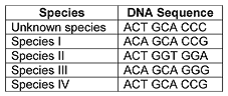
If two organisms of different species have similar DNA sequences, they likely...
share a common ancestor
share a common environment
share a common population
share the same mom
A fossil of an extinct dinosaur is found and the anatomy of the fossil shows similarities to that of a bird. What could this mean?
This is purely by chance and isn't significant
The extinct dinosaur and modern bird may be related through evolution.
All dinosaurs evolved into birds and that's why there aren't any dinosaurs alive today
Dinosaurs choose to fly and evolved into birds to escape predation and capture food

The study of the early stages of development before one is born or hatched :
Comparative biochemistry
Embryology
Biogeography
Comparative Anatomy

If an organism has a vestigial structure, that structure likely once had a function in a(n)...
close relative
early ancestor
unrelated organism
embryological stage
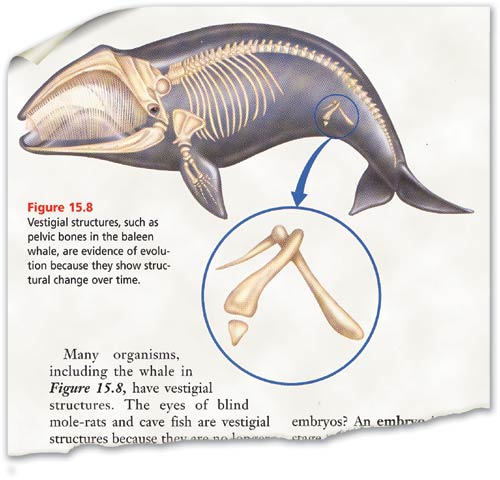
The hind leg bones in a whale are examples of which type of structure?
(a)
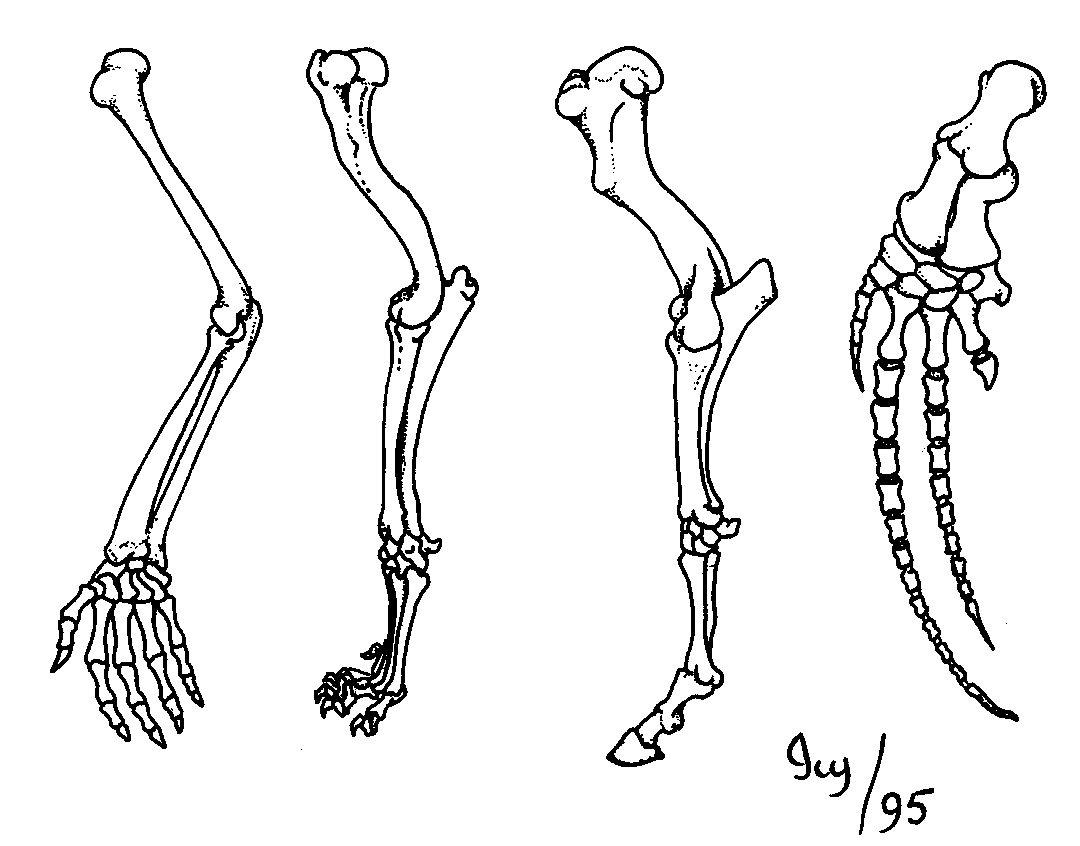
Structures with the same parts have different functions; suggests that organisms share a common ancestry. These are called (a) structures.

Which of the following can be determined by observing the embryos shown in the diagram
Which of the following is the collection of life's remains found in sedimentary rock?
natural selection
homologous structures
Charles Darwin
the fossil record

Amino acid sequences can be compared to determine relationships between species. When comparing the sequences provided, which two organisms are humans most closely related to?
horses and gorillas
gorillas and chimpanzees
chimpanzees and zebras
zebras and horses
experience similar selective pressures from the environment
develop homologous structures over time
eventually merge into the same species


individuals with alleles for an extreme type are more likely to survive and reproduce
stabilizing selection
directional selection
disruptive selection
genetic drift

the selection pressure favors the extreme phenotypes, dividing the population into 2 distinct groups
directional selection
stabilizing selection
geographic selection
disruptive selection

Individuals with intermediate traits are more likely to survive and reproduce
stabilizing selection
directional selection
adaptive radiation
disruptive selection
Female water frogs tend to be attracted to the males with the loudest and most distinctive mating call (an acoustical display).
directional selection
stabilizing selection
disruptive selection
artificial selection
sexual selection

Seed cracker birds have either large beaks or small beaks. They do not have medium sized beaks because medium sized beaks do not allow for adequate cracking of seeds.
Stabilizing
Directional
Disruptive
The number of times a particular allele appears in a gene pool is known as the
population of the allele
relative percentage of the allele
frequency of the allele
evolution of the allele
Evolution can be defined as a ____________
change in the frequency of an allele in a population over time
change in the frequency of reproduction in a population
change in the frequency of an allele in an individual
There are 3 dominant alleles and 7 recessive alleles of a particular gene in a population. Calculate the frequency of the recessive allele.
0.30
0.70
0.07
0.03
When populations no longer look the same
When populations no longer have the same frequency of alleles
When populations are living in different environments
When populations can no longer interbreed
Which best describes punctuated equilibrium?
Speciation occurs due to natural selection
Speciation occurs due to isolation
Speciation occurs slowly in geologic time, followed by long periods with very fast evolutionary change.
Speciation occurs suddenly and rapidly in geologic time, followed by long periods with little evolutionary change.
A new river forms and splits two populations, causing ______________ speciation
Sympatric
Allopatric
Extreme
Convergent
A speciation in which new species evolve from a single ancestral species while inhabiting the SAME geographic region.
Sympatric speciation
Allopatric speciation
Complex speciation
Divergent speciation


Where is the alligator and T. rex's common ancestor?
Point A
Point B
Point C
Point D
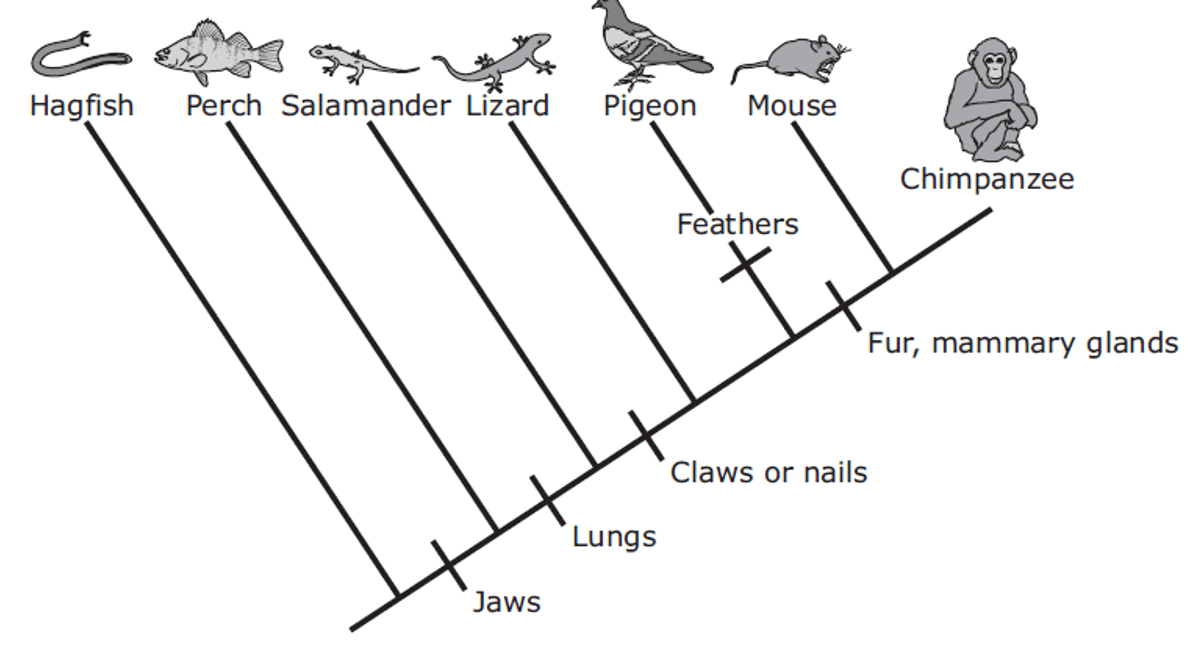
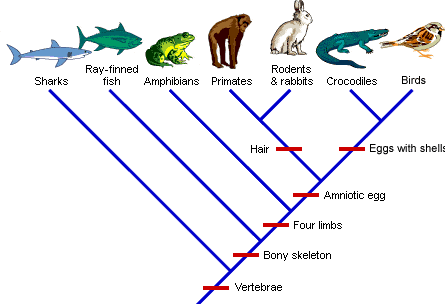

Which letter represents the most recent common ancestor of sponges and mushrooms?
A
B
C
D
E

Which trait should go where A is on the cladogram?
eyes
feet
lips
hat

According to the diagram, what is the common ancestor of ALL organisms on the phylogenetic tree?
B
C
D
E

What is the common ancestor of Letters A, B, C, D, E?
1
2
3
4

According to this tree, which of these animal phyla are most closely related?
Arthropoda & Mollusca
Arthropoda & Chordata
Chordata & Mollusca

arachnids and insects?
Which best describes derived characteristics?
They appear in all the ancestors.
They appear at the end of each branch.
They are newly evolved traits.
They stem from primary characteristics.

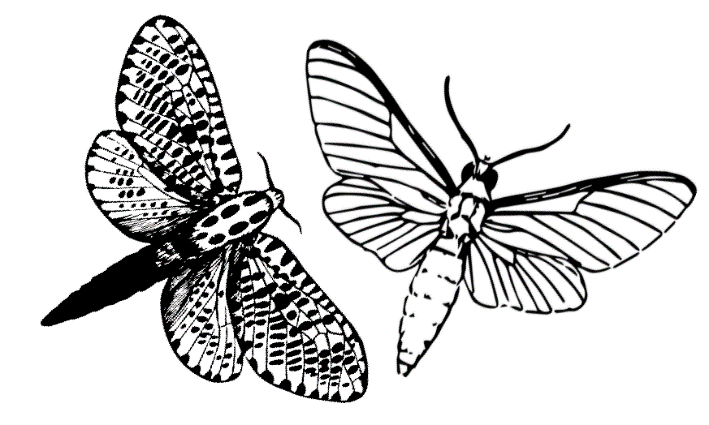
Which statement best explains why this trait evolved in both types of organisms?
The two groups of organisms bred with each other
Each goup inhabited a niche in which selection pressures (natural selection) favored this trait
Both groups expressed recessive ancestor genes for this trait
Both groups underwent the same sequence and timing of genetic mutations
Structures that are built the same but do not necessarily have the same function are called:
homologous structures
molecular homologies
vestigial structures
A physical trait favored by an environmental change can be called an
adaptation
extinction
possibility
mutation

