wayground logo

Free Printable Worksheets

Font size

S
M
L
XL
Worksheets

Taxonomy and Classification (and evolution)

Total questions: 205

Worksheet time: 3hrs 11mins

Name
Class
Date
1.

Who created the most commonly used system of taxonomy?

a)

Niels Bohr

b)

Watson and Crick

c)

Charles Darwin

d)

Carl Linnaeus

2.

Which is the correct order?

a)

Kingdom Phylum Order Class

b)

Class Order Family Genus

c)

Domain Phylum Kingdom Species

d)

Order Family Species Genus

3.

Identify the one that is NOT an archaea.

a)

Methanogen

b)

Thermophile

c)

Halophile

d)

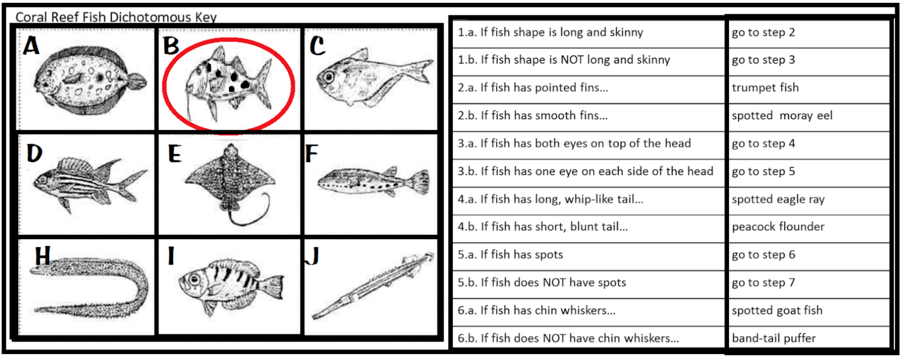
Virus

4.

You find a species that seems to be unicellular and is eating smaller cells around it. It has organelles and a nucleus. Which kingdom is it MOST likely a part of?

a)

Fungi

b)

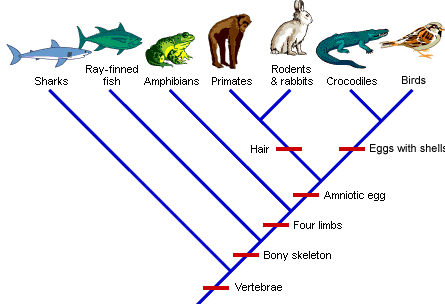
Bacteria

c)

Protists

d)

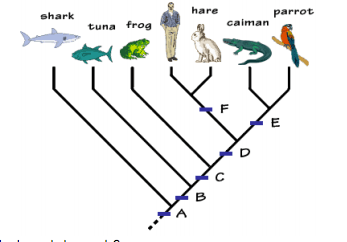
Plants

5.

Which of the following is NOT a unicellular kingdom?

a)

Prokaryotes

b)

Protists

c)

Archaea

d)

Fungi

6.

Which one is NOT a difference between plants and fungi?

a)

Plants use cellulose but fungi use chitin

b)

Plants are autotrophs but fungi are heterotrophs

c)

Plants have cell walls but fungi don't

d)

Plants make their own food and fungi decompose their food

7.

You identify a small living organism that is eating something at your feet. It's visible but pretty tiny, you take it to a lab and find that it has cell walls made of chitin. Which is its domain and kingdom?

a)

Prokaryote, Fungi

b)

Eukaryote, Fungi

c)

Prokaryote, Plant

d)

Eukaryote, Plant

8.

Which is NOT a eukaryote?

a)

Plants

b)

Animals

c)

Archaea

d)

Protists

9.

How are mammals different from all the other classes of vertebrates?

a)

They don't have keratin

b)

They don't have a backbone

c)

They don't lay eggs (except two)

d)

They aren't animals

10.

Which best explains why a sponge is an animal?

a)
b)

All animals breath and sponges breath

c)

Animals live underwater and so do sponges

d)

Animals are multicellular heterotrophs and so are sponges
11.
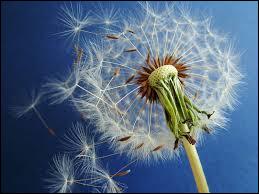
Dandelion, What kingdom does it belongs to?
a)
Plant Kingdom
b)
Animal Kingdom
c)
Fungi Kingdom
d)
Protista Kingdom
12.
Organisms in this smallest taxonomic group share many characteristics.
a)
domain
b)
kingdom
c)
species
d)
class
13.
Which organisms are most closely related?
a)
Equus caballas (Horse) & Equus burchellii (Zebra)
b)
Cyanea artica (Jellyfish) &
Ctenodiscus crispatus (Mud Starfish)
c)
Naja naja (cobra) & Glycine max (soya bean)
d)
Ophiocomina nigra (black brittle star) & Brassica nigra (black mustard)
14.
The science of describing, classifying, and naming living things is called:
a)
Geology
b)
Biology
c)
Taxonomy
d)
Chemistry
15.
The scientific name for an organism is made from the:
a)
class and family name
b)
genus and species name
c)
domain and kingdom name
d)
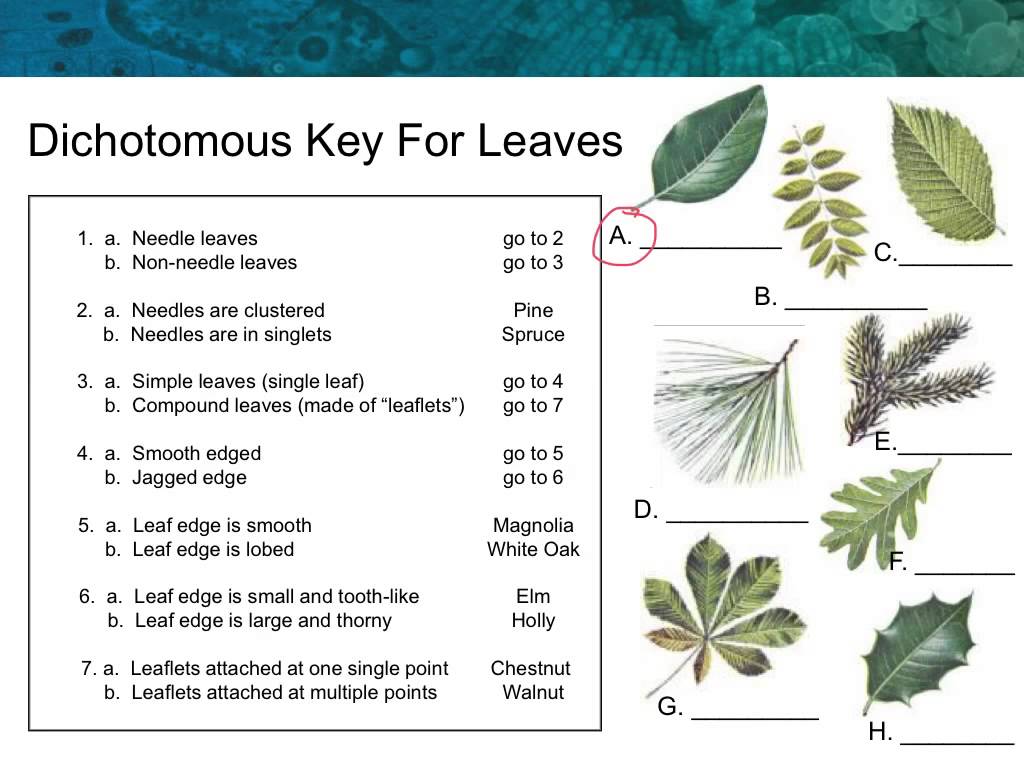
kingdom and phylum name
16.
The 8 levels of classification, broadest to most specific.
a)
Domain, Genus, Family, Order, Class, Phylum, Kingdom, Species
b)
Domain, Species, Kingdom, Genus, Phylum, Family, Class, Order
c)
Domain, Kingdom, Phylum, Class, Order, Family, Genus, Species
d)
Order, Kingdom, Species, Domain, Phylum, Family, Class, Genus
17.
An organism made up of more than one cell would be called:
a)
multicellular
b)
unicellular
c)
heterotroph
d)
autotroph
18.
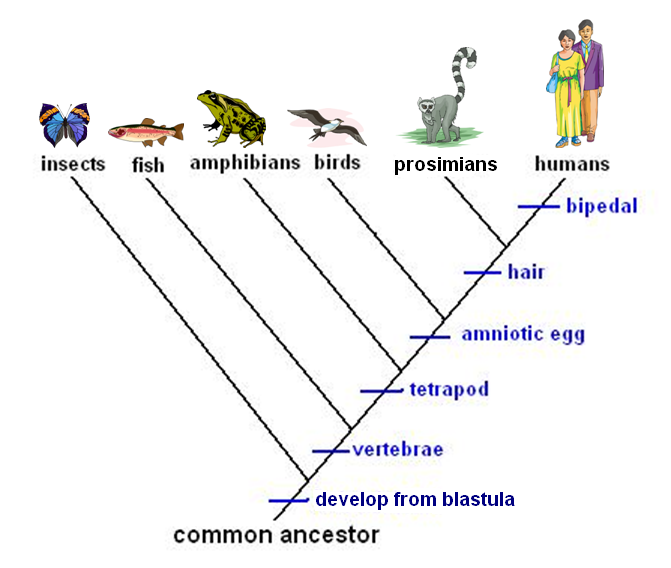
Which organisms pictured on the cladogram have hair?
a)
prosimians only
b)
prosimians and humans
c)
humans only
d)
prosimians and birds
19.
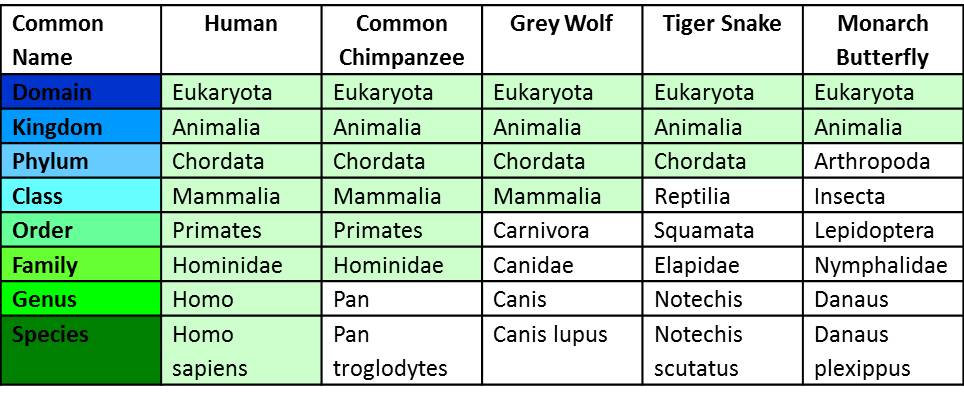
Which organism in the table is least closely related to the chimpanzee?
a)
human
b)
grey wolf
c)
tiger snake
d)
monarch butterfly
20.
Which organism in the table shown is most closely related to the common dolphin?
a)
human
b)
killer whale
c)
giant kelp
d)
bat star
21.
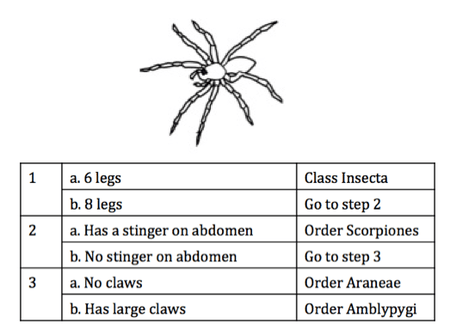
An illustration and a dichotomous key are given. What is the correct classification for this organism?
a)
Class Insecta
b)
Order Amblygygi
c)
Order Araneae
d)
Order Scorpiones
22.

Which 2 organisms would be able to reproduce and produce fertile offspring?

a)

2 organisms in the same class

b)

2 organisms in the same family

c)

2 organisms in the same genus

d)

2 organisms in the same species

23.
Members of this kingdom are multicellular and heterotrophic.
a)
Plantae
b)
Protista
c)
Animalia
d)
Achaebacteria
24.
What kingdom do unicellular, prokaryotic organisms that live in extreme environments?
a)
Animal
b)
Archaebacteria
c)
Eubacteria
d)
Plant
25.
I am prokaryotic and am found everywhere. What kingdom do I belong to?
a)
Eubacteria
b)
Archaebacteria
c)
Fungi
d)
Protista
26.
This organism is multicellular, heterotroph, that has a cell wall made of chitin.  What kingdom does it belong in?
a)
fungi
b)
plantae
c)
animalia
d)
eubacteria
27.
This organism is found in pond water.  It has a nucleus, is microscopic, unicellular and can perform photosynthesis.  What kingdom does it belong in?
a)
protista
b)
eubacteria
c)
archaebacteria
d)
plantae
28.
This organism is multicellular, autotroph, that has a cell wall made of cellulose.
a)
animalia
b)
plantae
c)
fungi
d)
eubacteria
29.
An organism is microscopic, does not have a nucleus, and is known to cause strep throat in humans.  What kingdom does it belong in?
a)
archaebacteria
b)
fungi
c)
eubacteria
d)
protista
30.
I'm motile and have no cell walls. What kingdom do I belong to?
a)
Animalia
b)
Archaebacteria
c)
Eubacteria
d)
Plantae
31.
The scientific name for an organism is made from the:
a)
class and family name
b)
genus and species name
c)
domain and kingdom name
d)
kingdom and phylum name
32.
Tool used by a taxonomist to identify an unknown organism is a:
a)
dichotomous key
b)
binomial nmenclature
c)
scientific name
d)
binomial key
33.
An illustration and a dichotomous key are given. What is the correct classification for this organism?
a)
Class Insecta
b)
Order Amblygygi
c)
Order Araneae
d)
Order Scorpiones
34.
A table of arachnid and insect characteristics is shown. Which characteristic could be used to distinguish between
arachnids and insects?
a)
Jointed legs
b)
Body segments
c)
Presence of eyes
d)
Presence of antennae
35.
A botanist discovers a new plant in the jungle. Which of the
following observations of the plant’s characteristics would be useful in determining its identity with a dichotomous key?
a)
It was discovered in the summertime
b)
It is wet from a recent rain storm.
c)
Its leaves curl up on the edges.
d)
It is eaten by native jungle ants.
36.
When using a dichotomous key to identify organisms, what do we look at?
a)
physical features
b)
weather patterns
c)
environment
d)
diet
37.
A dichotomous key for trees is provided. Hikers found a tree that has large brown cones and single sharp needles. What species of tree have the hikers found?
a)
Juniper
b)
Pine
c)
Spruce
d)
Fir
38.
What step do we always start with when using dichotomous keys?
a)
1
b)
2
c)
3
d)
4
39.
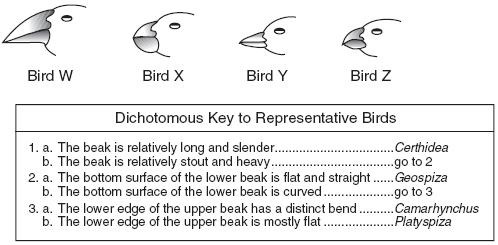
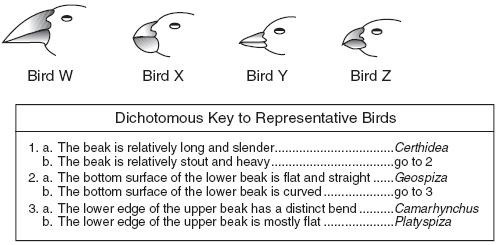
What is the name of bird W?
a)
Certhidea
b)
Geospiza
c)
Camarhynchus
d)
Platyspiza
40.
What is the name of bird Z?
a)
Certhidea
b)
Geospiza
c)
Camarhynchus
d)
Platyspiza
41.
What is a dichotomous key used for in science?
a)
To organize biomes
b)
Classify organisms
c)
Identify bacteria only
d)
None of these
42.
A student discovers an arachnid with a segmented abdomen, long legs, and a tail with no stinger. The student uses the dichotomous key below to identify it. Which arachnid has the student found?
a)
Whip Scorpion
b)
Wind Scorpion
c)
Daddy long legs
d)
Scorpion
43.
Using this dichotomous key, identify the name of the circled Fish, J.
a)
peacock flounder
b)
band-tail puffer
c)
trumpet fish
d)
spotted goat fish
44.
Using this dichotomous key, identity the name of the circled fish.
a)
band-tail puffer
b)
spotted goat fish
c)
peacock flounder
d)
trumpet fish
45.
A dichotomous key for insects is given. To what order does an insect with two pairs of scaly wings belong?
a)
Coleoptera
b)
Heteroptera
c)
Diptera
d)
Lepidoptera
46.
Which of the following is the correct way to write the scientific name of a house cat? (imagine that these options are all in italics)
a)
Felis Domesticus
b)
felis domesticus
c)
Felis domesticus
d)
felis Domesticus
47.
The first part of a scientific name is an organism's _______________ and the second part is its ________________.
a)
species, genus
b)
phylum, order
c)
class, spices
d)
genus, species
48.
Kangaroos and opossums both incubate their immature in pouches. This means they -
a)
share a common ancestor
b)
possess vestigial organs
c)
have similar skeleltal structures
d)
belong to the same species
49.
According to this cladogram, primates are most closely related to -
a)
Amphibians
b)
Rodents and rabbits
c)
Crocodiles
d)
Birds
50.
According to this cladogram, birds are LEAST related to -
a)
Amphibians
b)
Sharks
c)
Ray Finned Fish
d)
Crocodiles
51.
Which trait do only humans have, according to the cladogram?
a)
jaws
b)
mammary glands & hair
c)
terrestrial during all life stages
d)
opposable thumbs
52.
According to the cladogram, which organism is most distantly related to the human?
a)
crayfish
b)
rat
c)
perch
d)
frog
53.
On the cladogram, which organism is the closest relative of the human?
a)
Frog
b)
Hare
c)
Caiman
d)
Parrot
54.
Individuals that are well adapted to their environment will survive and produce:
a)
Fewer mutations
b)
Stronger genes
c)
More offspring
d)
Better traits
55.
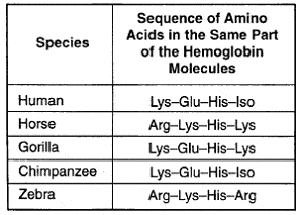
You look at two species and see very similar amino acid sequences. What does this likely tell you?
a)
These are the same animal.
b)
These animals have a common ancestor.
c)
These animals are not likely related.
d)
These animals are likely becoming one species.
56.
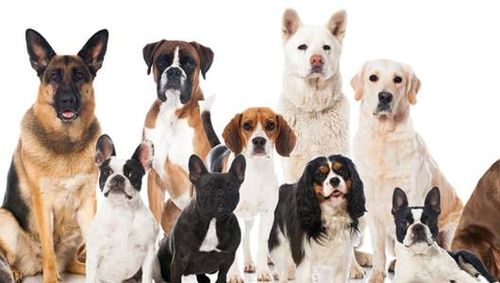
Breeding dogs for specific desired traits is an example of which type of evolutionary evidence?
a)
Artificial selection
b)
Embryology
c)
Fossils
d)
Biochemical molecules
57.
An inherited characteristic that increases an organisms ability to survive and reproduce in its specific environment is called a(n)
a)
vestigial structure
b)
speciation
c)
analogous structure
d)
adaptation
58.
What genus does Bird Z belong to?
a)
Certhidea
b)
Geospiza
c)
Camarhynchus
d)
Platyspiza
59.
The system of classification for organisms is called -
a)
taxonomy
b)
classification
c)
terraformy
d)
cladogram
60.
What genus does Bird X belong to?
a)
Certhidea
b)
Geospiza
c)
Camarhynchus
d)
Platyspiza
61.
Which of these is a characteristic shared between Fungi and Plantae?
a)
Heterotrophic
b)
Mobile
c)
Prokaryotic
d)
Multicellular
62.
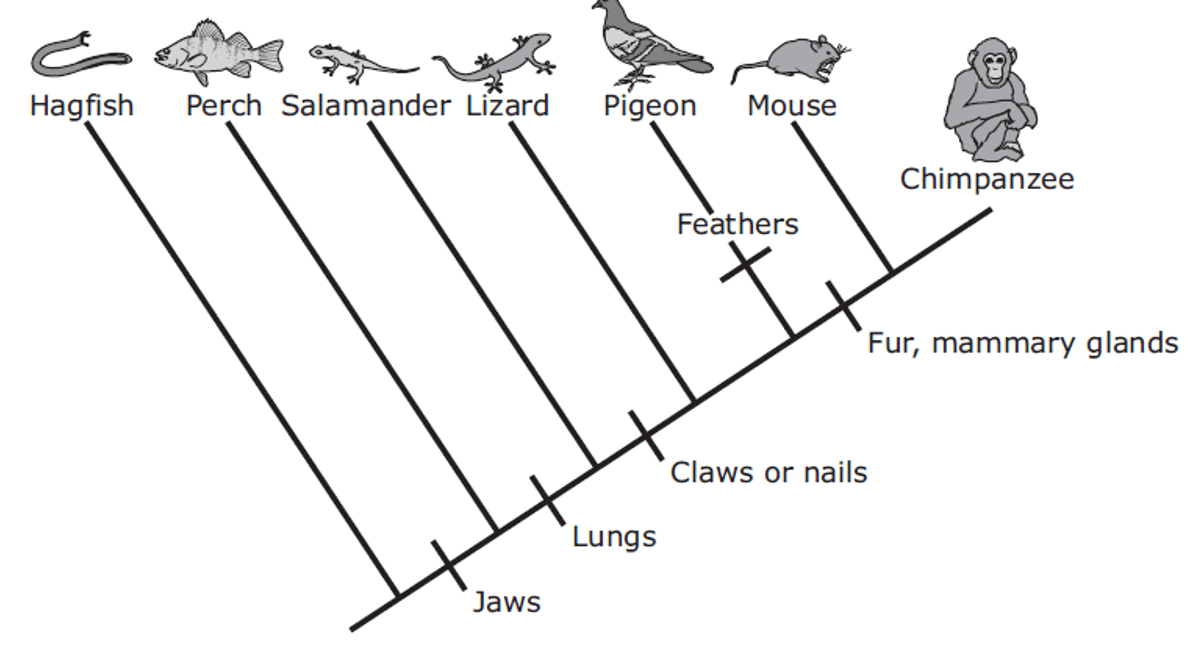
All the animals to the right of the hagfish would have the common characteristic of -
a)
Fur
b)
Claws or nails
c)
Lungs
d)
Jaws
63.
This experiment was conducted by the scientists:
a)
Stanley Miller and Harold Urey
b)
Harold Urey and Albert Einstine
c)
Harrison Ford and Denzel Washington
d)
James Watson and Francis Crick
64.
Which question were the scientists trying to answer with this experiment?
a)
Where do cells come from?
b)
What came first the chicken or the egg?
c)
How are biomolecules formed?
d)
What gave rise to the Eukaryotic cell?
65.
The apparatus in the experiment was used to mimic what?
a)
proteins
b)
Earth's present conditions
c)
early Earth's conditions
d)
they didn't mean to mimic anything in particular
66.
The gas in the apparatus mimicked? 
a)
space
b)
time
c)
stars
d)
atmosphere
67.
The electrical sparks mimicked?
a)
heat waves
b)
lightening
c)
volcano
d)
hurricane
68.
The water used in the apparatus was used to mimic what part of early Earth?
a)
sea
b)
swimming pool
c)
ocean
d)
rain
69.
What was the result of the Miller-Urey Experiment?
a)
amino acids
b)
nucleotides
c)
lipids
d)
glucose
70.
In recent years "SuperBugs" (bacteria that aren't effected by antibiotics) are becoming more and more common. How could natural selection explain this?
a)
Superbugs survive antibiotics and reproduce
b)
Antibiotics cause bacteria to become superbugs
c)
We have always had the same amount of superbugs; modern media just discusses them more.
d)
There is no reliable data on the origin of super bugs.
71.
Why do peppered moths tend to be the same color as the trees on which they live?
a)
The coloring goes along with tasting like the tree. 
b)
It keeps the moth the same temperature as the tree. 
c)
It makes the moths faster than the birds
d)
It makes the moths harder to see.
72.
Which of these is an example of natural selection?
a)
The largest animal in a population will have more opportunities for reproduction.
b)
Several species of organisms work together so that they all succeed.
c)
One species takes all the resources in an environment leaving none for others.
d)
Organism that are best suited to an environment tend to survive and reproduce more often.
73.
Humans have been a very successful species on earth.  They have very large, very diverse populations spread all around the world. As a result,
a)
Human have very limited ability to adapt to changes in the environment.
b)
Young humans have lower survival rates as compared to other species.
c)
Humans have a potential to adapt to various environmental changes.
d)
All humans are more disease resistant.
74.
Which of the following explains adaptation.
a)
An individual organism changes to meet its needs in the environment. These changes pass down to their offspring.
b)
The species as a whole changes their characteristics.
c)
Beneficial traits allow organism to survive and pass on those traits
d)
New characteristics arise in a species as needed.  If these traits are helpful, they are passed down.
75.
A large herd of goats lives in a field full of poison ivy.  Some goats are able to eat the poison ivy while others have become sick when they eat it. Over time the herd as a whole will tend to
a)
Become more likely to eat poison ivy.
b)
Become less likely to eat poison ivy.
c)
Not change in the proportion of goats that can and can not eat poison ivy.
d)
Eat all the poison ivy and leave only plants all the goats can eat.
76.
Darwin studied which of these species on Galapagos?
a)
Pigeons and tortoises
b)
Tortoises and finches
c)
Finches and Pigeons
d)
Zebras and Mockingbirds
77.
Which of these was not a form of adaptation mentioned in the reading?
a)
Structural
b)
Behavioral
c)
Survival
d)
Functional
78.
The clear wing moth and the wasp look similar to each other. Why? 
a)
The wasp mimics the moth to attract prey.
b)
The moth and the wasp are closely related
c)
The moth mimics the wasp to repel predators
d)
The moth had one wasp parent
79.
Breed an organism for a desired trait is the definition of
a)
selective breeding
b)
natural selection
c)
natural breeding
d)
biological evolution
80.
Which of these would best form a fossil?
a)
Muscle
b)
Bone
c)
Skin 
d)
Leaves
81.
When an environment changes faster that an species can adapt, the most likely outcome is...
a)
...biological evolution.
b)
...voluntary mutation
c)
...species extinction
d)
...selective breeding
82.
A group of orangutan have become very similar after a series of drastic changes in their environment.  This similarity is likely the result of
a)
selective breeding
b)
random mutaion
c)
inbreeding
d)
natural selection
83.
Some organisms change to resemble their surroundings even when that environment changes.  They most likely do this to
a)
be easier to see
b)
be harder to see
c)
attract a mate
d)
to adapt their diet
84.
Among organism that live in the desert, the most common adaptation is 
a)
water conservation
b)
large ears
c)
broad leaves
d)
deep roots
85.
Evolution works by 
a)
individuals changing to suit their environment
b)
Individuals learned new traits and pass them on
c)
sudden change in the environment cause a species change 
d)
small changes pass down through many generations
86.
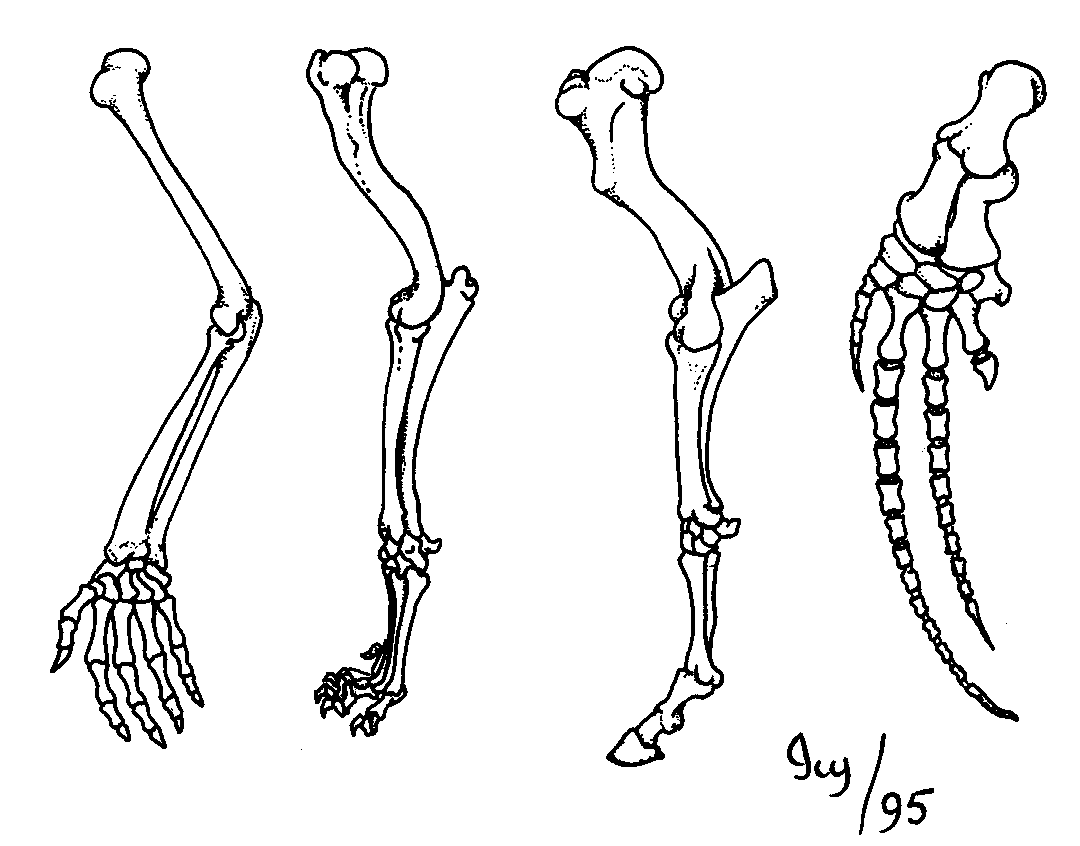
What might account for the fact that all of these limbs share similar structures?
a)
They came from the same source
b)
They are all from one animal
c)
They are very similar organisms
d)
Cooincidence
87.
Define homologous structures.
a)
Structures that appear the same, but have different ancestral origins.
b)
Structures that appear the different, but have the same ancestral origins.
c)
Any two body parts from the same organism
d)
Parts that no longer appear to have a function
88.
Define analogous structures.
a)
Structures that appear the same, but have different ancestral origins.
b)
Structures that appear the different, but have the same ancestral origins.
c)
Any two body parts from the same organism
d)
Parts that no longer appear to have a function
89.
Some people use similarities in embryos to support the the theory that 
a)
The organisms have the same ancestors 
b)
The organisms have similar numbers of offspring
c)
Cells naturally develop along similar line 
d)
There are no connections 
90.
A flash flood carried a raft of Amazon ants away from their original population. There is enough distance between the two groups, that they will never meet in nature again. What type of reproductive barrier is this?
a)
behavioral isolation
b)
temporal isolation 
c)
gametic isolation
d)
geographic isolation 
91.
The genitalia of the male damselfly varies in shape. Certain males can only hold onto & mate with females whose genitalia fit.  What type of reproductive barrier is this?
a)
behavioral isolation
b)
temporal isolation 
c)
gametic isolation
d)
mechanical isolation 
92.
Some female peacocks prefer males with large, colorful tales while other female peacocks prefer males with no tail at all. Females are beginning to only mate with the type of males with the tail they prefer. What type of reproductive barrier is this?
a)
behavioral isolation
b)
hybrid sterility 
c)
temporal isolation
d)
mechanical isolation 
93.
The flowers of pink tulips open in the morning, while the flowers of lavender tulips open in the early afternoon. The bees that pollinate these tulips cannot carry pollen back & forth between the two types of tulips because of their flowers being closed at different times of day. What type of reproductive barrier is this?
a)
behavioral isolation
b)
hybrid sterility 
c)
temporal isolation
d)
mechanical isolation 
94.
The term for the formation of new and distinct species over the course of evolution is...
a)
speciation
b)
biological species concept
c)
reproductive barrier
d)
natural selection
95.
What is a species? 
a)
A group of organisms that can mate with each other and produce fertile offspring. 
b)
A group of organisms that can mate and produce offspring even if those offspring are infertile.
c)
A group of organisms that genetically are very different from each other. 
d)
Indivual organisms that live in the same environment. 
96.

A new river forms and splits two populations, causing ______________ speciation

a)

Sympatric

b)

Allopatric

c)

Extreme

d)

Convergent

97.

Orcas occur in the same habitat but some are avoiding each other and do not interbreed. They have different diets, vocal behavior, and social structures. What type of speciation is this?

a)

Allopatric

b)

Sympatric

c)

Complex

d)

Covergent

98.

when the organism develops different courtship rituals which do not attract main population this is a part of ____________ speciation.

a)

Allopatric

b)

Sympatric

c)

Simple

d)

Temporal

99.

The emergence of a mountain range is an event that would lead to _______________ speciation

a)

Allopatric

b)

Sympatric

c)

Temporal

d)

Behavioral

100.

The emergence of new rivers or streams is a type of ____________ isolation.

a)

Temporal

b)

Mechanical

c)

Behavioral

d)

Geographic

101.

When the Grand Canyon in Arizona formed, two populations of one squirrel species were separated by the giant canyon. This is an example of _____________ speciation.

a)

Allopatric

b)

Sympatric

c)

Simple

d)

Divergent

102.

Different finch populations lived on separate islands with different environments. They evolved to best adapt to those particular environments and can no longer mate. What type of speciation is this?

a)

Allopatric

b)

Sympatric

c)

Temporal

d)

Mechanical

103.

Which domain? Streptococcus pyogenes

a)

Bacteria

b)

Archaeabacteria

c)

Eukarya

d)

Animalia

104.

Which domain? Birgus latro (coconut crab)

a)

Bacteria

b)

Archaeabacteria

c)

Eukarya

d)

Animalia

105.

Which domain? Halobacterium noricense was found in a salt mine that is 6 times saltier than the ocean.

a)

Bacteria

b)

Archaeabacteria

c)

Eukarya

d)

Animalia

106.

Which KINGDOM? Euglena gracilis

a)

Animal

b)

Plant

c)

Fungi

d)

Protist

107.

Which KINGDOM? Theraphosa blondi (AKA Goliath bird eater)

a)

Animal

b)

Plant

c)

Fungi

d)

Protist

108.

Which KINGDOM? Bryophyta – AKA “Moss”

a)

Animal

b)

Plant

c)

Fungi

d)

Protist

109.

Which KINGDOM? Bryophyta – AKA “Moss”

a)

Animal

b)

Plant

c)

Fungi

d)

Protist

110.

Which KINGDOM? Eterocephalus glaber (Nake Mole Rat)

a)

Animal

b)

Plant

c)

Fungi

d)

Protist

111.

Which KINGDOM? Arachniodes standishii (Fern)

a)

Animal

b)

Plant

c)

Fungi

d)

Protist

112.

Which KINGDOM? Stachybotrys chartarum (Toxic Black Mold)

a)

Animal

b)

Plant

c)

Fungi

d)

Protist

113.

Which KINGDOM? Amanita muscaria

a)

Animal

b)

Plant

c)

Fungi

d)

Protist

114.

Which KINGDOM? Rhizopus stolonifer (bread mold)

a)

Animal

b)

Plant

c)

Fungi

d)

Protist

115.

Which KINGDOM? Volvox carteri (volvox colony)

a)

Animal

b)

Plant

c)

Fungi

d)

Protist

116.

Which KINGDOM? Hypsibius dujardini

(Tardigrade or Water bear)

a)

Animal

b)

Plant

c)

Fungi

d)

Protist

117.

Which KINGDOM? Dionaea muscipula (Venus Fly trap)

a)

Animal

b)

Plant

c)

Fungi

d)

Protist

118.

Which KINGDOM? Asterionella Formosa (diatoms)

a)

Animal

b)

Plant

c)

Fungi

d)

Protist

119.

Which KINGDOM? Lactobacillus acidophilus (makes yogurt)

a)

Animal

b)

Plant

c)

Fungi

d)

Bacteria

120.

Which KINGDOM? Archaeal Richmond Mine acidophilic nanoorganisms (ARMAN) were first discovered in an extremely acidic mine located in northern California

a)

Animal

b)

Plant

c)

Fungi

d)

Archaebacteria

121.

Which KINGDOM? Fuligo septica (Dog vomit slime mold)

a)

Animal

b)

Plant

c)

Fungi

d)

Protist

122.

Which KINGDOM? Xylotrupes ulysses (rhinoceros beetle)

a)

Animal

b)

Plant

c)

Fungi

d)

Protist

123.
Which of the following is a term for a group of similar organisms that can reproduce fertile offspring?
a)
individual
b)
population
c)
species
d)
fossil
124.
If an organism has a vestigial structure, that structure likely once had a function in a(n)
a)
close relative
b)
early ancestor
c)
unrelated organism
d)
embryological stage
125.
Mutations are important because they bring about
a)
death of the organism in which they develop
b)
genetic variation needed for a population to evolve
c)
benefits for the individual, not for the population
d)
Hardey-Weinberg equilibrium within a population
126.
Extinction can occur because of which of the following?
a)
All can be causes of extinction.
b)
Increased competition with other species
c)
New predators within the environment
d)
Loss of habitat and/or catastrophes
127.
Finches on the Galapagos Islands had different beaks in order to help them do what?
a)
Build nests
b)
Fight off predators
c)
Collect food sources
d)
Compete with rivals
128.
This scientist came up with the idea of natural selection.
a)
Jean Baptiste Lamarck
b)
Gregor Mendel
c)
Charles Darwin
d)
Thomas Malthus
129.
A remnant or trace of an organism from the past is called a _______.
a)
Ancestor
b)
Skeleton
c)
Fossil
d)
Imprints
130.
Inherited trait that helps an organism survive is a(n) __________.
a)
Fossil
b)
Adaptation
c)
Ancestor
d)
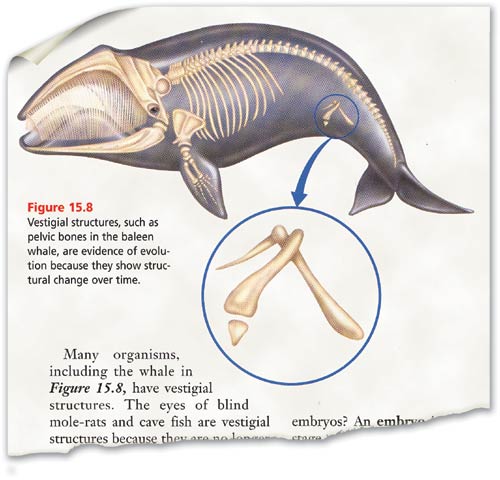
Natural selection
131.
Survival of the fittest or when favorable adaptations reproduce faster is called what?
a)
Evolution
b)
Adaptation
c)
Natural selection
d)
Fossilization
132.
This occurs when no more of a species is living.
a)
Fossilization
b)
Adaptation
c)
Extinction
d)
Natural selection
133.
Magda is a tall, 11 year old drummer. She has a scar on her right cheek. She is good at swimming. Which of her traits did Magda most likely inherit?
a)
height
b)
the scar
c)
ability to swim
d)
ability to play drums
134.
According to the diagram, which organism is older?
a)
ammonite
b)
coral
c)
gastropod
d)
trilobite
135.
Structures with the same parts have different functions; suggests that organisms share a common ancestry
a)
vestigial structures
b)
homologous structures
c)
adaptive radiation
d)
fossil
136.
Which of the following is an example of a vestigial structure?
a)
the wings of a red-tailed hawk
b)
the hind limbs of a house cat
c)
the fins of sharks
d)
the tailbone of a human
137.
The diagram shows fossils in different rock layers. Which of these statements about the age of these fossils is most likely correct?
a)
Fossil A and C are the same age
b)
Fossil B is older than fossil C
c)
Fossils A is older than fossil B
d)
Fossil D is older than fossil C
138.
If species A and B have very similar genes and proteins, what is probably TRUE?
a)
species A and B share a relatively recent common ancestor
b)
species A evolved independently of species B for a long period
c)
species A is younger than species B
d)
species A is older than species B
139.
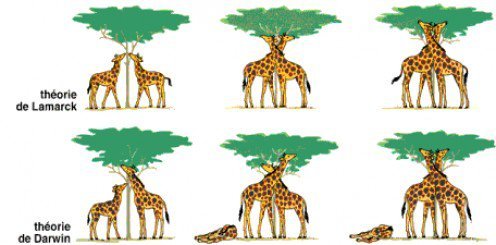
What would happen if the Giraffes never evolve?
a)
they would survive
b)
They would thrive
c)
They would become extinct
d)
They will find another source of food
140.
The ability of an organism to survive and reproduce in its specific environment 
a)
diversity.
b)
evolution
c)
adaptation
d)
 fitness
141.
Why are advantageous traits more likely to be passed onto offspring?
a)
Because they are more likely to survive and reproduce.
b)
Because they come from dominant alleles.
c)
Because they come from recessive alleles.
d)
Because the trait is an acquired phenotype.
142.
Farmers breed cows to produce high amounts of milk. This is an example of...
a)
Natural Selection 
b)
Variations in a species 
c)
Selective Breeding 
d)
inbreeding
143.

According to this image, which two domains of life are most related?

a)

Bacteria & Archaea

b)

Archaea & Eukarya

c)

Eukarya & Bacteria

144.

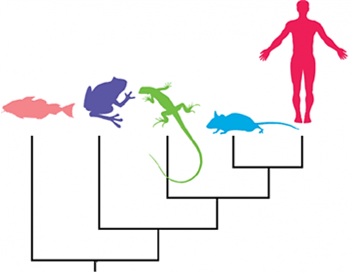
According to this phylogenetic tree, which creature is the least related out of all pictured?

a)

Fish

b)

Frog

c)

Salamander

d)

Human

145.

What do you call the traits shown on phylogenetic trees, such as "four limbs" or "vertebrae"?

a)

Derived characteristics

b)

Speedy Lambofeeties

c)

Branching elements

d)

Harmonious changes

146.

Which group of animals on this tree are most closely related to birds?

a)

Saurischian dinosaurs

b)

Ornithischian dinosaurs

c)

Crocodiles

d)

None of these are related to birds

147.

What number is the common ancestor of C and D

a)

1

b)

2

c)

3

d)

4

148.

From the picture above, What do the species all have in common?

a)

Back bone

b)

Same father

c)

Common ancestor

d)

Feathers

149.
Which of the following organisms are LEAST closely related?
a)
organisms that share a domain
b)
organisms that share a family 
c)
organisms that share a genus 
d)
organisms that share a species 
150.
The scientific name for an organism is made from the:
a)
class and family name
b)
genus and species name
c)
domain and kingdom name
d)
kingdom and phylum name
151.

Phylogeny is usually represented by a tree diagram called a _________ - _____

a)

Genetic Line

b)

Phylogenetic Tree

c)

Photographic Queue

d)

Future Babies

152.

What is the common ancestor of Letters A, B, C, D, E?

a)

1

b)

2

c)

3

d)

4

153.

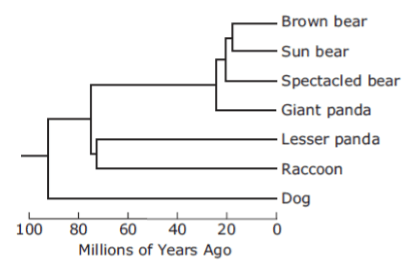
Who is the closest relative to the brown bear?

a)

Giant panda

b)

Dog

c)

Lesser panda

d)

Sun bear

154.

Which organism is the most distantly related to all the others?

a)

Raccoon

b)

Dog

c)

Giant Panda

d)

Sun Bear

155.

Which group of animals on this tree are most closely related to birds?

a)

Saurischian dinosaurs

b)

Ornithischian dinosaurs

c)

Crocodiles

d)

None of these are related to birds

156.

On a phylogenetic tree, what do the branch lengths represent?

a)

The age of the organisms

b)

amount of genetic change since divergence

c)

amount of genetic change since convergence

d)

The age of divergence

157.
The scientific name for an organism is made from the:
a)
class and family name
b)
genus and species name
c)
domain and kingdom name
d)
kingdom and phylum name
158.
Tool used by a taxonomist to identify an unknown organism is a:
a)
dichotomous key
b)
binomial nmenclature
c)
scientific name
d)
binomial key
159.
An illustration and a dichotomous key are given. What is the correct classification for this organism?
a)
Class Insecta
b)
Order Amblygygi
c)
Order Araneae
d)
Order Scorpiones
160.
A table of arachnid and insect characteristics is shown. Which characteristic could be used to distinguish between
arachnids and insects?
a)
Jointed legs
b)
Body segments
c)
Presence of eyes
d)
Presence of antennae
161.
A botanist discovers a new plant in the jungle. Which of the
following observations of the plant’s characteristics would be useful in determining its identity with a dichotomous key?
a)
It was discovered in the summertime
b)
It is wet from a recent rain storm.
c)
Its leaves curl up on the edges.
d)
It is eaten by native jungle ants.
162.
When using a dichotomous key to identify organisms, what do we look at?
a)
physical features
b)
weather patterns
c)
environment
d)
diet
163.
A dichotomous key for trees is provided. Hikers found a tree that has large brown cones and single sharp needles. What species of tree have the hikers found?
a)
Juniper
b)
Pine
c)
Spruce
d)
Fir
164.
What step do we always start with when using dichotomous keys?
a)
1
b)
2
c)
3
d)
4
165.
What is the name of bird W?
a)
Certhidea
b)
Geospiza
c)
Camarhynchus
d)
Platyspiza
166.
What is the name of bird Z?
a)
Certhidea
b)
Geospiza
c)
Camarhynchus
d)
Platyspiza
167.
What is a dichotomous key used for in science?
a)
To organize biomes
b)
Classify organisms
c)
Identify bacteria only
d)
None of these
168.
A student discovers an arachnid with a segmented abdomen, long legs, and a tail with no stinger. The student uses the dichotomous key below to identify it. Which arachnid has the student found?
a)
Whip Scorpion
b)
Wind Scorpion
c)
Daddy long legs
d)
Scorpion
169.
Using this dichotomous key, identify the name of the circled Fish, J.
a)
peacock flounder
b)
band-tail puffer
c)
trumpet fish
d)
spotted goat fish
170.
Using this dichotomous key, identity the name of the circled fish.
a)
band-tail puffer
b)
spotted goat fish
c)
peacock flounder
d)
trumpet fish
171.
A dichotomous key for insects is given. To what order does an insect with two pairs of scaly wings belong?
a)
Coleoptera
b)
Heteroptera
c)
Diptera
d)
Lepidoptera
172.
Which of the following is the correct way to write the scientific name of a house cat? (imagine that these options are all in italics)
a)
Felis Domesticus
b)
felis domesticus
c)
Felis domesticus
d)
felis Domesticus
173.
The first part of a scientific name is an organism's _______________ and the second part is its ________________.
a)
species, genus
b)
phylum, order
c)
class, spices
d)
genus, species
174.
Structures are similar in appearance but not in structure
a)
Vestigial 
b)
Homologous 
c)
Analogous Structures 
d)
Embryonic 
175.
Which layer is the youngest
a)
1
b)
2
c)
3
d)
4
176.
Which layer is the oldest
a)
B
b)
A
c)
E
d)
C
177.

Which of the following is the collection of life's remains found in sedimentary rock?

a)

natural selection

b)

homologous structures

c)

Charles Darwin

d)

the fossil record

178.

Similar structures with different purposes found in different species are known as _____

a)

vestigial structures

b)

DNA

c)

homologous structures

d)

the fossil record

179.
The changes of species over time
a)
Embryonic 
b)
Natural selection 
c)
Mimicry 
d)
Evolution 
180.

The picture shows a/an ___________

a)

homologous structure

b)

vestigial structure

181.
The opossum and kangaroo both incubate their young in a pouch. This provides evidence that they---
a)
are descended from a common ancestor
b)
Have very similar skeletal structures
c)
belong to the same species
d)
must range great distances to eat
182.

What is this an example of?

a)

Homologous structure

b)

Analogous structure

c)

Vestigial organs

d)

Functional adaption

183.
Which of the following is an example of a vestigial structure?
a)
the wings of a red-tailed hawk
b)
the hind limbs of a house cat
c)
the fins of sharks
d)
the tailbone of a human
184.
Which is not evidence for evolution?
a)
many animals have homologous structures due to common ancestry
b)
Many animals have vestigial structures from an ancestor
c)
We can observe changes in life forms by observing the fossil record
d)
All of these are evidence for evolution
185.
How do fossils provide evidence that evolution has happened on Earth?
a)
Fossils show how the sizes of certain animals has changed drastically over millions of years
b)
Fossils show that some species have gone extinct
c)
Fossils show how life forms present today are different than those from the past
d)
Different sedimentary rock layers provide evidence for how the environment has changed over time
186.
A change in the inherited characteristics of an organism over time is ________
a)
evolution.
b)
development.
c)
growth.
d)
ancestry.
187.
If two organisms have similar traits of DNA they are probably
a)
share a common ancestor
b)
share a common environment
c)
share a common population
d)
speciation
188.

The appendix, which is not needed to survive, is conisdered to be a

a)

Homologous Structure

b)

Analagous Structure

c)

Vestigial Structure

d)

Homology

189.

Similarities in bone arrangements, like those in the picture, support the hypothesis that...

a)

these organisms are not well adapted

b)

these organisms share a common ancestor

c)

these organisms all share the same DNA sequences

d)

these organisms are members of the same species

190.
Structures are similar in appearance but not in structure
a)
Vestigial 
b)
Homologous 
c)
Analogous Structures 
d)
Embryonic 
191.
Which layer is the youngest
a)
1
b)
2
c)
3
d)
4
192.
Which layer is the oldest
a)
B
b)
A
c)
E
d)
C
193.

Which of the following is the collection of life's remains found in sedimentary rock?

a)

natural selection

b)

homologous structures

c)

Charles Darwin

d)

the fossil record

194.

Similar structures with different purposes found in different species are known as _____

a)

vestigial structures

b)

DNA

c)

homologous structures

d)

the fossil record

195.
The changes of species over time
a)
Embryonic 
b)
Natural selection 
c)
Mimicry 
d)
Evolution 
196.

The picture shows a/an ___________

a)

homologous structure

b)

vestigial structure

197.
The opossum and kangaroo both incubate their young in a pouch. This provides evidence that they---
a)
are descended from a common ancestor
b)
Have very similar skeletal structures
c)
belong to the same species
d)
must range great distances to eat
198.

What is this an example of?

a)

Homologous structure

b)

Analogous structure

c)

Vestigial organs

d)

Functional adaption

199.
Which of the following is an example of a vestigial structure?
a)
the wings of a red-tailed hawk
b)
the hind limbs of a house cat
c)
the fins of sharks
d)
the tailbone of a human
200.
Which is not evidence for evolution?
a)
many animals have homologous structures due to common ancestry
b)
Many animals have vestigial structures from an ancestor
c)
We can observe changes in life forms by observing the fossil record
d)
All of these are evidence for evolution
201.
How do fossils provide evidence that evolution has happened on Earth?
a)
Fossils show how the sizes of certain animals has changed drastically over millions of years
b)
Fossils show that some species have gone extinct
c)
Fossils show how life forms present today are different than those from the past
d)
Different sedimentary rock layers provide evidence for how the environment has changed over time
202.
A change in the inherited characteristics of an organism over time is ________
a)
evolution.
b)
development.
c)
growth.
d)
ancestry.
203.
If two organisms have similar traits of DNA they are probably
a)
share a common ancestor
b)
share a common environment
c)
share a common population
d)
speciation
204.

The appendix, which is not needed to survive, is conisdered to be a

a)

Homologous Structure

b)

Analagous Structure

c)

Vestigial Structure

d)

Homology

205.

Similarities in bone arrangements, like those in the picture, support the hypothesis that...

a)

these organisms are not well adapted

b)

these organisms share a common ancestor

c)

these organisms all share the same DNA sequences

d)

these organisms are members of the same species