
 Worksheets
Physics 20-1: Review Questions
Total questions: 136
Worksheet time: 5hrs 34mins
completely described by a magnitude with a direction.


What is the average velocity of the object between 15 and 40 seconds?
6.0 m/s
1.5 m/s
-4 m/s
0 m/s

What is the rate of acceleration of the object between 0 and 4 seconds?
1 m/s
0 m/s2
-1 m/s2
1 m/s2

Which graph(s) represents a constant velocity?
a and c
b and c
c
a and b
What is the acceleration at the apex of a y-direction problem?
Depends on the problem
9.8 m/s2
-9.8 m/s2
Positive on the way up and negative on the way down
Total distance an object travels with direction.
Displacement
Distance
Path
Velocity

A net force of 250 N is applied to an object that accelerates at a rate of 5 m/sec2. What is the mass of the object?
50 kg
245 kg
0.02 kg
1250 kg


A force of 25N is being applied to a 4kg box. The box moves a distance of 5m to the right. How much work is being done by the Normal Force?
125J
500J
100J
0J
Pick the correct formula to calculate for Potential Energy.
PE = 1/2mv2
PE = mgh
m = PE/gh
h = PE/mg

acceleration due to gravity on Earth (g) is always...
97 m/s
9.8 m/s2
42 m/s/s
3 m/s
Efficiency is calculated by Energy Out divided by Energy In, expressed as a percentage
False
True


How much is Fnet on the system?
40 N
50 N
10 N
4 N

For the system of attached masses m1 & m2, which mass will have a higher acceleration?
m1
m2
Both will have same acceleration because they're attached by a string

Calculate the acceleration of the system.
30/4 m/s2
10/4 m/s2
5 m/s2
20 m/s2

How much is Fnet on the system?
50 N
30 N
5 N
3 N


Which of the following is the best expression for the Normal Force?
FN = mg cos(ϴ)
FN = mg sin(ϴ)
FN = mg sin(180-ϴ)
FN = mg cos(90-ϴ)
Which of the following is the best expression for the Normal Force?
FN = mg cos(ϴ)
FN = mg sin(ϴ)
FN = mg sin(180-ϴ)
FN = mg cos(90-ϴ)

If there is no friction, then the acceleration would be equal to
mg
sin(θ)mg
g
sin(θ)g
If a system is isolated, the total energy of the system
Increases constantly.
Decreases constantly.
Is constant.
Depends on the work done on the system.
Depends on the work done by the system.
Which of the following is defined as an energy transfer?
kinetic energy
work
potential energy
chemical energy

Rank in order, from largest to smallest, the gravitational potential energies of the balls.
1 > 2 = 4 > 3
1 > 2 > 3 > 4
3 > 2 = 4 > 1
3 > 2 > 4 > 1
A major league pitcher can throw a baseball with a kinetic energy of 150 J. How much work must the pitcher do to the ball to give it that much KE?
150 J
0
Can’t tell without knowing the mass of the ball
A rock has 10 J of potential energy on top of a roof. If it is dropped and lands with only 8 joules of kinetic energy, how much work did air resistance do on the rock?
-18 J
-10 J
-8 J
-2 J
How much power is required to raise a 200-kg crate a vertical distance of 2 m in a time of 4 s?
400 W
1000 W
1600 W
4000 W

Energy is
how fast you do something.
the ability to do work.
confusing.
how fast you lift something.

On a work vs time graph, you can calculate the power by
the area.
the y-axis.
the y-intercept.
the slope.

How much work is done?
9 J
18 J
27 J
36 J
Which does not illustrate kinetic energy?
It is expressed in Joule.
It depends upon the objects’ mass and speed.
It is the energy an object possesses due to its motion.
It depends upon the objects’ mass and objects’ height.
A 100 N force is applied to move an object a horizontal distance of 5 meters at constant speed in 10 seconds. How much power is done?
50J
50W
500J
500W

How will you describe the energy at Point A?
mostly potential energy
mostly kinetic energy
losing PE, gaining KE
losing KE, gaining PE

The equation for spring force is
Fsp = mgh
Fsp = 1/2kx2
Fsp = Fd
Fsp = -kx

Calculate the elastic potential energy Leo puts into the trampoline mat when he stretches the mat (k= 473 Nm-1) by 0.35 m.
2.887 J
28.97 J
82.775 J
12.76. J
_________ is the unit of Spring Constant
N
N/m
m
Who discovered Hooke's law?
Robert Hooke
Charlie
Newton
A bungee rope has a spring constant of 5N/m. How much a person must weighs in Newton if we want it to extend (stretch) 10m?
20N
22cm
50N
50cm
21N
What is the spring constant of a bungee rope in N/m if a person weighs 100 N if we want it to extend (stretch) 20m?
5N/m
5N/cm
5N
10N
10N/m
If a bungee rope has a spring constant of 10 N/m. How far will it extend (stretch) if a person who weighs 300 N is placed on it?
21m
30m
31cm
21miles
None of the above
________________ force acts on an object when it falls.
Gravity
Electromagnet
Upthrust

What do all waves transfer?
Matter
Heat
Electricity
Energy

Which of the following can waves transfer energy through?
solid
liquid
gas
empty space
all of the above

What is the number of complete waves passing a fixed point in a given amount of time?
Amplitude
Intensity
Wavelength
Frequency

What are the two types of waves?
longitudinal and transverse
sound and light

What is the frequency of this wave? You must count the number of complete waves.
1 Hz
5 Hz
10 Hz

Period of a wave refers to...
how long it takes for the event to repeat.
how strong a wave is.
how long a wave is.
how much energy a wave has.
The vibrations in a longitudinal wave are (a) to the direction of energy transfer.
Sound waves are (a) waves.

What type of wave is pictured?
Transverse wave
Longitudinal wave
Wave, what wave?
Slinky wave

What part of the transverse wave is letter A?
trough
crest
wavelength
amplitude

What part of the transverse wave is letter B?
wavelength
amplitude
crest
trough

What part of the transverse wave is letter C?
wavelength
crest
trough
amplitude

What part of the transverse wave is letter D?
trough
wavelength
crest
amplitude
The matter through which waves travel is called a ?
amplitude
wavelength
medium
crest
___________ refers to the number of waves that pass a point in a certain amount of time.
Frequency
Crests
Amplitude
Rarefaction
What is radiant energy?
energy from the earth
energy from heat
energy given off by the sun
energy from ocean waves
The definition of the word refract is __________
to make warm
to go through
to bend
to create energy
A ____________ object does allow a few light waves to pass through it.
light
translucent
opaque
long
The louder the sound, the higher the ____________ of the wave.
amplitude
wavelength
pitch
compression

1) Refraction happens when light______
bends as it enters a new medium
bounces back when it hits a surface
by a substance

Identify the following image as or refraction.
Refraction
Reflection
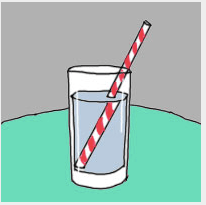
Why does the straw appear to be bent?
light is reflected
light is absorbed
light is turned
light is refracted
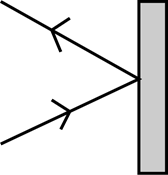
In the illustration, the light ray striking the object is-
Reflection is when light...
Bends
Bounces
Absorbs
transmits
The law of reflection states that
Angle of incidence = Angle of reflection
Angle of incidence = Angle of incidence
Angle of reflection = Angle of translucence
Angle of reflection = Angle of reflection

The angle of reflection is
90 degrees
55 degrees
45 degrees
135 degrees


What we call the final ray coming out of the glass slab?
Incident ray
Refracted Ray
Reflected ray
Emergent Ray
When light passes from air into water at an angle of 60° from the normal, what is the angle of refraction?
60°
40.6°
40°
4.6°
When light passes from water into diamond at an angle of 45° from the normal, what is the angle of refraction?
20.9°
20°
22°
22.9°
A block of amber is placed in water and a laser beam travels from the water through the amber. The angle of incidence is 35° while the angle of refraction is 26°. What is the index of refraction of amber? If the refractive index of water is 1.33
1.74
1.88
1.47
1.50

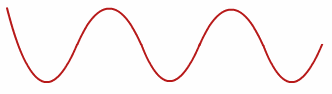
Which of these sound waves has the highest frequency?
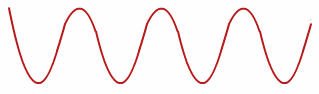
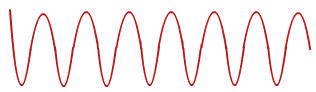
The ______ of a sound depends on the medium through which it's moving.
pitch
vibration
speed
loudness
Amplitude affects which characteristic of sound waves?
frequency
pitch
loudness
wave speed
Which state of matter do sounds travel fastest in?
Solid
Liquid
Gas
Plasma

Roughly what is the speed of sound in glass?
About 50 m/s
About 1 500 m/s
About 4 500 m/s
About 1800 m/s

A teacher bangs two bits of wood together. She hears an echo from a wall 0.14 seconds later. The wall is 25m away. What is the rough speed of sound, ACCORDING TO THESE RESULTS?
Roughly 340 m/s
Roughly 360 m/s
Roughly 375 m/s
Roughly 330 m/s





What is the Doppler Effect?
A change in frequency due to the relative motion of a wave source and an observer
When a wave overlaps with another wave
When a wave bounces off of another object
When a wave bends due to traveling through a different medium
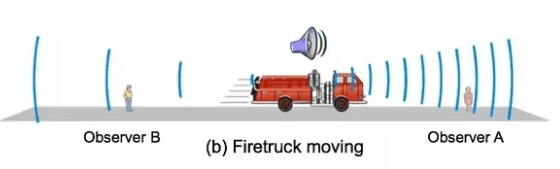
Look at the picture. Who is experiencing a higher pitched sound?
Observer A
Observer B
There's no difference

A car moves at 20 m/s away from a whistle. The whistle is stationary. The whistle makes a sound with a frequency of 500 Hz. The speed of sound in air is 330 m/s.
What is the frequency observed by the driver of the car?
530 Hz
470 Hz
520 Hz

You stand on the sidewalk next to the street. A fire truck is away from you. The frequency of the siren on the fire truck is 600 Hz.
What should you hear?
Frequency higher than 600 Hz
Frequency lower than 600 Hz
Exactly 600 Hz
No sound, silence.

A car moves at 20 m/s towards a whistle. The whistle is stationary. The whistle makes a sound with a frequency of 500 Hz. The speed of sound in air is 330 m/s.
What is the frequency observed by the driver of the car?
530 Hz
470 Hz
480 Hz
An ambulance is moving towards a stationary listener at a constant speed of 30 m∙s-1 . The siren of the ambulance emits sound waves having a wavelength of 0,28 m. Take the speed of sound in air as 340 m∙s-1
Calculate the frequency of the sound waves emitted by the siren as heard by the ambulance driver.
1 213 Hz
1 214,29 Hz
1 215 Hz
An ambulance is moving towards a stationary listener at a constant speed of 30 m∙s-1 . The siren of the ambulance emits sound waves having a wavelength of 0,28 m. Take the speed of sound in air as 340 m∙s-1 .
Calculate the frequency of the sound waves emitted by the siren as heard by the listener.
Choose the correct answer.
1 332 Hz
1 331,7 Hz
A train approaches a station at a constant speed of 20 m.s−1 with its whistle blowing at a frequency of 458 Hz . An observer, standing on the platform, hears a change in pitch as the train approaches him, passes him and moves away from him.
Calculate frequency of the sound that the observer hear while the train is approaching him. Use the speed of sound in air as 340 m.s−1 .
487 Hz
458 Hz
The speed of sound is ____.
below Mach 1
Mach 1
above Mach 1
Mach 5
Traveling 5 times faster than the speed of sound is ___.
ultrasonic
supersonic
hypersonic
crazy
Sound with a frequency higher than humans can hear is ___.
ultrasound
supersonic
hypersonic
magic
Bats, dolphins and some birds use ___ to navigate and find prey.
supersonic
sonar
echolocation
x-ray vision
Humans use ______ for mapping the sea floor.
echolocation
sonar
ultrasonography
sonic booms

