
 Worksheets
Chemistry Final Review Quiz
Total questions: 94
Worksheet time: 3hrs 37mins

What is the volume of a piece of zinc with measurements 5.0 cm x 5.0 cm x 5.0 cm?
15 cm3
125 cm3
15 cm
125 cm

What is the volume of the fluid in the graduated cylinder shown?
12.0 ml
13.0 ml
13.5 ml
12.5 ml

Which of the following is NOT a chemical property of sugar?
it decomposes readily
It is a white, crystalline powder
It has a composition of carbon, hydrogen, and oxygen
It will burn when heated
It does not conduct electricity so is non-ionic


Matter is made of small indestructible particles called:
protons
electrons
atoms
neutrons

Matter takes up space or ______, and has mass or quantity, measured in ______.
area, grams
mass, milliliters
volume, grams

Different substances can often be identified by their density. Density is a derived unit equal to:
mass x volume
volume / mass
length x width x height
mass /volume

All of the following are physical changes except:
Melting
burning
condensing
vaporizing

If the graph represents the energy of the reactants and products of a chemical reaction, which of the following is true of the reaction?
there is an exothermic reaction
there is an endothermic reaction
the activation energy is lower than the energy released
the total energy is higher than the starting energy

Atoms in a _______ are closely packed vibrating particles.
plasma
liquid
solid
gas

1 ml is the same as which af the following? (Mark all that apply)
1 cc
1 cm3
1 μl
1 dm3

Increasing the temperature of a substance causes the particles to speed up and can cause which of the following to occur? (Multiple answers)
condensing
vaporizing
melting
boiling

Which is NOT a chemical property?
iron will react with oxygen
white phosphorus is very flammable
copper is malleable (can be bounded into sheets) and ductile (can be pulled into wire)
lead is toxic

Which is NOT a Chemical Change?
iron is oxidized to become rust (iron oxide)
carbon products are usually combustible
Decomposition is a necessary reaction
dissolving substances is often the 1st step in any procedure

There are seven naturally occurring diatomic elements; which of the following is NOT a diatomic element?
H
O
Cl
N
C

A _________ is a pure substance made of different elements that are chemically combined into a new substance.
mixture
ion
compound

A material that is made of different substances that are NOT chemically combined is called a(an)
compound
mixture
ion

In a solution, the substance that causes the dissolving is known as a ________
solute
solvent
suspension
colloid

_________ mixtures are evenly blended and appear to be the same throughout.
homogeneous
heterogeneous

A mixture, like salt water, containing one substance dissolved in another, is known as a ____________
homogeneous mixture
solution
suspension
colloid

The two main parts of an atom are the:
principle energy levels and sublevels
nucleus and energy levels
planetary electrons and energy levels
nucleus and kernel

The number of electrons in the 2nd principal energy level, n=2, of an atom is: 2n2
4
2
8
18

When the particles of a liquid are heated, they begin to expand and the phase changes to a _____. These particles then move in straight lines until they bounce off of something. When the particles cool back down to a liquid it is called _________
Gas, condensation
Plasma, condensation
Gas, Sublimation
Plasma, vaporization

An atom of beryllium contains 4 protons, 5 neutrons, and 4 electrons. What is the mass number of this atom?
13
9
8
5

A substance that contains only one type of atom is known as a(n) ______
compound
element
Pure substance
Mixture

A can of baking powder reads: "Ingredients- cornstarch, sodium bicarbonate, calcium acid phosphate, and sodium aluminum sulfate." Baking soda is a
compound
mixture of compounds
molecule
mixture of elements

A 220 g piece of metal was submerged in a graduated cylinder containing 50 ml of water. The level of the water rose to 150 ml. What is the density of the metal?
2.2 g/ml
0.45 ml/g
320 g/ml
20 g/ml

Chlorine is represented by the electron dot structure shown in the picture. Which other atom(s) would have the same atomic dot structure? (Mark all that apply)
Iodine
Oxygen
Sodium
Fluorine
Elements in the same column of the periodic table always have the same # of _______ as one another.
Protons
Neutrons
Electrons
Valence Electrons
Which has the greater Electronegativity:
N or C?
C
N
Which group of the periodic table is composed of inert (not reactive) gases?
alkali metals
alkaline earth metals
halogens
noble gases

Which two statements are correct about the figure shown?
It is a covalent bond.
Hydrogen atoms loss electrons and Carbon gains the atoms.
It happens on metal and on another non-metal.
The valence electrons are shared by both atoms.

An electron dot diagram consists of the symbol representing the element and an arrangement of dots that usually shows
the atomic number
the atomic mass
the number of neutrons
the number of valence electrons

What element on the periodic table has 16 protons?
germanium Ge
phosphorus P
oxygen O
sulfur S

Which element easily gives up 1 electron to form a cation with +1 charge?
F
Cl
Mg
Li

Which atom will have the strongest affinity for electrons, becoming an anion with a -1 charge?
K
F
O
Fe

Where on the periodic table do you find elements that form the strongest bases?
left
right
middle
inert gases

If two atoms bond in such a way that one-member beomes a positive cation and the other a negative anion, what type of bond is formed?
ionic bond
covalent bond
polar bond
Vanderwaals bond

Isotopes are atoms with different numbers of ________.
protons
neutrons
electrons

The first scientist to show that atoms emit tiny negative particles was
J J Thomson
Ernest Rutherford
James Chadwick
Neils Bohr

The scientist whose alpha-particle scattering experiment led him to conclude that the nucleus of an atom contains a dense center of positive charge is
JJ Thomson
Ernest Rutherford
Neils Bohr
John Dalton

This scientist is responsible for the model that we use today to illustrate and help understand the atoms' energy levels.
JJ Thomson
Ernest Rutherford
Neils Bohr
John Dalton
Which of the following parts of Dalton's atomic theory are no longer entirely correct? (Mark all that apply)
atoms are small indestructible particles
all atoms of an element are alike and different from atoms of other elements
compounds are made of elements combined in different ratios of elements
chemical reaction occur that rearrange elements but do not destroy them
An atom has 10 protons, 15 neutrons and 10 electrons what is its mass number.
20
10
35
25
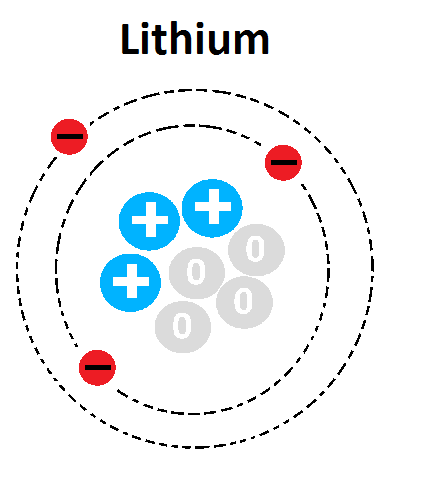
What is the mass number of this atom?
1
3
4
7
Which Bohr model represents Neon?


What atom matches this electron configuration?
1s2 2s2 2p6 3s2
Neon
Magnesium
Aluminum
Potassium
Solve this equation for alpha decay.
85209At = ___ + 24He
83205Bi
86209Rn
81207Tl
85208At

According to the graph, what fraction of the original parent isotope still exists after 3 half lives?
0,5000 g
0,2500 g
0,1250 g
0.0625 g
The total number of oxygen atoms indicated by the formula Fe2 (CO3)3 is
12
6
9
3
18
The correct name for LiCl is
lithium monochloride
lithium chloride
lithium I chloride
monolithium monochloride

The formula of this atom when it becomes an ion would be
N-2
N+3
N-3
N+2
Na1+ F1-
Cu + 2Ag(NO3) → 2Ag + Cu(NO3)
Synthesis Reaction
Decomposition Reaction
Single Replacement Reaction
Double Replacement Reaction
The correct name for FeO is
iron III oxide
iron II oxide
iron monoxide
iron I oxide
Which of the following is NOT the correct chemical formula for the compound named?
calcium sulfate CaSO4
beryllium oxide BeO
ammonium chromate (NH4)2CrO4
lead(II) dinitrate Pb(NO3)2
The correct formula for the ammonium ion is
NH4
N4H+
NH4+
Am+
The carbonate ion has the formula CO32-. What is the correct formula for sodium carbonate?
Na(CO3)2
Na2(CO3)2
Na3(CO)2
Na2CO3
Which element or ion listed below has the electron configuration 1s22s22p63s23p6? Choose all that apply.
Ca2+
Cl
Br
Ar
A phosphorus atom needs to gain _____ electrons to achieve a noble gas configuration and has an oxidation number of ______
5, -3
3, -3
3, -5
3, +5
What coeffiecient could be added in fron of the silver (Ag) reactant to balance the equation:
…Ag + H2S → Ag2S + H2
2
3
4
none
Sodium reacts with chlorine to produce sodium chloride (table salt). Which of the equations below is the proper balanced equation?
Na + Cl → NaCl
Na + Cl2 → 2NaCl
Na + Cl2 → NaCl
2Na + Cl2 → 2NaCl
Methane and oxygen react in a combustion reaction releasing carbon dioxide. Complete the balanced equation.
CH4 + 2O2 => CO2 +
CH4+2O2 => CO2 +H2
CH4+2O2=>CO2 +2H2O
2CH4+2O2=>CO2 +4H2+CO
Which of the following is a synthesis reaction?
2Mg + O2 → 2MgO
2Al+6HCl→2AlCl3 +3H2
2ZnS+3O2→2ZnO+2SO2
PCl5 → PCl3 +Cl2
Which of the following is a single replacement reaction?
2Mg + O2 → 2MgO
2Al+6HCl→2AlCl3 +3H2
Na2S+2HCl→2NaCl+H2S
PCl5 → PCl3 +Cl2
Which of the following is a double replacement reaction?
2Mg + O2 → 2MgO
2Al+6HCl→2AlCl3 +3H2
Na2S+2HCl→2NaCl+H2S
PCl5 → PCl3 +Cl2
What type of reaction is the equation C + O2 → CO2?
Synthesis Reaction
Decomposition Reaction
Single Replacement Reaction
Double Replacement Reaction
P4+O2 --> P2O3
What type of reaction is this?
2 C6H14 + 19 O2 → 12 CO2 + 14 H2O
Single Replacement
Double Replacement
Combustion
Decomposition

1 mole of water has a mass of _____ grams.
6.02 x 10^23
18.0
1.0
What is the molar mass of C4H10 , butane?
14
40
58
How many moles are present in 32.3 grams of carbon dioxide (CO2)?
44.01 moles
1421.52 moles
32.3 moles
0.73 moles
SiO2 + 3C → SiC + 2CO
I need to add 8 moles of Carbon to the reaction. How many grams of Carbon should I weigh?
96 g
0.67 g
2.67 g
48 g
2 KClO3 → 2 KCl + 3 O2
How many moles of oxygen are produced when 6.7 moles of KClO3 decompose completely?
6.7 mol
1.0 mol
10.1 mol
4.5 mol
How many grams are in 3 moles of nitrogen? (N - 14.01 molar mass)
14.01
4.67
6.98x10^-23
42.03
How many molecules are in 1 mole of sucrose sugar? ( C12H22O11 )
372
6.022×10²³
1.6×10²¹
2.2×1026
What percent of C3H8O is Hydrogen? (Molecular Mass = 60)
60%
13%
27%

