Wayground logo

Free Printable Worksheets

Font size

S
M
L
XL
Worksheets

Ecology

Total questions: 71

Worksheet time: 1hrs 2mins

Name
Class
Date
1.
All living things get their energy from which of the following sources?
a)
food
b)
water
c)
sun
2.

Which of the following is a word that could describe a plant?

a)
autotroph
b)
heterotroph
c)
consumer
3.
Which of the following is an organism that eats only meat?
a)
herbivore
b)
carnivore
c)
omnivore
4.
Which of the following terms describes an area where an organism lives?
a)
community
b)
habitat
c)
area
5.
Which is represented by all of the bullfrogs living around a pond?
a)
community
b)
habitat
c)
population
6.
What would most likely happen if the rabbit population was removed from the food chain grass —› rabbit —› fox?
a)
their would be more grass
b)

there would be less ants

c)

there would be less grass

d)

There would be more foxes

7.
Which is an example of a parasitic relationship?
a)
a bee pollinates a flower
b)
a tapeworm takes nutrients from a dog
c)
an orchid lives in a tree but does not harm the tree
8.
In which type of relationship do both species benefit?
a)
parasitism
b)
mutualism
c)
commensalism
9.
Barnacles grow on whales.  Whales give the barnacles a place to live but the barnacles do not help or harm the whale.  Which type of relationship is this?
a)
commensalism
b)
mutualism
c)
parasitiesm
10.
An oxpecker bird eats ticks off of a zebra.  The bird gets food from eating the ticks and the zebra has harmful parasites removed.  Which type of symbiosis is this?
a)
mutualism
b)
parasitism
c)
commensalism
11.
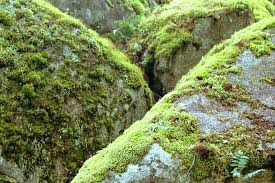
What are examples of pioneer species in a primary succession?
a)
Bushes and Shrubs
b)
Oak trees
c)
Mossess and Lichens 
d)
A rose Bush
12.
After a volcanic eruption, lava covers the land. What is the order that plants grow to repopulate the area?
a)
Lichens → Shrubs → Grasses → Trees
b)
Lichens → tree → shrubs→Grasses
c)
Grasses → Lichens → Shrubs → Trees
d)
Lichens → Grasses → Shrubs → Trees
13.
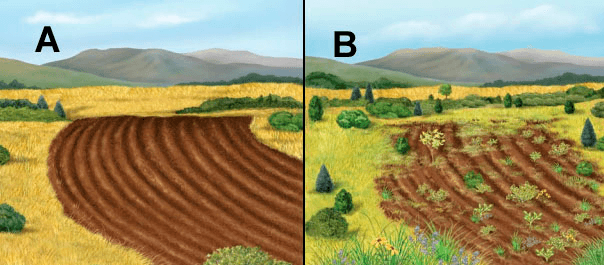
What type of succession is shown going from figure A to figure B?
a)
primary succession
b)
ecological succession
c)
secondary succession
d)
intermediate
14.
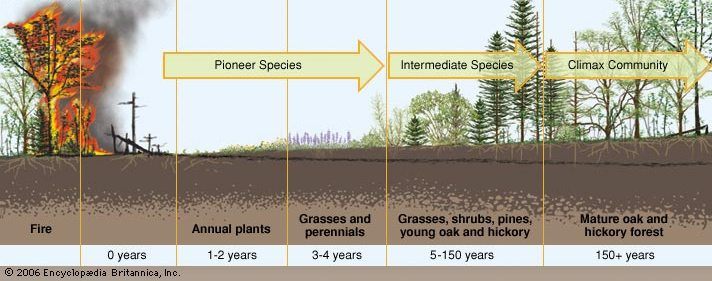
The picture shows what type of succession?
a)
primary
b)
secondary
c)
tertiary
d)
quadanary
15.

Reaches a climax community quicker because soil was already present.

a)

primary succession

b)

secondary succession

c)

both types of succession

16.
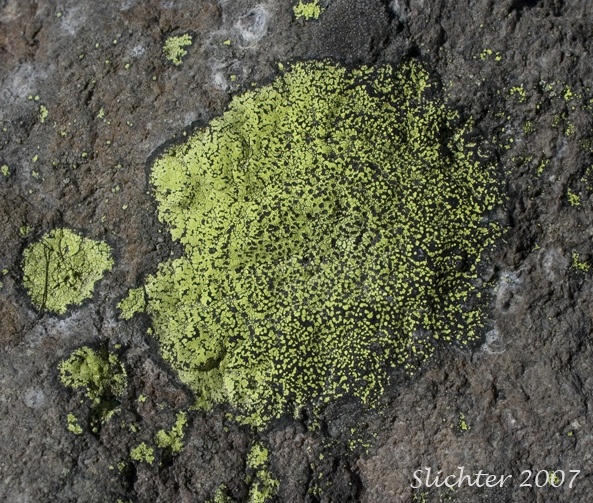
What is the first species you will see after a primary succession? (in picture)
a)
lichens
b)
grasses
c)
small plants
17.
What is the most important function of pioneer species?
a)
To create rocks
b)
To create soil and add nutrients to the environment 
c)
To look nice
d)
Food for animals 
18.
What is the term for the final stage of any ecological succession?
a)
climax community
b)
final community
c)
last community
d)
optimal community
19.
What is an ecological succession?
a)
Series of gradual changes that occur after a disturbance
b)
Changes that only happen when species die
c)
a series of changes that cause a population to increase or decrease
d)
an INSTANT change caused by a disturbance
20.
_______ is the study of relationships among living and nonliving parts of an environment. 
a)
Ecosystem
b)
Niche
c)
Habitat
d)
Ecology
21.
What is a niche?
a)
the place where a species lives
b)
what a species eats
c)
the role of a species
d)
how a species uses resources
22.

The process by which some organisms make glucose and oxygen from water and and carbon dioxide in the presence of a specific type of energy is called

a)
pollination
b)
photosysthesis
c)
scavenging
d)

cellular respiration

23.
What do consumers give off that producers need?
a)
oxygen
b)
carbon dioxide 
c)
sugars
d)
heat
24.
What do plants produce when they carry out photosynthesis?
a)

gluose

b)
carbon dioxide
c)
water
d)
all of the above
25.
A food web
a)
shows how energy is released by an organism
b)
compares the amount of energy at each level
c)
shows how different food chains in a community are linked together
d)
is unique since each organism can only be part of one food web
26.
A food chain is a diagram of how 
a)
communities are connected
b)
energy and nutrients pass among organisms in an ecosystem
c)
producers make food
d)
an ecosystem develops and changes
27.
Consumers cannot do which of the following
a)
give off carbon dioxide
b)
change sugars into energy
c)
give off oxygen
d)
carry out respiration
28.
In an energy pyramid, 
a)
the organisms in each level eat those in the level below them
b)
the amount of energy increases as you move up each level
c)
producers are at the top
d)
the smallest organisms are at the top
29.

What is the part of the water cycle when water evaporates from plants called?

a)

percolation

b)

condensation

c)

precipitation

d)

transpiration

30.
What is an omnivore?
a)
An organism that only eats plants for energy
b)
An organism that eats animals for energy
c)
An organism that eats both plants and animals for energy.
31.
The ___% rule states that only ____% of energy is transferred to the next trophic level.
a)
10%
b)
25%
c)
50%
d)
100%
32.
What are "trophic levels"?
a)
Levels in a food web/food chain
b)
Levels of land in a mountain
c)
Animal diets
33.
Raccoons eat meat AND plants. They are ____.
a)
Carnivores
b)
Herbivores
c)
Omnivores
34.

Which of the following organisms is a primary consumer?

a)

grass

b)

rabbit

c)

fox

d)

snake

35.

Which of the following organisms is a producer?

a)

grass

b)

rabbit

c)

fox

d)

snake

36.

Which of the following organisms in competition with the weasel for their food source?

a)

grass

b)

rabbit

c)

fox

d)

snake

37.

Which of the following organisms is a herbivore?

a)

grass

b)

rabbit

c)

fox

d)

snake

38.
The arrows in a food chain or web represents what?
a)
They point to the organism that is being eaten.
b)
It shows how sunlight flows within an ecosystem.
c)
They show what direction the energy is flowing between organisms. 
d)
They represent how water is transferred within a habitat.
39.
Which is a major environmental concern for our oceans?
a)
Oxygen pollution
b)
Nutrient pollution
c)
Plastic pollution
d)
Air pollution
40.
Which is a nonrenewable natural resource?
a)
Trees
b)
Solar energy
c)
Oil
d)
Oxygen
41.
Which of the following resources are in high demand due to large human populations?
a)
Oil
b)
Water
c)
Trees
d)
All of the above
42.
In the energy pyramid here, how much of the energy in each level gets lost as heat or used by the organism for survival?
a)
80%
b)
90%
c)
10%
d)
20%
43.

The collective mass of all living things in a particular area or at a specific trophic level of an ecosystem is known as...

a)

Population Size

b)

Biomagnification

c)

Biomass

d)

Apex Trophism

44.

Which organism in the food web shown to the right would

contain the lowest concentration of chemical pollutants?

a)

producers

b)

primary consumers

c)

secondary consumers

d)

tertiary consumers

45.
Which animal is the apex predator?
a)
hawk
b)
lizard
c)
snake
d)
grass
46.

The phenomenon by which toxins concentrate in the organisms at higher trophic levels within an ecosystem is known as...

a)

Biotoxicity

b)

Biomagnification

c)

Eutrophication

d)

Predation

47.

Consider the following food chain:

Algae > Mayfly > Minnow > Trout

In a polluted ecosystem, which organism would likely have the HIGHEST level of toxic chemicals in its body?

a)

Algae

b)

Mayfly

c)

Minnow

d)

Trout

48.

Which ecological nutrient cycle relies on photosynthesis and respiration?

a)

Carbon Cycle

b)

Nitrogen Cycle

c)

Phosphorus Cycle

49.
How did the zebra mussels end up in the Great Lakes?
a)
In ballast tanks of ships
b)
They were intentionally released
c)
They have always been in the Great Lakes
d)
That's not a zebra mussel
50.

What makes a species invasive?

a)

Moving to a new ecosystem and taking resources from natives

b)

Not having papers

c)

Species that can't adapt

d)

Plants that take up too much space

51.

The largest number of individuals that an environment can support long term is...

a)

carrying capacity

b)

emigration

c)

immigration

d)

population density

52.

What happens if a population grows past its carrying capacity?

a)

The population keeps growing

b)

The population starts to die off

c)

The entire species will go extinct

d)

The carrying capacity just increases

53.

Something that regulates the size of a population is called...

a)

a limiting measure

b)

a limiting factor

c)

carrying capacity

d)

biodiversity

54.

What are factors that affect carrying capacity?

a)

Biotic only

b)

Biotic and abiotic

c)

Depends on the ecosystem

d)

Abiotic only

55.

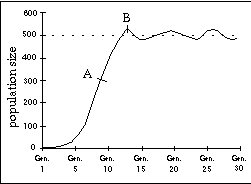
What is the carrying capacity of the graph?

a)

1000

b)

8000

c)

800

d)

600

56.

What is the carrying capacity of the graph?

a)

around 500

b)

more than 800

c)

less than 300

d)

around 700

57.
If the number of births in a population is the same as the number of deaths in a population, what will happen to the growth of the population?
a)
It will increase.
b)
It will decrease.
c)
It will stay the same.
d)
It will fluctuate.
58.
If the number of births is greater than the number of deaths in a population, what will happen to the growth of the population?
a)
It will increase.
b)
It will decrease.
c)
It will stay the same.
d)
It will fluctuate.
59.
What growth pattern describes a population whose growth rate slows or stops following a period of exponential growth?
a)
logistic growth
b)
population growth
c)
exponential growth
d)
predator-prey cycle
60.
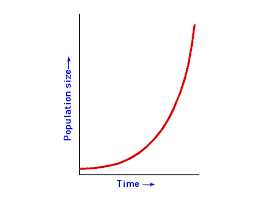
What type of growth is shown in the diagram?
a)
exponential growth
b)
logistic growth 
c)
predator-prey cycle
d)
boom-bust curve
61.
Largest number of individuals of a population that the environment can support...  
a)
carrying capacity
b)
population crash
c)
lag phase
d)
mutualism
62.
Plants and animals that are not native to a habitat (nonindigenous)...
a)
predators
b)
biological magnification
c)
invasive species
d)
prey
63.
What type of growth curve is pictured?
a)
exponential 
b)
logistic
c)
predator-prey
d)
invasive
64.
Type of growth that occurs when disease and parasites are present...
a)
exponential
b)
J-shaped
c)
predator-prey
d)
logistic
65.
Increased carbon dioxide may cause global warming by trapping more ____________ in the atmosphere.
a)
water
b)
gases
c)
heat
d)
water vapor
66.
Which of the following is the best conclusion that can be made from this graph?
a)
atmospheric carbon dioxide levels have been decreasing since 1960
b)
Hawaii has a lot of carbon dioxide
c)
humans have been working hard to decrease carbon dioxide levels
d)
atmospheric carbon dioxide levels have increased steadily since 1960
67.

Which of the following have been changed or altered due to climate change ?

a)

droughts

b)

flooding

c)

melting of polar ice caps

d)

all of the above

68.

The main human activity that releases greenhouse gases is

a)

riding bicycles

b)

burning fossil fuels

c)

texting on cellphones

d)

eating meat

69.

How does habitat fragmentation reduce genetic diversity in species?

a)

Habitat fragmentation makes nonnative species introduction possible.

b)

Habitat fragmentation opens migration routes.

c)

Habitat fragmentation isolates a large population into smaller groups.

d)

Habitat fragementation encourages open gene flow.

70.

the breaking of habitats into smaller pieces is called...

a)

habitat division

b)

habitat pollution

c)

habitat corruption

d)

habitat fragmentation

71.

Habitat loss means less space for animals to __________, __________, and _____________. (Choose 3 answers)

a)

feed

b)

breed

c)

locate new species

d)

raise their young