
Font size
 Worksheets
Unit 6 Test
Total questions: 100
Worksheet time: 55mins
A population of bacteria is treated with hand sanitizer. Because of genetic variation in the population, what is a possible outcome?
The population will grow quickly.
All of the bacteria are already resistant.
They will get better at obtaining a food source.
Some may be resistant and survive.
One of the biggest ways that a species evolves is because some organisms with some traits survive and reproduce better than others. This process is known as
Natural Selection
Convergent Evolution
Coevolution
Sexual Selection
Genes for traits that help and organism be more successful reproductively can be expected to
cause it to evolve into a new species
become more common in the future
cause the extinction of the species
eventually be eliminated by natural selection
An adaptation is
any trait an organism possesses
how an organism evolves during its own lifetime
a gene an organism has
a trait that helps an organism survive in its environment
Genetic diversity is ultimately/mainly the result of
meiosis
viruses
mutations
reproduction
Which of the following is NOT an example of evolution?
Horses becoming taller and faster over millions of years
All species of tortoises in the Galapagos islands descending from a common ancestor
Human brains becoming larger over time
A caterpillar going through a change into a butterful
Which of the following does NOT increase genetic variation?
Mutations
Gene flow
Mitosis
Crossing over
Which of the following is NOT a principle of natural selection?
Most species produce more offspring than will actually reproduce
Organisms compete for limited resources
Evolution will occur as an organism gets older and learns more
In every population, adaptations allow some organisms to survive and reproduce better than others
Individuals that are well adapted to their environment will survive and produce
fewer mutations
more offspring
stronger gene
better traits
Natural selection results in change over time by acting on traits that are
heritable
new
mutated
better
Why are advantageous traits more likely to be passed onto offspring?
Because they are more likely to survive and reproduce.
Because they come from dominant alleles.
Because they come from recessive alleles.
Because the organism knew it needed that trait, survives, and passes it on.
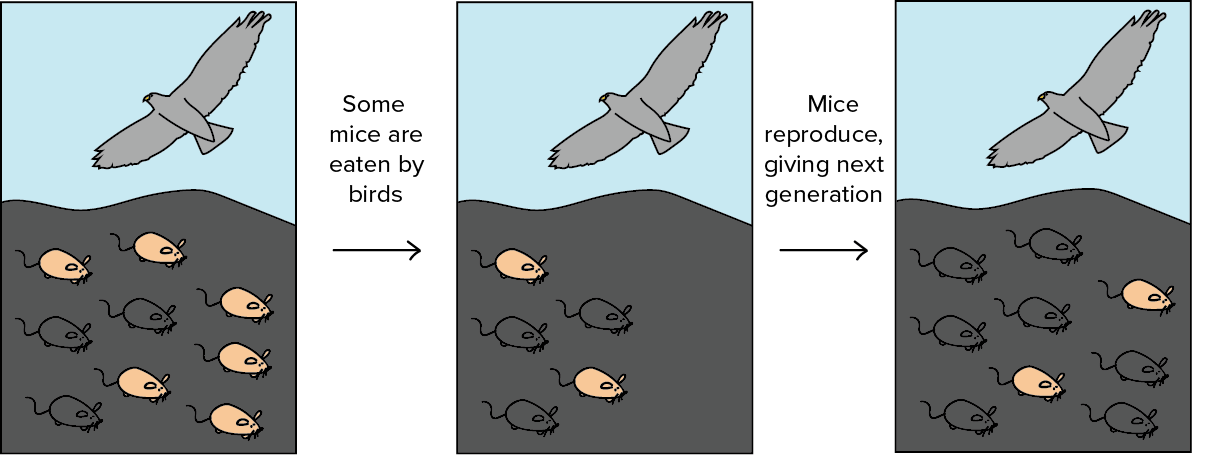
Where do adaptations come from?
The individual organism decides to adapt
Mutations that give an organism an advantage in its environment
Genetic recombination during meiosis
Both mutations and genetic recombination are sources of adaptation
"Organisms that are better adapted to the environment survive to pass traits to their offspring" is the definition of
Natural Selection
Evolution
Selective Breeding
Artificial Selection
Which best describes the role of mutations in natural selection?
Mutations help an organism to better survive in their environment
An organism may acquire a helpful mutation by interacting with the environment
A mutation may result in a beneficial trait that makes an organism more likely to survive and reproduce
Organisms with certain traits are more likely to win competitions for mutations


Evolutionary change on a small scale
macroevolution
microevolution
coevolution
parallel evolution
Evolutionary change on a large scale; Principle of common descent
macroevolution
microevolution
coevolution
parallel evolution
Lots of offspring and limited resources causes competition for those resources.
Overproduction of offspring
Natural selection
variation
adaptation
random change in the frequency of alleles in a population over time
Mutations
Natural Selection
Genetic Drift
Gene Flow
movement of genes into/out of a population
Mutations
Natural Selection
Genetic Drift
Gene Flow
Sexual selection (selection of traits by one sex of the opposite sex) is also known as
Gene Flow
non-random mating
Genetic Equilibrium
Mutations
when there are NO changes in the allele frequencies in a population over time
mutations
gene flow
Genetic equilibrim
Which of the following are reasons a species may go extinct? (Check all that apply.)
loss of habitat
new predators
greater competition
natural disasters
Charles Darwin presented the idea that evolution occurs due to _____.
Selective breeding
Artificial selection
Inheritance of acquired traits
Natural selection
Hummingbirds have a beak just the right length to reach the nectar in a cardinal flower and as they feed their foreheads bump into the pollen structure. Cardinal flowers are red which hummingbirds can see but bees can’t. Cardinal flower’s pollen structure is just the right length for the hummingbird to pick up pollen as it feeds
Convergent
Divergent
Coevolution
Bees don’t see red, but do see yellow, blue, and ultra-violet light. Thus, bee-pollinated flowers are mostly yellow or blue with UV nectar guides (landing patterns) to guide the bee. They usually have a small, narrow floral tube to fit the tongue-length of that species of bee.
Convergent Evolution
Divergent Evolution
Coevolution
In the ocean surrounding Antarctica, there are fish that survive the cold water by using a molecule made of glycoproteins that circulates the blood and keeps it from freezing. Certain kinds of worms that live in the Arctic ocean also make antifreeze proteins that help them live in icy water.
Convergent Evolution
Divergent Evolution
Coevolution
The beaver in North America and the capybara in South America share a common ancestor, but have evolved over time to look different
Convergent Evolution
Divergent
Coevolution
Ants are the correct size and weight needed to open the flowers for the peony plant. The peony plant provides food for the ant and the ant fertilizes the peony’s flowers
Convergent
Divergent
Coevolution
The Galápagos finches evolved through natural selection from a common ancestor into a wide variety of different looking species.
Convergent Evolution
Divergent Evolution
Coevolution
This kind of evolution is proven by DNA analysis and results in organisms with different ancestors becoming more alike as they adapt to similar environments.
Convergent Evolution
Divergent Evolution
Coevolution
Butterflies, bats, and birds all have wings that allow them to fly. Butterfly wings, however, do not have bones like bat and bird wings do. This is an example of
Convergent Evolution
Divergent Evolution
Punctuated Equilibrium
Coevolution
4000 years ago, a population of cichlid fish were isolated in Lake Nagubago in central Uganda. Since then 5 new species have formed, distinguished by their differing coloration and mating rituals. These five groups of fish are considered unique species because they do not naturally interbreed. This is an example of
Speciation
Extinction
Coevolution
Gradualism
A population of mollusks are living in a stable ecosystem in the ocean. A rapid drop in sea level causes the formation of a lake, which isolates a group of mollusks from the rest. This quick environmental change causes rapid evolutionary change. Due to the new small population, genetic drift occurs, and mollusks with larger shells rapidly become the most common trait.
Punctuated Equilibrium
Gradualism
Divergent Evolution
Speciation
The Dodo was a flightless bird, first spotted by Dutch sailors in 1598. Dodos had no known predators until sailors started hunting them and new invasive species were introduced. The last sighting of a Dodo was in 1662. This is an example of
Convergent Evolution
Extinction
Speciation
Gradualism
Dogs and wolves share a common ancestor - the Grey Wolf. They share similar body shape, skull size, limb formation, genetic makeup and much more. Varying temperament in wolves eventually became so drastic resulting in extremely aggressive wolves and docile wolves that were vitally domesticated, leading to the formation of dogs. This is an example of
Convergent Evolution
Divergent Evolution
Coevolution
Speciation
Male bumblebees go to flowers, such as orchids, to pick up chemicals that allow them to create attractive scents to put off for female bumblebees. Flowers have waxy pollen to stick to the bumblebee's heads and abdomens in order to spread their pollen to other flowers. These two traits have evolved together, forming a mutualistic relationships between flowers and bumblebees. This is an example of
Coevolution
Divergent Evolution
Convergent Evolution
Speciation
Fossil evidence suggests that whales evolved from land mammals. This was a slow process over thousands of years that resulted from continual reduction of the ancestral mammal's forelimbs over time, until they were reduces to fins. This is an example of
Speciation
Coevolution
Gradualism
Punctuated Equilibrium
Which pattern of evolution results in one species splitting into many over time?
Coevolution
Divergent Evolution
Convergent Evolution
Sexual Selection
Organisms that live in similar environments, such as the ocean, often have similar adaptations. This is often due to
Convergent Evolution
Coevolution
Gradualism
Sexual Selection
Multiple species evolving from a common ancestor is known as
Gradualism
Speciation
Punctuated Equilibrium
Divergent Evolution
Burst of evolutionary change followed by periods of stability is known as
Punctuated Equilibrium
Divergent Evolution
Coevolution
Gradualism
Formation of a new species from a pre-existing species is known as
Speciation
Gradualism
Coevolution
Convergent Evolution
Slow evolutionary changes over a long period of time is known as
Gradualism
Speciation
Convergent Evolution
Coevolution
When two organisms evolve in response to the other it is called
Convergent Evolution
Divergent Evolution
Coevolution
When unrelated species evolve similar characteristics because they live in similar environments it is referred to as
Divergent Evolution
Convergent Evolution
Coevolution
Which of the following is the collection of life's remains found in sedimentary rock?
natural selection
homologous structures
Charles Darwin
the fossil record
Similar structures with different purposes found in different species are known as _____
vestigial structures
DNA
homologous structures
the fossil record

The picture shows a/an ___________
homologous structure
vestigial structure
analogous structure
The appendix, which is not needed to survive, is conisdered to be a
Homologous Structure
Analagous Structure
Vestigial Structure
Homology
An inherited characteristic that increases an organism's chance of survival
adaptation
evolution
fitness

By looking at the genes of some animals we can determine which living species are most closely related to each other. This also reveals which species most recently diverged from their common ancestor.
Based on the partial gene segments shown, which pair of animals are genetically most closely related and therefore most recently diverged from their common ancestor?
Chimpanzee and Mouse
Rat and Mouse
Rat and Chimpanzee

Images of the embryo and adult stages of three different organisms are shown.
Which of the following is the best conclusion that can be drawn from this evidence?
Having similar embryos indicates that these organisms eat the same types of food.
Having similar embryos indicates that these organisms live in a similar environment.
Having similar embryos indicates that these organisms share a recent common ancestor.
Having similar embryos indicates that a certain protein controls how many legs the adult organisms will have.
Researchers discovered that the legs of birds are homologous to the feet of reptiles. Which claim is BEST supported by this fact?
Birds do not require legs
Birds and reptiles have a common ancestor
They randomly developed the same structures
Selection pressures have acted on birds, but not on reptiles

What evidence presented here supports the argument that vertebrates and insects evolved from a common ancestor?
The fact that the eye structures of vertebrates and insects are analogous
The fact that the genes encoding the eye structures of vertebrates and insects are analogous
The fact that the eye developmental genes of vertebrates and insects are homologous

What does it mean that the eye structures and specific genes for those structures are analogous but the genes that control eye development are homologous?
Select all that apply
It means vertebrates and insects had a common ancestor that possessed genes that coded for a primitive eye
It means every species that descended from the common ancestor developed additional genes that made changed the structure of their eye
It means that vertebrates and insects are not related to each other but developed eyes in a similar pattern

Which of these statements does NOT help explain why the development of gene sequencing technology provided a turning point in evidence gathering related to this claim?
Select all that apply
Before gene sequencing, the only evidence was the anatomical appearance of the eyes of vertebrates and insects
Because the eye structures are so different in appearance, it was easy to conclude these groups had no evolutionary relationship with each other
Gene sequencing shows that there are enough genetic similarities in the genes of eye development to suggest a very early common ancestor
Gene sequencing shows that, since the genes encoding eye structures are analogous, that vertebrates and insects share no common ancestors
Scientists can explore whether two different animal species have evolved from a common ancestor, using evidence from all of the sources below EXCEPT
analysis of strands of DNA
comparisons of bones and muscles
comparison of the experiences of each organism
studies of embryos during development
Two bodily structures, found in different species, have different internal bone structures but serve a similar purpose in each organism. This is most likely describing
homologous structures
vestigial structures
analogous structures
natural selection
If scientists wanted to learn more about evolution by studying biochemistry, they would study all of the following EXCEPT
DNA
proteins
nucleic acids
lipids (fats)
Ostriches have wings, but do not fly. Humans have an appendix with no apparent function, Whales contain bones for rear legs. Each of these are examples of
homologous structures
vestigial structures
analogous structures
natural selection
Fossil evidence shows that structures considered vestigial in living organisms
are not found in ancient organisms
have always be vestigial
were useful to their ancestors
do not fill gaps in the fossil record
Evidence of evolution from the field of paleontology examines
sequences of DNA and protein
embryos of different species
the location of different species across the planet
fossils compared to living species
Early during development, organisms as diverse as a human, a mouse, and a bat can appear indistinguishable. All of their embryos look nearly identical, suggesting that
during development, humans go through stages of being a mouse and a bat.
similar structures have developed because of convergent evolution
these very different species have a shared ancestry with all mammals.
this is a coincidental resemblance between them
Select all the fields of science discussed in class that provide evidence for evolution.
Biochemistry
Paleontology
Biogeography
Embryology
Direct Observation
Which IS NOT used as evidence for evolution?
Fossils
Natural Selection
Early Development/Embryos
Body Structure/Anatomy
DNA/Proteins
2-word naming system by Carolus Linnaeus
Binomial nomenclature
Dual names
Dual nomenclature
Binomial names
All life is classified into _______ domains based on common characteristics.
2
3
4
5

What is the common ancestor of Letters A, B, C, D, E?
1
2
3

On the cladogram, which organism is the closest relative of the human?
Parrot
Shark
Hare
Places on a phylogenetic tree where organisms share a common ancestor are called...
Nodes
Branches
Taxa
Species
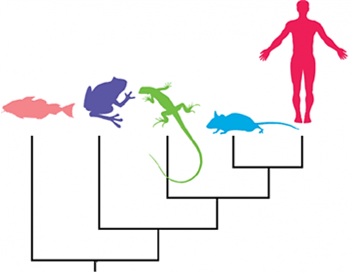
According to this phylogenetic tree, which creature is the least related out of all pictured?
Fish
Frog
Salamander
Human

What do you call the traits shown on phylogenetic trees, such as "four limbs" or "vertebrae"?
Derived characteristics
Speedy Lambofeeties
Branching elements
Harmonious changes

Which group of animals on this tree are most closely related to birds?
Saurischian dinosaurs
Ornithischian dinosaurs
Crocodiles
None of these are related to birds

What number is the common ancestor of C and D
1
2
3
4

From the picture above, What do the species all have in common?
Back bone
Same father
Common ancestor
Feathers

Phylogeny is usually represented by a tree diagram called a _________ - _____
Genetic Line
Phylogenetic Tree
Photographic Queue
Future Babies
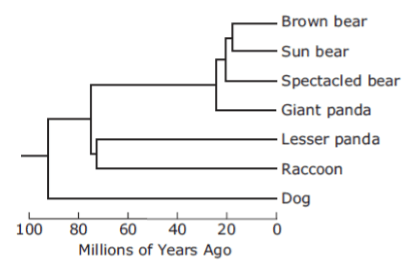
Who is the closest relative to the brown bear?
Giant panda
Dog
Lesser panda
Sun bear

The lizard has all these derived characteristics EXCEPT
Jaws
Lungs
Bipedal

How many derived characteristics are represented on the diagram above?
2
3
5

Which animals have amniotic eggs?
Turtle and Tuna
Turtle and Leopard
Lancelet and Lamprey

Which organism does not have a Vertebral Column?
Lamprey
Lancelet
Tuna

According to this cladogram, sharks are MOST closely related to which organism?
Amphibians
Ray-Finned Fish
Primates

Which trait do only humans have, according to the cladogram?
Bipedal and Opposable Thumbs
jaws
tetrapod
According to binomial nomenclature, species are given two names based on their
kingdom and species
genus and species
class and phylum
order and genus
Which of the choices below would be most closely related to the Harmonia axyridis ?
Curculio nimbusa
Diapres brevius
Harmonia yelloritus
Lixus scrobicollis
Which of the following statements about phylogenetic trees is NOT true?
They show which groups of organisms are most closely related.
They show which groups of organisms are more advanced than other groups.
They show which group of organisms diverged longest ago.
They show predictions of evolutionary relationships from the analysis of shared heritable traits.
Which of the following sequences shows the correct hierarchy of classification, going from broadest to most specific?
Kingdom, Domain, Phylum, Order, Class, Family, Genus, Species
Domain, Kingdom, Phylum, Class, Order, Family, Genus, Species
Genus, Species, Kingdom, Phylum, Order, Class, Family
Domain, Phylum, Kingdom, Genus, Species, Family, Order, Class
By looking at the genes of some animals we can determine which living species are most closely related to each other. This also reveals which species most recently diverged from their common ancestor.
Based on the partial gene segments shown, which pair of animals are genetically most closely related and therefore most recently diverged from their common ancestor?
Chimpanzee and Mouse
Rat and Mouse
Rat and Chimpanzee
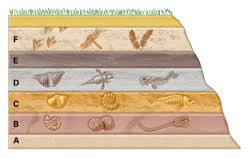
Which rock layer contains the newest fossils?

