Wayground logo

Free Printable Worksheets

Font size

S
M
L
XL
Worksheets

dna 2

Total questions: 62

Worksheet time: 31mins

Name
Class
Date
1.

What were James Watson and Francis Crick most known for

a)

Discovering a cure for cancer

b)

Discovering the structure of the DNA molecule

c)

Discovering how atoms bond into molecules

d)

Discovering the constant speed of light

2.

What type of pictures did Watson and Crick use to give them ideas for their discovery?

a)

Polaroid pictures

b)

X-Ray pictures

c)

MRI pictures

d)

Ultrasound pictures

3.

What were James Watson and Francis Crick most known for

a)

Discovering a cure for cancer

b)

Discovering the structure of the DNA molecule

c)

Discovering how atoms bond into molecules

d)

Discovering the constant speed of light

4.

What type of pictures did Watson and Crick use to give them ideas for their discovery?

a)

Polaroid pictures

b)

X-Ray pictures

c)

MRI pictures

d)

Ultrasound pictures

5.

What is the name of the twisting shape of the DNA molecule?

a)

Deep Nitrogen Atom

b)

Turning Ladder

c)

Twisted Strands of Life

d)

Double Helix

6.

How did Watson and Crick test their ideas on the structure of DNA?

a)

They used sophisticated computer modeling

b)

They used paper-mache models together with drawings

c)

They used stick-and-ball models

d)

They used Legos to model the shapes

7.

James Watson became the director of what biomedical lab in New York?

a)

Institute of Biomedical Research

b)

Watson Research Lab

c)

Cold Spring Harbor Lab

d)

Oak Ridge National Lab

8.

Watson and Crick were part of a team of researchers at the Cavendish Laboratory located at what university?

a)

University of Cambridge

b)

University of Illinois

c)

University of Paris

d)

Massachusetts Institute of Technology

9.

The discovery of the structure of DNA was important to what field of science?

a)

Physics

b)

Robotics

c)

Genetics

d)

Astronomy

10.

True or False: Crick and Watson had very different personalities, but were able to work together to make a great scientific discovery.

a)

True

b)

False

11.

Crick worked worked as a research professor at the Salk Institute in California.

a)

True

b)

False

12.
Who was responsible for the experiment depicted by the image?
a)
Martha Chase
b)
Watson and Crick
c)
Frederick Griffith
d)
Rosalind Franklin
13.
Who was responsible for the model shown?
a)
Oswald Avery
b)
Watson and Crick
c)
Erwin Chargaff
d)
Rosalind Franklin
14.
The work of Erwin Chargaff allowed Watson and Crick to determine the rules of.......
a)
protein synthesis
b)
transcription
c)
hydrogen bonding
d)
nitrogen base pairing
15.
What was Watson and Crick's main scientific accomplishment?
a)
Building the first accurate model of DNA
b)
Isolating strains of pneumonia causing bacteria
c)
Determining base pairing rules
d)
Discovering the process of genetic transformation
16.
What did Erwin Chargaff conclude from his experiments?
a)
Nitrogen bases are held together by peptide bonds
b)
A and T, C and G always occur in equal amounts
c)
Proteins are the carriers of genetic information
d)
C and G rarely occur in eukaryotic organisms
17.
How did Rosalind Franklin's photo 51 affect the work of Watson and Crick?
a)
It was used to determine the physical structure of DNA
b)
It was used to identify the four bases that make up DNA
c)
It was used to determine the theory of independent assortment
d)
It was used to show DNA was the molecule of inheritance
18.
Which of the following best describes a DNA molecule?
a)
double helix
b)
contains ribose
c)
made of amino acids
d)
contains Uracil
19.
What does DNA stand for?
a)
Deoxyribonucleic acid
b)
Denitrogenous acid
c)
Deribonucleic acid
d)
Diribonucleic acid
20.
The work of Erwin Chargaff allowed Watson and Crick to determine the rules of.......
a)
protein synthesis
b)
transcription
c)
hydrogen bonding
d)
nitrogen base pairing
21.
Why is DNA important?
a)
it is very small and very complicated
b)
it's in everything
c)
it serves as the blueprint for traits of all living things
d)
because we eat it every day for energy
22.
In a molecule of double-stranded DNA, the amount of Adenine present is always equal to the amount of
a)
cytosine
b)
guanine
c)
thymine
d)
uracil
23.
Which organelle is DNA usually found in?
a)
cell membrane
b)
vacuole
c)
ribosome
d)
nucleus
24.
Guanine bonds with ______________.
a)
Adenine
b)
Guanine
c)
Cytosine
d)
Thymine
25.
What will the matching sequence be on a strand that reads AAGCTAT?
a)
AACGATA
b)
TTCGTTA
c)
CCTGATA
d)
TTCGATA
26.
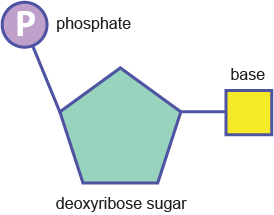
What are the three components of a nucleotide?
a)
sugar, hydrogen, nitrogen base
b)
sugar, oxygen, nitrogen base
c)
sugar, phosphate, nitrogen base
d)
sugar, phosphate, protein
27.
DNA codes for...
a)
bases
b)
proteins
c)
amino acids
d)
phosphates
28.
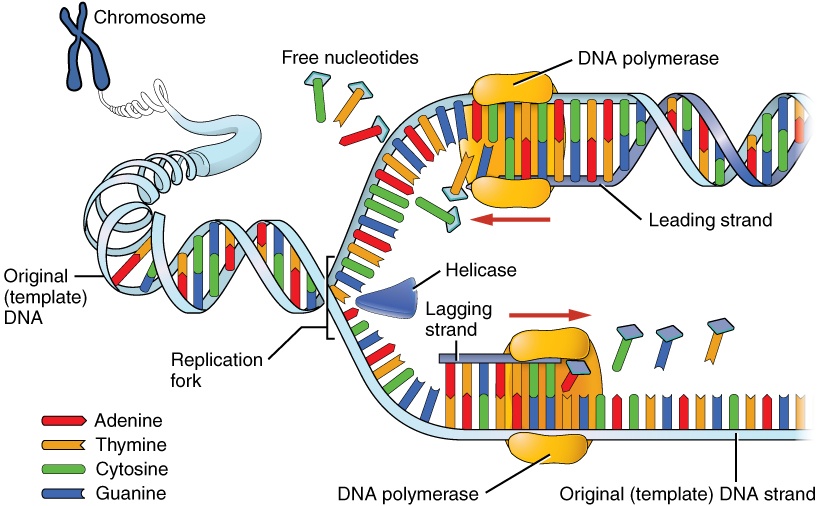
the process of making a copy of DNA
a)
transcription
b)
double helix
c)
DNA replication
d)
replication fork
29.
Which shows the correct complementary base pairing for DNA?
a)
C-A, T-G
b)
A-G, C-T
c)
C-G, U-A
d)
T-A, G-C
30.
Which 2 molecules forms the sides (backbone) of the DNA ladder?
a)
deoxyribose and adenine
b)
deoxyribose and a hydrogen bond
c)
sugar and the nucleus
d)
deoxyribose (sugar) and phosphate
31.
What is responsible for holding the two strands of the DNA double helix together?
a)
hydrogen bonds
b)
alleles
c)
London dispersion forces
d)
deoxyribose sugars
32.
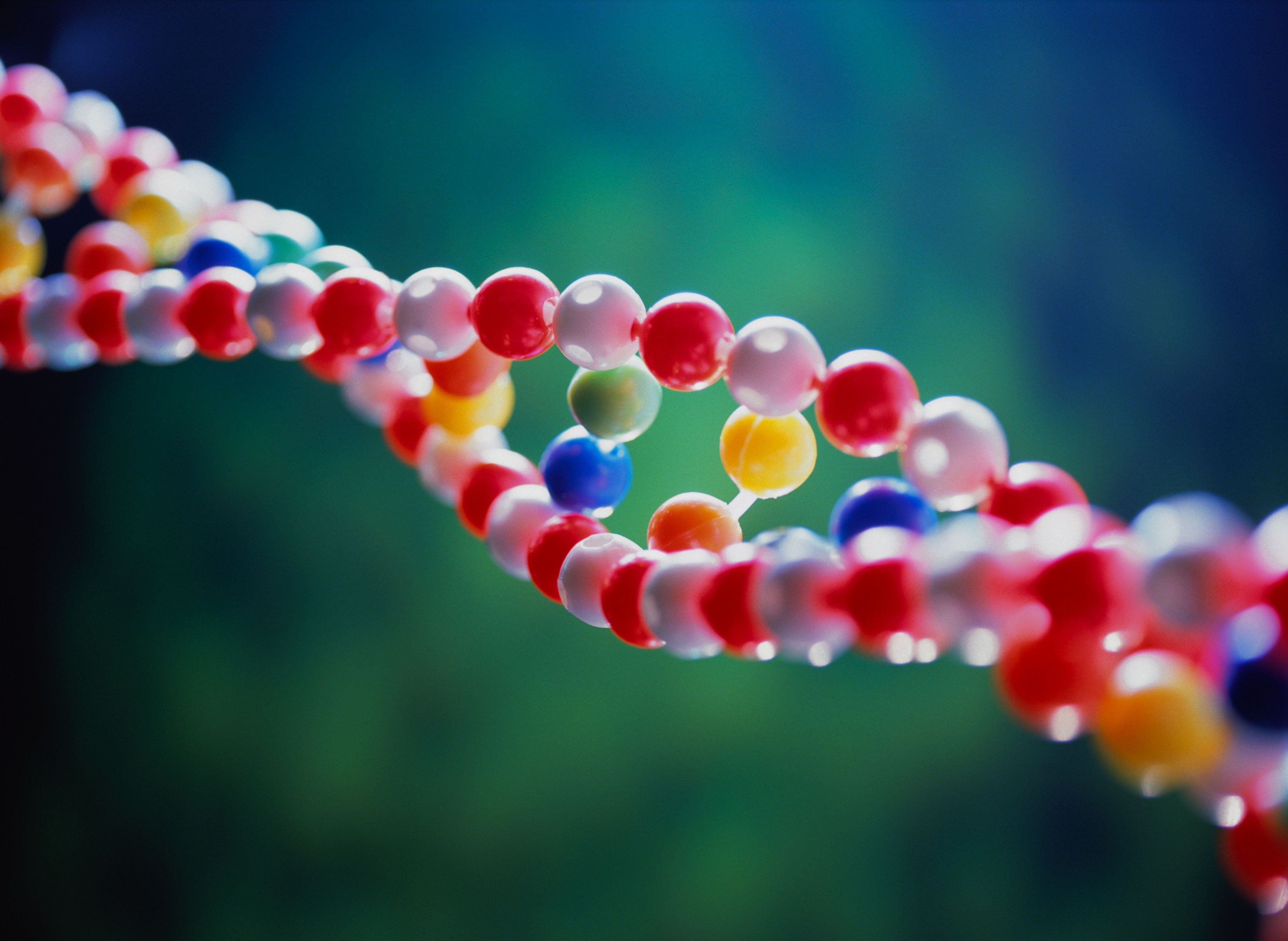
Name this structure
a)
double helix
b)
nucelotide
c)
twisted ladder
d)
hydrogen bond
33.
In a molecule of double-stranded DNA, the amount of Adenine present is always equal to the amount of
a)
cytosine
b)
guanine
c)
thymine
d)
uracil
34.
Nucleotides are made up of a sugar, phosphate, and..?
a)
nitrogenous base
b)
nucleic acid
c)
cholesterol
d)
fatty acid
35.
What determines the code, or information, of a DNA molecule?
a)
the shape (structure) of the nitrogen bases
b)
the order (sequence) of the nitrogen bases
c)
the color of the nitrogen bases
d)
the frequency (number) of nitrogen bases
36.
Suppose a double-stranded DNA molecule was shown to have 15% adenine bases. What would be the expected percentage of guanine bases in that molecule?
a)
15%
b)
35%
c)
85%
d)
Not enough information
37.
Which is larger guanine or cytosine
a)
guanine because it's a purine
b)
guanine because it's a pyrimidine
c)
cytosine because it's a purine
d)
cytosine because its a pyrimidine
38.
what kind of bond holds one nucleotide to another one above it or below it?
a)
ionic
b)
glycosidic
c)
hydrogen
d)
phosphodiester
39.

All of the following are true of purine bases, EXCEPT.

a)

contain two rings

b)

contain the element nitrogen

c)

capable of forming hydrogen bonds

d)

Cytosine is an example

40.

What makes up the SIDES of a DNA ladder?

a)

nitrogen bases

b)

sugars & phosphates

c)

genes & chromosomes

d)

RNA

41.

What makes up the rungs (steps) of a DNA ladder?

a)

sugars & phosphates

b)

nitrogen bases

c)

sugars

d)

genes & chromosomes

42.

If one strand of a DNA molecule has the following order of bases, what will be the correct order of bases on the complementary (matching) strand?

AATTGGCC

a)

AATTGGCC

b)

TTAACCGG

c)

GGCCAATT

d)

GACTGACT

43.

What is DNA made up of?

a)

nucleotides

b)

cytoplasm

c)

RNA

d)

cells

44.

Which is NOT one of the three parts of a nucleotide?

a)

sugar

b)

base

c)

ribosome

d)

phosphate

45.

Challenge- How many TOTAL NUCLEOTIDES are there in the DNA molecule pictured?

a)

5

b)

10

c)

2

d)

20

46.

What is the largest in size?

a)

Chromosome

b)

Gene

c)

DNA

47.
Cytosine always pairs with
a)
Adenine
b)
Thymine
c)
Uracil
d)
Guanine
48.
What is the complement to the DNA strand below:
5'-ATGCCAT-3'
a)
5'-TACGGTA-3'
b)
3'-TACGGTA-5'
c)
3'-ATGGCAT-5'
d)
5'-ATGGCAT-3'
49.
A nucleotide includes...?
a)
pentose sugar
b)
nitrogenous base
c)
phosphate group
d)
all of the above
50.
What is this image showing?
a)
DNA
b)
Chromosome
c)
Alleles
d)
Phenotype
51.

a ______ codes for a particular trait. It is a distinct sequence of DNA forming part of a chromosome

a)

Gene

b)

Chromosome

c)

Pedigree

d)

Protein

52.
Replicate the following strand of DNA: 
AATCATGGA
a)
AATCATGGA
b)
TTAGTACCT
c)
UUAGUACCU
d)
GGATAUCUA
53.
For what reason does DNA copy itself?
a)
to replace worn out DNA
b)
so cells can divide
c)
to export DNA to other parts of the body
d)
more DNA is better
54.
What is the end result of replication?
a)
Two new identical strands of DNA
b)
One parent strand and one daughter strand of DNA
c)
Two new and different strands of DNA
d)
One new strand of DNA
55.

DNA is called the "blueprint of life" because

a)

it is like a fingerprint

b)

it has a blue color

c)

it contains the plans for building an organism

d)

it can relay messages to other molecules

56.

Identify what structure is outlined in the BLACK outline.

a)

Base pair

b)

deoxyribose sugar

c)

phosphate group

d)

hydrogen bonds

e)

Nucleotide

57.

Identify what structure is outlined in the BLACK outline.

a)

Base pair

b)

deoxyribose sugar

c)

phosphate group

d)

hydrogen bonds

e)

Nucleotide

58.

Identify what structure is outlined in the BLACK outline.

a)

Base pair

b)

deoxyribose sugar

c)

phosphate group

d)

hydrogen bonds

e)

Nucleotide

59.

Identify what structure is outlined in the BLACK outline.

a)

Base pair

b)

deoxyribose sugar

c)

phosphate group

d)

hydrogen bonds

e)

Nucleotide

60.

What group do these bases belong to?

a)

Purines

b)

Pyrimidines

61.

What group do these bases belong to?

a)

Purines

b)

Pyrimidines

62.
DNA is a polymer made of:
a)
Nucleotides
b)
Ribosomes
c)
Purines
d)
Pyrimidines