
Font size
 Worksheets
Enzymes, Digestive System, Plant Nutrition &Photosynthesis
Total questions: 66
Worksheet time: 48mins
Where in a plant cell does photosynthesis take place
Palisade cells
Chlorophyll
Chloroplasts
Mitochondria
What is the purpose of photosynthesis?
To release energy from glycogen
To produce glucose and oxygen
To ensure plant growth
To get oxygen for respiration
Which of these are limiting factors for photosynthesis? Choose 3 options.
Light intensity
CO2 concentration
Temperature
Oxygen concentration
pH level
Which tissue in a leaf does the majority of photosynthesis?
Upper epidermis
Spongy mesophyll
Palisade mesophyll
Stomata
Which of these are suitable ways to measure the rate of photosynthesis? Choose 2 answers.
Measure amount of carbon dioxide produced
Measure amount of oxygen produced
Measure pH change
Check for starch presence with iodine
Which wavelengths of light does chlorophyll absorb?
Green
All visible light
Red and blue light
It reflects all light

What is limiting the rate of photosynthesis at point B?
CO2 concentration or temperature
No any limiting factors
Light intensity
Surface area of leaf

Which factors must be kept constant when investigating the effect of light intensity on photosynthesis? Choose 3 answers.
Mass of pond weed
Species of pond weed
Light intensity
Temperature
Size of test tube
Which mineral ion is needed by a plant in order to build chlorophyll?
Calcium
Nitrates
Magnesium
Phosphorous
Which of these is the correct equation for photosynthesis?
6O2 + C6H12O6 --> 6CO2 + 6H2O
6O2 + 6CO2 --> C6H12O6 + 6H2O
6CO2 + 6H2O --> 6O2 + C6H12O6
6CO2 + 6H2O --> O2 + C6H12O6
What are the products of photosynthesis?
Oxygen and Energy
Carbon Dioxide and Glucose
Glucose and Oxygen
Oxygen and Water
When testing a leaf for starch why is it necessary to boil it in ethanol first?
To break open the plant cells
To release the starch form the cells
To kill the plant cells
To remove the chlorophyll from the leaf
A student wanted to see if covering a leaf in foil would stop it from producing starch. Why should the student put the plant in a dark cupboard for 48 hours before returning it to the light and starting the experiment?
To make the results reliable
So that the plant would photosynthesise faster when returned to the light
So that any starch already in the leaf was used up by the plant
Why might photosynthesis slow down or stop at high temperatures? Choose 2 answers.
Enzymes denature
Chlorophyll denatures
The plant wilts
Stomata close so no CO2 can enter the leaf

Why does hydrogen carbonate indicator change colour if a photosynthesising plant is present? Choose 2 answers.
O2 is produced by the plant
CO2 is absorbed by the plant
Higher dissolved O2 lowers the pH
Lower dissolved CO2 levels raises the pH
Lower dissolved CO2 levels lowers the pH
Why does a plant need nitrates from the soil? Choose the best answer.
To make glucose
To make amino acids
For growth
Because it is a mineral

Pond weed is placed in hydrogen carbonate indicator. After 60 minutes the indicator colour has not changed. Why?
No photosynthesis is occurring
It is night time
The rates of respiration and photosynthesis are equal
The indicator is already saturated with CO2
Which is a definition for photosynthesis?
Releasing energy from nutrients
The breaking down of large insoluble molecules into small soluble molecules
The process by which plants make carbohydrates from raw materials using energy from light
The movement of particles from a high concentration to a low concentration
What structures are found in the vascular bundle? (pick 2 options)
Xylem
Phloem
Palisade mesophyll
Spongy mesophyll
What is the role of stomata?
Openings in the leaf that allows gas in and out of the plant
Transports water and supports the plant
transports sugars
Where photosynthesis happens
What does the plant need magnesium for?
For the production of chlorophyll
For the production of amino acids
For the production of glucose
For the production of starch
What is the role of the spongy mesophyl?
It allows gas to move through the leaf
It transports water
It transports sugars
It is where photosynthesis happens
The enzymes are inactive.
Enzyme active site are altered or denatured
Exposure to light and carbon dioxide


Which molecule would most likely react with the enzyme?
A
B
C
D

What process is shown in the diagram?
Digestion
Synthesis
Replication
Reproduction
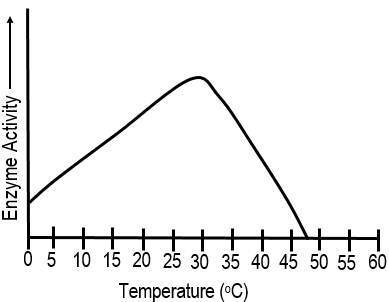
Enzymes in your body probably work best at which of the following temperatures>
25oC
98oC
37oC
210oC
they produce
What is a characteristic of all catalysts?
They are enzymes.
They are proteins.
They speed up chemical reactions.
They work in living organisms.
Which substances do root hairs take from the soil?
water and mineral ions
water and carbon dioxide
carbon dioxide, oxygen and mineral ions
carbon dioxide, oxygen and water
Which condition can sometimes be prevented by eating plenty of fresh fruit and vegetables?
bleeding gums
brittle bones
diabetes
soft bones
Lock is the _________ in lock and key hypothesis.
enzyme
substrate
active site
enzyme-substrate complex
What is the function of chlorophyll?
To store raw materials for photosynthesis
To store magnesium ions
To release energy from carbohydrates
To convert light energy to chemical energy
What are enzymes?
Fats that have a characteristic molecular shape
Fats that are secreted by glands in the digestive system
Proteins that are unaffected by temperature
Proteins that act as biological catalysts
Starch produced during photosynthesis can be detected by which solution?
Iodine
Benedict
Biuret
DCPIP
Where is lipase produced, and into which part of the intestine is it secreted?
Produced by liver
Secreted to ileum
Produced by pancreas
Secreted to ileum
Produced by pancreas
Secreted to duodenum
Produced by liver
Secreted to duodenum
Which substance catalyses the breakdown of fats to fatty acids and glycerol?
pepsin
protease
lipase
bile
Which part of the tooth is known as the toughest substance in the human body?
Dentine
Cementum
Enamel
Jaw bone
Which teeth are used for tearing food?
Incisors
Canines
Molars
Premolars
Which type of teeth are used to cut and bite food?
Molars
Canines
Premolars
Incisors
The teeth is used to carry out which type of digestion
Chemical
Mechanical
Both chemical and Mechanical
None of the above
What is often added to water and tooth paste to improve the quality of peoples teeth.
Whitening agents
Water
Fluoride
Chlorine
How many teeth are there in the human body
33
34
32
43
__________________ converts fats to emulsified fats
Bile juice
Pancreatic juice
Gastric juice
Orange juice
What is the process of wave-like muscle contractions that moves food through the digestive tract?
Pericardium
Peristalsis
Pepsin
Pericoronitis
Where does absorption primarily take place?
Stomach
Small intestine
Large intestine
Gall bladder
Where is bile produced?
Kidney
Pancreas
Liver
Small intestine
What is the term given to a ball-like mixture of food and saliva that forms in the mouth?
Peristalsis
Mucus
Epiglottis
Bolus
What is the acidic fluid that passes from the stomach following churning?
Bolus
Chyme
Hydrochloric acid
Enzymes

What are these structures call that are found on the lining of the small intestine?
Gallbladder
Villi
Sphincter
Duodenum

A short tube at the end of the large intestine that stores solid waste is the...
stomach
rectum
liver

