
 Worksheets
Chemistry Unit 1 Test Review
Total questions: 82
Worksheet time: 1hrs 22mins
(6.9 x 10⁷) / (2.3 x 10⁻³)
How many significant figures: 450 m
3
2
1
0
129.6/3

Student A
Student B
Student C
Cannot be determined
How close a measurement is to the accepted value is called (a) .
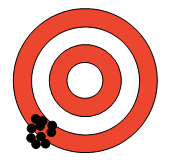
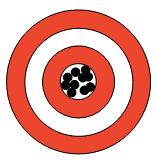
This bullseye demonstrates...
High Accuracy & High Precision
High Accuracy & Low Precision
Low Accuracy & High Precision
Low Accuracy & Low Precision
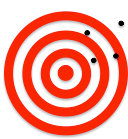
Describe the accuracy and precision of the image
Very accurate and somewhat precise
Very accurate but not precise at all
Not accurate at all but very precise
not accurate and not very precise
Be
(a)
Mg
(a)
Y
(a)
Sb
(a)
Pt
(a)
Re
(a)
Cr
(a)
Sr
(a)
Si
(a)
Ce
(a)
Nihonium
(a)
Mercury
(a)
Potassium
(a)
Tin
(a)
Rhodium
(a)
Thulium
(a)
Protactinium
(a)
Palladium
(a)
Astatine
(a)
Dubnium
(a)


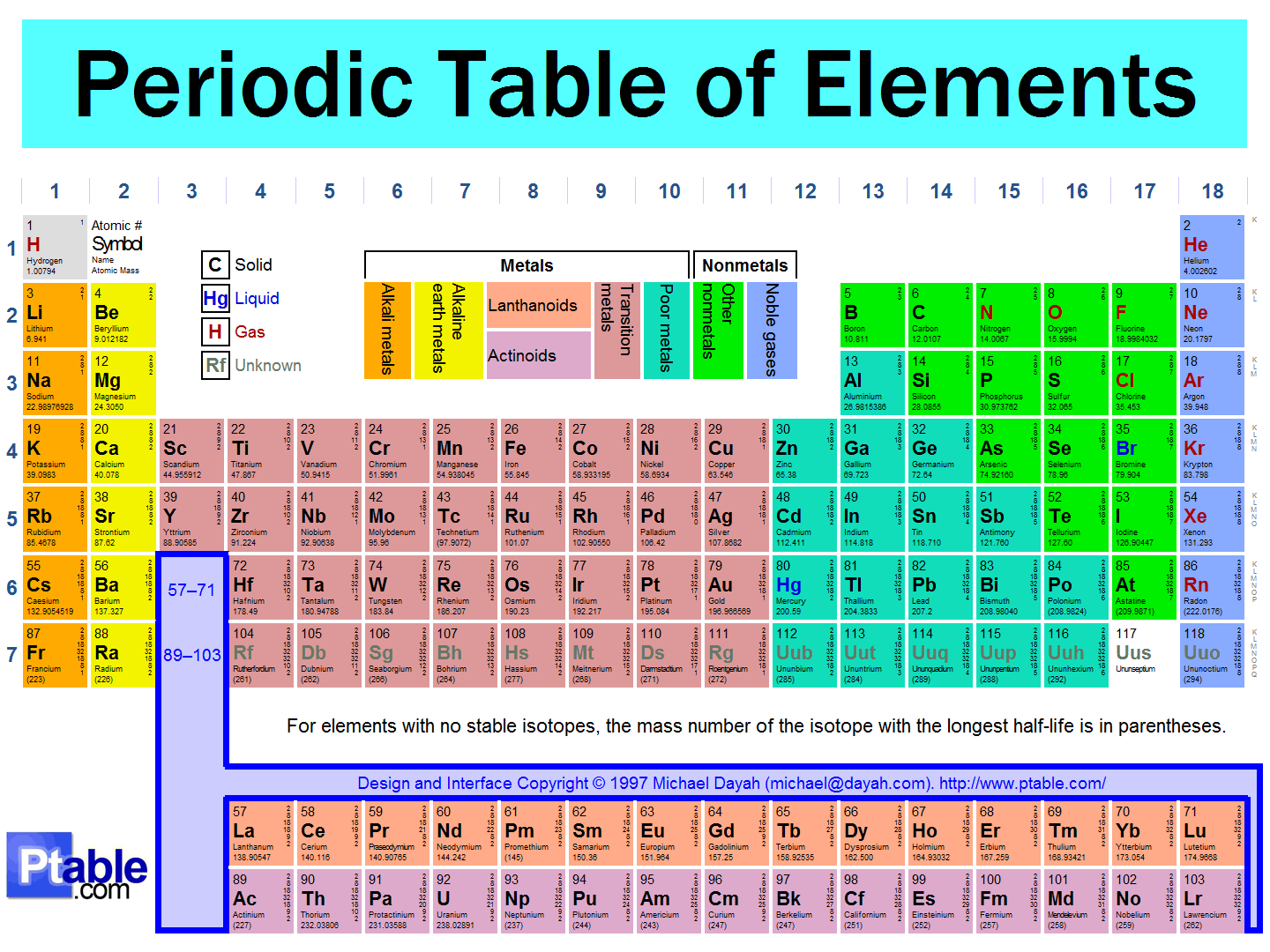
6.15: Which of these is not a property of noble gases?
Colourless
Odourless
Flammable
Gas at room temperature
The reason that Noble Gases do not react is because
Their outer electron shell is filled
Their inner electron shell is filled
They are able to bond to fill their outer shell
None of the above, Noble Gases are highly reactive


What is the atomic mass for nickel?
58.693
28
30.693
86.693

What is the atomic number for boron?
15.811
5
5.811
10.811
If the atomic mass is not given, how do we calculate it?
(protons) + (electrons)
(atomic mass) - (atomic number)
(protons) - (neutrons)
(protons) + (neutrons)
How do we calculate the number of neutrons in an atom?
(atomic number) - (atomic mass)
(atomic mass) - (atomic number)
(atomic mass) + (atomic number)
atomic mass only
An ion is an atom that has an electrical charge.
true
false
Electrons have a positive charge.
true
false
Atoms have a total charge of zero if the number of protons and the number of electrons are equal.
true
false
If the atom has more protons, it is left with a negative charge.
true
false
We use the sign "+" next to the atom's symbol to show that the ion has a positive charge.
true
false
We use the "-" sign next to the atom's symbol to show that the ion has a negative charge.
true
false
A cation is an ion with a positive charge.
true
false
An anion is an ion with a negative charge.
true
false
Who is credited as the first person to explain matter with atoms?
Democritus
John Dalton
Erwin Schrodinger
Benedict Spinoza
Democritus' idea of atoms is considered _______ because he only discussed his ideas.
Unscientific
Scientific
John Dalton was important for using experiments to verify the atomic hypothesis. How many postulates did he develop from them?
5
2
1
4
JJ Thompson discovered what in 1897?
Electron
Proton
Neutron
Neutrino
Thompson's Model of the atom was called the Plum Pudding model. What were its features?
Positive mass core
Sprinkles of electrons on the surface of matter
Ring of electrons
Hexagons
Niels Bohr's Model is also called the
Planetary Model
Nebular Model
Quantum Model
Electron Hover Model
Who is considered the father of Chemistry?
Robert Boyle
John Dalton
Antoine Lavoisier
Albert Einstein
Through the work of Mosely, how do we order the elements now in the Periodic Table?
Atomic Mass
Atomic Number
Electron Configuration
Rest Mass
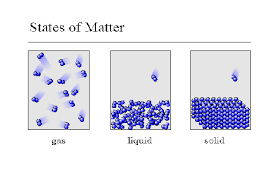
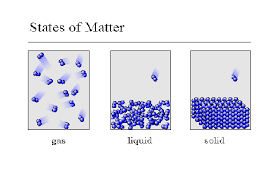

Freezing
Solid to gas
Liquid to solid
Gas to solid

Boiling
liquid to gas
gas to solid
gas to liquid

The state of matter that has no definite size or shape is
Solid
Liquid
Gas
Solid to Gas
Deposition
Sublimation
Evaporation
Liquid to Gas
Condensation
Evaporation
Sublimation
Particles move relative to each other, but remain in contact with each other.
solid
liquid
gas
The amount of space something takes up is its...
Mass
Volume
Thermal Energy
Temperature
Oobleck was an example of a
Subpar mediocre experiment
Non-newtonian fluid
Amorphous solid
Colloid
The soap-powered boat uses what effect?
Marangoni
Coriolis
Magnus
Coanda
A substance that has the same number of protons but may have a different number of neutrons
Atom
Element
Isotope
Ion
Oxygen-17 has how many neutrons?
8
9
10
7
Uranium 235 has how many neutrons?
143
140
92
235

