wayground logo

Free Printable Worksheets

Font size

S
M
L
XL
Worksheets

Ecology review

Total questions: 72

Worksheet time: 51mins

Name
Class
Date
1.
Study of interactions between organisms and their environment 
a)
niche
b)
community 
c)
ecology
d)
ecosystem
2.
Members of a species in a defined area
a)
Ecosystem
b)
community
c)
biodiversity
d)
population
3.
Non-living factor that affects an ecosystem
a)
biotic factor
b)
abiotic factor
c)
food chain 
d)
biome
4.
What is the original source of almost all energy in most ecosystems?
a)
carbohydrates
b)
sunlight
c)
water
d)
carbon
5.
The nonliving aspects of an ecosystem.
a)
Abiotic factors
b)
Biotic factors
6.
A collection of organisms that belong to different populations but all live in the same area and interact with one another.
a)
Population
b)
Ecosystem
c)
Community
d)
Ecosphere
7.
Individuals that can breed with one another make up a
a)
species
b)
population
c)
community
d)
ecosystem
8.
Organisms that obtains its energy from abiotic sources, such as sunlight or inorganic chemicals
a)
Autotroph
b)
Heterotroph
c)
Omnivore
d)
Carnivore
9.

A bee receives nectar from a flower and carries the pollen to other flowers:

a)

predation

b)

parasitism

c)

mutualism

d)

commensalism

10.

Mistletoe grows and spreads on trees, taking their nutrients:

a)

predation

b)

parasitism

c)

mutualism

d)

commensalism

11.

What would be a good example of a primary consumer?

a)

carnivore

b)

detrivore

c)

decomposer

d)

herbivore

12.

Which organisms would be at the top or last trophic level?

a)

plant

b)

herbivore

c)

omnivore

d)

carnivore

13.

The monkey would be a

a)

decomposer

b)

producer

c)

primary consumer

d)

secondary consumer

14.

Barnacles do not affect whales as they grow, but receive the benefit of a food source. This is

a)

parasitism

b)

mutualism

c)

commensalism

d)

neutralism

15.

These organisms are often not shown in a food chain, but are important for recycling nutrients

a)

producers

b)

decomposers

c)

primary consumers

d)

carnivores

16.

A lion that eats a zebra that eats grass is a

a)

primary consumer

b)

secondary consumer

c)

tertiary consumer

d)

quaternary consumer

17.

90% of the energy that gets lost as you move up a food pyramid or chain gets lost as

a)

pollution to the environment

b)

heat to the environment

c)

energy for decomposers

d)

gets recycled

18.

What percentage of energy is passed on to the next trophic level?

a)

5%

b)

10%

c)

50%

d)

90%

19.

The Sun is the source of all energy within an ecosystem. Plants depend on light from the sun in order to perform the process of photosynthesis. Sunlight is an example of what type of factor?

a)

Biotic

b)

Abiotic

20.

All living things or organisms in an ecosystem are

a)

None

b)

biotic factors

c)

abiotic factors

21.
What is it called when plants give off water vapor as a waste product?
a)
condensation
b)
evaporation
c)
sublimation
d)
transpiration
22.
What is the water cycle?
a)
the 3 forms of water
b)
the movement of water on, above, or below the surface of the Earth
c)
when water melts
d)
when clouds form
23.
What does NOT produce carbon dioxide?
a)
Photosynthesis
b)
Burning Fossil Fuels
c)
Animal respiration
d)
Plants decaying
24.
TRUE or FALSE?
All of the carbon in existence is continually recycled in the carbon cycle.
a)
True
b)
False
25.
Which of the following removes carbon from the atmosphere?
a)
Combustion
b)
Respiration
c)
Photosynthesis
d)
Death
26.
Respiration is the process by which animals take in _____ and release _____. 
a)
photosynthesis, air
b)
carbon, oxygen
c)
oxygen
d)
oxygen, carbon dioxide
27.
Autotrophs
- Use sun's energy to make their own food
- Plants (grass)
a)
Herbivore
b)
Consumers
c)
Producers
d)
Scavangers
28.
What is the process of combining nitrogen gas with other elements to make nitrogen into usable compounds?
a)
nitrogen composition
b)
ammonia 
c)
nitrogen fixation
d)
denitrification
29.
Organisms that break down dead plants & animals and release nitrogen back into atmosphere...
a)
bacteria
b)
plants
c)
animals
d)
producers
30.

Which of the following organisms compete for the mouse as a food source?

a)

hawk and snake

b)

snake and kinglet

c)

oak tree and pine tree

d)

pine borer and salamander

31.

Which of the following stores most of the earth's carbon?

a)

fossil fuels

b)

atmosphere

c)

ocean

d)

rock

32.
Combustion is another word for __________.
a)
Transportation
b)
Respiration
c)
Fossil Fuels
d)
Burning
33.
How much of the atmosphere is composed of nitrogen gas?
a)
87%
b)
38%
c)
78%
d)
21%
34.
Organisms that need nitrogen to survive
a)
only plants
b)
only animals
c)
only bacteria
d)
all living organisms
35.
If the atmosphere is 78% N2, why can't we just get our nitrogen by breathing?
a)
We have no mechanism to break the triple bond of nitrogen between the atoms.
b)
Our lungs would be damaged by the N2.
c)
We need Oxygen for cellular respiration.
d)
The legumes take it up first.
36.
_____ brings phosphorous into our waterways. .
a)
precipitation
b)
runoff
c)
transpiration
d)
condensation
37.
This is released by the weathering of rocks.
a)
Carbon
b)
Oxygen
c)
Phosphorus
d)
Nitrogen
38.
Which nutrient is not cycled through the atmosphere and stays only on ground level?
a)
carbon
b)
nitrogen
c)
phosphorus
d)
water
39.
Which of the following is a physical adaptation for the underlined animal?
a)
A snake unhinges its jaw to eat a rabbit it just caught.
b)
A hognose snake rolls over, slows its breathing, and hangs its tongue out to pretend to be dead.
c)
A herd of buffalo encircle their young to protect them from a pack of wolves.
d)
A dung beetle rolls a piece of dung across the desert.
40.

what is an adaptation?

a)

a change in behavior or physical aspect of an organism in order to be better suited to survive in a particular environment.

b)

a change that an organism quickly develps to survive

c)

a unique characteristic that makes an organsism more dominant

d)

a shift in an organisms behavior

41.
When an animal looks like another animal it is called ______________.
a)
camouflage
b)
mimicry
c)
warning coloration
d)
protective resemblance
42.
_____________ is when an animal stands out in its environment.
a)
warning coloration
b)
mimicry
c)
protective resemblance
d)
camouflage
43.

The growth of a plant toward or away from light is called?

a)

Stimuli

b)

Phototropism

c)

Thigmotropism

d)

Geotropism

44.

The growth of a plant in response to touch is?

a)

Stimuli

b)

Phototropism

c)

Thigmotropism

d)

Geotropism

45.

The growth of a plant with or against gravity is called?

a)

Stimuli

b)

Phototropism

c)

Thigmotropism

d)

Geotropism

46.

Which type of tropism is represented in the GIF?

a)

Hydrotropism

b)

Thigmotropism

c)

Phototropism

d)

Geotropism

47.

What is gravitropism?

a)

Response to water

b)

Response to touch

c)

Response to gravity

d)

Response to light

48.
Barnacles create home sites by attaching themselves to whales. This relationship neither harms nor benefits the whales. 
a)
parasitism
b)
commensalism
c)
mutualism
49.
Yucca flowers are pollinated by yucca moths. The moths lay their eggs in the flowers where the larvae hatch and eat some of the developing seeds. Both species benefit. 
a)
parasitism
b)
commensalism
c)
mutualism
50.
Mistletoe extracts water and nutrients from a spruce tree. The spruce tree is harmed. 
a)
parasitism
b)
commensalism
c)
mutualism
51.
a relationship that occurs when two or more organims of the same species need the same resource at the same time
a)
competition
b)
symbiosis
c)
predation
52.
In a parasitic relationship, one organism is ___________ and one organism is benefiting. 
a)
helped
b)
harmed
c)
not effected
d)
happy
53.
In a mutual relationship, both organisms are ________________. 
a)
hurt
b)
not effected
c)
harmed
d)
benefiting 
54.
Commensalism is where one organism is benefiting and the other organism is _____________________. 
a)
not effected
b)
helped
c)
harmed
d)
hurt
55.
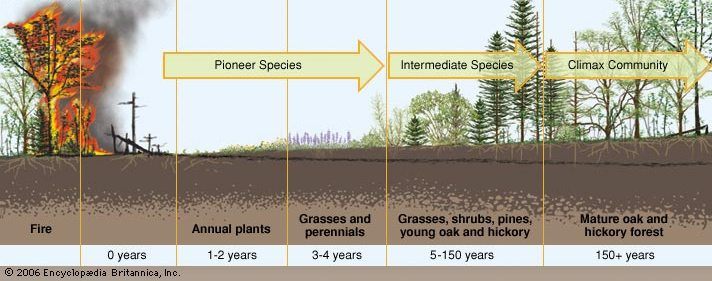
The picture shows what type of succession?
a)
primary
b)
secondary
c)
tertiary
d)
quadanary
56.
What are examples of pioneer species in a primary succession?
a)
Bushes and Shrubs
b)
Oak trees
c)
Mossess and Lichens 
d)
A rose Bush
57.
After a volcanic eruption, lava covers the land. What is the order that plants grow to repopulate the area?
a)
Lichens → Shrubs → Grasses → Trees
b)
Lichens → tree → shrubs→Grasses
c)
Grasses → Lichens → Shrubs → Trees
d)
Lichens → Grasses → Shrubs → Trees
58.
Reaches a climax community quicker because soil is already present
a)
primary succession 
b)
secondary succession
c)
both types of succession
59.
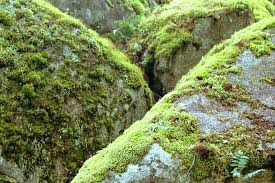
Succession type?
a)
primary succession
b)
secondary succession
c)
tertiary succession
d)
variable succession
60.
Which of the following will increase the size of a population?
a)
emigration and births
b)
immigration and deaths
c)
immigration and births
d)
emigration and deaths
61.
Which of the following is a density-dependent limiting factor?
a)
human activities 
b)
unusual weather
c)
competition
d)
natural disaster
62.
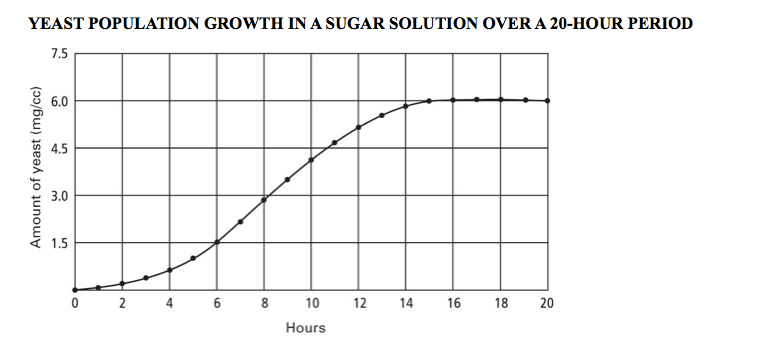
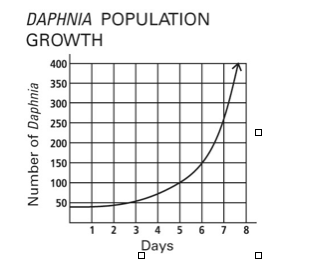
What type of growth is shown on this graph?
a)
logistic
b)
exponential
c)
average
d)
density-independent
63.
Which of the following is a density-independent limiting factor?
a)
natural disaster
b)
predation
c)
disease
d)
parasitism
64.
What pattern of growth will a population with limited resources show?
a)
density-dependent
b)
exponential 
c)
logistic
d)
logical 
65.
What type of population growth is shown in the graph?  
a)
logistic growth
b)
logical growth
c)
exponential growth
d)
density-dependent growth
66.
A sequence of biotic changes that regenerate or create an ecological community is known as
a)
factors
b)
erosion
c)
succession
d)
progression
67.
Lichens and mosses that first live in uninhabited areas are examples of
a)
secondary species
b)
non-native species
c)
pioneer species
d)
climax species
68.
Secondary succession is most likely to occur
a)
on a volcanic island
b)
after a rainstorm
c)
after a Thanksgiving Turkey dinner
d)
after a forest fire
69.

The largest number of individuals that an environment can support long term is...

a)

carrying capacity

b)

emigration

c)

immigration

d)

population density

70.

What happens if a population grows past its carrying capacity?

a)

The population keeps growing

b)

The population starts to die off

c)

The entire species will go extinct

d)

The carrying capacity just increases

71.

This may cause a population to increase

a)

increase of food supply

b)

removal of predators

c)

removal of disease

d)

all of these

72.

Something that regulates the size of a population is called...

a)

a limiting measure

b)

a limiting factor

c)

carrying capacity

d)

biodiversity