wayground logo

Free Printable Worksheets

Font size

S
M
L
XL
Worksheets

Unit 3: Genetics

Total questions: 100

Worksheet time: 2hrs 52mins

Name
Class
Date
1.

The "father" of genetics was

a)

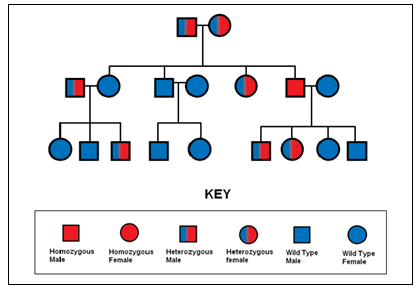
T.A. Knight

b)

Hans Krebs

c)

Gregor Mendel

d)

None of these

2.

Mendel's finding that the inheritance of one trait had no effect on the inheritance of another became known as the

a)

law of universal inheritance

b)

law of separate convenience

c)

law of independent assortment

d)

law of dominance

3.

Since the allele for colorblindness is located on the X chromosome, colorblindness

a)

cannot be inherited

b)

is sex linked

c)

occurs only in adults

d)

none of these

4.

When crossing over takes place, chromosomes

a)

mutate in the first division

b)

produce new genes

c)

decrease in number

d)

exchange corresponding segments of DNA

5.

Crossing over occurs

a)

during prophase II

b)

during prophase I

c)

during fertilization

d)

at the centromere

6.

The phenotype of an organism

a)

represents its genetic composition

b)

is the physical appearance of a trait

c)

occurs only in dominate pure organisms

d)

cannot be seen

7.

If an individual possesses two recessive alleles for the same trait, the individual is said to be

a)

mutated

b)

haploid for the trait

c)

homozygous for the trait

d)

heterozygous for the trait

8.

During which phase of meiosis do homologous pairs of chromosomes line up next to one another along the equator?

a)

Anaphase I

b)

Metaphase I

c)

Prophase II

d)

Metaphase II

9.

Refer to the illustration above. The process shown in the diagram is

a)

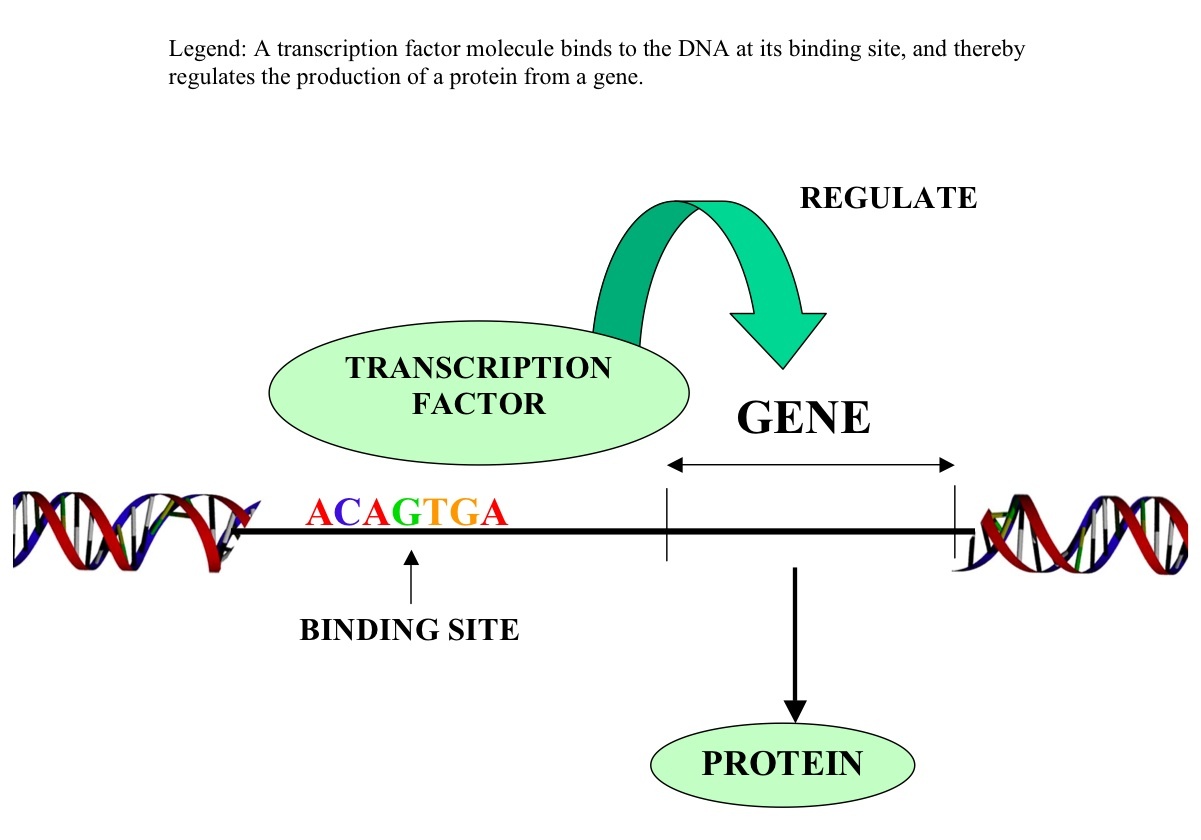
Mitosis

b)

chromosomal mutation

c)

meiosis

d)

dominance

10.

The diploid number of chromosomes in a human skin cell is 46. How many chromosomes are in a human egg cell?

a)

23

b)

92

c)

125

d)

46

11.

What type of inheritance do two alleles have if their traits blend together?

a)

Incomplete Dominance

b)

Co-Dominance

c)

Mendelian Inheritance (Complete Dominance)

d)

Homozygous Inheritance

12.

Snap dragon color is a incomplete dominant trait. A red flower (RR) is crossed with white flower (WW)? What color are flowers that are RW?

a)

Red

b)

Red and White

c)

White

d)

Pink

13.

In Andalusian fowls, black individuals (BB) and white individuals (WW) are homozygous. Heterozygous individuals are grey (BW).

What is the genotype ratio for a cross between a grey fowl and a white fowl?

a)

2 BB: 2 BW: 0 WW

b)

0 BB: 4 BW: 0 WW

c)

0 BB: 2 BW: 2 WW

d)

1 BB: 2 BW: 1 WW

14.
This is an example of ___________.
a)
 Incomplete Dominance
b)
 Codominance
15.
A tall plant (TT) is crossed with a short plant (SS) and a medium plant (TS) results. This is what type of inheritance pattern?
a)
Incomplete Dominance
b)
Codominance
16.

Which of the following statement is correct regarding Codominance?

a)

Both alleles are expressed equally

b)

Neither allele is expressed

c)

Expression of a trait depends upon the environment
17.
Which of the following statements is true regarding blood types?
a)
A and O are codominant, B is recessive.
b)
B and O are codominant, A is recessive.
c)
A and B are codominant, O is recessive.
d)
A , B and O are all codominant with each other.
18.
In a pedigree, what shape represents a male?
a)
circle
b)
square
c)
triangle
d)
diamond
19.
Give the genotype for person III-3
a)
GG
b)
Gg
c)
gg
20.
What percentage of the female offspring will be a carrier for this recessive disease?
a)
0%
b)
50%
c)
100%
d)
25%
21.
If a woman is a carrier for a sex linked recessive trait of hemophilia and her husband has hemophilia, which of the following is true? Make a punnett square!
a)
All sons will have hemophilia
b)
all daughters will have hemophilia
c)
50% of daughters and 50% of sons have hemophilia
d)
100% of sons have hemophilia and 100% of daughters are carriers
22.

What is the genotype that should be in the blank square?

a)

yyRr

b)

YYRR

c)

yyrr

d)

YrYr

23.

Parent 1 is heterozygous for both pea color and shape. Parent 2 is heterozygous for both pea color and shape.

(What do you do first to determine to possible offspring's?)

a)

Foil the genotypes of the parents to get the gametes.

b)

Use the genotypes to fill out the Dihybrid cross

c)

The gametes are just the parent genotypes doubled

d)

The dominant traits will mean that all the gametes will be dominant.

24.
What gamete possibilities could come from this parent's genotype?
a)
AB, AB, aB, aB
b)
Ab, AB, Ab, ab
c)
Ab, Ab, Ab, Ab
d)
AB, aB, ab, aB
25.

A white mouse with red eyes is crossed with a black mouse with brown eyes. The white mouse is recessive for both of its traits. The black mouse is dominant for both of its traits.

This cross would be

a)

BBEE x bbee

b)

BBEe x BbEe

c)

BbEE x BbEe

d)

BBee x BBEE

26.
In a dihybrid cross
a)
one trait is crossed.
b)
two traits are crossed.
c)
four boxes are needed for the punnett square.
d)
mom's alleles are dominant.
27.

What mutation has occurred here?

T-G-A-C-C-A

T-G-A-G-C-A

a)

Substitution

b)

Deletion

c)

Insertion

d)

Frameshift

28.
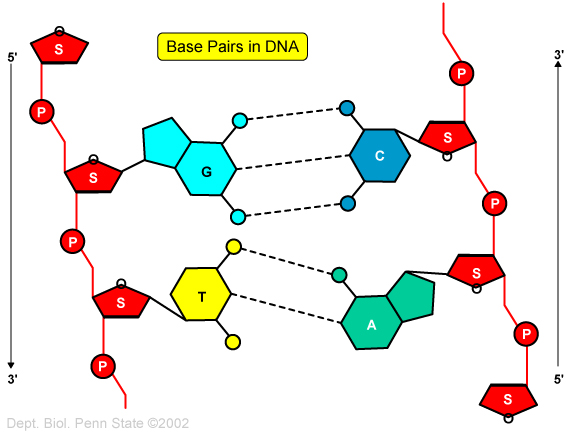
In a molecule of double-stranded DNA, the amount of Adenine present is always equal to the amount of
a)
cytosine
b)
guanine
c)
thymine
d)
uracil
29.
Which of the following units are repeatedly joined together to form a strand of DNA?
a)
amino acids
b)
nucleotides
c)
fatty acids
d)
polysaccharides
30.
The enzyme that unwinds the DNA to prepare for replication
a)
helicase
b)
replicase
c)
polymerase
d)
synthase
31.
DNA replication results in two DNA molecules,
a)
each one with two original strands
b)
each one with two new strands
c)
each one with one new strand and one original strand
d)
one with two new strands and the other with two original strands
32.
A process in which DNA has the unique ability to make an exact copy of itself.
a)
Replication
b)
Translation
c)
Transcription
33.
In what phase of the cell cycle does DNA replication take place?
a)
G1
b)
S
c)
G2
d)
M
34.
Which enzyme is responsible for adding nucleotides?
a)
Topoisomerase
b)
DNA Polymerase
c)
Ligase
d)
Primase
35.
The process of DNA replication is called semi conservative because it results in
a)
none of these
b)
Two DNA molecules.  One original molecule and one with two new strands
c)
two exact copies with new strands
d)
two identical molecules, each with 1 original strand and one new.
36.
Based on the diagram, how many origins of replication are represented?
a)
1
b)
2
c)
3
d)
4
37.
Nitrogenous bases are joined by which type of bond?
a)
polar bonds
b)
ionic bonds
c)
covalent bonds
d)
hydrogen bonds
38.
Guanine bonds with ______________.
a)
Adenine
b)
Guanine
c)
Cytosine
d)
Thymine
39.
Why is DNA important?
a)
it is very small and very complicated
b)
it's in everything
c)
it serves as the blueprint for traits of all living things
d)
because we eat it every day for energy
40.
Meiosis produces different types of cells than mitosis. If there was a "meiosis club," all of these cells could be included EXCEPT
(Which cell type is not produced in meiosis?)
a)
gametes
b)
body cells
c)
sperm cells
d)
egg cells
41.

3.   Seeds from a cross between a tall pigeon pea plant (heterozygous) and a short pigeon pea plant (homozygous recessive) were planted. Thirteen of the seedlings grew to be short plants.


How many seedlings would you expect to grow tall?

a)

13

b)

26

c)

39

d)

100

42.
The chromosomes that pair up during meiosis, are called __________ chromosomes.  
a)
homozygous 
b)
asexual
c)
homologous
d)
genes
43.
Which letter(s) in the diagram correspond to cells that are haploid? 
a)
A
b)
B
c)
C
d)
A and B
44.
What is one of the advantages, why is it better to reproduce sexually versus asexually?
a)
survival of the fittest
b)
overproduction
c)
genetic variation
d)
cloning
45.
Females have ____ and males have _____ chromosomes.
a)
XX, XY
b)
XY, XX
c)
XX, XX
d)
XY, XY
46.
If a somatic cell in a butterfly contains 24 chromosomes, a butterfly egg would contain
a)
3
b)
6
c)
12
d)
24
47.
Meiosis makes sperm and egg cells. In humans, sperm and egg cells each have _____ chromosomes. Therefore a fertilized human egg cell (sperm and egg cell combined) would create a cell with _____ chromosomes.
a)
23, 46
b)
46, 23
c)
2, 4
d)
50, 100
48.
A cell spends most of its life in what stage?
a)
Interphase
b)
Telophase
c)
Anaphase
d)
Metaphase
49.
The dark "spider" looking things on opposite sides of the cell are called "Spindle Fibers".  What is their job?
a)
Eating the chromosomes
b)
Pulling the chromosomes apart
c)
Putting the chromosomes together
50.

Which organelle is the location where protein is made?

a)

Ribosome

b)

Nucleus

c)

Cytoplasm

d)

Nucleotide

51.

During transcription, this type of ribonucleic acid is responsible for copying the DNA and brining it out of the nucleus.

a)

tRNA

b)

mRNA

c)

rRNA

d)

dRNA

52.

When these bond together, they form a protein

a)

Amino Acids

b)

Peptide Bonds

c)

Ribose

d)

Nucleotides

53.

These building blocks consist of a sugar, phosphate, and nitrogen base.

a)

Ribose

b)

Nucleotide

c)

Gene

d)

Protein

54.

mRNA occurs during this process

a)

Translation

b)

Transcription

c)

Replication

d)

Delivery

55.

Which of the following is the complementary mRNA sequence to this DNA strand: AACTGAA

a)

UUGACUU

b)

TTGACTT

c)

AACTGAA

d)

AACUGAA

56.
What is the term for a three-nucleotide sequence that codes for an amino acid?
a)
base
b)
codon
c)
amine
d)
serine
57.
The process to go from DNA to mRNA is _______
a)
translation
b)
transcription
c)
replication
58.
The process to go from mRNA to a protein is called ____
a)
transcription
b)
rRNA
c)
replication
d)
translation
59.
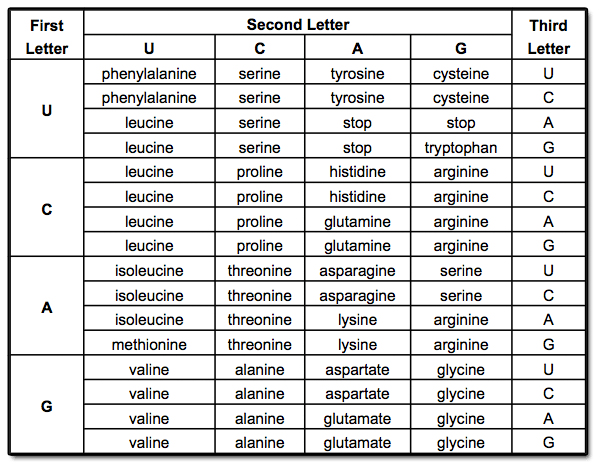
What amino acid is represented by the codon UUA?
a)
Phenylalanine
b)
Tyrosine
c)
Leucine
d)
Stop codon
60.
Genetic info flows in one direction. Which best represents this flow?
a)
DNA-protein-RNA
b)
Protein-RNA-DNA
c)
RNA-protein-DNA
d)
DNA-RNA-protein
61.
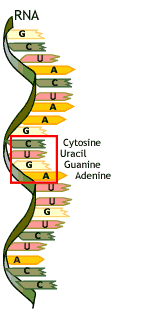
In RNA, Uracil pairs with ______. 
a)
cytosine
b)
adenine
c)
guanine
d)
thymine
62.
What is the location in the cell for transcription?
a)
nucleus
b)
cytoplasm
c)
ribosome
d)
mitochondria
63.
Aa, DD, bB, yy are all examples of
a)
genotypes
b)
phenotypes
64.
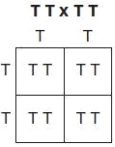
What ratio of the offspring from the cross shown will be homozygous recessive for the  trait of tallness? 
a)
0 in 4
b)
1 in 4
c)
2 in 4
d)
4 in 4
65.
What you see, or the physical appearance.
a)
Genotype
b)
Phenotype
c)
Homozygous
d)
Heterozygous
66.
What are genes?
a)
Something you wear.
b)
Segments of DNA that carry traits for offspring.
c)
The powerhouse of cells.
d)
None of the above.
67.
The middle part that holds the two chromatids together is called the
a)
Chromatin
b)
Centriole
c)
Centromere
d)
Nucleus
68.

Name the phase

a)

telophase

b)

metaphase

c)

anaphase

d)

prophase

69.

Name the phase

a)

telophase

b)

metaphase

c)

anaphase

d)

prophase

70.
What phase of mitosis is occuring in the picture?
a)
Prophase
b)
Metaphase
c)
Cytokinesis
d)
Telophase
71.
What phase of mitosis is pictured?
a)
Metaphase
b)
Telophase
c)
Prophase
d)
Anaphase
72.

What are the "X" shaped things in the drawing.

a)

PMATs

b)

Chromosomes

c)

Ribosomes

d)

Telophase

73.

During what phase of Mitosis do the chromosomes line up in the Middle

a)

Metaphase

b)

Prophase

c)

Telophase

d)

Anaphase

74.

In which phase of Mitosis do the Chromosomes pull Apart

a)

Metaphase

b)

Prophase

c)

Anaphase

d)

Telophase

75.

What is the purpose of Mitosis?

a)

Growth of an organism and Repair of damaged tissue

b)

To help the body get rid of extra cells

c)

To increase the amount of classwork you have to do

d)

To get rid of the nucleus

76.
DNA is replicated during the ______ phase of the cell cycle.
a)
G1
b)
Synthesis
c)
G2
d)
G0
77.
What do the cells look like at the end of mitosis?
a)
different from original cell
b)
similar to the original cell
c)
identical to the original cell
d)
none of these
78.

In this phase of mitosis, DNA condenses into chromosomes, nucleus breaks down, and spindle fibers form

a)

metaphase

b)

prophase

c)

anaphase

d)

interphase

79.

Find the complementary DNA sequence: AATCGAC

a)

UUAGCUG

b)

AATCGAC

c)

CCGATCT

d)

TTAGCTG

80.

Chromosomes that are organized in pairs, are the same size, and have the same genes are called _______ chromosomes.

a)

homeostasis

b)

homologous

c)

matching

d)

sister

81.

Body cells that contain both sets of chromosomes (from both parents) are called _________.

a)

diploid

b)

haploid

c)

triploid

d)

polyploid

82.

The 23rd pair of chromosomes that contain the genes to determine the sex of an individual are called ___________.

a)

sex chromosomes

b)

autosomes

c)

homologous

d)

genes

83.

A photograph of the chromosomes in a dividing cell that are arranged by size is called a _________.

a)

mutation

b)

gene

c)

picture

d)

karyotype

84.
The nuclear membrane dissolves during
a)
Prophase
b)
Metaphase
c)
Anaphase
d)
Telophase
85.

A version or variation of a gene

a)

trait

b)

gene

c)

allele

d)

DNA

86.

All eukaryotes utilize mitosis.

a)

True

b)

False

87.

"DNA makes RNA makes Protein" describes which process?

a)

natural selection

b)

gene expression

c)

mitosis

d)

meiosis

88.

For gene expression, which sequence is correct?

a)

Transcription then Translation

b)

Translation then Transcription

c)

Replication,

Translation,

Transcription

d)

Replication,

Transcription, Translation

89.

The process of translation takes place in the

a)

Nucleus

b)

Cytoplasm / Cytosol

c)

Ribosome

d)

Nucleolus

90.
A chromosome that is not a sex chromosome is known as a(an)
a)
autosome.
b)
karyotype.
c)
pedigree.
d)
chromatid.
91.

What is the cause of sickle-cell anemia?

a)

A change to the base sequence of a hemoglobin gene

b)

Mosquitos acting as the vector for malaria

c)

Iron deficiency due to the malaria parasite

d)

Production of more white blood cells than red blood cells by bone marrow

92.

What distinguishes an allele from a gene?

a)

An allele is made of RNA

b)

An allele is shorter

c)

An allele is a variety of a gene

d)

An allele cannot be transferred during genetic modification

93.

Each gene occupies a specific position on a specific chromosome, this position is referred to as....

a)

the locus

b)

the centromere

c)

the allele

d)

the proteome

94.

How are new alleles formed?

a)

By random mutation

b)

By pre-determined mutation

c)

During protein synthesis

d)

New alleles can never be formed

95.

What is Transcription?

a)

The making DNA segment.from mRNA.

b)

The making of an RNA strand into a protein.

c)

The making of an mRNA strand from the DNA template.

96.

How do you know when to begin translating a strand of mRNA?

a)

look for AUG

b)

start at the beginning

c)

look for ATG

d)

when the teacher says so!!!

97.
In eukaryotes, proteins that help the RNA polymerase bind to the regulatory region for transcription are called ____________.
a)
transcription factors
b)
topoisomerase
c)
regulatory genes
d)
activators
98.

In order for a gene to be expressed, ___ must bind to the gene's ___, a specific sequence of nucleotides at one end of the gene, thus initiating transcription.

a)

DNA polymerase, promotor

b)

DNA polymerase, operator

c)

RNA polymerase, promotor

d)

RNA polymerase, operator

99.

RNA processing in eukaryote includes:

a)

mRNA 5′- and 3′-end processing

b)

mRNA can always perform its function

c)

mRNA 5′- and 3′-end processing, intron splicing

d)

intron splicing

100.
Replicate the following strand of DNA: 
AATCATGGA
a)
AATCATGGA
b)
TTAGTACCT
c)
UUAGUACCU
d)
GGATAUCUA