wayground logo

Free Printable Worksheets

Font size

S
M
L
XL
Worksheets

Earth Science unit 3

Total questions: 87

Worksheet time: 1hrs 25mins
Name
Class
Date
1.
Which layer of the Earth is the most dense?
a)
crust
b)
mantle
c)
inner core
d)
outer core
2.
Which layer of the Earth is responsible for Earth's magnetic field?
a)
outer core
b)
inner core
c)
mantle
d)
crust
3.
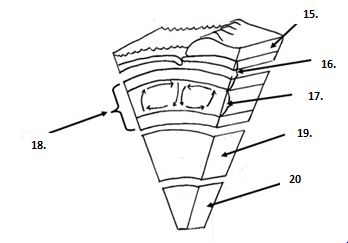
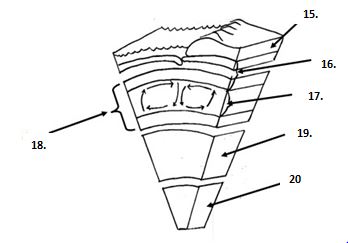
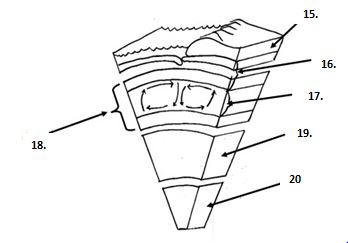
Identify each layer - #20.
a)
mantle
b)
asthenosphere
c)
inner core
d)
outer core
4.
Identify each layer - #15.
a)
Lithosphere
b)
Mantle
c)
Crust
d)
Asthenosphere
5.
Identify each layer - #19.
a)
mantle
b)
lithosphere
c)
inner core
d)
outer core
6.
The core is made-up of what two elements?
a)
iron and nickel
b)
iron and oxygen
c)
nickel and silicon
d)
oxygen and silicon
7.
What is the thinnest layer of the earth’s composition?
a)
mantle
b)
inner core
c)
crust
d)
outer core
8.
The thickest layer of the earth is the 
a)
crust
b)
mantle
c)
inner core
d)
outer core
9.
The solid, outer layer of the Earth that consists of the crust and the rigid upper part of the mantle
a)
Lithosphere
b)
Mesosphere
c)
Mantle
d)
Crust
10.
Temperature _____________________ as you go deeper into the earth.
a)
increases
b)
decreases
c)
goes up and down depending on the layer
d)
stays the same
11.
Pressure ______________________ as you go deeper into the Earth
a)
increases
b)
decreases 
c)
goes up or down depending on the layer
d)
stays the same
12.
What are the two kinds of crust that the Earth has?
a)
Oceanic and Crustatious Crust
b)
Oceanic and Continental Crust
c)
Optic and Continental Crust
13.
Which layer of Earth is characterized by rock that is plastic, or soft enough to flow?
a)
asthenosphere
b)
crust
c)
lithosphere
d)
inner core
14.

The prefix "Bio" means ____

a)

Life

b)

Earth

c)

Water

d)

Air

15.

The prefix "Geo" means ____

a)

earth, ground and soil

b)

water

c)

life

d)

air

16.

The prefix "Hydro" means ____

a)

ground

b)

water

c)

life

d)

air

17.

The prefix "Atmo" means ____

a)

ground

b)

water

c)

life

d)

air

18.

How much of the planet is covered by water?

a)

20%

b)

50%

c)

70%

d)

90%

19.

What do we call FRESH water that lies beneath the Earth's surface?

a)

groundwater

b)

lake

c)

river

d)

spring

20.

Which of the following is found in the earths Geosphere

a)

Soil

b)

Rocks

c)

Minerals

d)

All of the Above

21.

Water availability impacts plant growth and animals who depend on plants for food are interactions between the

a)

Geosphere and Hydrosphere

b)

Cryosphere and atmosphere

c)

Biosphere and geosphere

d)

Hydrosphere and biosphere

22.
This sphere is composed of all the living things 
a)
Hydrosphere 
b)
Biosphere 
c)
Atmosphere 
d)
Geosphere 
23.

Water is found only on Earth's surface.

a)

True

b)

False

24.

What is the atmosphere?

a)

all of Earth's water

b)

a mixture of gases that is air

c)

all the living things found on Earth

d)

Earth's surface layer of rock, soil, and sediments as well as the layers of hot molten, or liquid, rock that are inside Earth

25.

What is the hydrosphere?

a)

all of Earth's water

b)

a mixture of gases that is air

c)

all the living things found on Earth

d)

Earth's surface layer of rock, soil, and sediments as well as the layers of hot molten, or liquid, rock that are inside Earth

26.

What is the geosphere?

a)

all of Earth's water

b)

a mixture of gases that is air

c)

all the living things found on Earth

d)

Earth's surface layer of rock, soil, and sediments as well as the layers of hot molten, or liquid, rock that are inside Earth

27.

What is the biosphere?

a)

all of Earth's water

b)

a mixture of gases that is air

c)

all the living things found on Earth

d)

Earth's surface layer of rock, soil, and sediments as well as the layers of hot molten, or liquid, rock that are inside Earth

28.

What are the layers of the geosphere?

a)

troposphere, stratosphere, mesosphere, thermosphere, exosphere

b)

inner core, outer core, mantle, crust

c)

precipitation, evaporation, condensation

29.
Earth's current atmosphere is _?_.
a)
78% nitrogen, 21% oxygen, 0.9% argon and 0.037% carbon dioxide
b)
78% oxygen, 21%nitrogen, 0.9% argon, 0.037% carbon dioxide
c)

78% oxygen 21% argon, 1% oxygen

d)
78% oxygen, 21% nitrogen, 1% carbon dioxide
30.
The layers of the atmosphere in order from bottom to top are _?_.
a)
troposphere, stratosphere, mesosphere, thermosphere, exosphere
b)
troposphere, mesosphere, atmosphere, thermosphere
c)
mesosphere, thermosphere, troposphere, stratosphere, exosphere
d)
thermosphere, stratosphere, mesosphere, troposphere, exosphere
31.
The layer of the atmosphere containing the ozone layer is _?_.
a)
troposphere
b)
stratosphere
c)
thermosphere
d)
mesosphere
32.
The layer of the atmosphere containing our weather is _?_.
a)
thermosphere
b)
stratosphere
c)
troposphere
d)
mesosphere
33.
The layer of the atmosphere containing the ionosphere and auroras is _?_.
a)
troposphere
b)
mesosphere
c)
stratosphere
d)
thermosphere
34.
The layer of the atmosphere where meteors burn up _?_.
a)
mesosphere
b)
thermosphere
c)
troposphere
d)
stratosphere
35.

What happens to pressure and temerature as the you further up in the atmosphere_?_.

a)

They get hotter

b)

They get colder

c)

They change

d)

Nothing

36.

The hottest layer from the provided choices is the _?_.

a)

thermosphere

b)

stratosphere

c)

mesosphere

d)

troposphere

37.
The troposphere gets colder as you go up.  What is the reason for this?
a)
The troposphere is heated by the sun. reacting with oxygen (ozone)
b)
The troposphere is heated by Earth's surface.
c)
The troposphere is heated by carbon dioxide heat release.
d)
It is getting closer to outer-space.
38.
What makes up 99% of the atmosphere?
a)
nitrogen
b)
oxygen
c)
carbon dioxide
d)
nitrogen and oxygen together
39.
What does ozone in the atmosphere do?
a)
It absorbs and traps heat energy.
b)
It provides a place for water vapor to condense.
c)
It protects against harmful UV radiation.
d)
It helps plants grow.
40.
The layer of gases that surrounds the Earth is known as its _?_.
a)
lithosphere
b)
hydrosphere
c)
atmosphere
d)
biosphere
41.

What separates the layers of the atmosphere from one another?

a)

changes in pressure

b)

changes in color

c)

changes in altitude

d)

changes in temperature

42.
As you increase in altitude, pressure _?_.
a)
increases
b)
decreases
c)
remains the same
43.
This is the coldest layer of the atmosphere.
a)
troposphere
b)
thermosphere
c)
mesosphere
d)
stratosphere
44.
This layer of the atmosphere contains most of the ozone.
a)
troposphere
b)
thermosphere
c)
mesosphere
d)
stratosphere
45.
This is the layer where most commercial jet airliners fly.
a)
troposphere
b)
stratosphere
c)
mesosphere
d)
thermosphere
46.

The layer not always recognized is the ______?

a)

exosphere

b)

stratosphere

c)

mesosphere

d)

thermosphere

47.

What is the energy source for the water cycle?

a)

sun

b)

wind

c)

rain

d)

oceans

48.

On Earth, what process generates most of the water vapor?

a)

Condensation

b)

Evaporation

c)

Precipitation

d)

Transpiration

49.
What is A?
a)
Evaporation
b)
Condensation
c)
Precipitation
d)
Runoff
50.
What is B?
a)
Evaporation
b)
Condensation
c)
Precipitation
d)
Runoff
51.
What is      D?
a)
Evaporation
b)
Condensation
c)
Precipitation
d)
Runoff
52.

What are formed when water vapor condenses?

a)

Clouds

b)

Mountains

c)

Transpiration

d)

Valleys

53.
Evaporation happens when the sun ___________ water and turns it into vapor.
a)
cools
b)
heats up
c)
freezes
d)
lights up
54.
Which is the opposite of condensation?
a)
runoff
b)
evaporation
c)
precipitation
d)
transpiration
55.
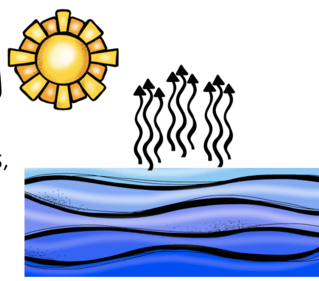
What part of the water cycle does this picture show?
a)
condensation
b)
precipitation
c)
evaporation
56.

The image shows various stages in the water cycle. During which stage does water flow back towards the sea as runoff?

a)

W

b)

X

c)

Y

d)

Z

57.

Water in its gas form is called ____________________,

a)

water vapor

b)

precipitation

c)

ice

d)

air

58.
What is it called when plants give off water vapor as a waste product?
a)
condensation
b)
evaporation
c)
sublimation
d)
transpiration
59.

Rain and snow are two different forms of precipitation that fall on Earth's surface. Which factor is responsible for there being different forms of precipitation?

a)

Evaporation

b)

Run-off

c)

Temperature

d)

Transpiration

60.

Precipitation means...

a)

water vapor cooling to form clouds

b)

water running downhill

c)

water falling from the sky

d)

water heating up and rising as gas

61.

Runoff means...

a)

water vapor cooling to form clouds

b)

water running downhill

c)

water falling from the sky

d)

water heating up and rising as gas

62.

Condensation means...

a)

water vapor cooling to form clouds

b)

water running downhill

c)

water falling from the sky

d)

water heating up and rising as gas

63.

Evaporation means...

a)

water vapor cooling to form clouds

b)

water running downhill

c)

water falling from the sky

d)

water heating up and rising as gas

64.
What follows evaporation during the water cycle? How does this occur?
a)
Water evaporates into water vapor
b)
Water vapor condenses and forms a  cloud
c)
Water precipitates to the ground
d)
Water runs down into the hydrosphere
65.
Snow, sleet, hail, and rain are all examples of  ________________. 
a)
evaporation
b)
condensation
c)
accumulation
d)
precipitation
66.

As a part of the water cycle, water from Earth's surface enters the clouds and finally falls back to the ground in the form of rain. What is the correct sequence of processes water undergoes?

a)

Evaporation, Condensation, Precipitation

b)

Precipitation, Condensation, Evaporation

c)

Condensation, Evaporation, Precipitation

d)

Evaporation, Precipitation, Condensation

67.

What is the original, and primary reservoir of inorganic phosphate (PO43-)in terrestrial ecosystems?

a)

live plants and animals

b)

groundwater

c)

the atmosphere

d)

rocks

68.

Nitrogen and carbon are cycled on a global scale. Why does phosphorus cycling tend to occur more locally?

a)

it primarily involves the weather of rocks, which are mostly stationary

b)

it only involves land animals that cannot swim across oceans to transport the nutrient

c)

it occurs in areas where cloud formation is low, so it rarely gets trapped in water vapors

d)

all of the answers are correct

69.

The phosphorus cycle occurs much more quickly than the carbon and nitrogen cycles.

a)

true

b)

false

70.

Phosphorus enters the P cycle as

a)

atmospheric phosphate

b)

diphosphorus

c)

rock phosphate

d)

organic phosphate

71.

This is NOT a part of the phosphorus cycle.

a)

Phosphate is incorporated into sedimentary rocks

b)

Phosphate bound to soil

c)

Atmospheric phosphate

d)

Phosphate is absorbed from the soil by plants

72.
Phosphorous is passed from plants to ____ who eat them
a)
plants
b)
animals
c)
scavengers
73.
Which of the following statements is true of the phosphorus cycle?
a)
Phosphorus enters the atmosphere as phosphates.
b)
The phosphorus cycle utilizes the processes of erosion, and weathering.
c)
Phosphates are used in carbohydrate and glucose storage.
d)
The phosphorus cycle utilizes bacteria to breakdown phosphates and make them available for plants.
74.
What role do decomposers play in the phosphorous cycle?
a)
absorb phosphorous 
b)
release phosphorous into atmosphere
c)
return phosphorous into the soil
d)
combustion
75.

Too much phosphorus in waterways (rivers, lakes) can lead to___________.

a)

excessive richness of nutrients in a lake

b)

Nothing at all

c)

Death to all animals

d)

diseases in animals

76.

______________ are created when living organisms die

a)

Fossils

b)

Oxygen

c)

Carbon

d)

Nitrogen

77.

________ and _______ need Nitrogen

a)

Humans

b)

Animals

c)

Aquatic life

d)

Plants

78.

Burning fossil fuels lead to ____________

a)

Greenhouse effect

b)

Cleaner air

c)

Less humidity

d)

Nuclear energy

79.

Deforestation causes an increase in ____________

a)

Oxygen

b)

Nitrogen

c)

Carbon dioxide

d)

Increased habitats

80.

Nitrogen goes through the process of ________ before plants can absorb them. 

a)

Transformation

b)

Transpiration

c)

Denitrification

d)

Fixation

81.

Which of these nitrogen cycle processes converts atmospheric nitrogen to a soil form of nitrogen that is usable by plants?

a)

nitrogen fixation

b)

nitrification

c)

denitrification

d)

ammonification

e)

assimilation

82.
Organisms that break down dead plants & animals and release nitrogen back into atmosphere...
a)
bacteria
b)
plants
c)
animals
d)
producers
83.
Nitrification happens in the ______
a)
Air 
b)
Soil 
c)
Ground Water 
d)
Plants 
84.
Which of the following removes carbon from the atmosphere?
a)
Combustion
b)
Respiration
c)
Photosynthesis
d)
Death
85.
Which of the following is an example of a decomposer?
a)
Owl
b)
Fish
c)
Tree
d)
Mushroom
86.

When humans EXHALE, we release __________________.

a)

Oxygen

b)

Carbon Dioxide

c)

Nitrogen

d)

Water

87.
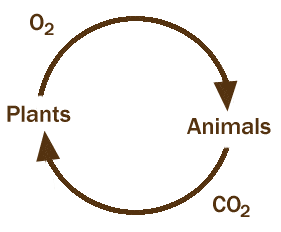
Which statement is true about the carbon dioxide-oxygen cycle?
a)
animals breathe in nitrogen and release oxygen which is used by plants
b)
animals breathe in oxygen and release carbon dioxide which is used by plants
c)
animals breathe in nitrogen and release carbon dioxide which is used by plants
d)
animals breathe in carbon dioxide and release oxygen which is used by plants