wayground logo

Free Printable Worksheets

Font size

S
M
L
XL
Worksheets

Unit 2- Chemistry of Life Test Review

Total questions: 103

Worksheet time: 3hrs 35mins

Name
Class
Date
1.
What word describes when water is attracted to other substances?
a)
cohesion
b)
adhesion
c)
capillary action
d)
surface tension
2.
What two elements make up water?
a)
Helium and oxygen
b)
Hydrogen and oxygen
c)
helium and carbon
d)
oxygen and carbon
3.
Attractions between the negative Oxygen atom of one water molecule and the positive Hydrogen atom of another water molecule are called
a)
Covalent bonds
b)
Ionic bonds
c)
Polar bonds
d)
Hydrogen bonds
4.
Water is a universal solvent because it...
a)
It can be found anywhere
b)
It freezes when it gets cold
c)
floats when frozen
d)
Dissolves most substances
5.
Which of the following is LEAST likely to dissolve in water?
a)
nonpolar fats and oils
b)
polar sugar molecules
c)
salt made of a positive sodium ion and a negative chloride ion
d)
all of the substances will dissolve easily in water
6.
Large bodies of water, such as lakes and oceans, do not quickly fluctuate in temperature. What is the reason for this phenomenon?
a)
Water is an acid.
b)
Water is a versatile solvent.
c)
Water has a high heat capacity.
d)
 Water acts as a buffer.
7.
 Small insects can walk across the surface of calm water. Their feet push the surface of the water down slightly, somewhat like a person walking across a trampoline, but they do not break the surface. What is the best explanation for why this happens?
a)
The insects are light enough so that they do not break the hydrogen bonds holding the water molecules together
b)
The insects actually use their wings to hover slightly above the water's surface and they only skim it with their feet
c)
The insects' feet are non-polar, so they are repelled by the polar water molecules and are pushed away from the water's surface
d)
The insects are small enough to see the individual water molecules, so they are able to step carefully from one molecule to the next
8.
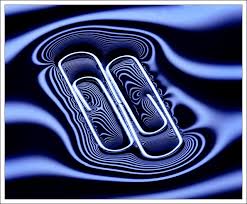
The tightness across the surface of water that enables paper clips to float is ____________.
a)
adhesion
b)
capillary action
c)
surface tension
d)
polarity
9.
Which statement explains why water molecules stick together?
a)
both sides are negative
b)
one side has a positive charge and the other side has a negative charge
c)
one side has a negative charge adn the other side has a neutral charge
d)
both sides are positive
10.
When a molecule has an opposite electrical charge on each end, it is known as what?
a)
cohesion
b)
polar molecule
c)
hydrogen bond
d)
solution
11.
Water beads up on the surface of a penny because of what property?
a)
Adhesion
b)
High Surface Tension
c)
Universal Solvent
d)
Changes in Density
12.
Which is considered neutral?
a)
pH of 4
b)
pH of 9
c)
pH of 14
d)
pH of 7
13.
Tomato juice has a pH of 4. Determine if it's an acid, base, or neutral. 
a)
acid
b)
base
c)
neutral 
14.
Household bleach has a pH of 12. Determine if it's an acid, base, or neutral.
a)
acid
b)
base
c)
neutral 
15.
Which end of the water molecule has a slightly positive charge?
a)
the oxygen end
b)
the hydrogen end
c)
both ends are slightly positive
d)
neither end is positive
16.
When water molecules stick easily to other water molecules, this is called what?
a)
cohesion
b)
adhesion
c)
solution
d)
polar molecule
17.

What is the chemical symbol of water?

a)

H2O

b)

CO2

c)

O2

d)

N2

18.

What do the green bonds represent?

a)

Covalent Bond

b)

Hydrogen Bond

c)

Ionic Bond

19.

What property of water causes these Alka-Seltzer tablets to dissolve?

a)

Universal Solvent

b)

Expansion Upon Freezing

c)

Cohesive Behavior

d)

High Specific Heat

20.

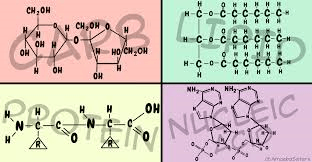
Below are the four biomolecules, EXCEPT:

a)

Protein

b)

Lard

c)

Carbohydrates

d)

Nucleic Acid

21.

The biomolecule that holds an organism's genetic information is called ___________.

a)

carbohydrate

b)

lipid

c)

nucleic acid

d)

protein

22.

Which of the following is the correct pair of biomolecules and their monomers?

a)

Carbohydrate: Fatty Acids

b)

Protein: Amino acid

c)

Lipid: Nucleotide

d)

Nucleic Acid: DNA

23.

The following statements are TRUE regarding lipids, EXCEPT:

a)

they store energy for later use

b)

they are insoluble in water

c)

they are composed of carbon, hydrogen, oxygen and phosphorus

d)

they can be found in fats and oils

24.

Which of the following is a monosaccharide?

a)

Chitin

b)

Sucrose

c)

Starch

d)

Glucose

25.

Cholesterol is a/an...

a)

carbohydrate

b)

lipid

c)

protein

d)

nucleic acid

26.

Enzyme is a/an...

a)

carbohydrate

b)

lipid

c)

protein

d)

nucleic acid

27.

What biomolecule serves as structural materials in hair, nails and connective tissues?

a)

protein

b)

lipid

c)

carbohydrate

d)

nucleic acid

28.

Monosaccharides are the building blocks of which group of biomolecules?

a)

protein

b)

lipid

c)

carbohydrate

d)

nucleic acid

29.

Which of the following elements is present in Nucleic acid but not in other biomolecules?

a)

Carbon

b)

Phosphorus

c)

Nitrogen

d)

Hydrogen

30.
What do monomers do?
a)
Bond to make a polymer
b)
Create essential proteins
c)
Stores energy
d)
Splits to make more cells
31.
Which biomolecule contains fats, oils, and waxes?
a)
Proteins
b)
Nucleic Acid
c)
Lipids
d)
Carbohydrate
32.
The monomer of a protein is called...
a)
an amino acid
b)
a monosaccharide
c)
a fatty acid
d)
a nucleotide
33.

Which organic molecule would a long-distance runner most likely choose to eat two hours before a race?

a)

A protein, because it builds muscle mass.

b)

A lipid because it provides long term energy storage.

c)

A carbohydrate because it releases energy quickly.

d)

A protein, because it transports oxygen into the blood stream.

34.

How are the functions of a carbohydrate and a lipid similar?

a)

Both are a source of energy.

b)

Both are replicated during meiosis.

c)

Both lower the activation energy of reactions.

d)

Both dissolve nutrients in the digestive system.

35.

What are the monomers of a lipid?

a)

fat cubes and glycogen

b)

glycerol and amino acids

c)

fatty acids and glycerol

d)

amino acids

36.

Nucleotides are a monomer of which biomolecule?

a)

Nucleic acids

b)

Proteins

c)

Carbohydrates

d)

Lipids

37.
What elements are common to all 4 biomolecules?
a)
Carbon, hydrogen, nitrogen
b)
Carbon, Nitrogen, Phosphorus
c)
Carbon, Hydrogen, Oxygen
d)
Carbon, Hydrogen, Phosphorus
38.
Which biomolecule contains pastas and breads?
a)
Lipid
b)
Protein
c)
Nucleic Acid
d)
Carbohydrate
39.
Which biomolecule helps form muscles?
a)
Nucleic Acid
b)
Carbohydrate
c)
Protein
d)
Lipids
40.
What is the function of nucleic acids?
a)
Stores energy
b)
Stores genetic information
c)
Movement
d)
Physical structure
41.
Carbon, Hydrogen, Oxygen and Nitrogen are elements in what biomolecule?
a)
Carbohydrate
b)
Lipid
c)
Protein
d)
Nucleic acid
42.

Which biomolecules can be DNA and RNA?

a)

Carbohydrates

b)

Lipids

c)

Proteins

d)

Nucleic Acids

43.

Which organic molecules is paired with its function?

a)

nucleic acid- to store energy

b)

lipids – to regulate metabolic.

c)

protein- to provide insulation.

d)

carbohydrates – to provide quick-release energy.
44.
What biomolecule do enzymes belong to? 
a)
Carbohydrate
b)
Lipid
c)
Nucleic Acid
d)
Protein
45.

Which biomolecule makes up cell membranes?

a)

Protein

b)

Carbohydrate

c)

Lipid

d)

Nucleic acid

46.
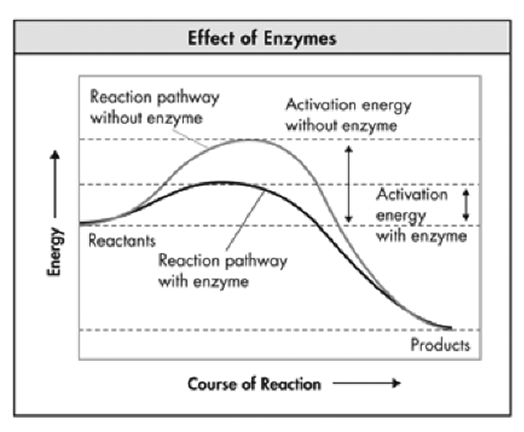
Enzymes catalyze reactions by ___________ Activation Energy.
a)
Increasing
b)
Decreasing
47.
What are the four biological molecules?
a)
proteins, carbohydrates, lipids, nucleic acids
b)
A, T, C, G
c)
water, air, earth, and fire
d)
Joe, Nick, and Kevin Jonas
48.
Which biomolecule is responsible for insulation and energy storage?
a)
Protein
b)
Nucleic Acid
c)
Lipid
d)
Carbohydrate
49.
The conditions for an enzyme to work need to be ____________
a)
specific
b)
normal
c)
variable
d)
don't matter
50.
If you want a reaction to speed up you need an _________.
a)
nucleic acid
b)
enzyme
c)
nerve cell
d)
carbohydrate
51.
Once an enzyme does it's work, the enzyme is ___________.
a)
destroyed
b)
unchanged
c)
duplicated
d)
changed
52.

What is the function of proteins?

a)

provides quick energy

b)

stores energy

c)

helps with growth and repair of tissues

d)

stores genetic information

53.

Which are examples of proteins?

a)

glucose, pasta, bread

b)

fats, oils, waxes

c)

meats, enzyme, lactase, eggs

d)

DNA, RNA

54.

Which are examples of lipids?

a)

glucose, pasta, bread

b)

fats, oils, waxes

c)

meats, enzyme, lactase, eggs

d)

DNA, RNA

55.
What do disaccharides, such as sucrose, and polysaccharides, such as starch, have in common?
a)
They are lipids made of fatty acids.
b)
They are proteins made of amino acids.
c)
They are nucleic acids made of nucleotides.
d)
They are carbohydrates made of simple sugars.
56.

A student makes a Venn diagram to compare the functions of carbohydrates and lipids.

Which function of carbohydrates and lipids should be placed in the shared section of the Venn diagram?

a)

Hormone production

b)

Structural support of cell walls

c)

Energy storage

d)

Catalyst for chemical reactions

57.

What is the function of lipids (in animals)?

a)

provides quick energy

b)

stores energy

c)

helps with growth and repair of tissues

d)

stores genetic information

58.

What is the monomer for Lipids?

a)

Monosaccarides

b)

Fatty Acids

c)

Amino Acids

d)

Nucleotides

59.
DNA and RNA are examples of 
a)
Carbohydrates
b)
Lipids
c)
Proteins
d)
Nucleic Acids
60.
Which macromolecule stores energy, insulates us, and makes up the cell membrane?
a)
lipids
b)
proteins
c)
carbohydrates
d)
nucleic acids
61.
All polymers are made up of...
a)
monosaccharides
b)
monomers
c)
proteins
d)
None of these
62.

The most important element that is the backbone of all biological molecules

a)
carbon
b)
nitrogen
c)
phosphorus
d)
sulfur
63.
Which is an example of a lipid?
a)
Candy
b)
Olive Oil
c)
DNA
d)
Meat
64.
The organic compounds that have many structural purposes and are used in many processes within the
cell are called ____________________.
a)
Carbohydrates
b)
Lipids
c)
Proteins
d)
Nucleic Acids
65.
This is one job proteins do NOT have in the body
a)
insulation
b)
structure for tissues and organs
c)
speed up chemical reactions
d)
transport things through cell membrane
66.
The element _______is found in all of the organic compounds.
a)
Iron
b)
Nitrogen
c)
Carbon
d)
Oxygen
67.

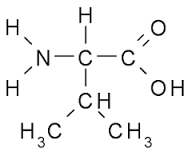
Which macromolecule is shown?

a)

lipid

b)

protein

c)

nucleic acid

d)

carbohydrate

68.

Which macromolecule is shown?

a)

lipid

b)

protein

c)

nucleic acid

d)

carbohydrate

69.
Carbohydrates are made of... 
a)
C H O
b)
C H O N
c)
C H O N P
d)
C H O N S
70.
Lipids are made of... 
a)
C H O
b)
C H O N
c)
C H O N P
d)
C H O N S
71.
Proteins are made of... 
a)
C H O
b)
C H O N
c)
C H O N P
d)
C H O N S
72.

This macromolecule make up cell membranes, store energy, and provide insulation

a)

carbohydrate

b)

lipids

c)

protein

d)

nucleic acid

73.

A macromolecule with C, H, O, and N only, is a.....

a)

carbohydrate

b)

lipid

c)

protein

d)

nucleic acid

74.

Which statement is true?

a)

Simple sugars are made of polysaccharides.

b)

Glycerol is made of fatty acids.

c)

RNA molecules are made of nucleotides.

d)

Amino acids are made of proteins.

75.

Plants build cellulose (a polysaccharide) to makeup their parts like leaves, roots, stems, etc. What monomer do plants use to build cellulose?

a)

monosaccharides

b)

disaccharides

c)

amino acids

d)

nucleotides

76.

This group includes steroids like estrogen and testosterone

a)

carbohydrate

b)

lipid

c)

protein

d)

nucleic acid

77.

Identify the macromolecule in the picture.

a)

carbohydrate

b)

lipid

c)

protein

d)

nucleic acid

78.

What is the term used to describe the energy needed to get a reaction started?

a)

activation energy

b)

adhesion energy

c)

cohesion energy

d)

chemical energy

79.

Which of the following statements is true about catalysts (enzymes)?

a)

Catalysts slow down the rate of chemical reactions.

b)

Enzymes help regulate pH.

c)

Catalysts are used up during a chemical reaction.

d)

Catalysts lower the activation energy of a chemical reaction.

80.

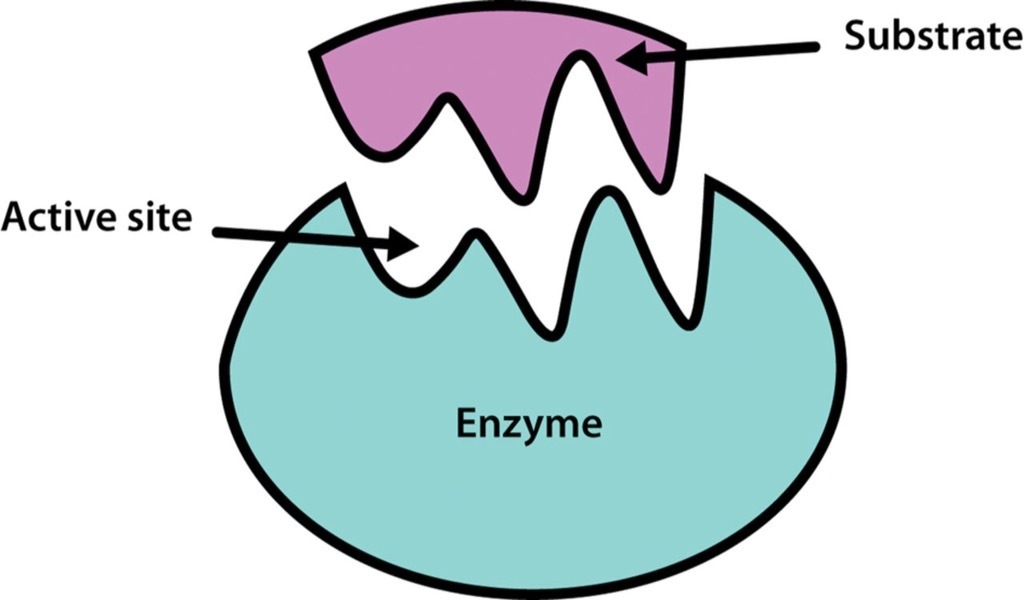
An enzyme and substrate can be compared to

a)

lock and key

b)

a faucet

c)

a door hinge

d)

light switch

81.

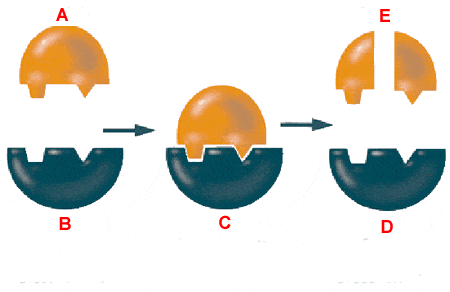
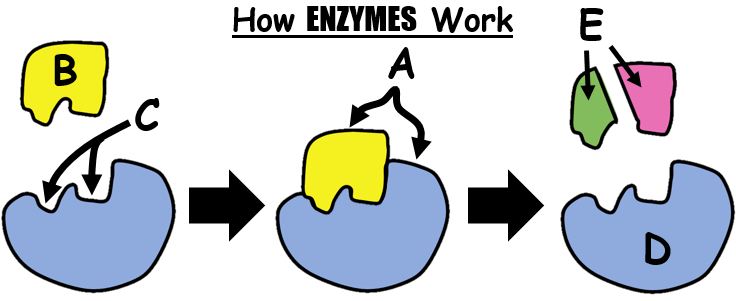
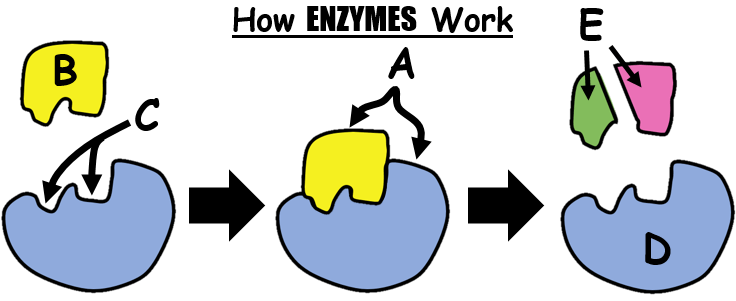
The picture below shows an enzyme acting on a substrate to form products during a chemical reaction. Using the figure, what letters represents the enzyme?

a)

A and B

b)

B and D

c)

A and E

d)

D and E

82.
What is a substance called if it speeds up a chemical reaction?
a)
reusable
b)
catalyst
c)
specific
d)
fragile
83.
With what 3 letters do enzymes typically end?
a)
-ose
b)
-ase
c)
-ese
d)
-tic
84.
Each enzyme only has 1 substrate that will fit its active site.  What is this called?
a)
reusable
b)
catalyst
c)
specific
d)
fragile
85.
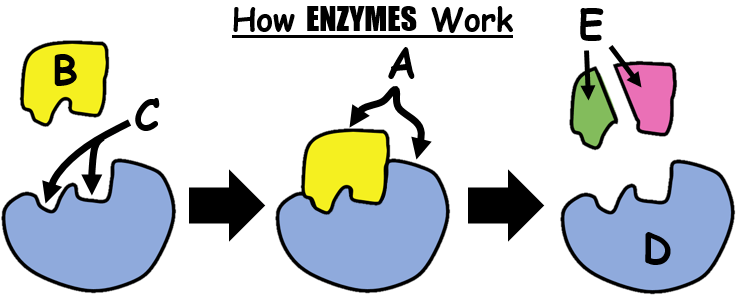
In the diagram, what is letter A? 
a)
product
b)
substrate
c)
enzyme-substrate complex
d)
active site
86.
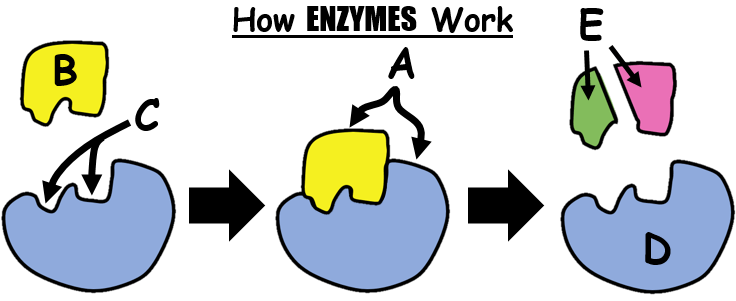
Letter D...
a)
active site
b)
enzyme
c)
substrate
d)
products
87.
Letter B...
a)
active site
b)
enzyme
c)
substrate
d)
products
88.
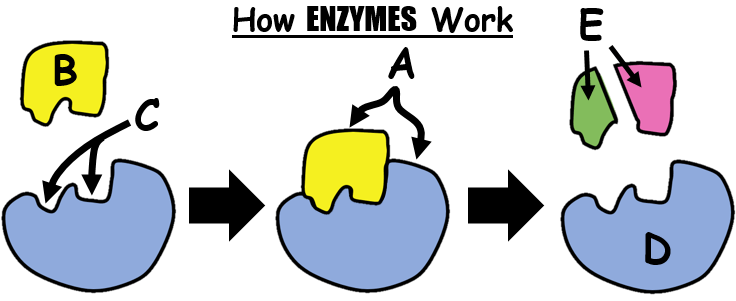
Letter C...
a)
active site
b)
enzymes
c)
substrate
d)
products
89.
Letter E...
a)
active site
b)
enzyme
c)
substrate
d)
products
90.
An enzyme speeds up a reaction by
a)
lowering the activation energy.
b)
raising the activation energy.
c)
releasing energy.
d)
absorbing energy.
91.

What happens when enzymes are heated to a high temperature?

a)

The enzymes die.

b)

The shape of the enzyme are changed and it denatures

c)

The enzymes' amino acid sequence changes.

d)

The enzymes remain the same

92.
The molecule an enzyme is working on is called the:
a)
Substrate
b)
Solvent
c)
Allosteric Inhibitor
d)
CoEnzyme
93.
Which of these is NOT true?
a)
Enzymes can denature (change shape) when the temperature gets too high.
b)
Enzymes can only be used once in a chemical reaction. 
c)
Extreme pH can denature enzymes.
d)
Enzymes speed up chemical reactions. 
94.
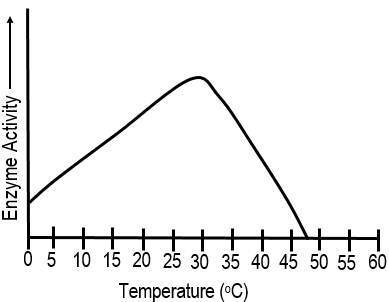
Based on the graph, what temperature does this enzyme work best? 
a)
15 C
b)
40 C
c)
30 C
d)
47 C
95.
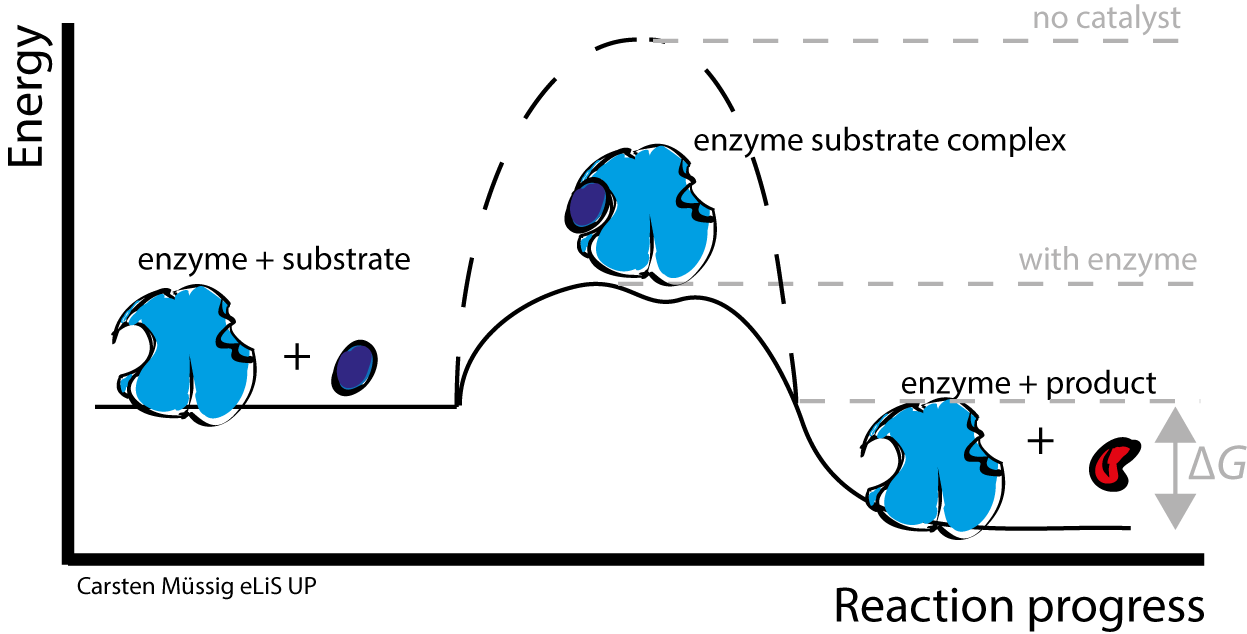
The graph shows how enzymes affect reactions in cells. Which statement best summarizes the information shown in the graph?
a)
Enzymes increase the energy of the reactants.
b)
Enzymes decrease the energy level of the products.
c)
Enzyme decrease the activation energy of the reaction.
d)
Enzymes reverse the direction of the reaction.
96.
What is the function of an enzyme?
a)
enzymes break themselves into small pieces
b)
enzymes slow down chemical reactions
c)
enzymes speed up chemical reactions
d)
enzymes combine products to form reactants 
97.
Enzymes will make a reaction go _______ and use ______ energy.
a)
faster, less
b)
faster, more
c)
slower, less
d)
slower, more
98.
What happens to an enzyme when it is denatured?
a)
Activation energy is lowered.
b)
It becomes stronger.
c)
It loses its shape.
d)
Activation energy is raised.
99.
Every enzyme has a optimal temperature and pH. True or False?
a)
True 
b)
False
100.
Enzymes are composed of which of the following monomers? 
a)
amino acids
b)
carbohydrates
c)
nucleotides
d)
monosaccharides
101.
Enzymes are capable of increasing the rate of a chemical reaction within a living cell.  Enzymes accomplish this through which of the following means?
a)
reducing the number of products   
b)
reducing the activation energy
c)
increasing the temperature of the cell
d)
increasing the concentration of reactants 
102.
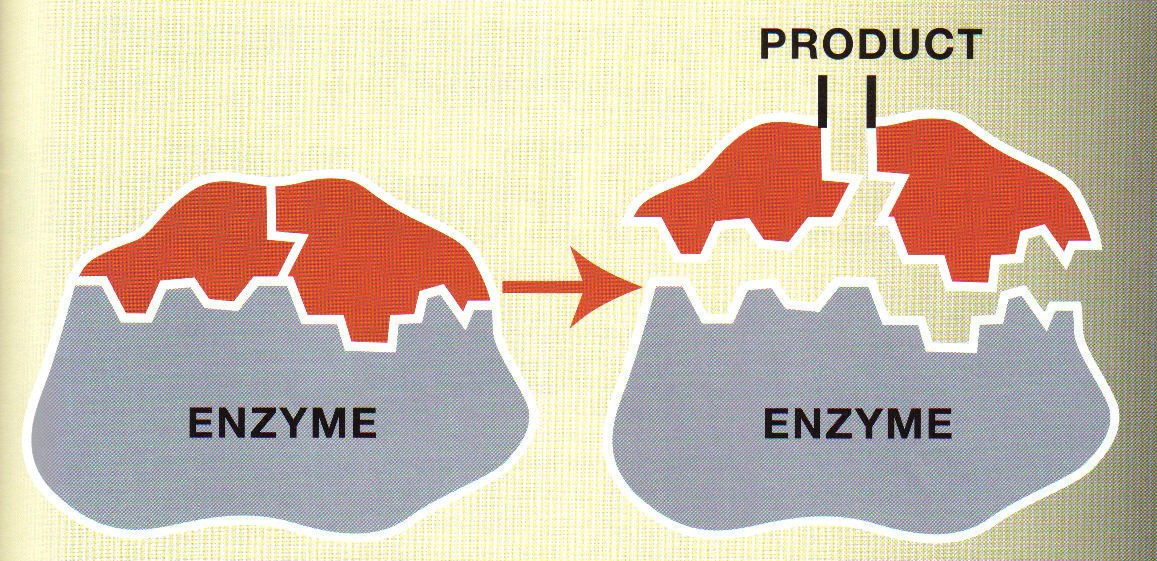
After the enzyme and substrate bind together and perform the reaction, what does the substrate become?
a)
a substrate
b)
an enzyme
c)
a product
d)
an active site
103.

How does an enzymes shape relate to its function?

a)

the shape of the enzyme has no relation to its function

b)

the enzyme is shaped specially for certain substrates to perform a specific reaction

c)

the enzyme shape acts as a receptor to certain products

d)

the enzyme shape can fit into specific substrates to cease a reaction