
Font size
 Worksheets
Chemistry - reactions & balancing
Total questions: 64
Worksheet time: 1hrs 1mins
What coefficients does ____H2 + ____O2 -> ____H2O need to be balanced?
1,1,1
2,2,2
2,1,2
none of the above

How many hydrogen atoms?
1
2
6
not enough information
Balance the equation ___Fe(s) + ___CuSO4(aq) -> ____FeSO4(aq) + ____Cu(s)
1,2,2,1
2,3,6,3
2,4,2,4
already balnced
What happens to the atoms in a chemical reaction?
they are created
they are converted to energy
they are destroyed
they are rearranged
How many nitrogen atoms are on the reactants side of 3Mg(NO3)2 + 2K3PO4 -> Mg3(PO4)2 + 6KNO3?
6
3
18
1
Balance the equation Fe3O4+H2−>Fe+H2O.
3,1,4,2
1,4,3,4
2,8,6,8
none of the above
What forces us to balance chemical equations?
The Law of Balanced Equations
The Law of Conservation of Mass
The Law of Conservation of Energy
The Law of Science
Fe + S --> FeS


Balance the following equation by filling in the blank:
N2 + 3H2 → _NH3
(a)
The mass number of an element tells you
The number of protons and neutrons
The number of protons and electrons
The number of neutrons and electrons
The number of neutrons only
The atomic number tells you
The number of electrons
The number of protons
The number of neutrons
The number of nucleons

An atom has no net charge due to
Its subatomic particles carrying no electrical charge
The positively charged protons cancel out the negatively charged neutrons
The positively charged neutrons cancel out the negatively charged electrons
The positively charged protons cancel out the negatively charged electrons
Why is it called a chemical "equation"?
The number of atoms of the elements before the reaction is equal to the number of atoms after the reaction
The total mass of the reacting elements would be the same as the total mass of whatever products are formed
The reaction produces an equal number of products to the number of elements which react
You MUST write an equals sign
Which is correct...
Most of the mass of an atom is concentrated towards the outside
That the mass of an atom is equally distributed
The the mass of an atom is concentrated in the centre of the atom
The masses of atoms are so small that are not important
A negative ion...
Has an equal number of protons and electrons
It has more electrons than protons
It has a different number of neutrons
It has more protons than electrons
An atom can be changed to an ion by...
Changing its atomic number
Losing or gaining electrons
Losing or gaining alpha particles
Being hit with a gamma ray
True or False: In a complete chemical equation, there must be the same number of atoms of each element on the reactants and products side.
True
False

Why are chemical equations always balanced? Select ALL that apply.
Matter cannot be created.
Matter cannot be destroyed.
Matter can only be rearranged/conserved.
Matter doesn't matter.
True or false?
A chemical reaction is a chemical change that occurs when two substances combine to form a new substance.
True
False
Group 1 elements are very reactive
false
true
The following elements are members of group 7 EXCEPT for one.
chlorine
hydrogen
fluorine
iodine
Which of the following characteristics is similar for fluorine and iodine?
Number of Protons
Number of Neutrons
Number of Orbitals
Number of Valence Electrons
Which statement would be most helpful in identifying an element?
The element has 36 protons
The element has 6 neutrons
The element has 8 valence electrons
The element has properties similar to nitrogen
Which statement would be most helpful in determining an element’s reactivity?
The element has the same number of electron shells as iodine
The element has the same number of valence electrons as cesium
The element has 47 neutrons
The element is a metal
USE THE PERIODIC TABLE
Find the element that has 5 Valence Electrons and 4 energy levels.
Arsenic - As
Selenium - Se
Calcium - Ca
Vanadium - V
An atom that gains or loses an electron becomes
an isotope
a new element
an ion
a molecule
a change to a substance that happens without forming a new substance
physical change
chemical change
double replacement reaction
combustion
Which one shows that a chemical reaction has occurred?
dissolving
melting
formation of a gas
bending


What type of bonding does this picture show?
Ionic
Covalent
Generally, atoms form bonds so that _______________.
Each atom loses its electrons
Each atom has a stable electron configuration
Each atom has an unstable electron configuration
Each atom gains electrons
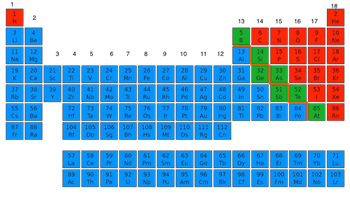
This refers to the tendency of atoms to prefer to have eight electrons in the valence shell
Octet rule
Valence electron
Electronegativity
Lewis symbol
If an atom loses two electrons what charge will it have?
-1
-2
+1
+2
Which particle is responsible for bonding?
Electrons
Protons
Nucleus
Neutrons
Why do elements bond?
To be friends
To create a new element
To become stable
To get bigger

An atom with a different number of electrons than it should have (more or less) is called an ---
isotope
valence electron
ion
octet

