Wayground logo

Free Printable Worksheets

Font size

S
M
L
XL
Worksheets

Unit One Review Honors Chem

Total questions: 68

Worksheet time: 6hrs 40mins

Name
Class
Date
1.
Which particles make up the nucleus of an atom?
a)
protons and neutrons
b)
electrons and protons
c)
electrons, protons, and neutrons
d)
electrons and neutrons
2.
An element with a mass number of 10 and an atomic number of 6 has how many protons?
a)
5
b)
8
c)
6
d)
10
3.
How many electrons does Si contain? (click to see image)
a)
14
b)
28
c)
2
d)
4
4.
Elements which are shiny, conduct electricity and heat are called
a)
metal
b)
nonmetal
c)
metalloid
d)
nonexistent
5.
Group 18 elements are known as the _____ _____ and have full valence shells.
a)
royal gases.
b)
supreme solids.
c)
noble gases.
d)
legit liquids.
6.
What period and group is Silver (Ag)? 
a)
Period 2, Group 1
b)
Period 3, Group 16
c)
Period 5, Group 11
d)
Period 2, 14
7.
An element's identity is determined by the number of
a)
electrons.
b)
protons.
c)
neutrons.
d)
valence.
8.
Rows on the period table are called _____ while columns are called _____.
a)
groups, families
b)
groups, periods
c)
periods, groups
d)
families, groups
9.
The central region of an atom where its neutrons and protons are is called the
a)
nucleus 
b)
electron cloud
c)
core 
d)
center 
10.
Beryllium is in group number______.
a)
Group 2
b)
Group 3
c)
Group 4
d)
Group 7
11.
The period for Bromine is ___________.
a)
3
b)
2
c)
4
12.
How many Valance electrons does Iodine Have?
a)
6
b)
16
c)
7
d)
17
13.
The elements in a column of the periodic table...
a)
have similar atomic numbers
b)
start with the same letter
c)
have similar properties
d)
are not related in any way
14.
What period and group is Flourine on the periodic table?
a)
Period 7, Group 3
b)
Period 5, Group 4
c)
Period 2, Group 17
d)
Period 8, Group 2
15.
Which of the following has six valence electrons?
a)
Sodium
b)
Iodine
c)
Oxygen
d)
Neon
16.
Metals are good conductors of heat and electricity.
a)
true
b)
false
17.
What is the atomic mass of "F"
a)
9
b)
18
c)
17
d)
19
18.
What is the number of protons that the element in this image contain?
a)
14
b)
7
c)
15
d)
18
19.
a)
Metals
b)
Nonmetals
c)
Metalloids
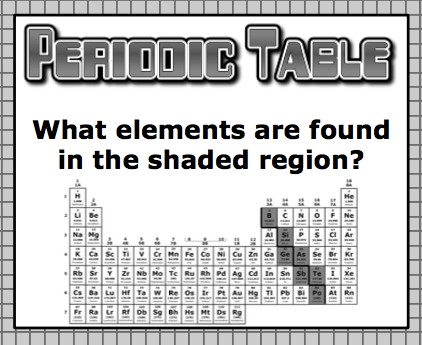
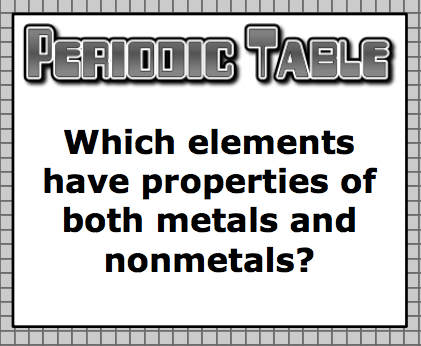
20.
a)
Metals
b)
Nonmetals
c)
Metalloids
21.
Which is an alkali metal?
a)
Magnesium
b)
Iron
c)
Sodium
d)
Europium
22.

What is the formula in getting the number of neutron?

a)

n= atomic mass + atomic number

b)

n= atomic mass - atomic number

c)

n= atomic mass X atomic number

d)

n= atomic mass / atomic number

23.

What is the atomic number of Nickel?

a)

~30

b)

30

c)

28

d)

58.693

24.
The majority of elements on the periodic table are
a)
man made.
b)
nonmetals.
c)
metals.
d)
gases.
25.
In what section would Transition Metals be found?
a)
purple
b)
light blue
c)
yellow
d)
red
26.

Isotopes of an element have a different number of...

a)

Protons

b)

Neutrons

c)

Electrons

d)

Mass

27.

Potassium-39 has how many neutrons?

a)

19

b)

18

c)

20

d)

21

28.

Nickel-59 has how many neutrons?

a)

30

b)

31

c)

32

d)

33

29.
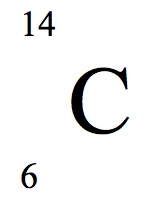
The photo above shows the isotopic notation for which isotope?
a)
Carbon 12
b)
Carbon 13
c)
Carbon 14
d)
Carbon 15
30.
Different isotopes have...
a)
different masses
b)
different atomic numbers
c)
different electrons
d)
different protons
31.
How many neutrons does a Sodium 24 isotope have?
a)
12
b)
13
c)
14
d)
15
32.
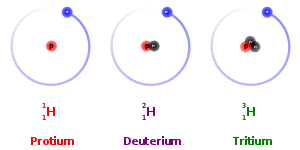
What is the atomic mass of the pictured isotope?
a)
2
b)
4
c)
6
d)
Hehehehe
33.
What is the name of the pictured isotope?
a)
Chlorine-Schmorine
b)
Chlorine-17
c)
Chlorine-35
d)
Chlorine-18
34.
What is the name of the pictured isotope?
a)
Carbon-12
b)
Carbon-13
c)
Carbon-14
d)
Carbon-15
35.

Which one of the following discoveries came first?

a)

electrons

b)

neutrons

c)

quarks

d)

atoms

36.

Which scientist discovered the electrons?

a)

Dalton

b)

Thomson

c)

Atristotle

d)

Bohr

37.

Rutherford and his students did experiments that showed

a)

quark

b)

nucleus

c)

proton

d)

electron

38.

Bohr discovered that electrons are located in

a)

the nucleus

b)

inside protons

c)

electron cloud

d)

circular orbits around the nucleus

39.

Which scientist discovered that the nucleus contained neutrons?

a)

bohr

b)

Rutherford

c)

Dalton

d)

Chadwick

40.

What is a particle with one negative charge called?

a)

electron

b)

proton

c)

quark

d)

neutron

41.

What subatomic particle changes for in an ion?

a)

electron

b)

neutron

c)

proton

d)

nucleus

42.

If there are more electrons, then the charge will be positive.

a)

True

b)

False

43.

How many electrons does S2- have?

a)

16

b)

14

c)

18

d)

2-

44.

How many electrons does Mg 2+ have

a)

10

b)

12

c)

14

d)

2+

45.

How many electrons can the d sublevel hold?

a)
8
b)
10
c)
2
d)
4
46.

What is the maximum number of electrons that an s orbital can have?

a)

1 electron

b)

2 electrons

c)

3 electrons

d)

4 electrons

47.

How many electrons can the p sublevel hold?

a)
8
b)

6

c)
2
d)
4
48.

What is the maximum number of electrons that an f orbital can have?

a)

11 electrons

b)

14 electrons

c)

13 electrons

d)

12 electrons

49.
What atom matches this electron configuration?
1s22s22p63s23p64s23d10
a)
Zinc
b)
Copper
c)
Nickel
d)
Germanium
50.
What electron configuration matches an oxygen atom?
a)
1s22s22p63s2, 3p64s23d104p5
b)
1s22s22p4
c)
1s22s22p6
d)
1s22s22p63s23p64s23d1
51.
What is the noble gas configuration for beryllium?
a)
[He]1s2
b)
[He]2s2
c)
[Li]2s1
d)
[Li]2s2
52.
What is the noble gas configuration for Sulfur?
a)
[Ar] 3p4
b)
[He] 3s2 3p4
c)
[Ne] 3s2 3p4
d)
[Na] 3s2 3p4
53.
[Ne]3s23p1 is the noble gas configuration for which element?
a)
scandium
b)
boron
c)
nitrogen
d)
aluminum
54.
[He]2s22p4 is the noble gas configuration for which element?
a)
oxygen
b)
sulfur
c)
phosphorus
d)
fluorine
55.
Which guideline, Hund’s rule or the Pauli exclusion principle, is violated in the following orbital diagrams?
a)
Hund's
b)
Aufbau's
c)
Pauli's Exclusive
56.
Which guideline, Hund’s rule or the Pauli exclusion principle, is violated in the following orbital diagrams?
a)
Aufbau's
b)
Hund's
c)
Pauli exclusive
57.
The atom with the largest atomic radius in Group 18 is - 
a)
Ar
b)
He
c)
Kr
d)
Rn
58.
As you move down a group, atomic radius increases because - 
a)
you add more and more neutrons
b)
you add more and more protons
c)
you add more and more shells (energy levels)
d)
you add more atomic mass
59.
The atom with the largest atomic radius in Period 4 (row 4) is - 
a)
K
b)
Kr
c)
Fe
d)
Fe
60.

Which of the following halogens has the greatest electronegativity?

a)

Chlorine (Cl)

b)

Bromine (Br)

c)

Iodine (I)

d)

Astatine (At)

61.

Which group of elements has the lowest ionization energies?

a)

Alkali Metals (Group 1)

b)

Alkaline Earth Metals (Group 2)

c)

Halogens (Group 17)

d)

Noble Gases (Group 18)

62.
Francium (Fr) has the lowest ionization energy in Group 1 because - 
a)
it has the smallest number of valence electrons
b)
it has the greatest atomic mass
c)
it has the greatest number of protons, so it attracts its electrons the strongest
d)
its 1 valence electron is very far from the nucleus, so little energy is needed to remove it
63.
The energy required to remove electrons is the definition of: 
a)
Electronegativity
b)
Atomic Number
c)
Atomic Radius
d)
Ionization
64.
Electronegativity is...
a)
the ability of an atom to attract/ accept electrons
b)
the ability of an atom to lose electrons
c)
the energy required to remove an electron from a specific atom
d)
how easy it is to make friends. 
65.

Which of the following will have a lower ionization energy than Scandium (Sc)?

a)

Helium (He)

b)

Titanium (Ti)

c)

Calcium (Ca)

d)

Magnesium (Mg)

66.
4.35% of all X atoms have a mass of 39.946 amu. 83.79% have a mass of 41.941 amu, 9.50% have a mass of 42.941 amu, and 2.36% have a mass of 43.939 amu. What is the average atomic mass of atom X?
a)
41.97 amu
b)
42.19 amu
c)
10.43 amu
d)
40.04 amu
67.
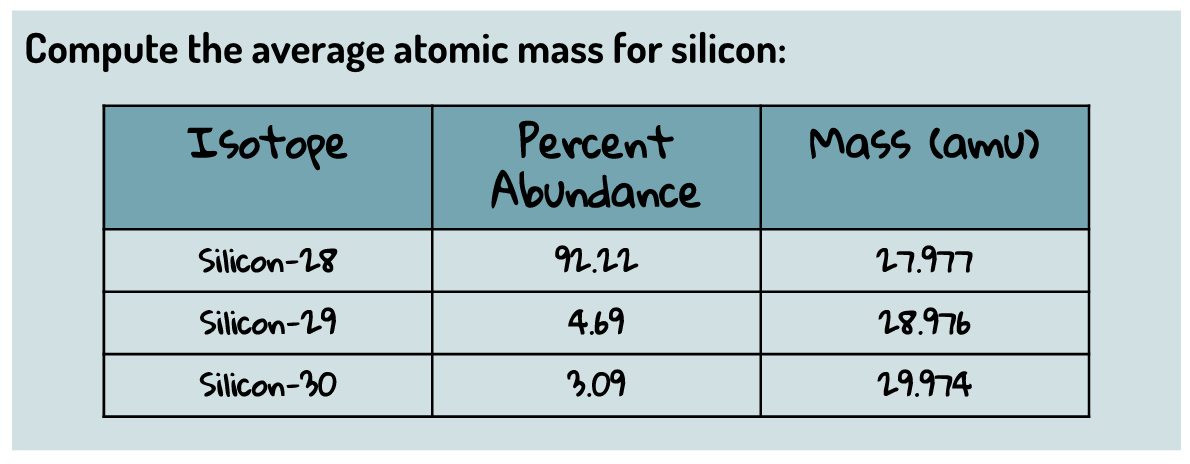
Compute the average atomic mass for silicon:
a)
27.977
b)
28.09
c)
28.976
d)
The average mass cannot be determined from provided information.
68.

Using the mass of Beryllium on your periodic table, calculate the percent abundances of Be-8 and Be-10.

a)

Be-8= 49.5%

Be-10= 50.5%

b)

Be-10= 49.5%

Be-8= 50.5%

c)

Be-8=33.6%

Be-10=66.4%

d)

Be-10=33.6%

Be-8= 66.4%