wayground logo

Free Printable Worksheets

Font size

S
M
L
XL
Worksheets

Chemistry 1st 9 Weeks REVIEW

Total questions: 117

Worksheet time: 3hrs 10mins

Name
Class
Date
1.
How many electrons can the first energy level hold?
a)
1
b)
2
c)
8
d)
0
2.

The second shell from the center of an atom can hold how many electrons?

a)

2

b)

6

c)

8

d)

18

3.

Valence electrons are located...

a)

inside the nucleus

b)

in outer space

c)

on the outermost orbit of an atom

4.
a)

10

b)

2

c)

8

d)

18

5.
a)

14

b)

4

c)

3

d)

28

6.
How many valence electrons are represented here?
a)
7
b)
5
c)
2
d)
8
7.

How many electrons can the d sublevel hold?

a)
8
b)
10
c)
2
d)
4
8.
There are 4 different types of subshells s,p,d,f
a)
true
b)
false
9.

What is the maximum number of electrons that an s orbital can have?

a)

1 electron

b)

2 electrons

c)

3 electrons

d)

4 electrons

10.

How many electrons can the p sublevel hold?

a)
8
b)

6

c)
2
d)
4
11.

How many electrons can the third energy level hold?

a)

2

b)

18

c)
8
d)
0
12.

What is the maximum number of electrons that an f orbital can have?

a)

11 electrons

b)

14 electrons

c)

13 electrons

d)

12 electrons

13.
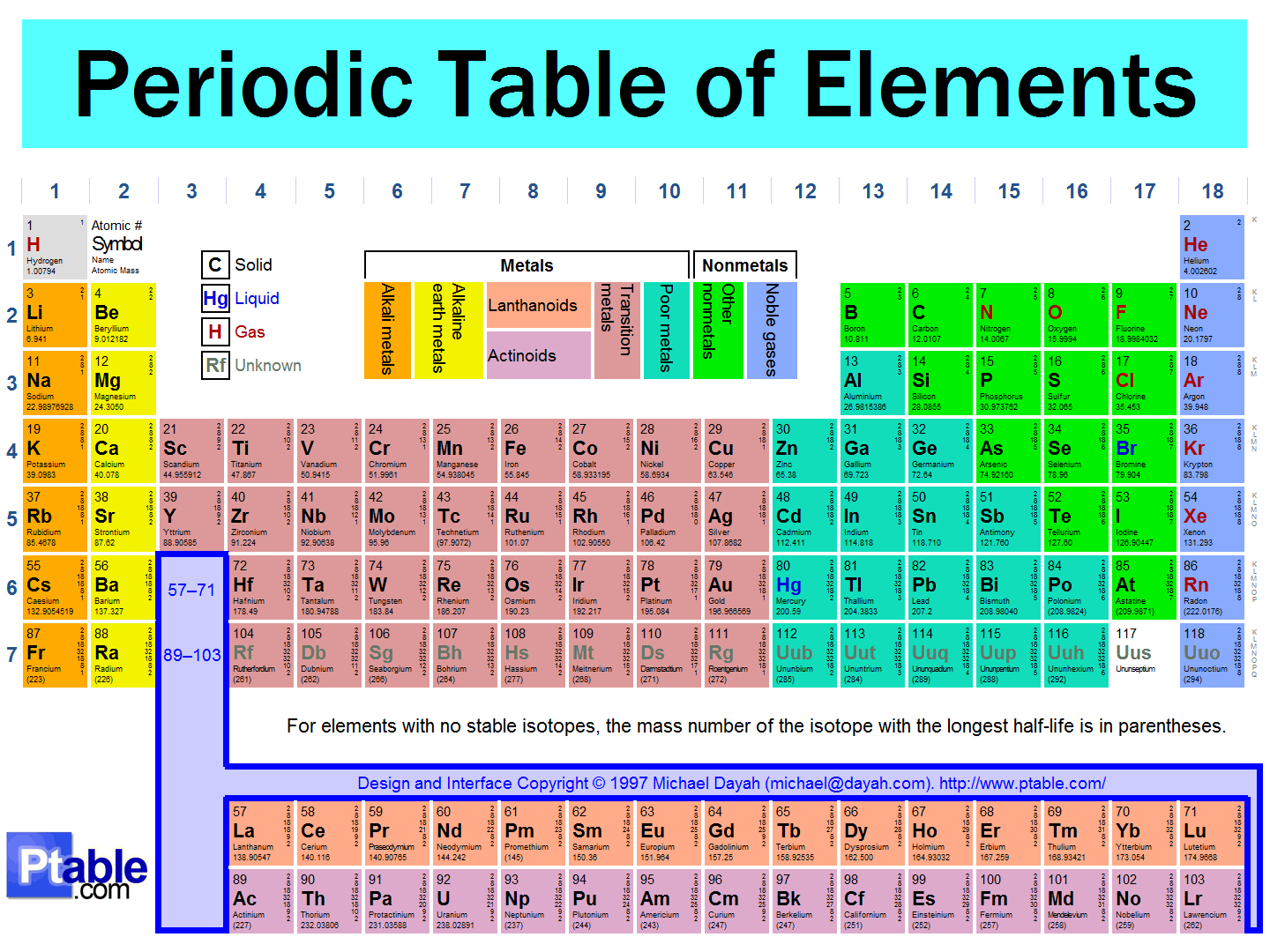
How many electrons does Si contain? (click to see image)
a)
14
b)
28
c)
2
d)
4
14.
What element in Period 4 has 5 valence electrons?
a)
Zr
b)
As
c)
V
d)
Sb
15.
What atom matches this electron configuration?
1s22s22p63s2
a)
Neon
b)
Magnesium
c)
Aluminum
d)
Potassium
16.
What atom matches this electron configuration?
1s22s22p63s23p64s23d10
a)
Zinc
b)
Copper
c)
Nickel
d)
Germanium
17.
What electron configuration matches an oxygen atom?
a)
1s22s22p63s2, 3p64s23d104p5
b)
1s22s22p4
c)
1s22s22p6
d)
1s22s22p63s23p64s23d1
18.
The electron configuration of an atom is 1s22s22p6.  The number of electrons in the atom is 
a)
3
b)
6
c)
8
d)
10
19.
What is this element?
1s22s22p63s2
a)
Neon
b)
Magnesium
c)
Aluminum
d)
Potassium
20.
Which electron configuration belongs to Chlorine (Cl)?
a)
1s2s2p3s3p5
b)
1s2s2p3s3p6
c)
1s2s2p3s3p7
21.
Which electron configuration belongs to Copper (Cu)?
a)
1s2 2s2 2p6 3s2 3p6 4s2 3d8
b)
1s2 2s2 2p6 3s2 3p6 4s2 3d9
c)
1s2 2s2 2p6 3s2 3p6 4s2 3d10
22.
Identify the Electron Configuration for Aluminum (Al)
a)
1s2s2p3s3p1
b)
1s2s2p3s3p3
c)
1s2s2p3s4p1
23.

Determine the group and periodicity of the following atoms!

a)

IIIA and 2

b)

IIA and 2

c)

VA and 3

d)

IVA and 1

24.

An atom has mass number 16. How many neutron this atom has if the atom located at group 6 period 2?

a)

8 neutron

b)

10 neutron

c)

14 neutron

d)

8 proton

25.

The element Br has mass number 80 and 45 neutron. How many electron valence this atom has?

a)

Seven

b)

Eleven

c)

Sevel

d)

Eight

26.

The valence electron for Li atom is located at which orbital?

a)

1s

b)

2s

c)

2p

d)

2d

27.

The valence electron for K atom is located at ___ orbital.

Choose one answer to fill in the blank

a)

2s

b)

2p

c)

3s

d)

3p

28.

Ion B has 10 electrons. It has a charge of (3+).

What is atom B?

a)

nitrogen

b)

neon

c)

aluminium

d)

sodium

29.

What atom matches this electron configuration?

1s22s22p63s23p64s23d10

a)

zinc

b)

copper

c)

nickel

d)

germanium

30.
What electron configuration matches an oxygen atom?
a)
1s22s22p63s2, 3p64s23d104p5
b)
1s22s22p4
c)
1s22s22p6
d)
1s22s22p63s23p64s23d1
31.
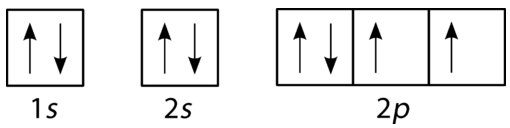
This orbital diagram represents:  
a)
C
b)
B
c)
N
d)
O
32.
This orbital diagram represents:  
a)
C
b)
B
c)
N
d)
O
33.

What is incorrect about this orbital diagram?

a)

Both arrows in the 2p box should be pointing up.

b)

There is nothing incorrect with this diagram.

c)

There should only be 1 arrow in the first 2p box and one in the 2nd 2p box.

d)

All the arrows should be pointing up.

34.

Electrons occupy orbitals of lowest energy first is part of what electron configuration rule?

a)

Hund’s rule

b)

aufbau principle

c)

Pauli Exclusion principle

d)

quantum rule

35.

What is the short-hand electron configuration for sulfur?

a)

[Ar] 3p4

b)

[He] 3s2 3p4

c)

[Ne] 3s2 3p4

d)

[Na] 3s2 3p4

36.

What is the short hand configuration for silicon?

a)

[Ar]2s22p2

b)

[Ne]2s22p2

c)

[Ne]3s23p2

d)

[Ne]3s23p4

37.
Most of the elements on the periodic table are classified as _____.
a)
Metals
b)
Nonmetals
c)
Metalloids
d)
Periods
38.
This class of elements are sometimes called "semiconductors."
a)
Metals
b)
Nonmetals
c)
Metalloids
d)
Groups
39.
These are found on the Periodic Table.
a)
Compounds
b)
Elements
c)
Mixtures
40.

______________ refers to the way a metal can be hammered or rolled into thin sheets.

a)

Luster

b)

Malleable

c)

Metalloids

d)

Solid

41.

There are _________ elements on the periodic table that are classified as metals.

a)

118

b)

nonmetals

c)

metals

d)

88

42.

Metals are found on the ______________ side of the periodic table.

a)

nonmetals

b)

left

c)

right

d)

metals

43.

This group of elements have properties that are opposite those of metals. ______________________

a)

luster

b)

nonmetals

c)

metalloids

d)

metals

44.

This group of elements sit along a stair step line on the periodic table and have properties of both metals and nonmetals. _________________________

a)

luster

b)

metals

c)

nonmetals

d)

metalloids

45.

Copper is a common metal. Which of the following properties does this metal most likely have?

a)

High conductivity, high malleability, and low luster

b)

Low conductivity, low malleability, and low luster

c)

High conductivity, high malleability, and high luster

d)

Low conductivity, high malleability, and high luster

46.
Which of the following is a good conductor of heat?
a)
Metal
b)
Nonmetal
c)
Metalloid
47.
Each column in the periodic table is called a _________ .
a)
period
b)
group
c)
cluster
d)
unit
48.
How are elements on the periodic table arranged by?
a)
in alphabetic order
b)
simular physical & chemical properties
c)
their symbols
d)
Just simular physical properties
49.
Periods on the periodic table are __________.
a)
Horizontal Rows
b)
Vertical Columns
50.
Groups on the periodic table are __________.
a)
Horizontal Rows
b)
Vertical Columns
51.

The Atomic number is known as the _______

a)

Number of electrons in an atom

b)

Number of Protons in an atom

c)

Number of neutrons in an atom

d)

Number of Protons and electrons in an atom

52.

What charge do protons have?

a)

Positive

b)

Negative

c)

Neutral

53.

How many periods are on the periodic table?

a)

5

b)

6

c)

7

d)

8

54.

Elements in the same group have : (2 correct answers)

a)

Similar chemical properties

b)

Similar names

c)

Same number of outer (valence) electrons)

d)

The same number of protons

55.

Name this group: These metals are the most reactive.

a)
b)
c)
d)
56.

True or False: The reactivity of metals tends to decrease as you move from left to right across the periodic table.

a)

True

b)

False

57.

Name this group: These metals are the second most reactive.

a)
b)
c)
d)
58.

Name this group: These metals contain familiar metals such as gold, iron, and copper.

a)
b)
c)
d)
59.

Which of the following could be properties of nonmetals?

a)

Poor electrical conductivity

b)

Poor thermal conductivity

c)

Dullness

d)

Brittleness

60.

Locate Lanthanides and Actinides.

a)
b)
c)
d)
61.

I am a nonmetal

I am in period 2

I am in group 16/6A

a)

Ba

b)

Si

c)

O

d)

S

62.

I am a metal

I am in group 2

I am in period 6

I am…

a)

Mo

b)

Re

c)

S

d)

Ba

63.

These two elements have similar chemical properties to Barium (Ba).

a)

Ca and Ra, because they are in the same group.

b)

Cs and La, because they are in the same period number.

c)

Ca and Y, because they are 90 degree angle.

64.

Which element has the highest electronegativity

a)

Flourine

b)

Copper

c)

Nitrogen

d)

Silver

65.
In the modern periodic table elements are arranged by:
a)
atomic mass
b)
atomic number
c)
valence electrons
d)
number of isotopes
66.
Elements in the same column of the periodic table always have the same # of _______ as one another.
a)
Protons
b)
Neutrons
c)
Electrons
d)
Valence Electrons
67.
Which group of the periodic table is composed of inert (not reactive)  gases?
a)
alkali metals
b)
alkaline earth metals
c)
halogens
d)
noble gases
68.
Which is a halogen?
a)
Helium
b)
Chlorine
c)
Oxygen
d)
Neptune
69.
Which periodic group has the smallest atomic radius?
a)
Alkali metals
b)
Halogens
c)
Noble Gases
d)
Transition metals
70.
Which of the following will have a larger radius than Zinc?
a)
Gallium
b)
Aluminum
c)
Magnesium
d)
Strontium
71.
Which has the greater EN: 
Cl or Al?
a)
Cl
b)
Al
72.

Ions are formed when atoms gain or lose ___.

a)

electrons

b)

protons

c)

neutrons

d)

atomic mass

73.

What property is being measured in this diagram?

a)

Density

b)

Ionization Energy

c)

Atomic Radius

d)

Atomic Mass

74.

Which of the following atoms has the greatest atomic radius?

a)

nitrogen

b)

phosphorus

c)

potassium

d)

cesium

75.

If a potassium atom lost one electron, what would be the symbol for that ion?

a)
b)
c)
d)
76.

Which element in period 4 has the highest electronegativity?

a)

potassium

b)

calcium

c)

copper

d)

bromine

77.

Which of these elements in group 1A has the largest atomic radius?

a)

cesium

b)

rubidium

c)

potassium

d)

sodium

78.

The common charge on an atom in group 17 would be....

a)

+1

b)

+7

c)

-7

d)

-1

e)

17

79.

What type of elements are poor conductors of heat and electricity?

a)

transition metals

b)

inner transition metals

c)

metals

d)

nonmetals

80.

What type of elements are malleable and ductile?

a)

noble gases

b)

nonmetals

c)

metals

d)

halogens

81.
Which of the following will have a lower ionization energy than Scandium (Sc)?
a)
Helium (He)
b)
Titanium (Ti)
c)
Calcium (Ca)
d)
Magnesium (Mg)
82.

What property does element X have based on its location in the periodic table?

a)

Highly reactive gas

b)

Manmade radioactive substance

c)

Nonreactive nonmetal

d)

Metallic solid

83.

Which pair of properties describes the elements in Group 1?

a)

They are chemically stable

b)

They have 8 valence electrons

c)

They are the most reactive metals

d)

They are the most reactive non metals

84.
An element's identity is determined by the number of
a)
electrons.
b)
protons.
c)
neutrons.
d)
valence.
85.
As you move down a group, atomic radius increases because - 
a)
you add more and more neutrons
b)
you add more and more protons
c)
you add more and more shells (energy levels)
d)
you add more atomic mass
86.
The atom with the largest atomic radius in Group 18 is - 
a)
Ar
b)
He
c)
Kr
d)
Rn
87.
Francium (Fr) has the lowest ionization energy in Group 1 because - 
a)
it has the smallest number of valence electrons
b)
it has the greatest atomic mass
c)
it has the greatest number of protons, so it attracts its electrons the strongest
d)
its 1 valence electron is very far from the nucleus, so little energy is needed to remove it
88.
The element with the smallest ionization energy in Period 6 is - 
a)
Rn
b)
Cs
c)
Os
d)
Tm
89.

Of the halogens, which has the smallest radius?

a)

F

b)

Br

c)

He

d)

At

90.

Which of the following will have a lower ionization energy than Scandium (Sc)?

a)

Helium (He)

b)

Titanium (Ti)

c)

Calcium (Ca)

d)

Magnesium (Mg)

91.

Which of the following will have a higher electronegativity than arsenic (As)?

a)

Carbon (C)

b)

Neon (Ne)

c)

Antimony (Sb)

d)

Germanium (Ge)

92.

Which of the following halogens has the greatest electronegativity?

a)

Chlorine (Cl)

b)

Bromine (Br)

c)

Iodine (I)

d)

Astatine (At)

93.

Which group of elements has the lowest ionization energies?

a)

Alkali Metals (Group 1)

b)

Alkaline Earth Metals (Group 2)

c)

Halogens (Group 17)

d)

Noble Gases (Group 18)

94.

What is the amount of energy required to remove an electron from an atom?

a)

atomic energy

b)

ionization energy

c)

ionic energy

d)

electron energy

95.

What is one-half the distance between the nuclei of identical atoms that are bonded together?

a)

atomic radius

b)

atomic diameter

c)

atomic width

d)

atomic length

96.

What is a measure of the tendency of an atom to attract a bonding pair of electrons when the atom is in a compound?

a)

ionization energy

b)

electropositivity

c)

electronegativity

d)

electron energy

97.

What is a positively-charged ion which forms when an atom loses electrons?

a)

atom

b)

ion

c)

cation

d)

anion

98.

What is a negatively-charged ion which forms when an atom gains electrons?

a)

cation

b)

anion

c)

electron

d)

ion

99.

What is a vertical (up and down) column in the periodic table?

a)

group or family

b)

period

c)

periodic law

d)

octet rule

100.
Which atom has the largest atomic radius?
a)
potassium
b)
rubidium 
c)
francium
d)
cesium
101.
Electrons occupy orbitals of lowest energy first is part of what electron configuration rule?
a)
Hund’s Rule
b)
Aufbau Principle
c)
Pauli Exclusion Principle
102.
Which guideline, Hund’s rule or the Pauli exclusion principle, is violated in the following orbital diagrams?
a)
Aufbau's
b)
Hund's
c)
Pauli exclusive
103.
Which guideline, Hund’s rule or the Pauli exclusion principle, is violated in the following orbital diagrams?
a)
Hund's
b)
Aufbau's
c)
Pauli's Exclusive
104.
All orbitals of equal energy are occupied by one electron before any single orbital is occupied by a second electron.
a)
Aufbau principle
b)
Pauli exclusion principle
c)
Hund’s rule
d)
Core Notation
105.
What is the Pauli Exclusion Principle?
a)
An atomic orbital can only hold a maximum of 2 electrons, each with opposite spins
b)
An atomic orbital can hold a minimum of 6 electrons, each with opposite spins
c)
An atomic orbital can hold a maximum of 6 electrons, each with the same spin
d)
An atomic orbital can hold a minimum of 2 electrons, each with opposite spins
106.
Which orbital shows a violation of Hund's Rule?
a)
A
b)
B
c)
C
d)
D
107.
Which orbital shows a violation of the Aufbau Principle?
a)
A
b)
B
c)
C
d)
D
108.
Which orbital shows a violation of the Pauli Exclusion Principle?
a)
A
b)
B
c)
C
d)
D
109.
Which element is depicted from this atomic orbital diagram?
a)
Carbon
b)
Nitrogen
c)
Oxygen
d)
Phosphorus
110.

The isotope of Bromine, bromine-67, has how many neutrons?

a)

34

b)

33

c)

32

d)

31

111.

How many electrons are in the 3rd energy level of Carbon?

a)

2

b)

1

c)

0

d)

4

112.

How many valence electrons are in Chlorine

a)

4

b)

5

c)

6

d)

7

113.
What is the noble gas configuration for beryllium?
a)
[He]1s2
b)
[He]2s2
c)
[Li]2s1
d)
[Li]2s2
114.
What is the noble gas configuration for boron?
a)
[He]1s22s2
b)
[He]2s22p2
c)
[He]2s22p1
d)
[Li]2s22p1
115.
What is the noble gas configuration for Sulfur?
a)
[Ar] 3p4
b)
[He] 3s2 3p4
c)
[Ne] 3s2 3p4
d)
[Na] 3s2 3p4
116.
What is the noble gas configuration for phosphorus?
a)
[Ar] 3p5
b)
[He] 3s2 3p5
c)
[Ne] 3s2 3p3
d)
[Na] 3s2 3p5
117.
[Ne]3s1 is the noble gas configuration for which element?
a)
sodium
b)
lithium
c)
fluorine
d)
aluminum