wayground logo

Free Printable Worksheets

NEW

Font size

S
M
L
XL
Worksheets

2.1 Review

Total questions: 69

Worksheet time: 2hrs 47mins

Name
Class
Date
1.
The product of the frequency and the wavelength of a wave equals the
a)
number of waves passing a point in a second.
b)
speed of the wave.
c)
distance between wave crests.
d)
time for one full wave to pass.
2.
Visible light, X rays, infrared radiation, and radio waves all have the same
a)
energy.
b)
wavelength.
c)
speed.
d)
frequency.
3.
The wave model of light does not explain
a)
the frequency of light.
b)
the continuous spectrum.
c)
interference.
d)
the photoelectric effect.
4.
The emission of electrons from metals that have absorbed photons is called the
a)
interference effect.
b)
photoelectric effect.
c)
quantum effect.
d)
dual effect.
5.
For an electron in an atom to change from the ground state to an excited state,
a)
energy must be released.
b)
energy must be absorbed.
c)
radiation must be emitted.
d)
the electron must make a transition from a higher to a lower energy level.
6.
If electrons in an atom have the lowest possible energies, the atom is in the
a)
ground state.
b)
inert state.
c)
excited state.
d)
radiation-emitting state.
7.
Bohr's theory helped explain why
a)
electrons have negative charge.
b)
most of the mass of the atom is in the nucleus.
c)
excited hydrogen gas gives off certain colors of light.
d)
atoms combine to form molecules.
8.
According to the Bohr model of the atom, the single electron of a hydrogen atom circles the nucleus
a)
in specific, allowed orbits.
b)
in one fixed orbit at all times.
c)
at any of an infinite number of distances, depending on its energy.
d)
counterclockwise.
9.
The electron in a hydrogen atom has its lowest total energy when the electron is in its
a)
neutral state.
b)
excited state.
c)
ground state.
d)
quantum state.
10.
The change of an atom from an excited state to the ground state always requires
a)
absorption of energy.
b)
emission of electromagnetic radiation.
c)
release of visible light.
d)
an increase in electron energy
11.
According to Bohr, electrons cannot reside at ____ in the figure below.
a)
point A
b)
point B
c)
point C
d)
point D
12.
The French scientist Louis de Broglie theorized that
a)
electrons could have a dual wave-particle nature.
b)
light waves did not have a dual wave-particle nature.
c)
the natures of light and quantized electron orbits were not similar.
d)
Bohr's model of the hydrogen atom was completely correct.
13.
The equation E = hn helped Louis de Broglie determine
a)
how protons and neutrons behave in the nucleus.
b)
how electron wave frequencies correspond to specific energies.
c)
whether electrons behave as particles.
d)
whether electrons exist in a limited number of orbits with different energies.
14.
Which model of the atom explains the orbitals of electrons as waves?
a)
the Bohr model
b)
the quantum model
c)
Rutherford's model
d)
Planck's theory
15.
Both the Heisenberg uncertainty principle and the Schrödinger wave equation
a)
are based on Bohr's theory.
b)
treat electrons as particles.
c)
led to locating an electron in an atom.
d)
led to the concept of atomic orbitals.
16.
A three-dimensional region around a nucleus where an electron may be found is called a(n)
a)
spectral line.
b)
electron path.
c)
orbital.
d)
orbit.
17.
The angular momentum quantum number indicates the
a)
orientation of an orbital around the nucleus.
b)
shape of an orbital.
c)
direction of the spin of the electron in its orbital.
d)
main energy level of an orbital.
18.
The number of sublevels within each energy level of an atom is equal to the value of the
a)
principal quantum number.
b)
angular momentum quantum number.
c)
magnetic quantum number.
d)
spin quantum number.
19.
An electron for which n = 4 has more ____ than an electron for which n = 2.
a)
spin
b)
particle nature
c)
energy
d)
wave nature
20.
The set of orbitals that are dumbbell shaped and directed along the x, y, and z axes are called
a)
d orbitals.
b)
p orbitals.
c)
f orbitals.
d)
s orbitals.
21.
The major difference between a 1s orbital and a 2s orbital is that
a)
the 2s orbital can hold more electrons.
b)
the 2s orbital has a slightly different shape.
c)
the 2s orbital is at a higher energy level.
d)
the 1s orbital can have only one electron.
22.
An orbital that can never exist according to the quantum description of the atom is
a)
3d.
b)
8s.
c)
6d.
d)
3f.
23.
The letter designations for the first four sublevels with the maximum number of electrons that can be accommodated in each sublevel are
a)
s:2, p:4, d:6, and f:8.
b)
s:1, p:3, d:5, and f:7.
c)
s:2, p:6, d:10, and f:14.
d)
s:1, p:2, d:3, and f:4.
24.
The number of possible different orbital shapes for the third energy level is
a)
1
b)
2
c)
3
d)
4
25.
The number of orbitals for the d sublevel is
a)
1
b)
3
c)
5
d)
7
26.
How many orientations can an s orbital have about the nucleus?
a)
1
b)
2
c)
3
d)
5
27.
At n = 1, the total number of electrons that could be found is
a)
1
b)
2
c)
6
d)
18
28.
If the third main energy level contains 15 electrons, how many more could it possibly hold?
a)
0
b)
1
c)
3
d)
17
29.
A single orbital in the 3d level can hold ____ electrons.
a)
10
b)
2
c)
3
d)
6
30.
"Orbitals of equal energy are each occupied by one electron before any is occupied by a second electron, and all electrons in singly occupied orbitals must have the same spin" is a statement of
a)
the Pauli exclusion principle
b)
the Aufbau principle.
c)
the quantum effect.
d)
Hund's rule.
31.
Two electrons in the 1s orbital must have different spin quantum numbers to satisfy
a)
quantum rule.
b)
the magnetic rule.
c)
the Pauli exclusion principle.
d)
the Aufbau principle.
32.
The atomic sublevel with the next highest energy after 4p is
a)
4d.
b)
4f.
c)
5p.
d)
5s.
33.
Which of the following lists atomic orbitals in the correct order they are filled according to the Aufbau principle?
a)
1s 2s 2p 3s 4s 3p 3d 4p 5s
b)
1s 2s 2p 3s 3p 4s 3d 4p 5s
c)
1s 2s 2p 3s 3p 4s 4p 3d 4d
d)
1s 2s 2p 3s 3p 3d 4s 4p 5s
34.

The element with electron configuration 1s2 2s2 2p6 3s2 3p2 is

a)
Mg (Z = 12).
b)
C (Z = 6).
c)
S (Z = 16).
d)
Si (Z = 14).
35.
What is the electron configuration for nitrogen, atomic number 7?
a)

1s2 2s2 2p3

b)

1s2 2s3 2p2

c)

1s2 2s3 2p1

d)

1s2 2s2 2p2 3s1

36.
The electron notation for aluminum (atomic number 13) is
a)

1s2 2s2 2p3 3s2 3p3 3d1.

b)

1s2 2s2 2p6 3s2 2d1.

c)

1s2 2s2 2p6 3s2 3p1.

d)

1s2 2s2 2p9.

37.
If the s and p orbitals of the highest main energy level of an atom are filled with electrons, the atom has a(n)
a)
electron pair.
b)
octet.
c)
empty d orbital.
d)
electron in an excited state.
38.
If the s and p sublevels of the highest main energy level of an atom are filled, how many electrons are in this main energy level?
a)
2
b)
8
c)
16
d)
32
39.
What atom matches this electron configuration?
1s22s22p63s23p64s23d10
a)
Zinc
b)
Copper
c)
Nickel
d)
Germanium
40.
What atom matches this electron configuration?
1s22s22p63s2
a)
Neon
b)
Magnesium
c)
Aluminum
d)
Potassium
41.
How many electrons does Si contain? (click to see image)
a)
14
b)
28
c)
2
d)
4
42.
What electron configuration matches an oxygen atom?
a)
1s22s22p63s2, 3p64s23d104p5
b)
1s22s22p4
c)
1s22s22p6
d)
1s22s22p63s23p64s23d1
43.
The electron configuration of an atom is 1s22s22p6.  The number of electrons in the atom is 
a)
3
b)
6
c)
8
d)
10
44.
What is this element?
1s22s22p63s2
a)
Neon
b)
Magnesium
c)
Aluminum
d)
Potassium
45.
Which electron configuration belongs to Chlorine (Cl)?
a)
1s2s2p3s3p5
b)
1s2s2p3s3p6
c)
1s2s2p3s3p7
46.
Which electron configuration belongs to Copper (Cu)?
a)
1s2 2s2 2p6 3s2 3p6 4s2 3d8
b)
1s2 2s2 2p6 3s2 3p6 4s2 3d9
c)
1s2 2s2 2p6 3s2 3p6 4s2 3d10
47.
Identify the Electron Configuration for Aluminum (Al)
a)
1s2s2p3s3p1
b)
1s2s2p3s3p3
c)
1s2s2p3s4p1
48.
What is the noble gas shorthand electron for Sulfur atom?
a)
[Ar] 3p4
b)
[He] 3s23p4
c)
[Ne] 3s23p4
d)
[Na] 3s23p4
49.
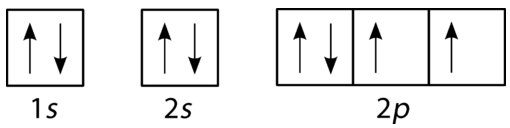
This orbital diagram represents:  
a)
C
b)
B
c)
N
d)
O
50.
a)

14

b)

4

c)

3

d)

28

51.
a)

10

b)

2

c)

8

d)

18

52.
How many valence electrons are represented here?
a)
7
b)
5
c)
2
d)
8
53.

The total number of waves produced in one second is called the ________ of the wave.

a)

Vibration

b)

Echo

c)

Frequency

d)

Amplitude

54.

This image is an illustration of_______.

a)

Bohr model

b)

quantum mechanical model

c)

photoelectric effect

d)

Dalton's atomic theory

55.

A particle of light is called a...

a)

Photoelectron

b)

Photon

c)

Proton

d)

Electron

56.
Light behaves like both a particle and a ______.
a)
Mass
b)
Wave
c)
Current
57.
What does the letter 'h' represent in the formula E = hv?
a)
Planck's constant
b)
Hydrogen
c)
Energy
58.

The minimum amount of energy that can be lost or gained by an atom is

a)

a photon

b)

a quantum

c)

the photoelectric effect

d)

the speed of light

59.

What is the Aufbau principle?

a)

Within an energy level, s orbitals are the lowest energy, followed by p, d and then f. F orbitals are the highest energy for that level.

b)

The lower the principal quantum number (n) the lower the energy.

c)

All three.

d)

The Aufbau Principle states that electrons enter the lowest energy orbitals first.

60.

Identify the rule that is being violated

a)

Aufbau principle

b)

Hund's rule

c)

Pauli Exclusion principle

d)

Heisenberg uncertainty principle

61.

What is incorrect about this orbital diagram?

a)

Both arrows in the filled 2p box should be pointing the same direction

b)

There is nothing incorrect with this diagram

c)

In the there should only be 1 arrow in the first 2p box and one in the 2nd 2p box

d)

All the arrows should be pointing the same direction.

62.

Planck's constant value

a)

6.626×1034Js6.626\times10^{-34}Js  

b)

6.626×1034 Js6.626\times10^{34\ }Js  

63.

matter can gain or lose energy only in small, specific amounts called

a)

quanta

b)

atoms

c)

particles

64.

Electrons loses fixed amount of energy on the form of _________ wave packet.

a)

Quantum

b)

Discrete

c)

Atoms

d)

Particles

65.
What is the frequency of UV light that has an energy of 2.39 × 10 -18 J? 
a)
2.32 x 10Hz
b)
3.60 x 10¹⁵ Hz
c)
1.58 x 10-51 Hz
d)
3 x 10⁸  m/s
66.

The emission spectra is produced when

a)

electrons release energy as they move to their excited state.

b)

electrons absorb energy as they move to their excited state.

c)

electrons release energy as they return to the ground state.

d)

electrons absorb energy as they return to the ground state.

67.
What is the energy of light whose wavelength is 4.06 x 10⁻¹¹ m? 
a)
2.69 x 10-44 J
b)
1.63 x 10⁻²³ J
c)
4.90 x 10⁻¹⁵ J
d)
8.97 x 10-53 J
68.
An area of high probability of finding an electron 90% of the time is called a(n)
a)
nucleus
b)
sublevel
c)
orbital
d)
energy level
69.

What is the wavelength, in nm, of radiation which has an energy of 3.371 x 10⁻¹⁹ joules per photon?

a)

655.9 nm

b)

152.5 nm

c)

170.0 nm

d)

590.0 nm

e)

745.1 nm