
 Worksheets
22 - 23 DNA, Replication, & Cell Cycle
Total questions: 112
Worksheet time: 2hrs 47mins

What makes up the SIDES of a DNA ladder?
nitrogen bases
sugars & phosphates
genes & chromosomes
RNA

What makes up the rungs (steps) of a DNA ladder?
sugars & phosphates
nitrogen bases
sugars
genes & chromosomes

What SHAPE is DNA?
single strand
straight ladder
double helix (twisted ladder)
DNA has no shape

In DNA. what base always pairs with A?
A
T
C
G

If one strand of a DNA molecule has the following order of bases, what will be the correct order of bases on the complementary (matching) strand?
5'-AATTGGCC-3'
3'-AATTGGCC-5'
3'-TTAACCGG-5'
3'-GGCCAATT-5'
5'-TTAACCGG-3'

What is DNA made up of?
nucleotides
cytoplasm
RNA
cells
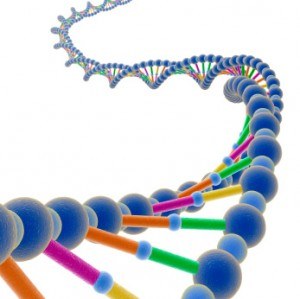
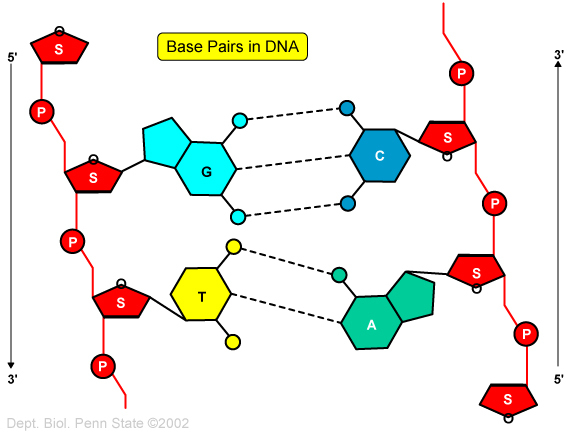

The picture below shows the steps of DNA replication beginning with step one and ending with step three.
Because you are reusing the old, or parent, DNA strand DNA replication is said to be
Semi- Conservative
Semi-discontinuous
Continuous
Fully-Conserveative

The picture below shows an enzyme unwinding and unzipping DNA.
What is the name of this enzyme?
DNA Helicase
DNA Ligase
DNA polyermase
RNA Polymerase
Which enzyme is responsible for adding the free nucleotides to the replicating DNA?
DNA Helicase
DNA Ligase
DNA polyermase
RNA Polymerase
hydrogen bond
Which of the following is NOT an important clue provided by Rosalind Franklin's Photo 51?
DNA is a helix shape
Nitrogen bases are on the inside of the molecule
There are 2 strands
Uracil is one of the nitrogen bases
What is the sequence of the bases in DNA most important for?
providing instructions for traits of an organism
allowing the DNA to condense
the accurate function of DNA polymerase
allowing it to be stored in the nucleus
Which sequence of DNA bases would pair with (complement) this partial strand
CAT TCA CTG
ATG TGA CAG
TAC ACT GTC
GTA AGT GAC
CAT TCA CTG
Which sequence of DNA bases would pair with (complement) this partial strand
CAT TCA CTG
ATG TGA CAG
TAC ACT GTC
GTA AGT GAC
CAT TCA CTG
Which of the following are the monomers of nucleic acids?
amino acids
nucleotides
fatty acids
polysaccharides

Which enzyme is responsible for adding complementary nucleotides during DNA replication?
Topoisomerase
DNA Polymerase
Ligase
Primase

Place the following steps of DNA Replication in sequential order
- DNA Recoils
- DNA Polymerase Adds Free complementary nucleotides
- DNA Helicase breaks Hydrogen bonds between nitrogen bases
1, 2, 3
2, 3, 1
3, 2,1


Which of the following are parts of a nucleotide?
- select all that apply
sugar
hydrogen bond
nitrogen base
phosphate group
The backbones or sides of a DNA molecule are comprised of alternating phosphate groups &
nitrogen bases
deoxyribose sugars
hydrogen bonds
atp
DNA Replication results in -
2 identical DNA molecules
2 complementary DNA molecules
1 DNA molecule
2 opposite DNA molecules
Who acquired photo 51?
Watson & Crick
Fraklin
Wilkins
Verchow
Which of the follow is NOT a clue about the structure of DNA that was gained from photo 51?
DNA is double stranded
DNA is a helix
bases are at the center of the molecule
DNA is made up of protein
What is the function of DNA
Quick energy
long term energy
transmit genetic information
build muscle
1. Suppose adenine made up 30% of the nitrogen bases in an organism. What percentage should be guanine in the DNA molecule?
30%
60%
40%
20%

The process of the cell cycle by which the material in the nucleus is divided equally between two new cells is called________
mitosis
cancer
spindle
centromere


The picture shows a cell in a phase of mitosis. What would be the next phase of mitosis?
Prophase
Metaphase
Anaphase
Telophase


Name the phase of mitosis:
Prophase
Metaphase
Anaphase
Telophase

Name the phase of mitosis:
Prophase
Metaphase
Anaphase
Telophase

Name the phase of mitosis:
Prophase
Metaphase
Anaphase
Telophase

Name the phase of mitosis:
Prophase
Metaphase
Anaphase
Telophase

Name the stages of mitosis in the correct order:
Metaphase, Anaphase, Prophase, Telophase
Prophase, Anaphase, Metaphase, Telophase
Prophase, Metaphase, Anaphase, Telophase
Anaphase, Prophase, Telophase, Metaphase
The division of the nucleus during the cell cycle is known as:
Synthesis
Mitosis
G1
G2
What is important about the S stage of interphase?
the cell grows
the nucleus divides
the cell membrane divides
the cell's DNA is replicated
If a human cell has 46 chromosomes before mitotic division, how many chromosomes will the daughter cells after mitosis.
12
23
46
92
Cells of organism will go through the cell cycle for which of the following purposes?
growth
repair of damaged cells
replacement of dying cells.
All of the above
Put the following stages of the cell cycle in order: G2, G1, S, mitosis, cytokinesis.
G1, G2, S, Mitosis, cytokinesis
G1, S, G2, Mitosis, cytokinesis
G1, G2, S, cytokinesis, mitosis
G1, S, G2, cytokinesis, mitosis
Put the following actions of the cell cycle in order: DNA replicates, cell grows, cell divides, cell prepares for mitosis.
DNA replicates, cell grows, cell prepares for mitosis, cell divides
cell grows, cell prepares for mitosis, DNA replicates, cell divides
cell grows, DNA replicates, cell prepares for mitosis, cell divides
DNA replicates, cell prepares for mitosis, cell grows, cell divides

Which of the following is NOT a reason we need mitosis.
Growth
Recovering from injuries
Replacement of dead cells
Sexual Reproduction and genetic variation
The purpose of mitosis, as a stage of the cell cycle, is to separate the two sets of DNA created during replication and --
redirect the expression of genes
discard the unwanted genes
place them into two separated nuclei
mutate them into new sequences
A chromosome may appear to have a structure that looks like an "X" but it is actually a set of sister _________ duplicated during the S phase that are held together by a ______________.
nuclei, centrosome
chromatids, centromere
daughter cells, nucleotide
centromeres, chromatid

The cell pictured still has its nucleus in tact and no chromosomes have condensed or become visible. Identify this stage of the Cell Cycle.
Prophase
Interphase
Anaphase
Telophase

CAT TCA CTG

What are the three components of a nucleotide?
sugar, hydrogen, nitrogen base
sugar, oxygen, nitrogen base
sugar, phosphate, nitrogen base
sugar, phosphate, protein

What part of the cell cycle is considered interphase? Select all that apply.
G1
G2
S
M
Which statement is NOT true about interphase?
It's the longest phase of the cell cycle
During interphase organelles duplicate
During interphase, DNA replicates
During interphase, the chromatin condenses into chromosomes.

What is this picture of?
Chromosomes
Chromatids
Chromatin
Centromeres
Which phase of the cell cycle will you find chromatin? Select all that apply.
Interphase
Prophase
Metaphase
Telophase
Cytokinesis


Why do cells go through the cell cycle?
growth
repair
reproduction
All of the above
True or False: Mitosis occurs for all cells somatic and gamete (sex) cells.
True
False
Unlike normal cells, cancer cells never leave the cell cycle to rest in G0. Because of this, cancer cells...
(select all of the correct answers)
never complete the cell cycle
repeat the cell cycle continuously
divide more often than normal cells
stop at every checkpoint

Which cell type would possibly be affected by cancer treatments like chemotherapy?
skin cell
red blood cell
liver cell
intestinal lining
If a somatic cell from a cat that contains 38 chromosomes completes the cell cycle, how many chromosomes will be in each daughter cell?
(a)
What is the purpose of checkpoints in the cell cycle?
to make sure each phase has been completed accurately
to make sure the DNA condenses before the mitotic phase
to make sure the cytoplasm is present
to make sure the cell gets rest

Which phase does the cell spend most of its time in?
mitotic phase
G1
interphase
cytokinesis
What is the process that ensures that irreparable cells will not divide?
apoptosis
replicating
cyclin
________________is a critical point where stop and go signals can regulate the cycle
Metastasis
Checkpoint
Malignant
Benign
Cancerous cells have a higher mitotic index than normal cells.
True
False

Somatic Cells are
Body Cells
Sex Cells
not part of an organism
only found in plants

