
Font size
 Worksheets
Earth Layers and Plate Tectonics Review Game 10.28.22
Total questions: 42
Worksheet time: 1hrs 3mins
Which sections of the Red Textbook did you finish? (Check all that apply)
Ch. 7 Section 1 (Inside the Earth)
Ch. 7 Section 2 (Restless Continents)
Ch. 7 Section 3 (The Theory of Plate Tectonics)
What textbook pages? I'm confused!!!!
I can play this game as many times as I want to get the best score possible.
True
False


Layer 3 is the Earth's ______


A force caused the continents to drift apart over time. Once scientists figured out what that force was, the theory of plate tectonics was born! The image above shows what Geologists think the Earth looks like millions of years ago. What name was given to this landmass?
Plate Tectonics
Oceana
Pangea
North America
Huge pieces of lithosphere that slowly move on the asthenosphere and consist of the crust and the rigid, uppermost part of the mantle
tectonic plates
North American Plate
Eurasian Plate
African Plate

What was Alfred Wegener's theory called?
one earth
jigsaw puzzle moves
continental drift
none of the above
What 2 pieces of evidence are there for continental drift?
continents fit like a jigsaw puzzle and fossil record
similar mountain ranges around the world, one plant species on all continents
gold and diamond deposits on all continents
none of the above

What was the name of the theory given to how the Earth is broken into pieces that are slowly moving?
Slow mover theory
Flow theory
Crackle theory
Plate tectonic theory
the crust nearest the ridges near sea floor spreading is the :
oldest
youngest
most dense
least dense

Under sea mountain ranges are called:
deep sea trench
aquatic ranges
mid-ocean ridges
salty hills

This type of boundary occurs when tectonic plate move together.
covergent
divergent
transform
none of the above

This is the type of boundary that occurs when tectonic plates move apart.
convergent
divergent
transform
none of the above

This type of boundary occurs when tectonic plates slide past one another.
convergent
divergent
transform
none of the above
Which of the following is found mainly around transform boundaries?
mountains
earthquakes
volcanoes
rift valley

When one piece of crust gets pushed under another one, it called:
radial fracture
lingering
subduction
leverage
When two continental crusts slam into each other which of the following is the prominent feature formed?
mountains
earthquakes
volcanoes
rift valley

The theory of plate tectonics is based on hot magma rising and cool magma sinking. This cycle is called:
subduction
convection
hot pockets
radial fracture

bivergent
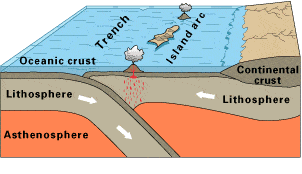
Observe this diagram of a plate boundary. One statement BEST describes what is happening. It is that
the denser ceanic crust is subducting under the less dense oceanic crust
volcanic islands are forming.
the tectonic plates are moving away from each other.

What is the correct order (starting from the surface) of Earth’s layers?
crust, outer core, inner core, mantle
mantle, outer core, inner core, crust
crust, mantle, outer core, inner core
The San Andreas Fault in California is known as an active earthquake area. What type of boundary is it?
Converging
Diverging
Transform
How does fossil evidence support Wegener's hypothesis of continental drift?
Similar fossils are found along continental margins that appear to join together.
Fossils are found in areas where the present-day climate could not have supported the organisms that made the fossils.
Similar fossils of giant, land-dwelling dinosaurs are found on continents separated by oceans.
All of the answers here are correct
A break in the earth's crust
Earthquake
Fault
Tectonic plates



