
NEW
Font size
 Worksheets
Year 10 Revision
Total questions: 60
Worksheet time: 41mins
Which term describes the different forms of a gene
Chromosome
Allele
DNA
Punnett Squares
Aa, DD, Bb, yy are all examples of _______
genotypes
phenotypes
Where is the majority of DNA stored within a cell?
Chloroplast
Cell wall
Cell membrane
Nucleus
Only takes 1 in a gene pair for a trait to show up
recessive genes
DNA
offspring
dominant genes

All of the following are homozygous genotypes except:
RR
Ss
tt
UU

Which of the following is a phenotype?
Homozygous dominant purple
Pp
pp
purple

If red eye color (R) in fruit flies is dominant to white eye color (r), predict the phenotype of an offspring which has a genotype of rr.
Red Eye
White Eye
Homozygous recessive white-eyed fly
Homozygous dominant white-eyed fly
A dominant trait is usually represented with a capital letter.
TRUE
FALSE

Consider this: Free earlobe is represented by capital letter E. Attached earlobe is represented by small letter e. Which of the them is a recessive trait?
free earlobe
attached earlobe
neither of the two
both
When HUMANS select or choose a plant or animal for breeding based on a desired trait
natural selection
artificial selection
Parts of the body that are similar to other species because they have a common ancestor
fossil record
homologous structures
embryology
Shows how different groups of organisms have changed over time.
fossil record
homologous structures
embryology
Body part you have that use to have a purpose but now has little or no function
vestigial organ
embryology
homologous structures
Scientist that contributed the most to our understanding of evolution
Darwin
Lamarck
Organisms with the best suited adaptations for their environment are more likely to survive and reproduce than organisms that are not very well adapted
natural selection
artificial selection
creationism
The more offspring an organism has the greater the odds that a few of them will survive, reproduce and pass on those traits
overproduction
variation
selection
adaptation
a trait that gives an organism an advantage in their particular environment
overproduction
adaptation
selection
variation
a trait that gives an organism an advantage in their particular environment
overproduction
adaptation
selection
variation
Species not closely related evolve similar traits due to their similar environment
Convergent evolution
divergent evolution
parallel evolution
Species from the same ancestor accumulate differences over time
convergent evolution
divergent evolution
parallel evolution
This occur because of the several mutagens like ultraviolet radiation and hazardous chemicals in the environment that can affect genes and chromosomes.
Speciation
Evolution
Mutation
The variable that is being measured or observed is called the _______________. Hint: this is the variable that is the result or effect
independent variable
dependent variable
control variable
The independent variable is
The variable that you change in an investigation
The variable that you measure in an investigation
A variable that you keep the same in an investigation
The process of obtaining information by using the senses is called a/an
Conclusion
Observation
Inquiry
Scientific method
Ben makes five paper helicopters with different wing lengths. He drops them the same way from a height of two meters for five trials each. He records the amount of time it takes for each helicopter to fall to the ground.
What is the dependent variable?
Dropping the same way
Wing Length
Amount of time it takes the helicopter to hit the floor
Dropping from the same height
Ben makes five paper helicopters with different wing lengths. He drops them the same way from a height of two meters for five trials each. He records the amount of time it takes for each helicopter to fall to the ground.
What is the independent variable?
Dropping the same way
Wing Length
Amount of time it takes the helicopter to hit the floor
Dropping from the same height
What is the chemical symbol for iron?
I
Ir
Fe
R
What is iron's atomic number?
12
26
55.85
55
Titanium is in group 4. What period is it in?
2
3
4
5
What element is the chemical symbol Au?
gold
silver
Augium
Auxiom
What is silver's chemical symbol?
S
Ag
Si
I
What is silver's chemical symbol?
S
Ag
Si
I
What is calcium's atomic number?
20
21
22
23

DNA is an acronym for _____
Diphosphorus Nucleic Acid
Ribose Nucleic Acid
Deoxyribonucleic Acid
Deoxyribonucleic Acetate

A nucleotide is composed of
A phosphate, sugar and nitrogenous base
A protein, protein and Guanine
A phosphate, Adenine, and nitrogenous base
A protein, Adenine and nitrogenous base

Which of the following is a base pair?
Adenine - Cytosine
Cytosine - Thymine
Deoxyribose - Cytosine
Cytosine - Guanine


The physical appearance of an organism based on traits
Genotype
Phenotype
Meiosis
Genetics
The genotypes codes for
phenotype (physical trait)
DNA
allele
Having two of the SAME alleles for a trait.
Recessive Trait
Homozygous
Genotype
Trait of an organism that can be HIDDEN by the dominant form of a trait.
Recessive Trait
Phenotype
Allele
Having two DIFFERENT alleles for a trait.
Recessive Trait
Heterozygous
Genotype
The trait that overshadows and is expressed.
Dominant Trait
Phenotype
Allele

T - tall and t = short
In the Punnett square, what belongs in the missing square?
tt
Tt
TT

B = brown fur b = white fur
In the punnett square, what is the probability for white fur?
0%
25%
50%
75%
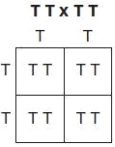
What is ratio of the offspring from the cross shown will be homozygous recessive for the trait of tallness? T = tall t = short
0 in 4
1 in 4
2 in 4
4 in 4



