
 Worksheets
Year 11 Organic Chemistry Review
Total questions: 124
Worksheet time: 1hrs 14mins
Green chemistry is regarded as a reduction process. Which of the following aspects are the targets of reduction?
(1) Cost of production
(2) Use of catalyst
(3) Risk and hazard
(1) and (2) only
(1) and (3) only
(2) and (3) only
(1), (2) and (3)
Which of the following types of reaction has the greatest value of atom economy?
Substituition
Addition
Elimination
Condensation
Which of the following substances is NOT a volatile organic compound?
Benzene
Trichloromethane
Carbon Dioxide
Methane
Green chemists reduce risk by?
Reducing the hazard inherent in a chemical product or process
Minimizing the use of all chemicals
Inventing technologies that will clean up toxic sites
Developing recycled products
Which of the following are among the 12 Principles of Green Chemistry?
Design commercially viable products
Use only new solvents
Use catalysts, not stoichiometric reagents
Re-use

Identify the Functional Group

Identify the Functional Group
Are hydrocarbons soluble in water
Yes
No

Identify the Isomer

Identify the Isomer
What is a functional group?
Group of atoms that give specific characteristics to a molecule
Group of molecules that give specific characteristics to an atom
Group of molecules that make up a group of atoms
Group of atoms that give specific characteristics to an element

What functional group is present on the molecule?
Alcohol
Carboxyl
Methyl
Carbonyl Aldehyde


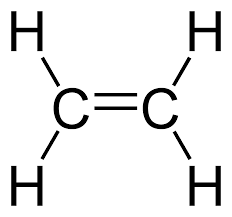
Classify the compound based on the functional group present.
alkane
alkene
alkyne



Select the carboxylic acid functional group


Name this compound.
Butanol
Butene
Oxybutanol
Butanoic acid

Name this compound.
Propane
Bropane
Propane(Br)
bromo-2-propane
The suffix for an alcohol
(a)
The suffix for a carboxylic acid
(a)
The suffix for a double bond
(a)
The suffix for a triple bond
(a)

What is the name for this compound?
4 - propylnonane
4 - ethylnonane
4 - propyloctane
4 - ethyloctane

What is the IUPAC nomenclature of this structure?
3,4,5,6-tetramethylheptane
2-methyl-3-methyl-4-methyl-5-methylheptane
2,3,4,5-tetramethylcycloheptane
2,3,4,5-tetramethylheptane

Given the formula representing a compound:
Which formula represents an isomer of this compound?


Name the following hydrocarbon:
3,4-diethylheptane
2,4-diethylheptane
3,3-dimethylheptane

Name the following hydrocarbon:
4,4-diethyl-5,6-dimethylheptane
4,4-diethyl-2,6-dimethylhexane
4,4-diethyl-2,3-dimethylheptane

Name the following hydrocarbon:
3,3,4-triethylhexane
2,3,4-trimethylhexane
2,4-dimethylheptane
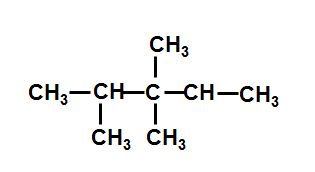
Which is the structures with IUPAC nomenclature
2,2,4-trimethylpentane
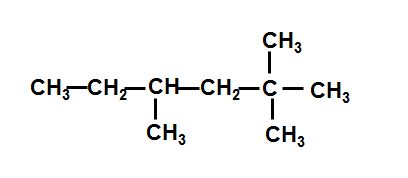
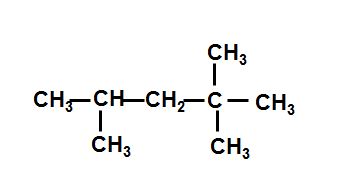
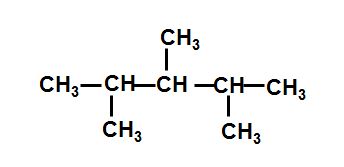
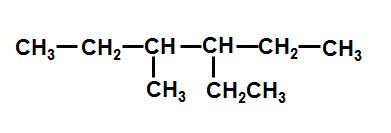
Give the IUPAC name for this compound
3-methyl-4-ethylhexane
3-ethyl-4-methylhexane
3-methyl-4-ethylheptane
3-ethyl-4-methylheptane
2,2-dimethyloctane
2-methylbutane
1-methylpropane
1-methylpentane
Which of the following is an acceptable IUPAC name?
2-ethyl-1-methylcyclopentane
1-ethyl-2-methylcyclopentane
2-methyl-1-ethylcyclopentane
1-methyl-2-ethylcyclopentane
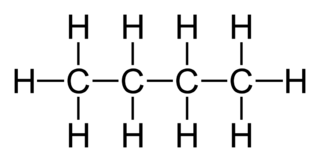
Which of the following is 1-bromopropane?


What is the name of this haloalkane?
1-chlorobutane
2-chlorobutane
1-chloropropane
2-chloropropane
Which of the following is NOT 1 chloropropane?


Which is 3-chloro-2,2-dimethylbutane?


Name this haloalkane:
1,1-difluoropropane
1-difluoropropane
1-fluorobutane
difluorobutane
Which of the following is 1,2-dibromopropane?


Name this haloalkane:
bichloromethane
dichloromethane
dichloroethane
dihydride-dichloro methane

Name this compound...
methane
methene
methanol
methoxymethane
Which one of these is a secondary alcohol?
Butan-1,4-diol
2-methylpropan-2-ol
Pentan-2-ol
Pentan-1-ol

Give IUPAC name for the structure above.
tert - butylalcohol
1,1 - dimethylethanol
2 - methyl - 2 - propanol
The products of the reaction of a carboxylic acid and an alcohol would be
Ketone and water
Amide and water
Acid chloride and water
Ester and water
Which of these molecules are named ethanoic acid


What is the suffix for carboxylic acids?
-ic acid
-oic acid
-oic
HCOOH
Which is the correct order of boiling points of carboxylic acids, from the lowest to the highest?
methanoic acid, ethanoic acid, butanoic acid, propanoic acid
methanoic acid, propanic acid, butanoic acid, ethanoic acid
methanoic acid, ethanoic acid, propanoic acid, butanoic acid
ethanoic acid, methanoic acid, propanoic acid, butanoic acid

Which two functional groups are present?
two alcohols
aromatic and amine
ketone and ester
carboxylic acid and alcohol
Vinegar tastes sour because of
Ethanoic acid
Ethanol
Butanoic acid
Ethyl ethanoate
Esters are formed through what type of reaction?
hydrolysis
condensation
hydration
dehydration

Name this compound
propanol
propanoic acid
butanoic acid
butanol


Esters are known for......
the bright colours
flammability
exploding
fruity smell
When detecting the odour of a chemical you should...
put your nose over the chemical and take a deep breath
use your hand to fan the odour towards your nose.
What catalyst is used in making esters?
sodium hydroxide
iron
sulfuric acid
lithium oxide

What is this compound called?
propyl ethanoate
ethyl ethanoate
ethyl propanoate
methyl ethanoate

The functional groups shown from left to right are
hydroxyl, carboxyl, ester
carboxyl, hydroxyl, ester
ester, carboxyl, hydroxyl
hydroxyl, ester, carboxyl

Which reagents would you use to make the following molecule?
methanol and propanoic acid
methanoic acid and butanol
methanol and butanoic acid
methanol acid and propanol

The name of the ester shown is
ethyl pentanoate
pentyl ethanoate
methyl hexanoate
hexyl methanoate
The number of carbon atoms in propyl butanoate is
3
4
7
6

The ester shown can be made by reacting
ethanol and propanol.
ethanoic acid and propanoic acid.
ethanol and propanoic acid.
propanol and ethanoic acid.
Compounds that are composed of the same number and type of atoms but have them arranged in different ways are ___________.
isomers
isotopes
polymers
alkanes
How many structural isomers exist for hexane
three
two
five
four
A structural isomer of pentane is?
2,2-dimethyl butane
2-methyl butane
1-methyl propane
1-methyl pentane
Given the formula representing a compound:
Which formula represents an isomer of this compound?
Which compound is an isomer of C2H5OC2H5?
CH3COOH
C2H5COOCH3
C3H7COCH3
C4H9OH
Which formulas represent compounds that are isomers of each other?


Given a formula representing a compound:Which formula represents an isomer of this compound?


Given the structural formulas:
Which two formulas represent compounds that are isomers of each other?
A and B
A and C
B and D
C and D
Which pair of compounds are isomers?
NO2 and N2O4
P2O5 and P4O10
HCOOH and CH3COOH
CH3OCH3 and C2H5OH

What is fractional distillation?
a process used to separate crude oil
a process used to burn up fuels
a way to make different products
how oil is extracted from the ground
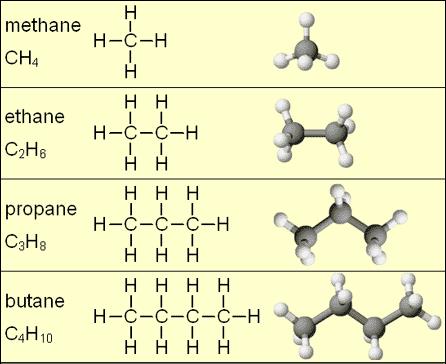
Which of these substances is not a hydrocarbon?
methane
ethane
propane
butane
ammonia
Fractional distillation separates crude oil based on the different __________ of the molecules in the mixture
melting point
boiling point
freezing point
chemical reactivity
A fraction of crude oil is made up of:
Hydrocarbons of similar chain lengths
Numbers
Large hydrocarbons
Alkenes only
Crude oil is made up of:
Ethane
Butane
A mixture of different hydrocarbons
Extremely large hydrocarbons which are broken up once extracted
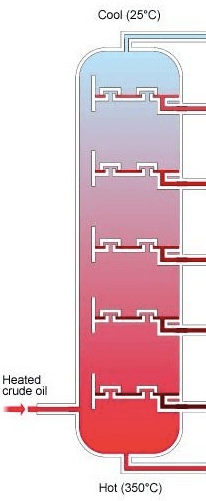
What process happens at each level in the fractionating column?
Evaporation
Condensation
Combustion
What process happens as the crude oil enters the fractionating column?
Evaporation
Condensation
Combustion

Where do short chain hydrocarbons collect?
At the top
In the middle
At the bottom

Where do long chain hydrocarbons collect?
At the top
In the middle
At the bottom
Shorter hydrocarbons have:
Higher boiling points
Lower boiling points
What is the most important feature in fractional distillation?
The two component part must have different boiling point
The two component part must have similar boiling point
The two component part must have same boiling point
When you heat up the chemical compound, they will both evaporate at the same time.
True
Maybe
I don’t know
False
Why do we need to create a open space between the condenser and the beaker with distillate?
To prevent low pressure to form
To prevent the pure water not dropping into the beaker
To prevent high pressure to form
To prevent a fire accident happen
Gasoline and many other chemicals are produced from____ using fractional distillation.
Oil
Crude Oil
Crude Water
Dirty Water
What makes the solution easy to separate?
Difference of boiling point more than 25 degrees
Difference of boiling point exactly 25 degrees
The boiling point is different
Difference of boiling point less than 25 degrees
Crude oil is made up of:
Ethane
Butane
A mixture of different hydrocarbons
Extremely large hydrocarbons which are broken up once extracted
A fraction of crude oil is made up of:
Hydrocarbons of similar chain lengths
Numbers
Large hydrocarbons
Alkenes only
Different fractions in crude oil are separated by:
Cracking
Fractional Distillation
Filtration
Crystalisation
Gases/LPG are used for:
Fuel in cars
Fuel for large ships
Roof and road surfacing
Domestic heating and cooking
Petrol is used for:
Fuel in cars
Fuel in aircraft
Domestic heating and cooking
Road surfacing
Kerosene (paraffin) is used for:
Fuel for cars
Domestic heating and cooking
Fuel in aircraft
Fuel for large ships and in power stations
Diesel oil is used for:
Fuel in cars
Fuel in aircraft
Road and roof surfacing
Fuel in some cars and larger vehicles
Fuel oil is used for:
Fuel in some cars and larger vehicles
Fuel for large ships and in some power stations
Roof and road surfacing
Fuel for cars
Bitumen is used for:
Fuel for large ships and in some power stations
Roof and road surfacing
Fuel in aircraft
Fuel in cars

fuel + oxygen -->
water + ________ __________
Macromolecules are made of repeating subunits called
monomers
monosaccharides
polymers
polysaccharides
A __________ consists of many monomers bonded together.
monomer
hydrocarbon
peptide
polymer

What is the name of the addition polymer?
poly(bromoethane)
poly(bromoethene)
poly(bromoethanol)

What is the name of the addition polymer?
poly(ethene)
poly(propene)
poly(butene)

What is the name of the addition polymer?
poly(fluoroethene)
poly(difluoroethene)
poly(tetrafluoroethene)

Identify the type of polymer involved
addition polymer
polyester
polyamide

Identify the polymer made from these monomer(s)


Identify the polymer made from these monomer(s)


Which alkene is used to prepare the polymer shown?
tetrafluoroethene
1,1,2,2-tetrafluoroethane
1, 2-difluoroethene

