
Font size
 Worksheets
Mineralogy
Total questions: 71
Worksheet time: 1hrs 8mins
What are the characteristics of Silicates?
Contains a combination of silicon and oxygen.
Makes up 96% of the earth's crust
Contains Carbonate (CO3)
Component of concrete and fireworks
Contains chlorine or fluorine combines with potassium or calcium
Used in salt, detergents, and fertilizer
Not combined with other elements
Used in precious gems and electronics
What are the characteristics of Carbonates?
Contains a combination of silicon and oxygen
Most common type
Makes up 96% of the earth's crust
Contains Carbonate (CO3)
Component of concrete and fireworks
Contains chlorine or fluorine combines with potassium or calcium
Used in salt, detergents, and fertilizer
Not combined with other elements
Used in precious gems and electronics
What are the characteristics of Native Elements?
Contains a combination of silicon and oxygen
Most common type
Makes up 96% of the earth's crust
Contains Carbonate (CO3)
Component of concrete and fireworks
Contains chlorine or fluorine combines with potassium or calcium
Used in salt, detergents, and fertilizer
Not combined with other elements
Used in precious gems and electronics
What are the characteristics of Oxides?
Contains oxygen and elements other than silicon
Used in abrasives
Contains a sulfate group (SO4)
Used for drywall, makeup, paint, and toothpaste
Consists of one or more elements combined with sulfur
Used in batteries and medicine
What are the characteristics of Sulfates?
Contains oxygen and elements other than silicon
Used in abrasives
Contains a sulfate group (SO4)
Used for drywall, makeup, paint, and toothpaste
Consists of one or more elements combined with sulfur
Used in batteries and medicine
What are the characteristics of Sulfides?
Contains oxygen and elements other than silicon
Used in abrasives
Contains a sulfate group (SO4)
Used for drywall, makeup, paint, and toothpaste
Consists of one or more elements combined with sulfur
Used in batteries and medicine
What are the physical properties of Luster?
The way a mineral reflects light
Tendency of a mineral to split along specific planes of weakness to form smooth, flat surfaces/Manner in which a mineral breaks along either curved or irregular surfaces
Ability to resist scratching
Color of a mineral in powder form (streak plate is used)
What are the physical properties of Cleavage/Fracture?
Tendency of a mineral to split along specific planes of weakness to form smooth, flat surfaces/Manner in which a mineral breaks along either curved or irregular surfaces
Ability to resist scratching
Often and unreliable identification clue
Color of a mineral in powder form (streak plate is used)
What are the physical properties of Hardness?
The way a mineral reflects light
Tendency of a mineral to split along specific planes of weakness to form smooth, flat surfaces/Manner in which a mineral breaks along either curved or irregular surfaces
Ability to resist scratching
Color of a mineral in powder form (streak plate is used)
What are the physical properties of Color?
The way a mineral reflects light
Tendency of a mineral to split along specific planes of weakness to form smooth, flat surfaces/Manner in which a mineral breaks along either curved or irregular surfaces
Ability to resist scratching
Often and unreliable identification clue
What are the physical properties of Streak?
Tendency of a mineral to split along specific planes of weakness to form smooth, flat surfaces/Manner in which a mineral breaks along either curved or irregular surfaces
Ability to resist scratching
Often and unreliable identification clue
Color of a mineral in powder form (streak plate is used)
What is an example of Magnetism?
Light entering minerals with low crystal symmetry is broken into two rays. The two rays are polarized so that the light in each vibrates in a direction at right angles to the other
Strong attraction to magnetic fields. This property is exhibited in few minerals, notably Magnetite and Pyrrhotite.
What is a mineral?
A mineral is a pure substance that is solid and has a specific gravity greater than 1 g/cm3
A mineral is a crystalline substance in which atoms are arranged in a regularly repeating and orderly pattern (symmetry).
A mineral is a naturally occurring compound found deep in the Earth's crust

What is the chemical formula for quartz
Fe2O3
SiO2
(Fe,Mn)AlSiO3
CaCO3

Mica Group (muscovite and biotite) are _________ silicates.
Framework
Sheet
Single Chain
Isolated

The basic building block for all silicate minerals is ____
Oxygen
Silicon
Silica Tetrahedron (SiO4)
Iron

___ T or F. Rocks made of several different minerals are also considered minerals
True
False
To be classified as a mineral, which of the following conditions must satisfied (check all that apply)
It must be the byproduct of an organism.
It cannot be synthetic
(made by people)
It must have a solid crystalline structure
It must have a definite chemical composition.
__ T or F. Ice can be a mineral
True
False

Is cement a mineral?
Yes
No

Which or the following is are metallic minerals
(Check all that qualify)
Galena
Magnetite
Gypsum
Diamond
Minerals that crystalized from ions dissolved in water,
whether in marine or freshwater environments, are called _________.
Feldspars
Pyroxenes
Basalts
Evaporites
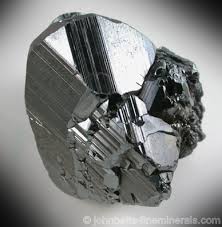
The mineral pictured has this optical feature of light reflecting off of its surface. What is this called?
Dull/earthy luster
Glassy luster
Metallic luster
Cubic crystal form
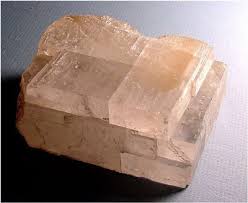
The mineral pictured is halite, table salt, NaCl. This mineral breaks along THREE (3) flat surfaces that reflect light in a consistent way. The three surfaces are called:
fractures
crystal form
luster
cleavage planes
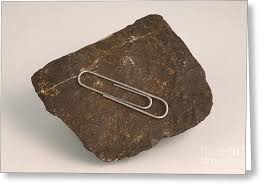
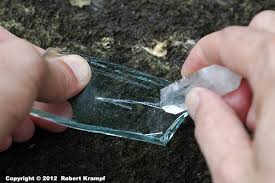

What is the relationship between a rock and a mineral?
Rocks are made up of minerals.
Minerals are made up of rocks.
Rocks are on the Earth's surface. Minerals are found underground.
Rocks and minerals are different names for the same thing.

The mineral pictured is halite (table salt), NaCl. It has three planes of cleavage that intersect at right angles. What is its crystal form/habit?
Rhombohedral
Cubic
Square
Intersecting angles at non-90o

Which minerals would all scratch apatite?
diamond, topaz, quartz
quartz, calcite, gypsum
fluorite, talc, calcite
diamond, fluorite, corundum

Each of the minerals pictured are Quartz (SiO2). Why does quartz come in many different colors?
Due to impurities (other elements) in the crystal structure
SiO2 can be all of those colors
Quartz is made of a bunch of different minerals
Quartz is many different minerals

When a mineral 'fractures', what does it lead to?
cleavage along planes
cleavage along 3 planes at 90o
breaking along a clean/smooth surface that reflects like consistently
irregular breaking patterns (no cleavage planes at all)

The mineral pictured is pyrite (fool's gold).
The image shows what mineral property?
2 cleavage planes that intersect at non-90o
cubic crystal form/habit
non-metallic luster
fractures irregularly

A mineral in its powdered form when rubbed along a harder surface (ex. porcelain plate) is called:
luster
hardness
cleavage
streak

Glass breaks in this specific way called:
Fracture
Conchoidal fracture
Glassy texture
Cleavage planes

What habit (crystal shape) does galena have?
cubic
oval
triangular
flaky

Is a mineral's streak always the same color as its outward appearance?
Yes
No
Which mineral fits the following description:
Metallic luster and cleavage planes


Which mineral fits the following description:
Fractures and is a color due to oxidation (rust) of iron
Which mineral is described?
This mineral has a single plane of cleavage


Which mineral fits the following description?
It has three (3) planes of cleavage at non-90o


If a mineral scratched a piece of glass the mineral's hardness would be...
5.5
<5.5
>5.5
>6.5

Check all that apply to this mineral
has metallic luster
has non-metallic luster
has cleavage
has fracture
Which mineral is a feldspar (orthoclase), is felsic, and has two cleavage planes that intersect at 90o?
This mineral is VERY COMMON in the Earth's crust.


If you could NOT scratch a mineral with a steel nail, the hardness would be...
<6.5
>6.5
6.5
6.8
Which mineral fits the following description?
It has three (3) planes of cleavage at 90o
Silicate mineral MUST contain Silicon (Si) and ______________.
Oxygen
Aluminium
Carbon
Hydrogen


This mineral group consists of minerals that contain BOTH silicon and oxygen.
*It is by far the most common type of minerals found in the Earth's crust.
Halides
Oxides
Sulfates
Silicates
What do we call the study of minerals?
Gemology
Mineralogy
Geology
Lithology

An element is a ___ that cannot be separated into simpler substances by physical or chemical means.
pure substance
mixture
solution
compound

Which of the following would be the best description of the mineral property called luster?
A minerals resistance to being scratched.
The color a mineral gives off.
How a mineral reflects light.
Observing the color of the powder left behind when scraping across a surface.

True or False: Hardness describes a mineral's ability to resist scratching.
True
False


The color of a mineral depends upon its.....
Atomic structure
Outer surface
Composition
Atomic structure and composition
The scale of hardness is?
Ritcher
Mohs
Ohm
Mho
Quartz shows which luster?
Metallic
Vitreous
Pearly
Resinous
It is the hardest known mineral.
Corundum
Topaz
Diamond
Quartz

Which of the following minerals can be scratched by a copper coin?
Orthoclase
Calcite
Corundum
Diamond

A Solid Substance with crystal structure that is formed by geological processes and not by living things.
Luster
Hardness
Fracture
Mineral

The pattern of how the particles of a mineral are arranged
Streak
Fracture
Crystal Structure
Cleavage

The color of a mineral as a powder.
Fracture
Color
Streak
Cleavage
The appearance of a mineral in reflected or transmitted light.
Streak
Color
Hardness
Fracture

The Ability to resist being Scratched
Hardness
Color
Streak
Fracture
The pattern of how the particles of a mineral are arranged
Streak
Fracture
Crystal Structure
Cleavage
This mineral is used to preserve and season food. It is the mineral name for salt.
magnetite
graphite
gypsum
halite
Which mineral is easily identified by smell?
graphite
galena
halite
sulfur
What equipment would you need to do a mineral streak test?
a long pointed iron rod
a rough white ceramic tile
a disposable sample of talc
a low powered microscope
In order to be classified as a mineral a substance must be
man-made
organic
able to be scratched by a penny
naturally occurring
What is the number of the most easily scratched mineral on the Mohs Hardness Scale?
1
4
7
10

