
 Worksheets
Mock Paper 2
Total questions: 60
Worksheet time: 57mins
Putting a glowing splint into a tube of gas and seeing the splint re-light is the test for which gas?
Holding damp litmus paper in a tube of the gas and seeing it bleach white is the test for which gas?
Adding nitric acid and silver nitrate is the test for which type of ion?
Adding hydrochloric acid and barium chloride is the test for which type of ion?
What colour would calcium go in the flame test?
Purple
Green
Yellow
Red
What colour would potassium go in the flame test?
Purple
Green
Yellow
Red
What colour would copper go in the flame test?
Purple
Green
Yellow
Red
What colour would a bromide ion go when tested using silver nitrate and nitric acid?
White
Cream
Yellow
How do you distinguish between aluminium and calcium in the precipitate test?
Add excess sodium hydroxide
Add two drops of sodium hydroxide
Add excess hydrochloric acid
Heat
Which type of ion is tested for using the flame test?
Anion
Cation
What colour does copper turn when sodium hydroxide is added?
Blue
Green
Purple
Brown
What can be added to a carbonate to produce carbon dioxide?
Any acid
Any alkali
Sulphuric acid
Sodium Hydroxide
What colour precipitate would be formed when a sulphate is present, if hydrochloric acid and barium chloride are added?
Colourless
White
Blue
Green
What is the formula of a hydroxide ion?
H+
H-
OH-
OH+
What is a hydrocarbon?
A compound that contains Hydrogen and carbon
A compound that contains Hydrogen and carbon only
A fuel that contains hydrogen and carbon
A misture of Carbon and water
What does the following sentence describe:
A compound in which there are only single bonds between the atoms in the molecule
Saturated compound
Polar compound
Flamable compound
Aromatic compound

Name this molecule
Methane
Ethane
Propane
Butane
This molecule is an example of
A saturated compound
An unsaturated compound
A molecule with hydrogen bonds
A molecule with a very low octane number
Which of the following is the general formula for the alkanes
CnH2n+2
CnH2n
CnHn
CH4
As the chain length of an alkane increases, the boiling point.....
Increases
Decreases
Is not affected

The molecules in the example are examples of
Isomers
Isotopes
Alkenes
Alkynes

The molecule shown is an isomer of:
Butane
Butene
Propene
Propane
Ethene is tested for unsaturation using:
Bromine water
Litmus
Concentrated sulphuric acidSulphuric
A lit splint

The image shows Fractional distillation but which of the following is a use of Naphta:
Fuel for shipping
Jet fuel
Creation of plastics
Lubrication
The image shows Fractional distillation but which of the following is a use of kerosine:
Fuel for shipping
Jet fuel
Creation of plastics
Lubrication
This reaction produces Carbon Dioxide & Water.
Combustion
Esterfication
Single Replacement
Substitution
The process that is used to produce alcohol.
Esterification
Fermentation
Saponification
Condensation Polymerization

What type of reaction is represent by the following equation?
Condensation Polymerization
Addition Polymerization
Esterification
Saponification
Several molecules of propene, C3H6, combine to form a single large molecule. The process is an example of
polymerization
substitution
saponification
fermentation
Esterification is a reaction of an acid with
alcohol
water
ester
base

Why does a higher temperature increase the rate of a reaction?
it increases both the frequency and energy of particle collisions
it only increases the frequency of particle collisions
it only increases the energy of particle collisions
it reduces the activation energy of the reaction
Grinding a effervescent tablet into powder increases the rate of reaction due to increased
concentration
surface area
temperature
reactants
Adding a catalyst ___________ the activation energy.
Raises
Lowers
Doesn't affect
Inreases
The minimum amount of energy needed for colliding particles to react is called
Chemical Energy
Kinetic Energy
Activation Energy
Potential Energy
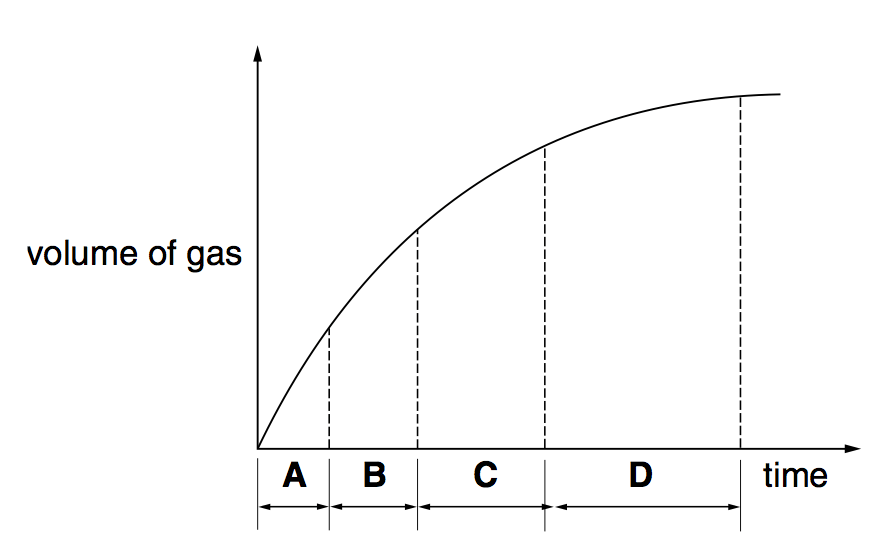
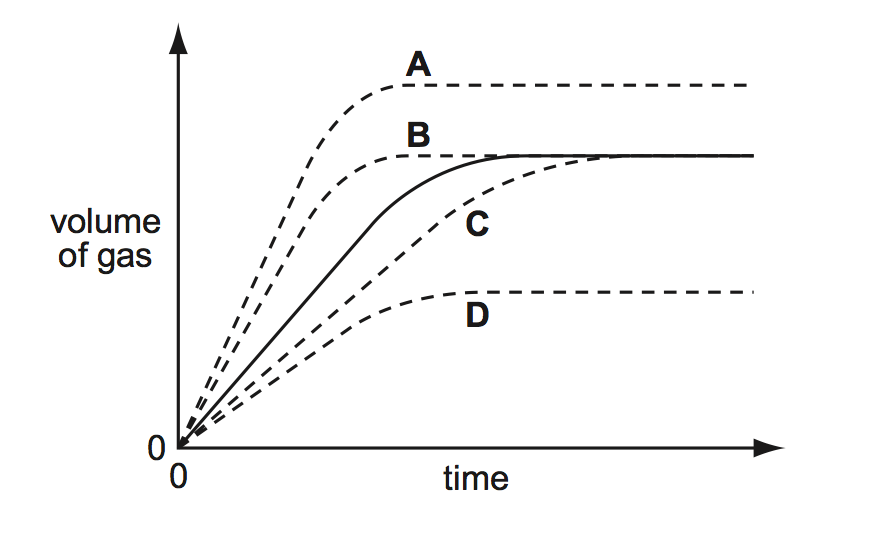
Which graph shows the effect of increasing temperature on the rate of reaction of calcium carbonate with dilute hydrochloric acid?
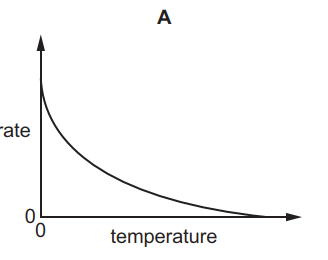
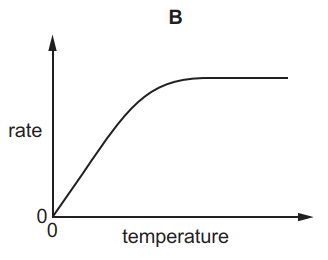
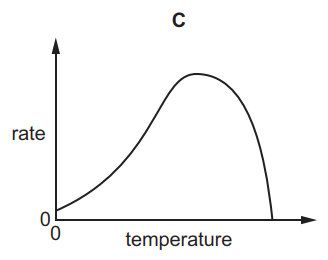
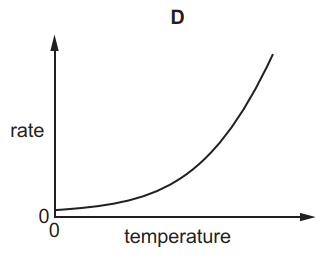

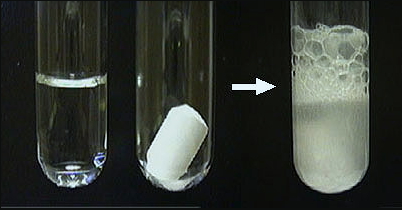
How could we make this reaction happen more quickly?
Decrease the concentration of the acid
crush the chalk to increase the surface area
Put the test tube in an ice bath


Which is true about the chemical energy changes?
A
B
C
D

The reaction profile for making nitrogen monoxide, NO, is shown below. What is the activation energy for this reaction ?
+140 kJ
+180 kJ
+320 kJ
-330 kJ

What is the value of X ?
67 kJ
134 kJ
346 kJ
542 kJ

How much energy is needed to break all the bonds in 0.025 g of nitrogen gas? Relative atomic mass (Ar): N = 14
1701 J
1701 kJ
844 J
844 kJ
Using the balanced equation below
2Ca + O2 --> 2CaO
Predict the number of particles of Ca
6.02x10²³
1.204x1024
6.02x10²²
1.204x10²³
6.0 mol of aluminium reacts with oxygen to form aluminium oxide. What is the amount of oxygen, in mol, needed for complete reaction?
4Al(s) + 3O2(g) → 2Al2O3(s)
1.5
3.0
4.5
6.0
What is the mass of CO2 produced when 35g of O2 reacts?
Gas grills use propane fuel. The combustion of propane is represented in this equation:
C3H8 + 5O2 ----> 3CO2 + 4H2O. How many grams of propane will burn when 36.0 moles of water are formed?
0.500 g C3H8
9.00 g C3H8
318 g C3H8
397 g C3H8
How many grams of hydrogen are produced if 120 g of Na are available?

Examine the image: How many bonds are formed looking at the model of the compound? And also indetify what type of bond is formed.
2 bonds; covalent
4 bonds; metallic
2 bonds; ionic
4 bonds; covalent
Predict the bond that form between Be and F
Covalent
Ionic
If an atom loses two electrons what charge will it have?
-1
-2
+1
+2


An atom with a different number of electrons than it should have (more or less) is called an ---
isotope
valence electron
ion
octet

