
 Worksheets
G10 Biology Unit 2 (2022-2023)
Total questions: 121
Worksheet time: 1hrs 14mins
What type of cellular transport requires energy?
facilitated diffusion
When moving particles UP their concentration gradient, this is called?
Passive Transport
Osmosis
Active Transport
Facilitated Diffusion


Up the concentration gradient low to high uses energy/ATP
facilitated diffusion
osmosis
active transport
diffusion

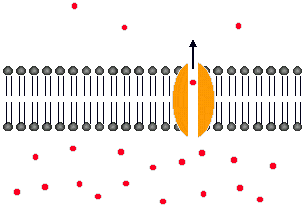
Need help from channel proteins. No energy required.

from high to low.

Uses energy.

Uses energy.

Doesn't need energy


What is the function of the cell membrane?
To control what comes in and out of the cell
To break down food inside the cell
to serve as a barrier
to eat the cells food
cell with no membrane bound structures and no
nucleus
Eukaryote
Prokaryote
Plant
Animal
where DNA is stored in a eukaryotic cell
vacuole
mitochondria
lysosome
nucleus
firm, fairly rigid structure found outside of
plants for support
cell membrane
cell wall
golgi apparatus
chloroplast
cell with membrane bound organelles and a
nucleus
prokaryote
eukaryote
bacteria
peroxisome
serves as a boundary between the cell and the
environment; has selective permeability
cell membrane
cell wall
cytoskeleton
mitochondria
transports proteins throughout the cell
lysosome
vesicle
cilia
vacuole


A cell structure that controls which substances can enter or leave the cell.
Cell Wall
Nucleus
Cell Membrane
Cytoskeleton
large oval structure that acts as a cell's control center, directing all of the cell's activities
DNA
Nucleus
Protein
Vacuole
small particles of RNA and proteins found throughout the cytoplasm; produces proteins
golgi body
smooth ER
DNA
ribosomes
fills the region between the cell membrane and the nucleus
cytoplasm
mitochondria
golgi body
protein
network of protein filaments within some cells that helps the cell maintain its shape and is involved in many forms of cell movement
Cytoskeleton
rough ER
Cytoplasm
Nucleus
the material that carries all the information about how a living thing will look and function
Mitochondria
Protein
DNA
smooth ER

Which statement best describes the role of the cell membrane?
The organelle responsible for making proteins for the cell
The organelle where photosynthesis takes place
A rigid layer that provides shape and structure for the cell
A semi-permeable layer that allows select materials to enter and leave the cell
Which organelle is present in eukaryotic cells but not in prokaryotic cells?
Ribosome
Nucleus
Flagella
Cytoplasm
Unlike a plant cell, an animal cell contains-
Central Vacuole
Chloroplasts
Centriole
Cell Wall

Which trait belongs in the both circle?
has genetic material
has a nucleus
bacteria
has golgi apparatus
Where are the proteins made?
Ribosome
Endoplasmic Reticulum
Vacuole
Organisms whose cells do not have a nucleus are called _____.
Prokaryotes
Unicellular
Eukaryotes
Multicellular
a cell that has the DNA and controls the cell's activities.
Golgi Bodies
Chloroplast
Mitochondria
Nucleus
What fluid can be found in cells that holds organelles?
Cytoplasm
Chlorine
Blood
Plasma
Which plant organelle transforms light into glucose to use as food?
Nucleus
Vacuoles
Mitochondria
Chloroplasts
The organelle that is the control center of the cell.
cell membrane
ER
nucleus
ribosomes
What are the small structures inside of cells that carry out specific functions called?
Tissues
Organelles
Organs
example of a prokaryote cell is
Animal Cell
Plant Cell
Virus
Bacteria
Animal and Plant cells are both this type of cell.
Eukaryote
Prokaryote
all organisms are made of cells
Cell Wall
Cell Theory
Golgi Apparatus
Chloroplasts
An organism made of only one cell is called
Unicellular
Multicellular
Monocellular
Eukaryotic
What two organelles are NOT in an animal cell?
Cell Membrane and Mitochondria
Nucleus and Ribosomes
Cell Wall and Chloroplasts
Golgi Body and Lysosomes
The tough outer barrier of some cells, holds the shape and protects the cell
Mitochondria
Cell Wall
Nucleus
Ribosomes
Holds the DNA, or genetic material, in ALL cells; the brain of the cell
Cell Wall
Mitochondria
Golgi Body
Nucleus
Creates ribosomes
Nucleolus
Ribosomes
Chloroplast
E.R.
How many vacuoles does a PLANT cell have?
1
2
3
4+

What is the LARGE blue circular organelle named?
Nucleus
Golgi Body
Cell Wall
Vacuole
Rigid layer that surrounds the cell of plants and some other organisms such as fungi
Cell Wall
Golgi Apparatus
Chloroplast
Cell Membrane
Rod-shaped organelles that convert energy in food molecules to energy the cell can use to carry out its functions
Mitochondria
Golgi Apparatus
Ribosomes
Endoplasmic Reticulum
Organelle in a cell that receives proteins and other newly formed materials from the endoplasmic reticulum, packages them, and distributes them to other parts of the cell
Golgi Apparatus
Lysosome
Endoplasmic Reticulum
Chloroplast

The mitochondria are
the place where photosynthesis happens
the place where ribosomes are made
the control center of the cell
the powerhouse of the cell
What organelle is only in plant cells?
cell membrane
chloroplasts
mitochondria
nucleus
tail-like structures that help with movement of the cell are called
cilia
flagella
mitochondria
chloroplasts
Cilia are
hair like and control movement of the cell
tails that control movement of the cell
pointless
something that does not help with movement of the cell
Which type of cell does NOT have a nucleus?
bacteria
plant
animal
fungus
In a eukaryotic cell, where is the DNA stored?
cytoplasm
nucleus
In a prokaryotic cell, where is the DNA stored?
cytoplasm
nucleus
What is made in the mitochondria?
protein
energy
nucleotides
waste
Which organelle is found in plant cells, but not in animal cells?
nucleus
ribosome
lysosome
chloroplast
Which process happens in the mitochondria?
photosynthesis
protein synthesis
DNA replication
cellular respiration
Where are proteins made?
nucleus
ribosome
Golgi Apparatus
vacuole
True or False: Prokaryotes have a cell membrane.
True
False
True or False: Animal cells have a cell wall.
True
False
A single, whip-like structure found on some prokaryotes and used for movement is called __________.
Cilia
Flagella
Whipella
Pili
Which organelle is sometimes covered with ribosomes?
Golgi Apparatus
Nucleus
Vacuole
Endoplasmic Reticulum
Where are lipids made?
Lysosomes
Ribosomes
Golgi Apparatus
Endoplasmic Reticulum
Which organelle puts the finishing touches on proteins and ships them around the cell or out of the cell?
Lysosomes
Ribosomes
Endoplasmic Reticulum
Golgi Apparatus
Which organelle is like the trash processing center for the cell?
Lysosome
Vacuole
Vesicle
Nucleus

Which organelle receives proteins from the ER, organises and distributes them?
Vacuoles
Golgi Apparatus
Nucleus
Chromatin

what is the function of ribosomes
to assemble amino acids to create proteins
to pack proteins
to clean proteins

Which organelle is found inside the nucleus and produces ribosomes
Nucleolus
Cell Membrane
Lysosome
Golgi Bodies

What is the function of the Vacuoles
Store food, water and waste
Receive proteins
Assembles amino acids
Found inside the nucleus
The mitochondria are the main site of...
Photosynthesis
ATP (energy) production
Making of proteins
The storage of protiens
Chloroplast is the site of photosynthesis.
False
True
This is responsible for removing waste and dead parts from the cell.
mitochondria
lysosome
vacuole
cell wall

Name this organelle
Cell Wall
Lysosomes
E.R.
Vacuole
in the cell cycle, what is the next stage after TELOPHASE (most of the time)?
Metaphase
anaphase
cytokinesis
interphase
In what stage do the chromosomes line up along the equator of the cell?
interphase
prophase
metaphase
anaphae


Name the phase:
Hint: Chromosomes are moving apart.
Anaphase
Telophase
Metaphase
Prophase


A nucleotide is composed of
A phosphate, sugar and nitrogenous base
A protein, protein and Guanine
A phosphate, Adenine, and nitrogenous base
A protein, Adenine and nitrogenous base
The chromosomes that pair up during meiosis I, are called __________ chromosomes.
homozygous
asexual
homologous
genes


Name this phase of Meiosis:
Telophase I
Prophase II
Telophase II
Anaphase II

Name this phase of Meiosis:
Anaphase I
Metaphase I
Telophase I
Prophase I

Name this phase of Meiosis:
Metaphase I
Prophase II
Telophase I
Anaphase II
A human usually has xx amount of chromosomes.
6
23
4
46
92

